|

 BR
Class
87 BREL/GEC Bo-Bo BR
Class
87 BREL/GEC Bo-Bo
Mainline express electric locomotives

Class 87 electric passenger locomotives are
powered by an overhead 25 kV AC supply. Class 87 locos have a top speed
of 110 mph and a maximum tractive effort of 58000 lbf/258 kN. Class 87
electric locomotives were built at Crewe works from 1973-1975.
Contemporary and Heritage-Preserved,
Diesel, Diesel-Electric and Electric Locomotives

My
Archive Steam Photos from the 1960s

5000 h.p. 25 kV AC overhead
power line express passenger electric
locomotive Class 87 87001 STEPHENSON (87 001), also named ROYAL SCOT
too. Class 87 87001 worked on the
West-Coast mainline and was built at Crewe Works in 1973.
The British Rail built
Class 87 electric locomotives were built in 1973–75 by British Rail
Engineering Limited. Thirty-six Class 87 locomotives were built to work
passenger services over the West Coast Main Line from London to
Birmingham, Liverpool, Manchester, Carlisle and Glasgow. They were the
flagships of British Rail's electric locomotive fleet working the West
Coast Mainline until the late 1980s, when the Class 90 Pendolino trains
entered service. The privatisation of British Rail saw all but one of
the Class 87 fleet transferred to Virgin Trains and continued service
until the advent of the new Class 390 Pendolinos, when they were
transferred to other operators or withdrawn and scrapped. There is one
Class 87 still in use in Britain, 87002, which is owned by the AC
Locomotive Group.
Class 87 87001 in BR blue livery
in York NRM


Class 87 electric
locomotives would haul Intercity trains of carriages like this Pullman
coach

In the yard of the LNWR Heritage Co. Ltd. is Class 87
electric locomotive 87035 Robert Burns in BR blue livery (Crewe Heritage
Centre, March 2020)


On left is Class 87 electric locomotive 87001 named 'National
Railway Museum' InterCity Swallow livery (near Crewe Station May 2024)
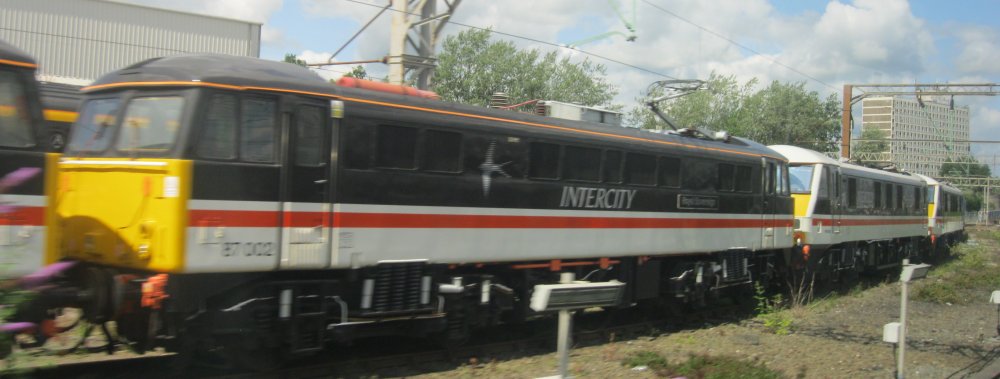
Class 87 electric locomotive 87002 Royal Sovereign Locomotive Services Limited,
InterCity Swallow Livery (Crewe May 2024)
CLASS 87 electric locomotives
from Wiki
https://en.wikipedia.org/wiki/British_Rail_Class_87
The British Rail Class 87 is a type of electric locomotive designed and
built by British Rail Engineering Limited (BREL) between 1973 and 1975.
A total of thirty-six locomotives were constructed, to work passenger
and freight services over the West Coast Main Line (WCML). The Class 87
electric type was developed in response to the need to add extra
capacity to the electric traction fleet operated by British Rail (BR),
in addition to the desire to introduce a higher performance electric
locomotive than the existing Class 86, upon which the Class 87 was
based. Class 87s were British Rail's flagship electric locomotives from
their introduction until the late 1980s, at which point they began to be
superseded by members of the newly-developed Class 90 fleet – itself an
improved derivative of the Class 87 design. As a consequence of the
privatisation of British Rail during the mid 1990s, all but one of the
Class 87s were transferred to Virgin Trains. Under this operator, the
type continued their passenger duties until the advent of the new Class
390 Pendolinos, after which they were gradually transferred to other
operators or withdrawn between 2002 and 2007.
For a time, the Class 87 electric was a staple of electrified freight
operations, before it was displaced by the Class 90 in this capacity as
well. By the end of the 2010s, there was only one Class 87 that remained
in an operational condition in Britain, 87002, which had been initially
preserved by the AC Locomotive Group and is presently owned by
Locomotive Services Limited. It was previously in use with Serco
Caledonian Sleeper and is intended for use on charter services. A large
proportion of the fleet has been exported to Bulgaria, where they have
entered regular use once again. Origins and development - A requirement
for more electric locomotives came about in the early-1970s, when the
decision was taken to extend electrification of the West Coast Main Line
from Weaver Junction north of Crewe, to Preston, Carlisle and Glasgow
Central. Extension of electrification to Glasgow was announced in March
1970, and completed on 6 May 1974, with the Class 87s being developed in
conjunction with this scheme. Initially, three Class 86 locomotives
(86101–86103) were used as test-beds to trial equipment (mainly
electrical equipment and suspension) that would be used in the new
locomotives. Effectively, these locomotives were Class 87s in everything
but their appearance.
The external appearance and layout of the Class 87 was closely based on
that of the Class 86. The only major visual difference was that the 87
had two front cab windows, instead of the three of the 86, and also
lacked a headcode indicator box; by 1973, visual recognition of train
reporting numbers by signallers was no longer deemed to be necessary.
The Class 87s were higher performance locomotives than the preceding
Class 86, with increased power and speed: power output was increased
from 3,600 to 5,000 horsepower (2,685 to 3,728 kW) to deal with the more
demanding gradients on the northern half of the WCML, such as Shap and
Beattock Summit. The top speed of Class 87 electric was raised from 100
mph (160 km/h) to 110 mph (180 km/h),[10] which is the fastest speed
allowed on the West Coast Main Line for trains without a tilting
mechanism. The Class 87s were also fitted with multiple working
equipment, which enabled locomotives to work with other members of the
class, and some Class 86s, while controlled by one driver. During the
1980s, the original multiple working system was replaced with a newer
system that was based on time-division multiplexing (TDM). The new
apparatus enabled the Class 87 to work with various other classes of
locomotives, including Class 86s, Class 90s and Class 91s. Perhaps even
more importantly, the newer multiple working equipment had also enabled
the type to work with the newly-introduced Driving Van Trailers (DVTs).
Whilst the first 35 Class 87 electric locomotives (numbered from 87001
to 87035, known as Class 87/0) were identical, the 36th and last member
of the class, which was going to carry the number 87036 before entering
traffic but was allocated 87101 instead, had major equipment differences
from the rest of the class. While the Class 87/0s were fitted with a
traditional tap changer transformer and rectifiers, 87101 had a new
thyristor power control system and better anti-slip protection; it spent
over a year on test before entering service in 1976. It was reported
that the locomotive's hauling ability was around 20% better than the
87/0s, a feature which made it particularly suitable for freight work.
The locomotive, named Stephenson after transfer of the name from
87001,[9] worked the same services as the standard locomotives for many
years, until British Rail was sectorised in the 1980s. The locomotive
was then transferred to Railfreight in 1989, to be used exclusively for
freight work, and was limited to 75 mph (121 km/h). As a freight
locomotive, it was transferred to EWS and, after suffering a major
failure, the locomotive was withdrawn in 1999. It was sold to the French
train manufacturing company Alsthom, who used it as a source of spare
parts for the remainder of the fleet before scrapping its remnants at
Barrow Hill during January 2002; it was the first Class 87 to be
withdrawn and scrapped.
Some thyristor equipment from the Class 87 electric has been preserved
by AC Locomotive Group. This locomotive was, in many respects, the
prototype for later electric locomotives such as the Class 90 and Class
91. Main article: British Rail Class 90. The Class 90s were a modernised
derivative of the Class 87s, built in the late 1980s. They were
originally designated as the Class 87/2. Throughout the 1970s and 1980s,
BR undertook numerous schemes, including the electrification of the East
Coast Main Line (ECML) and the ultimately-cancelled procurement of the
Advanced Passenger Train (APT), (the latter being at one point intended
to succeed the Class 87 as BR's next major InterCity express train) that
had led to a significant nationwide shortage of electric traction.[16]
Various different efforts were launched during this era to alleviate
this shortage, including an electrified version of the InterCity 125
(known as the HST-E), the Class 89 mixed-traffic locomotive and what
would become the InterCity 225.
It was clear that additional electric locomotives like the Class 87
electric locomotives were necessary no matter what, as both the 1950s
era Class 81 and Class 85 electric locomotives were nearing the end of
their viable service lives and had become quite unreliable. The Class 87
locomotives had proved to be capable and reliable since their
introduction roughly one decade earlier, thus there was considerable
interest procuring additional units as a low-cost option with virtually
no risk for the West Coast Main Line (WCML). BREL issued its submission
to produce an initial batch of 25 Class 87/2s, which quickly received a
favourable reception. The BR board decided that it would curtail its
plans to procure the InterCity 225 for the WCML and instead procure the
Class 87/2 to haul its intended traffic. Accordingly, the procurement of
the type was assured. This move meant that no InterCity 225s would ever
be procured for the WCML. Authorisation for building the locomotives was
given in 1985. Originally conceived as an updated version of the Class
87, the type was initially designated as the Class 87/2 prior to their
introduction, however as it became clear that they differed considerably
in appearance, and in a number of technical aspects from the older Class
87 fleet, they were redesignated as the Class 90. A total of 50 Class 90
locomotives were manufactured by BREL at the Crewe Works from 1985 to
1990; these were numbered 90001-050. Service need extra

My
Archive Steam Photos from the 1960s
docspics images of Class 87 electric
locomotive rail tour holidays photos of Class 87 electric locomotive
rail tour holidays photographs
of Class 87 electric locomotive rail tour holidays pictures of Class 87 electric
locomotive rail tour holidays © Dr Phil Brown * Treyn Railway Holidays to France, Italy
and Spain from Class 87 electric locomotive rail tour holidays Booking tickets for Great Railway Journey luxury Rail Trip
holidays Train travel in Europe Rail holidays from Class 87 electric locomotive
rail tour holidays to the USA & Canada luxury train through the Rocky Mountain Canadian rail
railway holidays through the Rockies US Cities by train from Class 87 electric
locomotive rail tour holidays Continental rail
holidays to France Germany Italy Austria Switzerland Glacier Express Treyn
Holidays from Class 87 electric locomotive rail tour holidays from Eurostar to Paris Brussels Avignon Turin Turino Rome Roma Florence
Firenze TGV fast trains Railway travel holidays
special steam excursions from Class 87 electric locomotive rail tour holidays great steam heritage line and offers luxury Pullman
coach dining trains Class 87 electric locomotive rail tour holidays Travelling by train always seems a pleasure, especially if
through wonderful scenery to Class 87 electric locomotive rail tour
holidays in England, Scotland, Wales or on holiday in
the rest of Europe! The railway trip from Class 87 electric locomotive rail tour
holidays involves seeing or travelling behind a
'real' steam locomotive in action and there is nothing like the sight and sounds
of a steam train to invoke feelings of nostalgia in some of us to Class 87
electric locomotive rail tour holidays even more luxury
by having a special trip out on a steam dining train! England Scotland Wales Northern
Ireland top class hotels in Class 87 electric locomotive rail tour holidays dining out travel
tours top tourist destinations tourist information on Class 87 electric
locomotive rail tour holidays weekend breaks mini-breaks
family holidays restaurants touring coach trips from Class 87 electric
locomotive rail tour holidays continental tours cruise ships
pleasure cruises summer breaks spring breaks continental winter breaks European
winter holidays spring holidays summer holidays European Rail
tours Railway travel holidays special steam excursions from Class 87
electric locomotive rail tour holidays A great steam
heritage line and offers luxury Pullman coach dining trains European
Rail tours US and Canadian Railway travel holidays special steam
excursions to Class 87 electric locomotive rail tour holidays A great steam heritage line and offers luxury Pullman coach
dining trains Travelling by train from Class 87 electric locomotive rail
tour holidays always seems a pleasure, especially if
through wonderful scenery either in England, Scotland, Wales or on
holiday in the rest of the railways of Europe! The railway trip involves
seeing or travelling behind a 'real' steam locomotive or heritage diesel
in action on a special trip from Class 87 electric locomotive rail tour
holidays Booking Eurostar
Continental Rail Travel Tour Tickets Stuttgart Brussels Eurostar
Brussels from Class 87 electric locomotive rail tour holidays by TGV to Ebbsfleet International, Ashford International Stratford International,
St Pancras International Paris Gare du Nord Paris Gare de Lyon Paris Gare de L'est Paris Gare Montparnasse
by
Eurostar from Class 87 electric locomotive rail tour holidays London to Paris, Eurostar London - Brussels Eurostar London to
Lille deals bargain city breaks Class 87 electric locomotive rail tour
holidays Great Railway Journey holidays in Italy,
Spain and France by TGV booking from Class 87 electric locomotive rail tour
holidays Booking Eurostar Continental Rail Travel Tour Tickets to the
Continent eg Paris Brussels Avignon or railway tours across France,
Holland, Austria, Czech Republic, Hungary, Russia, Asia or China for a
travel spectacular Class 87 electric locomotive rail tour holidays
  Good
trainspotting 'TRAINSPOTS' Good
trainspotting and photographic locations
Barnetby Station, North Lincolnshire
*
Carlisle Station *
Clapham Junction Station,
London *
Colton Junction, south of York
*
Coventry *
Crewe Station *
Doncaster Station, South Yorkshire
*
Grantham *
Hellifield
station - Carlisle to Settle line *
Lancaster station
*
Newcastle Station *
Northallerton Station *
Nuneaton
Station *
Peterborough *
Sheffield Station *
Stratford Station, East London
*
Tamworth *
Warrington Bank Quay
station *
Wigan North
Western - WCML *
York Station Good
trainspotting 'TRAINSPOTS' Good
trainspotting and photographic locations
Barnetby Station, North Lincolnshire
*
Carlisle Station *
Clapham Junction Station,
London *
Colton Junction, south of York
*
Coventry *
Crewe Station *
Doncaster Station, South Yorkshire
*
Grantham *
Hellifield
station - Carlisle to Settle line *
Lancaster station
*
Newcastle Station *
Northallerton Station *
Nuneaton
Station *
Peterborough *
Sheffield Station *
Stratford Station, East London
*
Tamworth *
Warrington Bank Quay
station *
Wigan North
Western - WCML *
York Station
See other TOPS classes of diesels and
electrics *
Class 01
*
Class
02 *
Class
03 *
Class
04 *
Class 08
*
Class 09
*
Class
10 *
Class 11
*
Class 14 *
Class 20
*
Class 24
*
Class
25 *
Class
26 *
Class 27
*
Class 31
*
Class 33
*
Class 35 *
Class 37
*
Class 40
*
Class 43
*
Class 44
*
Class 45
*
Class 47
*
Class
50 *
Class 52
*
Class
55 *
Class 56
*
Class 57 *
Class 58 *
Class 60
*
Class 66
*
Class
67 *
Class 68
*
Class 70
*
Class
71 *
Class 73
*
Class
76 *
Class
77 *
Class 84 *
Class 86
*
Class 87
*
Class 88 *
Class
90 *
Class 91
*
Class 92
*
Derby Lightweight
*
Class 101
*
Class 108
*
Class 114
*
Class 117
*
Class 120 *
Class 121
*
Class 122 *
Class 127
*
Class 141
*
Class
142 *
Class
144 *
Class 150
*
Class 153
*
Class 155
*
Class
156 *
Class
158
*
Class
159 *
Class 165
*
Class
166 *
Class
170
*
Class 172 *
Class 175
*
Class
180 *
Class
185 *
Class 195 *
Class 196 *
Class 197 *
Class
220 *
Class 221
*
Class
222 *
Class 252
*
Class
313 *
Class
315 *
Class 317 *
Class
319 *
Class 320
*
Class 321
*
Class 322
*
Class 323
*
Class
325 *
Class 331 *
Class
332 *
Class 333
*
Class 334 *
Class 350
*
Class
357 *
Class
360 *
Class
365
*
Class 373
*
Class
375 *
Class 376
*
Class
377 *
Class
378 *
Class
379 *
Class 380 *
Class 387 *
Class 390
*
Class
395 *
Class
414 *
Class
423 *
Class
442 *
Class
444 *
Class
450 *
Class
455 *
Class
458 *
Class
460 *
Class
465 *
Class 466 *
Class 489 *
Class 507/508 *
Class 700 *
Class 730 *
Class 755 *
Class 800 *
Class 801 *
Class 802 *
Class 803
*
Class 805 *
Class 3000
*
INDEX of My IMAGES OF PRESERVED STEAM LOCOMOTIVES
|


 Enter specific words e.g. locomotive, train, station, place, anything of
railway interest!
Enter specific words e.g. locomotive, train, station, place, anything of
railway interest!