|
A-Level organic chemistry exam revision notes on
isomerism
Constitutional carbon chain isomerism
[Author
©
Dr Phil Brown GRIC, PhD:
Doc Brown's advanced level organic chemistry exam revision notes
suitable for students of UK A level chemistry courses & US K12 grade
11, grade 12 and AP honors chemistry courses: isomerism
- carbon chain isomers
[page
RE-EDIT]
Email doc
brown query? comment?
*
[privacy policy, cookies
and disclaimer]
INDEX
of notes on isomerism chemistry
All Advanced Organic
Chemistry Notes
Structural
constitutional carbon chain isomerism - variations in carbon chain for
the same homologous series and functional group.
The similarities and differences between the physical
and chemical properties of the carbon chain isomers are described and
explained.
Abbreviations used:
fpt freezing
point, mpt
melting point, bpt
boiling point
Scroll down to study the examples of carbon chain
isomerism.
Then have a go at the two
practice questions on carbon chain isomers
14.1.2(a)
Chain isomerism -
changing the arrangement of the carbon atoms

CHAIN ISOMERISM is where the carbon
chain arrangement is varied for the same molecular formula.
By connecting the atoms in different
configurations you can form structural isomers, but you need a minimum
of four carbon atoms to produce a branched molecule in terms of its
carbon chain.
14.1.2(a) Structural Isomerism - Carbon chain
isomerism
Case
study 1a.1 Chain isomers of the alkane molecular formula
C5H12
- shorter/longer alkanes
 |
 |
 |
|
pentane (the
least compact) |
2-methylbutane |
2,2-dimethylpropane |
 |
 |
 |
The
three carbon chain isomers of the molecular formula
C5H12 shown as simple 'ball and stick' models and
space filling models (above), and abbreviated (but unambiguous)
structural formula and skeletal formula (below). Note the differences in
boiling points between the isomers.
(1)
 , ,
 ,
pentane,
volatile colourless liquid, bpt 34oC, linear. ,
pentane,
volatile colourless liquid, bpt 34oC, linear.
(2)
 , ,
 ,
methylbutane (2-methylbutane, but 2- not needed), volatile colourless liquid/gas, bpt 28oC,
some branching. ,
methylbutane (2-methylbutane, but 2- not needed), volatile colourless liquid/gas, bpt 28oC,
some branching.
(3), , ,
 ,
2,2-dimethylpropane, colourless gas, bpt 9.5oC, maximum
branching. ,
2,2-dimethylpropane, colourless gas, bpt 9.5oC, maximum
branching.
One physical consequence of this isomerism,
is that as the molecule gets more branched it becomes more compact
(see the ball and stick AND space filling model diagrams above).
Therefore
the decreased surface-surface contact weakens the intermolecular
bonding (intermolecular
forces), which in this case are the instantaneous dipole-induced
dipole forces between non-polar hydrocarbon molecules.
Hence
the weak intermolecular bonding of Van der Waals forces are
influenced by the shape of the molecule.
Hence less and less thermal kinetic energy is needed to overcome them, so the boiling point
is reduced from molecule (1) to (3).
They can be separated by fractional
distillation.
Chemically they are very similar e.g. they all readily
burn to carbon dioxide and water or react with chlorine-uv light to form
isomeric substituted halogenoalkanes.
More on intermolecular
forces
There are no isomers for the lower alkanes CH4, C2H6 or C3H8,
but C4H10 has two chain isomers:
(4)

 butane, boiling point -0.5oC, you then see
a reduction in boiling point of the isomer
butane, boiling point -0.5oC, you then see
a reduction in boiling point of the isomer
(5)

 2-methylpropane (methylpropane), boiling point -11.7oC.
[lots of named
alkane structures and how to work out the possible isomers for a
given molecular formula]
e.g. some of the possible
chain isomers of the alkane series of molecular formula C8H18
Examples of their structural formula
and skeletal formula are shown below
2,2-dimethylhexane,
 , ,

2,3-dimethylhexane,
 , ,

2,4-dimethylhexane,
 , ,

2,5-dimethylhexane,
 , ,

3,3-dimethylhexane,
 , ,

3,4-dimethylhexane,
 , ,

3-ethylhexane,
 , ,

3-ethyl-2-methylpentane,
 , ,

3-ethyl-3-methylpentane,
 , ,

They will be quite similar molecules,
both physically and chemically, but there will be small differences in melting
point, boiling point (but not insignificant) and density for the reasons
explained above.
See also
Isomers of molecular formula C8H18
(Mr = 114)
14.1.2(a) Structural Isomerism - Carbon chain
isomerism
Case
study 1a.2
Four aromatic hydrocarbons based on C8H10 arenes
(1)
 ethylbenzene,
mpt -94oC, bpt 136oC, all colourless liquids. ethylbenzene,
mpt -94oC, bpt 136oC, all colourless liquids.
(2) 1,2-dimethylbenzene,
(3) 1,3-dimethylbenzene, (4) 1,4-dimethylbenzene
(2)
 mpt
-25oC, bpt 144oC , (3) mpt
-25oC, bpt 144oC , (3) mpt -47 oC, bpt 139oC ,
(4)
mpt -47 oC, bpt 139oC ,
(4) mpt
14oC, bpt 137oC, mpt
14oC, bpt 137oC,
Isomer (1) can be synthesised
by the Friedel Crafts reaction using chloroethane/aluminium chloride with benzene and only one
monosubstituted product can be formed.
Isomers (2) to
(4) are obtained from the refining and reforming of crude oil fractions.
(2) to (4) are also positional
isomers based on the two methyl groups.
(2)-(4) are formed when methylbenzene is alkylated with chloromethane/aluminium
chloride reagent (Friedel Crafts reaction). Although (2) and (4) are the
predominant products.
The similarity of boiling points, particularly (3)
and (4), makes them very
difficult to separate even by fractional distillation.
(3), bpt 139oC)
and (4), bpt
137oC, with similar bpts, can be separated as a mixture from
(2), bpt 144oC, by fractional distillation.
Then (4), fpt 14oC, is separated from (3, fpt -47oC) by fractional
crystallisation because on cooling to low temperatures (4) will
crystallise out well before (3) because of its higher freezing point.
Dimethylbenzenes are chemically very similar e.g.
they undergo the usual electrophilic
substitution reactions of benzene (nitration, chlorination, sulfonation
etc.) and on side chain oxidation,
e.g. reflux with KMnO4(aq)/NaOH(aq),
followed by 'working up' and adding dilute hydrochloric/sulfuric acid to
give the free aromatic dicarboxylic acid.
On oxidation (1) gives benzoic acid, C6H5COOH, and (2)-(4) give
1,2 or 1,3 or 1,4-benzenedicarboxylic acid respectively.
C8H6O4,


 benzene-1,2-dicarboxylic acid
(or 1,3 or 1,4), benzene-1,2-dicarboxylic acid
(or 1,3 or 1,4),
three more positional or carbon
chain isomers - both descriptions apply here.
[lots of named aromatic structures]
14.1.2(a) Structural Isomerism - Carbon chain
isomerism
Case
study 1a.3 The chain isomerisation of alkanes
and the octane number of petrol fuels
Chain Isomerization is used
in the
petrochemical industry to produce more branched alkanes with a higher
octane number from linear alkanes, for fuels more suitable for petrol
engines.
The proportions of the 'isomers', as well as the hydrocarbon
chain length, in crude oil does not match specific market demands.
Straight chain alkanes are heated with a suitable catalyst to
break up the chains and more branched alkanes, as well as lower alkanes are formed on recombination
of the fragments (see examples below).
For a given carbon number of
an alkane, the more branched the alkane, the higher the octane number.
The higher the
octane number of a fuel/molecule, the less the tendency it has
to cause auto-ignition resulting in 'knocking' or 'pinking'
damaging the car engine.
(1) , ,
 , is
linear
heptane, , is
linear
heptane,
a chain isomer of C7H16,
and assigned an octane number of 0.
(2) , ,
 , is
2,2,4-trimethylpentane, , is
2,2,4-trimethylpentane,
a highly branched chain isomer of
C8H18,
octane number = 100 (used to be called 'iso-octane').
The known tendency of a
mixture
of (1) and (2) to auto-ignite are compared with other fuels/molecules to give
them their individual 'octane rating'. (In the UK petrol octane
numbers of 95 and 99 are most common)
Using skeletal formula, one
possible isomerisation reaction of pentane C5H12
is shown below.
They are reversible reactions, so changing reaction
conditions, can change the position of the equilibrium.
(3)
pentane, octane number 62
 (4) 2-methylbutane, octane number 93
See also in chemistry of alkanes
1.2
Sources of alkanes, boiling points of alkanes,
fractional distillation of crude
oil into useful products
1.3
Modification of alkanes by
cracking, isomerisation and reforming
1.4
Complete and incomplete
combustion of alkanes and environmental pollution
And alkane isomers
of a given molecular formula - all carbon chain isomers
Isomers of molecular
formula C4H10
(Mr = 58)
Isomers of molecular formula C5H12
(Mr = 72)
Isomers of molecular formula C6H14
(Mr = 86)
Isomers of molecular formula C7H16
(Mr = 100)
Isomers of molecular formula C8H18
(Mr = 114)
Isomers of molecular formula C9H20
(Mr = 128)
Isomers of molecular formula C10H22
(Mr = 142)
APPENDIX - a challenging
exercise in working out constitutional carbon chain isomers
A brief guide to
working out the 18 structural carbon chain isomers of non-cycloalkanes C8H18
There are 18 basic structural isomers and all deduced from
changing the carbon chain arrangement, so they centre all chain isomers, but
some have four different groups (H or alkyl) around a specific carbon atom.
This is a chiral i.e. asymmetric carbon atom and therefore some
R/S
optical isomers will exist
(I think I've spotted the five
of them?).
For more details see
Isomers of molecular formula C8H18
including some NMR spectra data
(1)
octane, CH3-CH2-CH2-CH2-CH2-CH2-CH2-CH3
Start with the linear
(unbranched) carbon chain, then make the next longest chain with a single, but
shortest, carbon branch (-CH3), to give three
methylheptanes ...
(2) 2-methylheptane, (CH3)2CHCH2CH2CH2CH2CH3
(3) 3-methylheptane, CH3CH2CH(CH3)CH2CH2CH2CH3
(also optical
R/S isomers)
(4) 4-methylheptane,
CH3CH2CH2CH(CH3)CH2CH2CH3
then do double methyl
branching permutations to make 6 dimethylhexanes ...
(5) 2,2-dimethylhexane,
,
(6) 2,3-dimethylhexane,
,
(also
optical R/S isomers)
(7) 2,4-dimethylhexane,
,
(also optical
R/S isomers)
(8) 2,5-dimethylhexane,
,
(9) 3,3-dimethylhexane,
,
(10) 3,4-dimethylhexane,
,
(also
optical
R/S isomers)
then you can
make one ethylhexane ...
(11) 3-ethylhexane,
,
and don't try
2-ethylhexane, because its actually 3-methylheptane using the
nomenclature rules correctly.
Now you can do a
double branching again to make two ethylmethylpentanes ...
(12) 3-ethyl-2-methylpentane,
,
(13) 3-ethyl-3-methylpentane,
,
and you can do a
triple branching to give four trimethylpentanes ...
(14) 2,2,3-trimethylpentane,
(CH3)3CCH(CH3)CH2CH3
(also
optical
R/S isomers)
(15) 2,2,4-trimethylpentane
(isooctane), (CH3)3CCH2CH(CH3)2,
,
(16) 2,3,3-trimethylpentane, (CH3)2CHC(CH3)2CH2CH3
(17) 2,3,4-trimethylpentane,
(CH3)2CHCH(CH3)CH(CH3)2
Then finally,
the most branched isomer is the single tetramethylbutane (shortest
possible main chain) ...
(18) 2,2,3,3-tetramethylbutane, (CH3)3CC(CH3)3
I only did this for fun!
|
QUESTIONS
Advanced A-level chemistry - practise exam questions on
isomerism - carbon chain isomers
Jot
down your responses and check out the answers:
ANSWERS
If you think there are
any errors, please email me asap at
chem55555@hotmail.com
I don't mind if students/teachers do a selected printout
of these questions and answers.
Q1 Draw the skeletal
formulae of the five carbon chain isomers of molecular
formula C6H14 and name them.
Q2 Give the structural
formulae and skeletal formula of at least three carbon
chain isomers of carboxylic acids of molecular formula C5H10O2
and name them.
Jot
down your responses and check out the answers:
ANSWERS
If you think there are
any errors, please email me asap at
chem55555@hotmail.com
|
Summary of all the types of
isomerism you need to know about

[SEARCH
BOX]
Email doc
brown query? comment?
INDEX
of notes on isomerism chemistry
All Advanced Organic
Chemistry Notes Index of
sets of isomers for a given
molecular formula, some include IR and NMR spectroscopy data
The chemistry of
ALKANES and the petrochemical
industry
The
chemistry of ALKENES
The
chemistry of organic HALOGEN compound (haloalkanes)
The
chemistry of
ALCOHOLS (mention of ethers)
The chemistry of
ALDEHYDES and KETONES
The
chemistry of CARBOXYLIC ACIDS, ESTERS and other derivatives
The chemistry of
ORGANIC-NITROGEN compound e.g. amines
The chemistry of
AROMATIC COMPOUNDS - benzene and derivatives
|
ANSWERS
Advanced A-level chemistry - practise exam questions on
isomerism - carbon chain isomers
If you think there are
any errors, please email me asap at
chem55555@hotmail.com
I don't mind if students/teachers do a selected printout
of these questions and answers.
Q1 Draw the skeletal
formulae of the five carbon chain isomers of molecular
formula C6H14 and name them.
ANSWERS

See
Isomers of molecular formula C6H14
for full details
Q2 Give the structural
formulae and skeletal formula of at least three carbon
chain isomers of carboxylic acids of molecular formula C5H10O2
and name them.
ANSWERS: There four
carbon chain carboxylic acids isomers.
(1)
pentanoic acid , CH3CH2CH2CH2COOH ,
 , ,

(2)
2-methylbutanoic acid ,
CH3CH2CH(CH3)COOH,
 , ,

(3)
3-methylbutanoic acid ,
(CH3)2CHCH2COOH,
 , ,

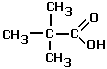
(4) 2,2-dimethylpropanoic acid , (CH3)3CCOOH
,
 ,
,

See
Isomers of molecular formula
C5H10O2
for full details of many other isomers of all types! |
What you need to know about carbon chain isomerism,
carbon chain isomerism is defined, examples of carbon chain isomerism
explained, defining what is meant by carbon chain isomerism,
similarities and differences between the physical and chemical
properties of the carbon chain isomers are described and explained, the
structural formula, skeletal formula and IUPAC names are given for the
carbon chain isomers |
