|
Doc Brown's
Advanced Chemistry: Part 14.7:
Selected
constitutional structural
functional group isomers of molecular formula
C5H10O2
[Author
©
Dr
Phil Brown GRIC, PhD: Doc
Brown's advanced level organic chemistry exam revision notes suitable
for students of UK advanced level chemistry courses, IB advanced
chemistry & US K12 grades 11-12 and AP honors chemistry courses: Molecular
spectroscopy and analysing the isomers of C5H10O2
[spectra page updated
RE-EDIT]
Sub-index for this
page on selected isomers of molecular formula
C5H10O2
Introduction to isomerism for
molecular formula
C5H10O2
(a)
4 carboxylic acid isomers of formula
C5H10O2
(b)
9 ester isomers of
formula C5H10O2
(c)
Selected methoxy or hydroxy-aldehydes and
methoxy or hydroxy-ketones of formula C5H10O2
(d)
Selected ene-diols
with molecular formula
C5H10O2
(e)
Selected alicyclic isomers of
formula C5H10O2
(f)
Selected heterocyclic isomers of
formula C5H10O2
(g) Extra comments
and information on selected isomers of
C5H10O2
(h) Learning objectives
for the isomers of
C5H10O2
(i) Practise exam questions
based on the isomers of C5H10O2
email doc
brown - comments - query?
*
[privacy policy, cookies
and disclaimer]
Associated organic chemistry page links
Index of sets of isomers for a given
molecular formula
This is a big chemistry website, please allow time
to explore it
Introduction to the
isomerism, selected constitutional isomers and stereoisomers of molecular formula C5H10O2
Composition of
C5H10O2
Percent composition based on atomic masses C= 12.01 H =
1.01 O = 16.00 and Mr(C5H10O2)
= 102.15
Element composition (to two dp): carbon = 58.79%
hydrogen = 9.89% oxygen = 31.33%
Empirical formula = molecular formula =
C5H10O2
Please
note there are a very large number of isomers of molecular formula C5H10O2
and this page presents a selection of them and where appropriate
indicates the type of isomerism involved.
Structural isomerism
- isomers of the same specific molecular formula, based on different connectivity's of the constituent atoms
(the constitutional isomers), so
they cannot be spatially identical (but sometimes can be defined as having the same shape).
This includes (a)
carbon chain variation (usually need a minimum of 4 atoms),
(b) change in position of a substituent or functional group and
(c) functional group isomerism where the atoms have a different
connectivity configuration, usually with significant differences in
chemical and physical properties e.g.
In terms of isomers of
C5H10O2
there are
(a) chain variations based on the C or O atoms, open chain aliphatic linear, branched and cyclic (alicyclic)
and heterocyclic structures,
(b) positional isomers e.g. hydroxy group in
the aldehydes and ketones, substituent positions in the cyclic
compounds.
(c) They are all functional group isomers of
each other
e.g. in terms e.g. carboxylic acids, esters, hydroxy-aldehydes, hydroxy-ketones,
alkene-alcohols (unsaturated 'enols'), saturated substituted cycloalkane
based molecules.
Stereoisomerism - isomers
based on the same connectivity of the atoms (same constitutional
formula), but in some way, they are 2D or 3D spatially different non-superimposable images (e.g. E/Z
'geometrical' isomers or mirror image R/S 'optical' isomers)
This is where
molecules have the same basic constitutional structural formula, but
isomers differ in the 2D/3D arrangement of the atoms.
For stereoisomers, the (CIP) abbreviation
means the
IUPAC Cahn-Ingold-Prelog priority order rule for assigning E/Z (geometrical) and
R/S (optical)
stereoisomers.
E/Z stereoisomerism
was called 'geometrical isomerism' e.g.
cis (= Z) and
trans (= E) isomers of alkenes
or disubstituted cyclic alkanes where there are 2D/3D spatial variations
that are not mirror images and not super imposable.
There are
many examples of E/Z geometrical isomers
in open chain compounds via the C=C restricted rotation or two
substituents in a ring where both can be above the 'plane' of a ring or one above and one below the plane of the ring
- can be complicated with overlapping R/S optical isomerism for the
same molecule as in the case 1,2-dimethylpropane.
R/S stereoisomerism
was called 'optical isomerism', the pairs of isomers are called
enantiomers, which are 3D non-superimposable mirror image forms of the
molecule (enantiomers).
The molecule must have a
chiral centre
(a stereocentre), that is an asymmetric carbon atom with four different
atoms/groups attached to it.
There
many examples of R/S optical isomers,
but, as already mentioned, it can be complicated with overlapping E/Z
geometric isomers for the same molecule and some molecules,
particularly the 'cyclic' ring containing molecules may have two or
three chiral centres (asymmetric carbon atoms).
NOTE
Initially I have chosen examples of isomers
that pre-university students are most likely to come across, and that is usually
carboxylic acids and esters.
There are huge number of constitutional isomers (I've
identified at least ~50, theoretical or actual) and many stereoisomers (at
least~29 pairs) of formula C5H10O2 and
there are many more.
NEXT (a-e) Details of selected constitutional isomers
and stereoisomers of
C5H10O2
below.
(a)
and (b) Examples of aliphatic
carboxylic acid and ester structural isomers of molecular formula
C5H10O2
The expected number of 1H or 13C NMR peaks and the integrated
proton ratio quoted are based on the structural formula of the given isomer
(but there can be complications e.g. due a chiral carbon atom).
I haven't worked them all out, but if there are some
you would like analysed, just
email me.
(a) There are four constitutional isomeric carboxylic acids (1) to (4)
of molecular formula
C5H10O2
Note that COOH is shorthand for the
4 carboxylic acid's functional group
O=C-O-H
(1)
pentanoic acid ,
CH3CH2CH2CH2COOH ,
 , ,

Number of low resolution
NMR
chemical shift
δ
signal peaks:
5
1H and
5
13C
(email
if disagree?)
1H NMR ratio of peaks: 3 : 2 : 2
: 2 : 1 (for equivalent protons)
(2)
2-methylbutanoic acid ,
CH3CH2CH(CH3)COOH,
 , ,

This molecule has a chiral carbon (the C of
the CH group), so this molecule will exhibit R/S
stereoisomerism, optical isomers - non-superimposable
mirror image forms known as enantiomers.
Number of low resolution
NMR
chemical shift
δ
signal peaks:
5
1H and
5
13C
(email
if disagree?)
1H NMR ratio of peaks: 3 : 2 : 1
: 3 : 1 (for equivalent protons)
(3)
3-methylbutanoic acid ,
(CH3)2CHCH2COOH,
 , ,

Number of low resolution
NMR
chemical shift
δ
signal peaks:
4
1H and
4
13C
(email
if disagree?)
1H NMR ratio of peaks: 6(3+3) : 1 :
2 : 1 (for equivalent protons)
(4)
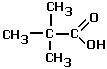
2,2-dimethylpropanoic acid ,
(CH3)3CCOOH
,
 ,
,

Number of low resolution
NMR
chemical shift
δ
signal peaks:
2
1H and
3
13C
(email
if disagree?)
1H NMR ratio of peaks: 9
(3x3) : 1 (for equivalent protons)
(b) There are nine
constitutional isomeric esters e.g. (5) to (13)
of molecular formula
C5H10O2
Note that COOC shorthand for the ester
linkage functional group
O=C-O-C
The 9
esters are all illustrated below
(5) methyl butanoate
(methyl butyrate),
 , ,

 An ester made
from butanoic acid and methanol.
An ester made
from butanoic acid and methanol.
Number of low resolution
NMR
chemical shift
δ
signal peaks:
4
1H and
5
13C
(email
if disagree?)
1H NMR ratio of peaks: 3 : 2 : 2
: 3 (for equivalent protons)
(6)
ethyl propanoate,
 , ,

 An ester made
from propanoic acid and ethanol.
An ester made
from propanoic acid and ethanol.
Number of low resolution
NMR
chemical shift
δ
signal peaks:
4
1H and
5
13C
(email
if disagree?)
1H NMR ratio of peaks: 3 : 2 : 2
: 3 (for equivalent protons)
(7)
propyl ethanoate ,
 ,
,
 An ester made
from ethanoic acid and propan-1-ol.
An ester made
from ethanoic acid and propan-1-ol.
Number of low resolution
NMR
chemical shift
δ
signal peaks:
4
1H and
5
13C
(email
if disagree?)
1H NMR ratio of peaks: 3 : 2 : 2
: 3 (for equivalent protons)
Brief
notes on the IR, mass, 1H NMR & 13C NMR spectrums of propyl ethanoate
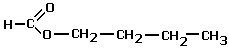
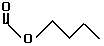
(8) butyl methanoate,
HCOOCH2CH2CH2CH3 ,
 ,
,
An ester made
from methanoic acid and butan-1-ol.
Number of low resolution
NMR
chemical shift
δ
signal peaks:
4
1H and
5
13C
(email
if disagree?)
1H NMR ratio of peaks: 1 : 2 : 2 : 2
: 3 (for equivalent protons)
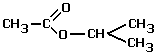
(9) 1-methylethyl ethanoate,
CH3COOCH(CH3)2 ,
 ,
,

An ester made
from ethanoic acid and propan-2-ol. (isopropyl acetate)
Number of low resolution
NMR
chemical shift
δ
signal peaks:
3
1H and
4
13C
(email
if disagree?)
1H NMR ratio of peaks: 3 : 1 : 6(3+3) (for equivalent protons)
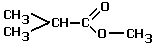
(10) methyl 2-methylpropanoate,
(CH3)2CHCOOCH3 ,
 ,
,

An ester made
from 2-methylpropanoic acid and methanol.
Number of low resolution
NMR
chemical shift
δ
signal peaks:
3
1H and
4
13C
(email
if disagree?)
1H NMR ratio of peaks: 6(3+3)
: 1 : 3 : (for equivalent protons)
(11) 1-methypropyl methanoate,
HCOOCH(CH3)CH2CH3 ,
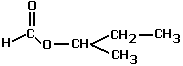 , ,

An ester made from methanoic acid and butan-2-ol, R/S
isomers.
Number of low resolution
NMR
chemical shift
δ
signal peaks:
5
1H and
5
13C
(email
if disagree?)
1H NMR ratio of peaks:
1 : 1 : 3 : 2 : 3 (for equivalent protons)
(12) 2-methylpropyl methanoate,
HCOOCH2CH(CH3)2 ,
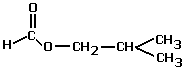 , ,

An ester made from methanoic acid and 2-methylpropan-1-ol
Number of low resolution
NMR
chemical shift
δ
signal peaks:
4
1H and
4
13C
(email
if disagree?)
1H NMR ratio of peaks:
1 : 2 : 1 : 6(3+3) (for equivalent protons)
(13) 1,1-dimethylethyl methanoate,
HCOOC(CH3)3 ,
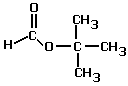 , ,

An ester made from methanoic acid and 2-methylpropan-2-ol.
Number of low resolution
NMR
chemical shift
δ
signal peaks:
2
1H and
3
13C
(email
if disagree?)
1H NMR ratio of peaks: 1 : 9(3x3) (for equivalent protons)
For
examples (c) onwards, you are more likely to come across them at university
level, but the odd structure may crop up in advanced pre-university chemistry
courses.
(c)
There are also lots
of methoxy- or hydroxy-aldehydes and methoxy- or
hydroxy-ketones with a C5H10O2
molecular formula
For the functional groups
in abbreviated structural formulae, note ...
CO is the >C=O carbonyl group of ketones (named
...one),
and CHO is the
H-C=O aldehyde group (named ...al),
plus some have an
ether C-O-C group linkages (instead of an OH hydroxy group) e.g.
via the methoxy group OCH3
A molecule with a chiral carbon (often the C of a CH group), will exhibit R/S
stereoisomerism, exhibiting R/S isomers, optical isomers -
non-superimposable mirror image forms known as enantiomers.
Note that IUPAC nomenclature rules state that the aldehyde
or ketone group takes precedence over the ether methoxy or hydroxy alcohol groups, the
compounds are named with the ...al or ...one suffix and the
alcohol named as the hydroxy substituent prefix. Take care with the prefix
number too!
Some of the hydroxy-aldehyde
or methoxy-aldehyde isomers of molecular formula
C5H10O2
Isomers with a linear carbon chain
with an aldehyde and alcohol functional groups
CH3CH2CH2CH(OH)CHO
2-hydroxypentanal, R/S isomers, C2 chiral
Number of low resolution
NMR
chemical shift
δ
signal peaks:
6
1H and
5
13C
(email
if disagree?)
1H NMR ratio of peaks: 3 : 2 :
2 : 1 : 1 : 1 (for equivalent protons)
CH3CH2CH(OH)CH2CHO
3-hydroxypentanal, R/S isomers
C3 chiral
CH3CH(OH)CH2CH2CHO
4-hydroxypentanal, R/S isomers
C4 chiral
HOCH2CH2CH2CH2CHO
5-hydroxypentanal
and two
methoxy-aldehydes (ether-aldehydes)
CH3OCH2CH2CH2CHO
4-methoxybutanal
CH3CH(OCH3)CH2CHO
3-methoxybutanal, R/S isomers
C3 chiral
Isomers with a branched carbon chain
(CH3)2CHCH(OH)CHO
2-hydroxy-3-methylbutanal, R/S isomers
C2 chiral
(CH3)2C(OH)CH2CHO
3-hydroxy-3-methylbutanal
HOCH2CH(CH3)CH2CHO
4-hydroxy-3-methylbutanal, R/S isomers
C3 chiral
Some of the hydroxy-ketone
or methoxy-ketone isomers of molecular formula C5H10O2
Isomers with a linear carbon chain
with a ketone and alcohol functional group
CH3CH2CH2COCH2OH
1-hydroxypentan-2-one (1-hydroxy-2-pentanone)
Number of low resolution
NMR
chemical shift
δ
signal peaks:
5
1H and
5
13C
(email
if disagree?)
1H NMR ratio of peaks: 3 : 2 :
2 : 2 : 1 (for equivalent protons)
CH3CH2CH(OH)COCH3
3-hydroxypentan-2-one (3-hydroxy-2-pentanone), R/S isomers,
C3 chiral
CH3CH(OH)CH2COCH3
4-hydroxypentan-2-one (4-hydroxy-2-pentanone), R/S isomers,
C4 chiral
HOCH2CH2CH2COCH3
5-hydroxypentan-2-one (5-hydroxy-2-pentanone)
HOCH2CH2COCH2CH3
1-hydroxypentan-3-one (1-hydroxy-3-pentanone)
CH3CH(OH)COCH2CH3
2-hydroxypentan-3-one (2-hydroxy-3-pentanone), R/S isomers,
C3 chiral
and two methoxy-ketones
(ether-ketones)
CH3OCH2COCH2CH3
1-methoxybutan-2-one (1-methoxy-2-buttanone)
CH3CH(OCH3)COCH3
3-methoxybutan-2-one (3-methoxy-2-butanone), R/S isomers,
C4 chiral
Isomers with a branched carbon chain
HOCH2COCH(CH3)2
1-hydroxy-3-methylbutan-2-one
CH3COC(OH)(CH3)2
3-hydroxy-3-methylbutan-2-one
CH3COCH(CH3)CH2OH
4-hydroxy-3-methylbutan-2-one, R/S isomers,
C3 chiral
(d)
Selected examples of ene-diols
with molecular formula
C5H10O2
e.g. some examples based on pentenes
with an alkene group and two alcohol (diol) functional groups
CH2=CHCH(OH)CH(OH)CH3
pent-4-ene-2,3-diol, R/S isomers,
C3 chiral, NOT E/Z isomerism
Number of low resolution
NMR
chemical shift
δ
signal peaks:
7
1H and
5
13C
(email
if disagree?)
1H NMR ratio of peaks: 2 : 1 :
1 : 1 : 1 : 1 : 3 (for equivalent protons)
CH2=CHCH2CH(OH)CH2OH
pent-4-ene-2,3-diol, R/S isomers,
C2 chiral, NOT E/Z isomerism
Like a number of the isomers, the two end H
atoms attached the end of the C=C bond, prohibit E/Z isomerism.
CH3CH=CHCH(OH)CH2OH
pent-3-ene-2,3-diol R/S isomers (C2 chiral) and E/Z isomerism, complex
overlapping stereoisomerism)
The
first two are based on pent-1-ene, but named on the IUPAC higher priority
'ol' group.
The
third is based on pent-2-ene, but again, named on the IUPAC higher
priority 'ol' group.
So, there are lots more ene-diols based on pentenes and
methylbutenes.
You can also have lots of alkoxy enols i.e. molecules with
an alkene, alcohol and ether linkage functional groups e.g.
CH2=CHCH(OCH3)CH2OH,
2-methoxypent-3-ene-1-ol, R/S isomers, because C2 is chiral.
(e)-(f)
There are also
many cyclic compounds
of molecular formula
C5H10O2
(e)
Selected examples of alicyclic
compounds of
C5H10O2
Saturated
cyclic compounds with a ring of 3, 4 or 5 carbon atoms
e.g.
cyclopentane diols

 and
and
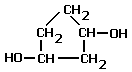

cyclopentane-1,2-diol and
cyclopentane-1,3-diol and these two diols exhibit
E/Z geometrical (cis/trans) overlapping with R/S optical isomerism,
2 chiral centres, so a complicated stereoisomerism situation!
Five more are illustrated
below involving cyclopentane, cyclobutane and cyclopropane rings.

(1) There is also theoretically
cyclopentane-1,1-diol, which does NOT exhibit either E/Z or
R/S isomerism. (Note there is no cyclic 1,4 diol until cyclohexane diols)
(2)
3-methylcyclobutane-1,2-diol, two secondary alcohol
groups, can exhibit complex
'overlapping' E/Z and R/S isomerism, 3 chiral centres, C1, C2
and C3.
(3)
2-methoxycyclobutan-1-ol,
secondary alcohol and ether functional groups, can exhibit complex 'overlapping' E/Z and R/S isomerism,
two
chiral centres, C1 and C2.
(4)
3,3-dimethylcyclopropane-1,2-diol,
two secondary alcohol
groups, can exhibit complex
'overlapping' E/Z and R/S isomerism, two
chiral centres, C1 and C2.
(5)
2-ethoxycyclopropan-1-ol,
secondary alcohol and ether functional groups, can exhibit complex 'overlapping' E/Z and R/S isomerism, 2
chiral centres, C1 and C2.
There are dozens
of other possibilities where the substituent alkyl, hydroxyl
(alcohol) or alkoxy (ether) groups can go.
(f)
Selected examples of alicyclic compounds
S aturated
cyclic compounds, which, theoretically, can have a ring of 3 to 7
carbon or oxygen atoms.
Six examples are
illustrated below involving six different heterocyclic ring systems
(not named).

(1) Based on a 1,4-epoxybutane ring and secondary
alcohol group
complex
'overlap' of E/Z and R/S isomerism, two
chiral centres (C3 and C4).
(2) Based on a 1,2-dioxolane ring,
complex
'overlap' of E/Z and R/S isomerism, two
chiral centres (C2 and C3).
(3)
Based on a 1,3-dioxolane ring,
complex 'overlap' of E/Z and R/S
isomerism, two
chiral centres (C2 and C4).
(4) Based on an oxetane ring and secondary alcohol
group, complex
'overlap' of E/Z and R/S isomerism, two
chiral centres (C2 and C3).
(5) Based on a 1,3-dioxetane ring,
complex
'overlap' of E/Z and R/S isomerism, two
chiral centres (C2 and C4).
(6) Based on a 1,2-epoxy ring and a primary alcohol
group,
complex
'overlap' of E/Z and R/S isomerism, two
chiral centres (C1 and C2 of the ring).
Like the alicyclic
examples above, there are dozens of other possibilities where the
substituent alkyl, hydroxyl (alcohol) or alkoxy (ether) groups can
go and .even more possibilities involving carbon and oxygen ring
systems.
Over 100 isomers of C5H10O2
isomers are commercially available via
https://www.molport.com/shop/molecular-formula/C5H10O2
(g)
A few extra spectra comments of selected isomers of
C5H10O2
Constitutional isomers of
C5H10O2
show distinct infrared (IR) spectra due to differences in functional groups
and molecular connectivity. Key spectral differences arise from the presence
of carboxylic acid, ester aldehydes, ketone, alcohol and ether groups.
Overview:
C5H10O2
Constitutional Isomers
This molecular formula allows for several isomers including:
Each has different functional group environments, which affect
their IR spectra.
Key IR Spectral Features by Isomer Type of formula
C5H10O2
|
Example in isomer |
Key IR Peaks (cm⁻¹) |
| hydroxyl group C-O-H |
Broad O–H stretch ~3200–3600; C–O
~1050–1150 |
| carbonyl group
C=O |
Sharp strong peak,
stretching at
~1730-1715
(aldehydes and ketones) |
| alkene group
C=C |
Sharp strong
peak, stretching at
~1680-1640 |
Student Exam Tips for Spectral
Interpretation
-
Broad O–H peaks suggest hydrogen bonding
(diols).
-
Sharp C–O–C peaks indicate ether linkages.
-
Presence of carbonyl peaks suggests
aldehydes, ketones or carboxylic acids.
-
Presence of C=C suggests unsaturation e.g. alkene
Physical‑properties data table for selected
C5H10O2
isomers
1. Carboxylic
acids have the highest boiling points
-
Due to
hydrogen‑bonded dimers (two molecules
acting as one large unit).
-
Pentanoic acid
(~186 °C) versus methyl butanoate (~102 °C) is a
perfect comparison.
2. Esters show
moderate boiling points
-
No H‑bond donors →
rely on dipole–dipole +
London forces.
-
Branching lowers
b.p. (isopropyl acetate < propyl acetate).
3. Lactones
(cyclic esters) can exceed acids
-
γ‑Valerolactone
(~207 °C) has a rigid ring and
strong dipole → unusually high b.p.
4. Hydroxy
carbonyls show intermediate behaviour
-
OH group gives
hydrogen bonding → b.p. higher than esters but
lower than acids.
|
Uses of selected isomers of C5H10O2
Isomers of
C5H10O2
— especially carboxylic
acids and
esters — appear widely in
flavour chemistry,
solvents,
pharmaceutical
intermediates, and
biochemical pathways,
making them excellent real‑world examples for students
studying functional groups, structure–property
relationships, and industrial relevance.
Carboxylic acids (e.g., pentanoic acid, methylbutanoic
acids)
Key uses
-
Flavour & fragrance
chemistry
— Branched acids such as
2‑methylbutanoic
acid and
3‑methylbutanoic acid contribute
pungent, cheesy,
fruity aromas in dairy products and
fermented foods.
-
Perfume and cosmetic
intermediates
— Straight‑chain
pentanoic acid (valeric acid) is used to
make valerate
esters, valued for pleasant odours.
-
Pharmaceutical
synthesis
— Valeric acid is used to prepare
acid chlorides
and valerate esters
of steroid drugs (e.g.,
betamethasone
valerate,
estradiol valerate) to improve solubility
and absorption.
-
Biological relevance
— Acts as a
short‑chain fatty acid (SCFA) involved in
mammalian metabolism and gut health; emerging
research suggests roles in
gut integrity,
neurological
pathways, and even
anti‑tumour
activity.
Esters (e.g., ethyl propanoate, methyl butanoate,
isopropyl acetate)
Key uses
-
Flavourings
—
-
Ethyl propanoate
has a fruity
aroma and is used in food flavourings
and perfumes.
-
Methyl butanoate
smells like
pineapple and is widely used in fruit
flavour formulations.
-
Solvents
—
-
Ethyl propanoate
is a
biodegradable, low‑toxicity solvent
used in coatings, inks, and polymer dispersions.
-
Isopropyl acetate
is used in nail
polish removers,
printing inks,
and adhesives due to volatility and solvency.
-
Green chemistry
—
-
Esters like ethyl
propanoate are increasingly used as
eco‑friendly
solvents in sustainable formulations.
Hydroxy carbonyl compounds
-
Example:
3‑hydroxypentan‑2‑one, an aldol product
found in natural sources such as onions.
-
Useful for teaching
aldol reactions,
C=O chemistry,
and stereochemistry.
Lactones (cyclic esters)
-
Used in
biodegradable
plastics and as
green solvents
(e.g., γ‑valerolactone).
-
Good for teaching
ring strain,
intramolecular
reactions, and
cyclic IR/NMR
patterns.
|
(h)
Learning objectives - questions to be answered?
Can you IUPAC name the carboxylic
acid and ester isomers
of molecular formula C5H10O2?
Can you deduce the number of principal 1H chemical
shifts and proton ratio you would expect to see in the 1H NMR spectrum of
these
C5H10O2
isomers?
Can you deduce the number of principal 13C chemical
shifts you would expect to see in the 13C NMR spectrum of these ?C5H10O2
isomers?
How do you work out the structure
of the isomers of molecular formula C5H10O2?
How do you draw the structural
formula and skeletal formula of the isomers of molecular formula
C5H10O2?
How do you name the isomers of molecular formula
C5H10O2?
How many aliphatic structural
isomers are there of molecular formula C5H10O2?
How many aliphatic carbon chain
isomers are there of molecular formula C5H10O2?
How many positional isomers are
there of molecular formula C5H10O2?
Are there any
aliphatic open chain alkene isomers of molecular formula C5H10O2?
Are there any carboxylic acid isomers of
molecular formula C5H10O2?
Are there any ester
isomers of molecular formula C5H10O2?
Are there any
alkene-alcohol enol isomers of molecular formula C5H10O2?
Are there any alkene isomers of molecular formula
C5H10O2?
Are there any alcohol isomers of molecular formula
C5H10O2?
Are there any aldehyde isomers of molecular formula
C5H10O2?
Are there any ketone isomers of molecular formula
C5H10O2?
Are there any functional group
isomers with a molecular formula C5H10O2?
Does C5H10O2 have any stereoisomers?
Are there any E/Z (geometrical)
isomers with a molecular formula C5H10O2?
Are there any R/S (optical) isomers
(enantiomers) with a molecular formula C5H10O2?
How many E/Z (geometrical) isomers
are there of molecular formula C5H10O2?
How many R/S (optical) isomers
(enantiomers) of molecular formula C5H10O2?
This page will answer these questions
for molecular formula C5H10O2
(i)
QUESTIONS
| Practise exam questions
based on the isomers of molecular formula
C5H10O2
Jot
down your responses
with explanations!
ANSWERS to the questions based on the isomers of
C5H10O2
If you think there are
any errors, please email me asap at
chem55555@hotmail.com
I don't mind if students/teachers do a selected printout
of these questions and answers.
Given six
structural formula of isomers of C5H10O2
...
|
(A)
CH3CH2CH(CH3)COOH |
(B)
(CH3)2CHCH2COOH |
(C)
HCOOCH2CH2CH2CH3 |
|
(D)
(CH3)2CHCOOCH3 |
(E)
CH3CH2CH2CH(OH)CHO |
(F)
CH3CH=CHCH(OH)CH2OH |
Q1
IUPAC name the six structural formula shown above.
Q2
Which isomers can exhibit R/S optical isomerism?
Q3
Which isomers can exhibit E/Z geometrical isomerism?
Q3
Which isomers form esters with carboxylic acids?
Q4 What
functional groups are present in these isomers of C5H10O2?
(a)
CH3CH(OCH3)CH2CHO
(b)
HOCH2COCH(CH3)2
(c)
CH2=CHCH(OCH3)CH2OH
ANSWERS to the questions based on the isomers of
C5H10O2
If you think there are
any errors, please email me asap at
chem55555@hotmail.com
|
Associated organic chemistry links
Advanced Level pre-university
organic chemistry notes
IR, mass and H-1 & C-13 NMR
spectra of organic compounds
Examples of the effects of isomerism on the similarity or difference
in the physical and chemical properties of structural isomers
Index of sets of isomers for a given
molecular formula
The molecular structure and naming of CARBOXYLIC ACIDS and DERIVATIVES,
including isomers
INDEX of ALL revision notes on the
chemistry of CARBOXYLIC ACIDS and DERIVATIVES
For isomerism in organic chemistry, see also the
notes
Isomerism: introduction, structural isomerism - chain,
positional, functional group, tautomerism
Stereoisomerism:
introduction, definition,
priority rules, E/Z isomerism (cis/trans isomerism)
Stereoisomerism - R/S isomerism (optical
isomerism) -
definition - examples explained This is a big chemistry website, please allow time
to explore it
Index of my advanced
(pre-college/university) organic
chemistry revision notes
Index
of all my spectroscopy pages
Index
of all my isomerism pages
The chemistry of
alkanes and the petrochemical
industry
The
chemistry of alkenes
The
chemistry of haloalkanes
The
chemistry of
alcohols
The chemistry of
aldehydes
and ketones The
chemistry of carboxylic acids and derivatives The chemistry of
organo-nitrogen compounds
The chemistry of
aromatic compounds

| Website
content © Dr Phil Brown 2000+. All copyrights reserved on Doc
Brown's Chemistry revision notes, images, quizzes, worksheets etc.
Copying of website material is NOT permitted. Advanced
level pre-university/college organic chemistry
revision notes
The isomerism of molecular formula C5H10O2.
All
suitable for
chemistry students taking the WJEC advanced A level chemistry, CCEA
advanced A level chemistry, Cambridge CIE advanced A level chemistry, AQA
advanced A level chemistry, Edexcel advanced A level chemistry, OCR
advanced A level chemistry, Salters advanced A level chemistry, IB
advanced level chemistry, US grade 11-12 K12 AP Honors chemistry courses |
Keywords or phrases: how many isomers are
there of molecular formula C5H10O2? how do you name the isomers of
molecular formula C5H10O2? what is the molecular structure of the
isomers of C5H10O2, what type of isomerism is exhibited by molecules
of formula C5H10O2, how do you work out the isomers of molecular
formula C5H10O2, what are the structural isomers of C5H10O2, the carbon chain
isomers of C5H10O2 in the homologous series of alkanes, comparing
the spectra of isomers of molecular formula C5H10O2 how many structural isomers of
C5H10O2 can you draw? how many structural isomers does C5H10O2 have?
what are the possible isomers of C5H10O2? revision notes on
isomerism of C5H10O2 molecules, isomerism in
aliphatic carboxylic acids, isomerism in aliphatic esters,
carboxylic acid
isomers of C5H10O2, ester isomers of C5H10O2, the molecular structure of
the isomers of C5H10O2
how to draw the structural formula of isomers of C5H10O2, how to
draw the displayed formula of isomers of C5H10O2, how to draw
the skeletal formula of isomers of C5H10O2, how to name the
isomers of molecular formula C5H10O2
R/S optical isomers enantiomers of C5H12O2,
isomers of C5H10O2 of molecular mass 102 carboxylic acid molecules isomeric of molecular formula C5H10O2, ester molecules isomeric with molecular formula C5H10O2, ketones hydroxyketones isomeric with molecular formula C5H10O2, aldehydes hydroxyaldehydes isomeric with molecular formula C5H10O2, alkenediols isomeric with molecular formula C5H10O2, structural isomers of molecular formula C5H10O2, optical isomers R/S enantiomers isomeric with molecular formula C5H10O2, positional isomers isomeric with molecular formula C5H10O2, which types of isomerism are exhibited by molecules isomeric with molecular formula C5H10O2
Diagrams of the structure
of the isomers of C5H10O2,
Drawings the structural
formula and skeletal formula of the isomers of C5H10O2, names of the isomers of
C5H10O2, structural isomers are of C5H10O2, the number of carboxylic acid isomers of
C5H10O2, number of ester
isomers of C5H10O2, the alkene-alcohol enol isomers of C5H10O2, the alkene isomers of
C5H10O2, alcohol isomers of C5H10O2? the aldehyde isomers of
C5H10O2, the ketone isomers of C5H10O2, the any functional group
isomers with a C5H10O2 the
stereoisomers of C5H10O2,
the E/Z geometrical isomers of C5H10O2, the R/S optical
isomers (enantiomers) of C5H10O2
|
ANSWERS to the
Practise exam questions
based on the isomers of molecular formula
C5H10O2
If you think there are
any errors, please email me asap at
chem55555@hotmail.com
Given six
structural formula of isomers of C5H10O2
...
|
(A)
CH3CH2CH(CH3)COOH |
(B)
(CH3)2CHCH2COOH |
(C)
HCOOCH2CH2CH2CH3 |
|
(D)
(CH3)2CHCOOCH3 |
(E)
CH3CH2CH2CH(OH)CHO |
(F)
CH3CH=CHCH(OH)CH2OH |
Q1
IUPAC name the six structural formula shown above.
ANSWERS
(A)
2-methylbutanoic acid,
(B)
3-methylbutanoic acid,
(C) butyl
methanoate
(D)
methyl 2-methylpropanoate,
(E)
2-hydroxypentanal,
(F)
pent-3-ene-2,3-diol
Q2
Which isomers can exhibit R/S optical isomerism?
ANSWERS
A C2 is
chiral,
E
C2 is chiral and F
C2 is chiral, chiral means an asymmetric carbon atom, four
different atoms/groups attached to the same carbon atom, so
non-superimposable mirror images forms can exist - enantiomers.
Q3
Which isomers can exhibit E/Z geometrical isomerism?
ANSWERS
F only
, C=C bond with two different atoms/groups at each end of the
double bond.
Q3
Which isomers form esters with carboxylic acids?
ANSWERS
E and F,
both have the hydroxyl (alcohol) functional group which can be
esterified.
Q4 What
functional groups are present in these isomers of C5H10O2?
ANSWERS
(a)
CH3CH(OCH3)CH2CHO,
ether
(C-O-C) and
aldehyde (H-C=O, -CHO)
(b)
HOCH2COCH(CH3)2,
primary alcohol
(hydroxyl, OH) and
ketone (R2C=O)
(c)
CH2=CHCH(OCH3)CH2OH,
alkene
(C=C), ether
(C-O-C) and primary
alcohol (C-OH)
If you think there are
any errors, please email me asap at
chem55555@hotmail.com
|
|
