|
Doc Brown's Advanced A
level theoretical chemistry revision notes
8.2.2 I nstantaneous
dipole – induced dipole intermolecular bonding, examples of
London/dispersion forces explained
[Author
© Dr
Phil Brown PhD: Doc
Brown's Chemistry exam revision notes suitable
for advanced A level chemistry students studying pre–university/college advanced level
theoretical–physical chemistry courses:
dispersion
forces [page updated May 2nd 2026 *]
email doc
brown - comments - query?
*
[privacy, cookies and disclaimer
policies]
Sub-index for this page on instantaneous
dipole – induced dipole forces (London forces)
Abbreviations used:
mpt = melting point, bpt = boiling
point, D = Debye (unit of a dipole moment)
ΔHvap and ΔHfus/melt for the
enthalpies of vapourisation and fusion/melting.
On this page I have used both terms: instantaneous dipole - induced dipole
forces and London dispersion forces to describe the origin of the intermolecular
bond. 1.
Introduction to the instantaneous dipole - induced
dipole intermolecular bonding forces
2.
The polarization
of a non-polar hydrocarbon molecules and noble gas and halogen trends
3.
The trend in
physical properties of alkanes related to their polarizability and
intermolecular bonding
4.
The mpt/bpt trends in sequences of Group 4/14 hydrides and
polyhalogenated methane molecules
5.
Alkane
isomers and considering surface to surface contact as well as polarizability
6.
Why are stereoregular polymers
stronger?
7.
The thermal stability of graphite - weak intermolecular
forces?
8.
Viscosity and linear molecule trends in a homologous series
9. Why weaken
intermolecular forces? Use of plasticisers (plasticizers)
AND
INDEX of notes on intermolecular
attractive forces (intermolecular bonding)
(separate page)
8.2.2 Instantaneous
dipole – induced dipole interactions of intermolecular bonding
1.
Introduction -
names used and origin of the attractive force
- London forces
or dispersion forces
are caused by an instantaneous dipole inducing a dipole in a
neighbouring molecule, and so causing electrostatic attraction.
- Hence the descriptive term
instantaneous dipole -
induced dipole intermolecular bonding force, which is the
weakest component of the
Van der Waals forces.
- This attractive force is named
after the German physicist Fritz London (1900-1954).
- Other names used for these forces
arising from temporary fluctuations in electron distribution.
- or transient dipole - induced
dipole attractive forces
- or temporary dipole - induced
dipole forces (sorry, but all 4 descriptors are used)
In the diagrams
••••
represents the intermolecular bonding.
(Read the 2nd part of
the introduction about the
polarizability of a molecule)
The
electrons of an atom behave in a random way within the spatial
region they occupy for their specific quantum level e.g. in 2p. 3s
or 3d atomic orbitals or a bonding molecular orbitals.
At any
given instant in time the electron cloud will randomly distorted,
giving rise to a dipole of partial charges (δ+---δ–)
which then induces a dipole in a neighbouring molecule (δ+---δ–).
- Note that
these partial charges are shown as a delta plus (δ+)
or a delta minus (δ–)
and they are tiny charges compared to a full single plus charge
e.g. on an Na+ sodium ion or a full single
minus charge on a Cl– chloride ion in
crystals of the ionic compound sodium chloride.
- The London dispersion
force or
instantaneous
dipole - induced dipole
intermolecular bonding force acts in all directions between
neighbouring molecules.
- These forces act between
all particles whatever their nature whether they be
non-polar or polar molecules or even ions (which can be
considered as molecular ions).
The random movement of
electrons in their atomic/molecular orbitals creates these temporary
(induced or transient or instantaneous) dipoles, which intern
induces an equally transient dipole in a neighbouring molecule.
Therefore e.g. this somewhat random partial positive charge of one
dipole will attract the induced partial negative in the neighbouring
molecule or vice versa.
Imagine, initially, an
even distribution of the electron clouds, then imagine at random,
the electron clouds become spontaneously
unevenly distributed
to give a temporary dipole moment.
For most
molecules, this is the dominating contribution to the total
intermolecular force, but the presence of polar bonds can add a
significant contribution to this and the consequential affects on
the properties of the molecule.
Comparing
the boiling points and intermolecular forces operating between
molecules with a
similar number of electrons does provide important
insights into their molecular behaviour.
However, you should be aware that the way the electrons are
distributed, both in terms of their electronic energy levels, and
their spatial distribution, can have significant effects on the
strength of instantaneous dipole – induced dipole forces.
Final
introduction notes
on instantaneous dipole - induced dipole forces:
-
(i)
You come across other words other than instantaneous e.g.
'temporary', 'transient', 'London',
dispersion/dispersive or even 'induced' – induced
dipole attractions.
-
(ii)
The molecule does not have to be polar for this force to
exist.
-
(iii)
The same force exists between ANY neighbouring molecules,
whether they are the same, different, polar or non-polar or even
an ion! It is a universal intermolecular force.
See
comparing 8 organic molecule
boiling points
and
homologous series comparison of boiling
point trends
and
other case studies of boiling
points related to intermolecular forces
2.
The polarization of a
hydrocarbon molecule and the noble gas/halogen polarization trends and
its consequences
-
HYDROCARBONS
-
From symmetrical
distribution = polarization => unsymmetrical distribution of
electron clouds
-
 = polarized =>
 δ+
dipole formation
δ–
δ+
dipole formation
δ–
-
This asymmetry in one
molecule induces a dipole in a neighbouring molecule giving the
instantaneous dipole - induced dipole interaction (the London
forces).
-
Note that the
polarised particles are still neutral overall (unless they are ions
in the first place).
-
So, this results in a
weak intermolecular force attraction between adjacent molecules,
irrespective of whether the molecules are the same or different or
polar or non-polar..
-
••••
δ–=>
attraction <=δ+
-
So even
with a completely non–polar hydrocarbon molecule (i.e. a
molecule with no significant polar bonds like alkanes and alkenes)
there are still intermolecular attractive forces.
-
See also section 3.
Trends
in physical properties of alkanes related to polarizability and
intermolecular bonding
-
-
-
NOBLE GASES
- Even in the case of
helium, which has the lowest melting point and boiling point
of any substance, you still can get transient dipoles because of the
random behaviour of the two electrons in the 1s orbital.
-
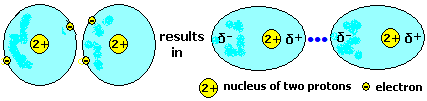
- The result is
transient helium atom attractions
He••••He
-
Methane CH4 and neon Ne
(both have 10 electrons) have very different polarizabilities of
2.59 and 0.38 respectively because the electrons in the Group 0/18
noble gases are the most strongly held of the elements
- This shows in the difference in
the boiling points of CH4 -162oC and Ne -246oC
respectively as the intermolecular forces (ID-ID) are much weaker in
neon.
- However, you get a clear trend in
properties if you just look at the
Group 0/18 noble gases.

|
Relevant data table for the Group 0/18
Noble Gases |
|
Period |
atom |
polarizability |
electrons |
bpt/K |
ΔHvap
kJ/mol |
|
2 |
Ne |
0.38 |
10 |
27 |
1.8 |
|
3 |
Ar |
1.66 |
18 |
87 |
6.5 |
|
4 |
Kr |
2.50 |
36 |
121 |
9.0 |
|
5 |
Xe |
4.01 |
54 |
166 |
12.6 |
|
6 |
Rn |
5.30 |
86 |
211 |
15.4 |
- The atomic radii increase due to
the increase in filled inner electron shells as you descend the
group.
- The increase in electron number
increases the polarizability of the Noble Gases.
- Group 0/18 trend boiling points
oC (and number of electrons = atomic number) are ...
- He -269 (2); Ne -246 (10);
Ar -186 (18); Kr -153 (36); Xe -108 (54); Rn -62 (86)
- Therefore down group 0/18, as the
number of electron shells increases, the outer electrons are further
from the nucleus, therefore the increasing number of electrons are
less strongly held by the nucleus and so polarization can take place
more easily.
- This increase in polarization
increases the probability and strength of the instantaneous
dipole - induced dipole attractive forces (London dispersion
forces).
- KE note: So, for an
increase in the strength of any type of intermolecular bonding, on
average, a greater particle vibrational or translational kinetic
energy is required to vaporise the atom/molecule and the enthalpy of
fusion (melting, data not shown) or vapourisation is increased,
reflecting the greater KE needed to escape from the intermolecular
forces at the surface of the liquid in the case of the boiling point
(or increased KE of vibration to melt the solid).
- The KE note above is a
general argument for this page and any other about intermolecular
bonding.
- -
-
THE
HALOGENS
-

-
REMINDER: The
diagram also indicates the difference between strong
intramolecular covalent bonds (X-X)
and the much weaker intermolecular bond (X2••••X2),
which in this case is entirely due to instantaneous dipole -
induced dipole attractive forces (London dispersion forces).
-
-
Following on from
the noble gas discussion, you see exactly the same pattern in
the increase in melting/boiling points and state change
enthalpies of the
Group 7/17 halogen elements.
-
As
you descend the group, the diatomic molecules get bigger with
the increase in inner filled electron shells per atom, so the
halogen molecules become more and more polarizable and
increasing the strength of the intermolecular bonding,
increasing the melting/boiling points, and the corresponding
enthalpies of fusion/vapourisation as the particles need a
greater KE to effect a state change.
-
In all three
cases, all the points made, add up to the same line of argument
to explain the trend in physical properties with increase in
electron number and polarizability.
3.
The trend in physical
properties of alkanes related to their polarizability and intermolecular
bonding - boiling point, enthalpy of vaporisation and dynamic viscosity.

-
The above diagram
'attempts' is my idea to there might several points where dipoles
are formed in longer hydrocarbon molecules.
-

-
This change, and
increase, in intermolecular forces, gives rise to different, but
increasing hydrocarbon boiling points, the basis of separating the
components of crude oil by fractional distillation.
-
As the organic
molecule (e.g. alkanes) gets bigger with more electrons in it, the
diagram is more polarizable and the transient dipole - induced
dipole effect increases - the intermolecular forces of attraction
-
The boiling point
rises as more kinetic energy is needed to effect the state
change as the molecules (and electron number) rises with increase in
the intermolecular force between neighbouring molecules.
-
As the boiling point
increase, so will the enthalpy of vaporization e.g. for ...
-
C5H12
pentane ΔHvap
= 26.4 kJmol-1, rising incrementally to 71.7 kJmol-1
for C14H30 tetradecane.
-
See the
table of polarizabilities in section 8. on the alkane trend in
viscosity because the steady increase in the strength of the
intermolecular bond, also steadily increases the dynamic viscosity
of the liquid alkane hydrocarbons.
-
Apart from fractional
distillation, the chromatographic separation of hydrocarbons can be
related to the differences in intermolecular bonding strength.
-
Gas-liquid
chromatography is a way of analysing mixtures such as a mixture
of liquid hydrocarbons.
-

-
The components are
separated due to their difference in temporarily adhering to the
coating in the separating column.
-
The main factor
controlling this is the temporary intermolecular bonds between the
mixture components and the immobile phase in the separating column.
-
The larger the
hydrocarbon molecule, the greater the temporary intermolecular
bonding, hence the smaller and least easily polarized molecules are
eluted by the carrier gas from the column first with smaller
retention times.
-
e.g. in
terms of retention time: heptane > hexane > pentane
-
More details on gas chromatography
4.
Trends in sequences of Group
4/14 carbon group hydrides and polyhalogenated methane molecules
-
The group 4/14 carbon group hydrides
-
|
Relevant data
table for the
Group 4/14 carbon
group hydrides |
|
Period |
XH4 |
polarizability |
electrons |
bpt/K |
ΔHvap
kJ/mol |
|
2 |
CH4 |
2.45 |
10 |
112 |
8.2 |
|
3 |
SiH4 |
4.78 |
18 |
161 |
13.0 |
|
4 |
GeH4 |
4.77 |
36 |
184 |
23.0 |
|
5 |
SnH4 |
? |
54 |
221 |
32..6 |
|
6 |
PbH4 |
? |
86 |
260 |
? |
-
Note: Electrons = sum of atomic
numbers in the molecular formula.
-
These are all symmetrical non-polar molecules with
zero dipole moments, so the intermolecular bonding is due to the
instantaneous dipole - induced dipole forces (London dispersion
forces).
-
Know that as the size of the hydride increases, the
molecule has more electrons and a greater polarizability, increasing
the strength of the intermolecular bonding via the instantaneous
dipole - induced dipole forces and increasing the boiling points and
enthalpy of vaporisation.
-
The same electron number and polarizability arguments apply to the
series of increasing melting and boiling points for methane and its
multi-halogen substitute compounds.
-
The
polarizabilities are in the
()
and the order of increasing melting/boiling points are ....
-
CH4
(2.45)
< CF4
(2.82)
< CCl4 <
(10.00)
CBr4
(?)
< CI4
(?)
-
From left to
right, the size of the molecule with an increasing number of
electrons steadily increases the polarizability of the molecule
and leads to increase in the dispersion attractive forces
(transient dipole - induced dipole forces), hence the increase
in melting/boiling point as more kinetic energy is needed to
effect the state change.
-
All five molecules
are symmetrical with zero dipole moments, so no complications
from polar bonds or polar molecules.
-
Obviously, down
group 7/17 the halogens have an increasing number of filled
inner electron shells, hence a significant number of electrons
and a larger volume of electron clouds that are more readily
polarized increasing the intermolecular bonding.
-
Same argument applies
to some extent to the melting/boiling points for the series
increasing chlorination or bromination of methane, as each
successive substitution greatly increases the number of electrons in
the molecule.
-
The
polarizabilities are in the
()
and the order of melting/boiling points are ....
-
CH4
(2.45)
< CH3Cl
(4.42)
< CH2Cl2
(6.66)
< CHCl3
(8.13)
< CCl4
(10.00)
-
The middle three
are polar molecules with a dipole moments of 1.90,1.62 and 1.02
D respectively, but this seems to make little difference to the
trend, which is similar for the following too.
-
CH4
(2.45)
< CH3Br
(5.61)
< CH2Br2
(8.68)
< CHBr3
(11.87)
< CBr4
(?)
-
Again, the middle
three are polar molecules with a dipole moments of >0 D.
-
In all cases, the
enthalpy of fusion/vaporization will increase in the same order,
as increasingly greater kinetic energies are needed to overcome
the increasing intermolecular bonding to effect a state change.
-
However for the
'middle' three molecules there will be a small contribution to
the total intermolecular bonding from the permanent dipole -
permanent dipole attractive forces.
5. Alkane isomers and considering surface to surface contact as
well as polarizability
Isomers of C5H12
(a)
 , ,
 ,
pentane, volatile colourless liquid, bpt 34oC,
linear, shape is more cylindrical (polarizability 9.88),
ΔHvap = 26.2 kJ/mol ,
pentane, volatile colourless liquid, bpt 34oC,
linear, shape is more cylindrical (polarizability 9.88),
ΔHvap = 26.2 kJ/mol
(b)
 , ,
 ,
methylbutane (2-methylbutane, but 2- not needed), volatile
colourless liquid/gas, bpt 28oC (polarizability 8.77),
ΔHvap = 24.8 kJ/mol ,
methylbutane (2-methylbutane, but 2- not needed), volatile
colourless liquid/gas, bpt 28oC (polarizability 8.77),
ΔHvap = 24.8 kJ/mol
(c), , ,
 ,
2,2-dimethylpropane, colourless gas, bpt 9.5oC,
maximum branching, most compact molecule (polarizability 10.24),
ΔHvap = 22.4 kJ/mol ,
2,2-dimethylpropane, colourless gas, bpt 9.5oC,
maximum branching, most compact molecule (polarizability 10.24),
ΔHvap = 22.4 kJ/mol
One
physical consequence of this isomerism, is that as the molecule
gets more branched it becomes more compact.
Therefore
the decreased surface-surface contact weakens the intermolecular
bonding (intermolecular forces), which in this case, are the
instantaneous dipole-induced dipole forces between the non-polar
hydrocarbon molecules.
This leads to a
decrease in the boiling point and enthalpy of vaporization as the
branching increases for the same molecular formula.
The polarizabilities are quite
similar, with no clear pattern, so it is the shape-surface area that seems
to affect the intermolecular bonding and hence the boiling points.
Isomers of C6H14
C6H14:
bpts/K: hexane 342 (polarizability 11.63); 3-methylpentane 336;
2-methylpentane 333; 2,3-dimethylbutane 331; 2,2-dimethylbutane 323
Similar arguments to above
apply here, where the increased branching produces slightly lower boiling
points as the surface area - surface area contact is reduced.
I was not able to find other
polarizability values, so cannot argue about their influence on the boiling
point of these isomers.
6. Why are stereoregular polymers
stronger?
Comparing amorphous and
crystalline regions of plastic materials
Stereoregular polymers
maximises the surface to surface
contact increasing the strength of the intermolecular bonding and hence the
strength of the plastic material.
The greater stereoregularity
of the polymer chain leads to the formation of stronger crystalline regions
in the polymer structure and an increase in tensile strength.
A good example is
poly(propene), shown below, where all the pendant side-chain methyl groups
are all on the same side of the ...C-C-C.. carbon chain.

This
maximises the surface to surface contact and maximises the intermolecular
bonding resulting from the instantaneous dipole - induced dipole attractive
forces increasing the tensile strength of the plastic.
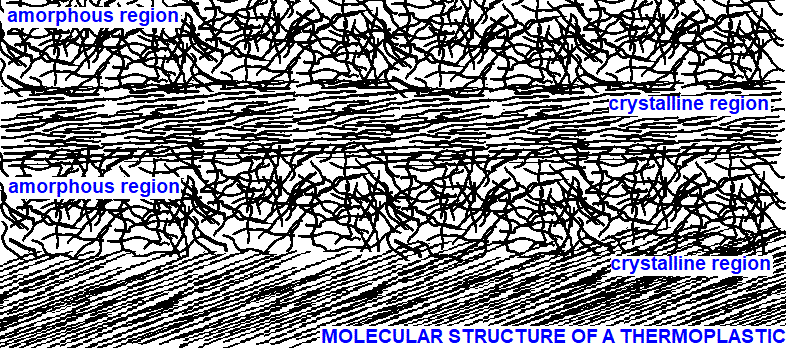
See also section 9.
Why weaken intermolecular forces? Use of plasticisers (plasticizers)
More on
isomerism and stereoregular polymers
7.
The high thermal stability of graphite -
weak intermolecular forces?
 Although
instantaneous dipole - induced dipole intermolecular attractive forces are
the weakest, do NOT assume a material cannot be strong or have a high
melting/boiling point. Although
instantaneous dipole - induced dipole intermolecular attractive forces are
the weakest, do NOT assume a material cannot be strong or have a high
melting/boiling point.
In the structure of graphite
(an allotrope of carbon), layers of
conjoined hexagonal rings of carbon atoms are held together by instantaneous
dipole - induced dipole intermolecular bonding, yet graphite only vaporises
at >3500oC.
The high thermal stability is the result of a large total intermolecular
attractive force from a large surface area, that is so great that
graphite won't melt at normal pressure, but above 3500oC the
thermal vibration KE in the molecular lattice is then great enough to
disrupt it and the graphite vaporises directly in molecular chunks of 1-4
carbon atoms.
8.
Viscosity and linear molecule trends in a homologous series of organic chemistry
Explaining the increase in viscosity of linear alkanes or alcohols.
Dynamic viscosity is a
measure of a liquid's resistance to flow.
As the carbon chain length
increases, there is a steady Increase in the strength of the temporary
dipole - induced dipole intermolecular attractive force due to the increase
in length-size of the molecular 'electron cloud' for every extra -CH2-
unit (an extra 8 electrons).
The increase in the
intermolecular bonding makes the liquid more viscous i.e. the liquid flows
less freely due to the increase in the instantaneous dipole - induced dipole
attractive forces.
An extra minor effect due
to the longer carbon chain, is the more entangled the molecules become,
which in turn, helps increase the viscosity, restricting the flow.
In the two examples described
and explained, they are compared in terms of their polarizability, number of
electrons in the molecule and dynamic viscosity.
(a)
Dynamic viscosities of
linear aliphatic liquid alkanes
from pentane to decane
Just take the polarizability
as relative value and don't worry about the units.
|
Molecule formula |
Relative polarizability |
Electrons |
Viscosity mPa s at 298K/25oC |
|
CH4 |
2.59 |
10 |
gas |
|
CH3CH3 |
4.48 |
18 |
gas |
|
CH3CH2CH3 |
6.35 |
26 |
gas |
|
CH3(CH2)2CH3 |
8.02 |
34 |
gas |
|
CH3(CH2)3CH3 |
9.88 |
42 |
0.22 |
|
CH3(CH2)4CH3 |
11.63 |
50 |
0.30 |
|
CH3(CH2)5CH3 |
13.37 |
58 |
0.40 |
|
CH3(CH2)6CH3 |
15.24 |
66 |
0.61 |
|
CH3(CH2)7CH3 |
17.37 |
74 |
0.75 |
|
CH3(CH2)8CH3 |
19.10 |
82 |
0.86 |
The table neatly
illustrates how the increase in electron number influences both the
polarizability and viscosity of liquid alkanes
Relating
viscosities to the uses of liquid hydrocarbons
Petrol needs to flow very
freely from the petrol tank to the combustion chamber of the car engine,
so the lower alkanes are suitable with their low viscosity (and higher
volatility).
Hydrocarbon lubricants
need to be much more viscous and not very volatile, otherwise they would
not stick to the surfaces of the moving engine parts required to run
smoothly.
(b)
Dynamic viscosities of linear aliphatic liquid alcohols from methanol to
butan-1-ol
These are all linear
primary alcohols (-1-ol).
|
Molecule |
Relative polarizability |
Electrons in
molecule |
Viscosity
mPa s
at 298K/25oC |
|
CH3OH |
3.23 |
18 |
0.55 |
|
CH3CH2OH |
5.11 |
26 |
1.09 |
|
CH3CH2CH2OH |
6.67 |
34 |
1.95 |
|
CH3(CH2)2CH2OH |
8.57 |
42 |
2.53 |
|
CH3(CH2)3CH2OH |
11.58 |
50 |
3.47 |
|
CH3(CH2)4CH2OH |
? |
58 |
4.59 |
|
CH3(CH2)5CH2OH |
? |
66 |
5.97 |
|
CH3(CH2)6CH2OH |
? |
74 |
7.59 |
|
CH3(CH2)7CH2OH |
? |
82 |
9.51 |
|
CH3(CH2)8CH2OH |
? |
90 |
11.50 |
Again, the table neatly
illustrates how the increase in electron number influences both the
polarizability and viscosity of liquid alcohols.
All the molecules have the
same δ-O-Hδ+
polar bond, so the contribution of permanent dipole interactions is
probably constant?
Extra note on comparing alcohol and alkane viscosities
For the same size molecules and number of electrons, the alcohols
have greater viscosities than the liquid alkanes.
This will be due to the extra stronger intermolecular bonding
from the O-H polar bonds and hydrogen bonding between the alcohol
molecules.
For more details see
Hydrogen bonding intermolecular forces
Hydrocarbon molecules
are non-polar and the intermolecular bonding only originates from
the instantaneous dipole - induced dipole attractive forces.
9.
Why weaken
intermolecular forces? Use of plasticisers (plasticizers)
Plasticisers (plasticizers), are compounds added to polymer plastics to make
them more flexible, resilient, and easier to handle i.e. changing and making
the physical properties more useful.
They behave like this by
reducing the intermolecular forces of attraction between polymer chains,
making the material more plastic.
Low melting point - high
boiling point liquid phthalate esters are typical plasticiser molecules
(examples shown below).
The plasticizer molecule needs
to be quite large and relatively non-volatile at room temperature.

By using the plasticiser
molecules you retain most of the tensile strength but allow the plastic to
be more flexible.

The diagram shows plasticiser
molecules distributed amongst the aligned molecules of the crystalline
regions of a polymer.
The plasticizer molecules 'push' some of the polymer molecules
further apart, weakening the intermolecular bonding to make the plastic more
flexible.
A good example is PVC used as strong but flexible insulating
material for electric cables.
See also
section 6.
Why are stereoregular polymers
stronger?
Some
learning objectives for
On this page I have used both terms: instantaneous dipole -
induced dipole forces and London dispersion forces to describe the origin of
the intermolecular bond.
1.Understanding the origin of instantaneous dipole - induced
dipole intermolecular bonding forces.
Know that instant dipole - induced dipole forces have other
names e.g. London forces, dispersion forces, transient dipole - induced
dipole forces, temporary dipole induced dipole forces.
I suggest you use instantaneous dipole - induced dipole
forces or London dispersion forces and know that they are due to the random
behaviour of electrons in their orbitals leading to an asymmetric
distribution creating a dipole.
Know that these attractive forces exist between all
molecules irrespective of their polarity i.e. it is irrelevant whether the
molecule in non-polar or highly polar.
This in turn causes a dipole in a neighbouring molecule
producing an intermolecular bonding force of attraction.
Know that in diagrams denote the dipole with the symbols
δ+---δ– (delta plus and delta minus).
Know that the instantaneous dipole - induced dipole force is
the weakest of the Van der Waals intermolecular bonding forces.
Know that both polarizability and the instantaneous dipole -
induced dipole force generally increase the greater the number of electrons
in the molecule (the larger the volume of electron clouds, the greater the
chance of dipole formation).
2. Examples of the polarization of non-polar hydrocarbon
molecules, noble gas atoms and halogen molecules
Know that non-polar hydrocarbon molecules exhibit
instantaneous dipole - induced dipole forces between their molecules.
Appreciate that even the Group 0/18 noble gases exhibit
attraction due to the instantaneous dipole - induced dipole forces.
Know, and be able to argue why, the melting points, boiling
points and enthalpies of vaporization i.e. explanation based on more
electrons, more polarizable, increase in instantaneous dipole - induced
dipole forces (London dispersion forces) with increase in atomic number.
GENERAL POINT FOR THIS PAGE and any on intermolecular
bonding: For any trend in the above physical properties (mpt, bpt, dHvap)
be able to explain why a change in state, requires for the particles, an
increasing amount of vibrational or translational kinetic energy to overcome
the London dispersion forces.
Be able to explain, using the arguments for the Group 0/18
noble gases, why the melting/boiling points and enthalpies of fusion/boiling
all increase with increase in atomic number.
3. Understanding the trends in physical properties of
alkanes related to their polarizability and intermolecular bonding.
Know that as the length of a hydrocarbon (e.g. alkanes)
chain increases, the molecule has more electrons and a greater
polarizability, increasing the strength of the intermolecular bonding via
the London dispersion forces and increasing the physical properties
melting/boiling points, enthalpy of state changes and the dynamic viscosity
if liquid.
Relate the trend in intermolecular bonding strength to the
separation of hydrocarbons by fractional distillation and gas-liquid
chromatography.
4. Explaining the mpt/bpt trends in sequences of Group 4/14
hydrides and polyhalogenated methane molecules
Be able to explain the trends in physical properties of the
carbon group 4/14 hydrides and tetrahalogenated methane molecules (see data
table and comments).
5. Alkane isomers and considering surface to surface contact
as well as polarizability.
Know that, and be able to explain, why the isomers of a
given alkane molecular formula, decrease in boiling point as the branching
increases.
6. Explaining in terms of intermolecular bonding why are
stereoregular polymers stronger?
Be able to describe and explain why the more crystalline a
polymer, due to a greater alignment of the polymer molecules, leads to
increased surface to surface contact, increased instantaneous dipole -
induced dipole forces and increased tensile strength.
7. Explaining the extraordinary thermal stability of
graphite from a weak intermolecular force!
Know that the thermal stability of graphite is due to
instantaneous dipole - induced dipole forces operating over a large surface
area - surface area contact, producing a strong intermolecular bond (despite
the fact that instantaneous dipole - induced dipole forces are supposed to
be the weakest).
8. Explaining the viscosity of linear molecule trends in a
homologous series.
Know that as the carbon chain
length increases, there is a steady Increase in the London dispersion
forces, increasing the intermolecular attractive force because of the
increase size and polarizability of the electron clouds and this makes the
liquid more viscous.
9. Why might we wish to weaken the intermolecular forces?
Explaining the use of plasticiser (plasticizer) additives in plastics.
Be able to explain, with the aid of a diagram, how a
plasticiser (plasticizer) molecule is added to a polymer to weaken the
intermolecular bond to make the plastic more flexible.
WHAT NEXT?
8.2
INDEX for
intermolecular bonding (intermolecular attractive forces) and examples
explained
Sub-index for this page on intermolecular forces an intermolecular
bonding
(1) Three introductory sections important to read (a) to (c) first
(a)
Introduction to intermolecular forces – Van
der Waals forces
(b)
Dipole moments and the polarizability of a
molecule
(c)
Electronegativity, covalent bond character
and polar molecules
Four types of
intermolecular attractive force sections (2) to (4) are the most
important
(2)
Instantaneous dipole – induced dipole interactions (London forces or
dispersive forces)
(3)
Permanent dipole – permanent dipole interactions (Keesom
forces/orientation forces)
(4)
Hydrogen bonding intermolecular forces
(5)
Permanent dipole – induced dipole interactions (Debye forces or
induction forces)
email
doc brown - comments - query?
INDEX Part 8. Phase equilibria–vapour
pressure, boiling/melting points, solubility and intermolecular forces
Index of ALL my chemical equilibrium context revision notes Index
ALL
my advanced A level theoretical chemistry revision study notes
Part 8 sub–index: 8.1 Vapour pressure, nature,
origin and examples explained * 8.2.1
Introduction to the types of intermolecular forces
and examples explained (index) * 8.2.2
Detailed comparative discussion of boiling points of 8 organic molecule
of similar molecular mass * 8.3
Boiling point plots of six organic homologous series
- graphs and explanation * 8.4
Other case studies of boiling points related
to intermolecular forces * 8.5
Steam distillation – theory and practice
* Evidence and theory for hydrogen bonding
in simple covalent hydride * 8.7
Solubility of covalent compounds, miscible and immiscible liquids
Advanced Equilibrium Chemistry Notes Part 1.
Equilibrium, Le Chatelier's Principle–rules * Part 2.
Kc and Kp equilibrium expressions and
calculations * Part 3.
Equilibrium and industrial processes *
Part 4.
Partition, solubility product and ion–exchange
* Part 5.
pH, weak–strong acid–base theory and
calculations * Part 6. Salt hydrolysis, Acid–base
titrations–indicators, pH curves and buffers * Part 7.
Redox equilibria, half–cell electrode
potentials, electrolysis and electrochemical series
Explaining the importance of instantaneous dipole
- induced dipole forces
in intermolecular bonding chemistry What you need to know about
instantaneous dipole - induced dipole forces for intermolecular bonding
chemistry Explaining the use of instantaneous dipole - induced dipole forces knowledge in
intermolecular bonding chemistry Examples of instantaneous dipole - induced
dipole forces explained
when studying intermolecular bonding chemistry What is
the significance of instantaneous dipole - induced dipole forces in
intermolecular bonding chemistry What is the use of instantaneous dipole -
induced dipole forces in intermolecular bonding chemistry Describing and
explaining the theory of instantaneous dipole - induced dipole forces when studying
intermolecular bonding chemistry revision notes
for instantaneous dipole - induced dipole forces in exams content © Dr
Phil Brown 2000+. Explaining the importance of London dispersion forces
in intermolecular bonding chemistry What you need to know about London
dispersion forces for intermolecular bonding chemistry Explaining the use of
London dispersion forces knowledge in intermolecular bonding chemistry Examples of
London dispersion forces explained
when studying intermolecular bonding chemistry What is
the significance of London dispersion forces in intermolecular bonding
chemistry What is the use of London dispersion forces in intermolecular bonding
chemistry Describing and
explaining the theory of London dispersion forces when studying
intermolecular bonding chemistry revision notes
for London dispersion forces in exams All copyrights reserved on
Doc Brown's Chemistry revision notes. Copying of website material is NOT
permitted.
Doc Brown's Chemistry: Theoretical-Physical Advanced A Level Chemistry (US
grades 11-12 AP Honors) Intermolecular attractive forces - intermolecular
bonding Notes on London Forces:
Explaining the
importance of explaining with examples what a instantaneous dipole -
induced dipole intermolecular bonding force is for theoretical chemistry exam questions, What you need to know about
explaining with examples what a instantaneous dipole - induced dipole
intermolecular bonding force is for theoretical chemistry, Explaining the use of
explaining with examples what a instantaneous dipole - induced dipole
intermolecular bonding force is knowledge in
theoretical chemistry exam questions, Examples of explaining with
examples what a instantaneous dipole - induced dipole intermolecular bonding
force is explained when studying
theoretical chemistry, What is the significance and use of explaining
with examples what a instantaneous dipole - induced dipole intermolecular
bonding force is in theoretical
chemistry, describing and explaining the theory behind the study of
explaining with examples what a instantaneous dipole - induced dipole
intermolecular bonding force is,
exam revision notes on explaining with examples what a instantaneous
dipole - induced dipole intermolecular bonding force is for exams, online help for the
explaining with examples what a instantaneous dipole - induced dipole
intermolecular bonding force is topic,
revision notes for explaining with examples what a instantaneous dipole
- induced dipole intermolecular bonding force is, what do I need to learn for
explaining with examples what a instantaneous dipole - induced dipole
intermolecular bonding force is in exams?
revision summary for explaining with examples what a instantaneous
dipole - induced dipole intermolecular bonding force is, help in teaching
explaining with examples what a instantaneous dipole - induced dipole
intermolecular bonding force is, learning notes for explaining with examples
what a instantaneous dipole - induced dipole intermolecular bonding force is,
help to pass exam questions involving explaining with examples what a
instantaneous dipole - induced dipole intermolecular bonding force is, help to prepare for examination questions on
explaining with examples what a instantaneous dipole - induced dipole
intermolecular bonding force is? Explaining the
importance of what are London/dispersion forces?, how do they affect the
physical properties of a molecule compound for theoretical chemistry exam questions, What you need to know about
what are London/dispersion forces?, how do they affect the physical
properties of a molecule compound for theoretical chemistry, Explaining the use of
what are London/dispersion forces?, how do they affect the physical properties
of a molecule compound knowledge in
theoretical chemistry exam questions, Examples of what are
London/dispersion forces?, how do they affect the physical properties of a
molecule compound explained when studying
theoretical chemistry, What is the significance and use of what are
London/dispersion forces?, how do they affect the physical properties of a
molecule compound in theoretical
chemistry, describing and explaining the theory behind the study of what
are London/dispersion forces?, how do they affect the physical properties of a
molecule compound,
exam revision notes on what are London/dispersion forces?, how do they
affect the physical properties of a molecule compound for exams, online help for the
what are London/dispersion forces?, how do they affect the physical properties
of a molecule compound topic,
revision notes for what are London/dispersion forces?, how do they
affect the physical properties of a molecule compound, what do I need to learn for
what are London/dispersion forces?, how do they affect the physical properties
of a molecule compound in exams?
revision summary for what are London/dispersion forces?, how do they
affect the physical properties of a molecule compound, help in teaching what are
London/dispersion forces?, how do they affect the physical properties of a
molecule compound, learning notes for what are London/dispersion forces?, how do
they affect the physical properties of a molecule compound,
help to pass exam questions involving what are London/dispersion
forces?, how do they affect the physical properties of a molecule compound, help to prepare for examination questions on
what are London/dispersion forces?, how do they affect the physical
properties of a molecule compound?
[SEARCH
BOX]
My advanced level equilibrium
notes index
All my advanced level
organic chemistry notes
All my advanced level
inorganic chemistry notes
All my advanced level
theoretical chemistry notes |
|


