|
Doc Brown's
Advanced Organic Chemistry: Part 14.7 Isomerism
The 25
constitutional-structural open chain isomers
and cycloalkane isomers of molecular formula C6H12
plus examples of their E/Z and R/S stereoisomers
[Author
©
Dr
Phil Brown PhD: Doc
Brown's advanced level organic chemistry exam revision notes suitable
for students of UK advanced level chemistry courses, IB advanced
chemistry & US K12 grades 11-12 and AP honors chemistry courses: Molecular
spectroscopy and analysing the isomers of C6H12
[page updated
RE-EDIT]
Associated organic chemistry page links
Index of sets of isomers for a given
molecular formula
email doc
brown - comments - query?
* [privacy policy,
cookies
and disclaimer]
This is a big chemistry website, please allow time
to explore it
The 25 non-cyclic alkene and cycloalkane
constitutional-structural isomers of molecular
formula C6H12
The constitutional isomer number of 25 excludes E/Z (geometrical isomers) and R/S (optical
isomers)
stereoisomers, which, if stereoisomers are included, would bring the total
of distinct isomers to at least 36, and probably more.
Introduction to the
isomerism for molecular formula C6H12

Percent composition of
C6H12 based on atomic masses C = 12.01 H =
1.01 and Mr(C6H12) = 84.18
Element composition (to two dp): carbon = 85.60%
hydrogen = 14.40%
Empirical formula = CH2
for
molecular formula = C6H12
Structural isomerism
- isomers of the same specific molecular formula, based on different connectivity's of the constituent atoms
(the constitutional isomers), so
they cannot be spatially identical (but sometimes can be defined as having the same shape).
This includes (a)
carbon chain variation (usually need a minimum of 4 atoms),
(b) change in position of a substituent or functional group and
(c) functional group isomerism where the atoms have a different
connectivity configuration, usually with significant differences in
chemical and physical properties e.g.
In terms of isomers of
C6H12
there are
(a) chain variations based on the, open chain linear
or branched alkenes and lots of saturated cyclic (alicyclic)
variations,
(b) positional isomers e.g. position of
alkene groups in the open chain compounds.
(c) They are all functional group isomers of
each other
e.g. in terms e.g. unsaturated alkenes versus saturated cycloalkane
molecules.
Stereoisomerism - isomers
based on the same connectivity of the atoms (same constitutional
formula), but in some way, they are 2D or 3D spatially different
non-superimposable images (e.g. E/Z
'geometrical' isomers or mirror image R/S 'optical' isomers)
This is where
molecules have the same basic constitutional structural formula, but
isomers differ in the 2D/3D arrangement of the atoms.
For stereoisomers, the (CIP) abbreviation
means the
IUPAC Cahn-Ingold-Prelog priority order rule for assigning
E/Z (geometrical) and R/S (optical)
stereoisomers.
E/Z stereoisomerism
was called 'geometrical isomerism' e.g.
cis (= Z) and
trans (= E) isomers of alkenes
or disubstituted cyclic alkanes where there are 2D/3D spatial variations
that are not mirror images and not super imposable.
e.g. there are 7 examples of E/Z geometrical isomers,
four in open chain alkene compounds via the C=C restricted rotation
and three in the alicyclic alkanes.
R/S stereoisomerism
was called 'optical isomerism', the pairs of isomers are called
enantiomers, which are 3D non-superimposable mirror image forms of the
molecule (enantiomers).
The molecule must have a chiral centre
(a stereocentre), that is an asymmetric carbon atom with four different
atoms/groups attached to it.
There 5 examples of R/S optical isomers,
one alkene and four of the alicyclic alkane molecules.
This can be complicated stereoisomerism because in
three cases E/Z and R/S isomers 'overlap' - need university level
for full analysis!
NOTE
The are 25
structural-constitutional isomers of molecular formula C6H12
Including the stereoisomers,
there are at least 34 unique
distinct isomers of formula C6H12.
There are
13 open chain
unsaturated aliphatic alkene constitutional isomers, linear and
branched
and
12 saturated aliphatic
cyclic compounds (alicyclic constitutional isomers) with 3-6 C atom membered rings.
All the isomers of molecular
formula C6H12 are open chain aliphatic compounds (e.g.
here unsaturated alkenes) or cyclic aliphatic compounds (e.g.
here saturated cycloalkanes), the latter sometimes
referred to as alicyclic compounds.
I've identified
13 structural alkene isomers
of molecular formula C6H12 (1)-(13),
excluding E/Z and R/S isomers
i.e.
13 carbon chain isomers and positional isomers of the C=C
double bond in C6H12 molecules - all open chain
unsaturated aliphatic molecules..
I've identified
12 alicyclic saturated alkane
molecules, (14) to (25) are cyclic molecules.
There are only 25
constitutional isomers
There are at
least 34 distinct isomers because some constitutional isomers exhibit E/Z
and R/S isomerism - there can be overlap of these two types of
stereoisomerism (university/college level analysis required).
Note
the two naming systems allowed i.e. hex-1-ene (e.g. UK)
and 1-hexene (e.g. US) etc.
Note that many of
the structural formulae of the alkenes are
abbreviated or condensed.
e.g.
CH3CH2CH2CH2CH=CH2
instead of CH3-CH2-CH2-CH2-CH=CH2
Details of the 25 constitutional isomers and also the
stereoisomers of
molecular formula
C6H12
I've identified 13 open chain
aliphatic alkene isomers (1-13) and 12 structural cycloalkane
isomers of molecular formula C6H12 (14-25), excluding
E/Z and R/S isomers, where things can get very complicated.
Most of the
cycloalkane structures are drawn as their skeletal formula.
There are two
groups of functional group isomers i.e.
open chain alkenes and cycloalkanes, each group belonging to
their own homologous series with their own distinctive
chemistries.
The chemistry of ALKANES
(detailed notes on all aspects of alkane chemistry)
The chemistry
of ALKENES
(detailed notes on all aspects of alkene chemistry)
(1)
hex-1-ene,
 , ,
 , ,
 (1-hexene) (1-hexene)
Hex-1-ene is an unsaturated
linear alkene molecule with a single C=C double bond and does not display
E/Z or R/S isomerism.
Hex-2-ene and hex-3-ene are
similarly described, with C=C bond in different positions - positional
isomers, but both exhibit E/Z (geometric) isomerism.
Number of low resolution
NMR chemical shift
δ
signal peaks: 6 1H
and 6 13C
(email
if disagree?)
1H NMR ratio of peaks: 3 : 2 : 2 : 2
: 1 : 2 (for equivalent protons)
BUT, for the 'end' =CH2 alkene protons,
you can get two chemical shifts very close together, if there are two
different groups attached to the other carbon of the C=C bond i.e.
R"R'C=CH2 where R" and R' are different
(R = H or alkyl). This causes the
two =CH2 protons to experience slightly different fields.
I've usually ignored this unless specific data was available.
Index of
1H NMR spectra organic
compounds
and
Index of
13C NMR spectra organic
compounds
(2) hex-2-ene,

CH3CH2CH2CH=CHCH3,
2-hexene has two E/Z isomers
Other names: (Z)-hex-2-ene, (E)-hex-2-ene,
(E)-2-hexene, (Z)-2-hexene,
(2Z)-hex-2-ene, (2E)-hex-2-ene, (2E)-2-hexene,
(2Z)-2-hexene, cis-hex-2-ene, trans-hex-2-ene, cis-2-hexene, trans-2-hexene.
Skeletal formulae and
structural formulae of the E/Z stereoisomers shown below.

CIP assignment priority rule for
E/Z isomers, so from
the C=C double bond:
6C6C
> 6C1H
Applying the CIP rule for the four atoms/groups around the >C=C< double bond
Z/cis-
 , ,
 , and
, and
E/ trans-,
 , ,

Number of low resolution
NMR chemical shift
δ
signal peaks: 6 1H
and 6 13C (email
if disagree?)
1H NMR ratio of peaks: 3 : 2 : 2 : 1
: 1 : 3 (for equivalent protons)
(3) hex-3-ene,
CH3-CH2-CH=CH-CH2-CH3,
structural formula
CH3CH2CH=CHCH2CH3, 3-hexene, has two E/Z isomers like hex-2-ene above, no R/S isomers.
Other names: (Z)-hex-3-ene, (E)-hex-3-ene,
(E)-3-hexene, (Z)-3-hexene,
(3Z)-hex-3-ene, (3E)-hex-3-ene, (3E)-3-hexene,
(3Z)-3-hexene, cis-hex-3-ene, trans-hex-3-ene, cis-3-hexene, trans-3-hexene.
The old names would be cis-hex-3-ene and trans-hex-3-ene.
Skeletal formulae and
structural formulae of the E/Z stereoisomers shown below.

CIP assignment priority rule for
E/Z isomers:
6C6C >
6C1H
CIP rule for the four atoms/groups around the >C=C< double bond
Z/cis-
 ,
,

and E/trans-
 , ,

Number of low resolution
NMR chemical shift
δ
signal peaks: 3 1H
and 3 13C (email
if disagree?)
1H NMR ratio of peaks: 6
(3+3) : 4 (2+2) : 2
(1+1) = 3 : 2 :
1 (for equivalent protons)
Reduced number of chemical shifts due to the symmetry of
the molecule.
(4) 2-methylpent-1-ene,
 , ,

The structural and skeletal
formula of 2-methyl-1-pentene, no E/Z
or R/S isomers.
2 -methylpent-1-ene
is an unsaturated aliphatic branched alkene molecule with a single
C=C double bond.
All the rest of the alkene molecules below can be similarly
described, apart from possible E/Z or R/S isomerism.
Number of low resolution
NMR chemical shift
δ
signal peaks: 5 1H
and 6 13C (email
if disagree?)
1H NMR ratio of peaks: 3 : 2 : 2 : 3
: 2 (for equivalent protons)
(5) 3-methylpent-1-ene,
 , ,
 ,
,
The structural formula and
skeletal formula of 3-methyl-1-pentene
3-methylpent-1-ene no E/Z isomers but has R/S isomers
(enantiomers), 3rd C
atom in the main chain is chiral (asymmetric carbon atom).
Number of low resolution
NMR chemical shift
δ
signal peaks: 6 1H
and 6 13C (email
if disagree?)
1H NMR ratio of peaks: 3 : 2 : 1 : 3
: 1 : 2 (for equivalent protons)
(6) 4-methylpent-1-ene,
 , ,

The structural formula and
skeletal formula of 4-methyl-1-pentene, no E/Z or
R/S isomers.
Number of low resolution
NMR chemical shift
δ
signal peaks: 5 1H
and 5 13C (email
if disagree?)
1H NMR ratio of peaks: 6
(3+3) : 1 : 2 : 1
: 2 (for equivalent protons)
(7)
2-methylpent-2-ene,
 , ,

The structural formula and
skeletal formula of 2-methyl-2-pentene, no E/Z or
R/S isomers
Number of low resolution
NMR chemical shift
δ
signal peaks: 4 1H
and 5 13C (email
if disagree?)
1H NMR ratio of peaks: 3 : 2 : 1 : 6
(3+3)
(for equivalent protons)
(8) 3-methylpent-2-ene,

3-methyl-2-pentene has E/Z isomers,
but no R/S isomers.
Other names:
(E)-3-methyl-pent-2-ene, (Z)-3-methylpent-2-ene, (E)-3-methyl-2-pentene,
(Z)-3-methyl-2-pentene,
(2E)-3-methyl-pent-2-ene,
(2Z)-3-methylpent-2-ene, (2E)-3-methyl-2-pentene, (2Z)-3-methyl-2-pentene,
cis-3-methylpent-2-ene, trans-3-methylpent-2-ene, cis-3-methyl-2-pentene,
trans-3-methyl-2-pentene.
Skeletal formulae and
structural formulae of the E/Z stereoisomers shown below.

CIP assignment priority rule for
E/Z isomers
from the C=C bond:
6C6C >
6C1H > 1H
CIP rule for the four atoms/groups around the >C=C< double bond
 , ,
 ,
E-3-methylpent-2-ene (trans) ,
E-3-methylpent-2-ene (trans)
and
 , ,
 ,
Z-3-methylpent-2-ene (cis)
,
Z-3-methylpent-2-ene (cis)
Number of low resolution
NMR chemical shift
δ
signal peaks: 5 1H
and 6 13C (email
if disagree?)
1H NMR ratio of peaks: 3 : 2 : 3 : 3
: 1 (for equivalent protons)
(9) 4-methylpent-2-ene,
 ,
4-methyl-2-pentene, E/Z isomers, no R/S isomers: ,
4-methyl-2-pentene, E/Z isomers, no R/S isomers:
Other names:
(E)-4-methyl-pent-2-ene, (Z)-4-methylpent-2-ene, (E)-4-methyl-2-pentene,
(Z)-4-methyl-2-pentene, (2E)-4-methyl-pent-2-ene,
(2Z)-4-methylpent-2-ene, (2E)-4-methyl-2-pentene, (2Z)-4-methyl-2-pentene,
cis-4-methylpent-2-ene, trans-4-methylpent-2-ene, cis-4-methyl-2-pentene,
trans-4-methyl-2-pentene.
Skeletal formulae and structural
formulae of the E/Z stereoisomers shown below.

CIP assignment priority rule for
E/Z isomers
from off the C=C double bond:
6C6C >
6C1H > 1H
CIP rule for the four atoms/groups around the >C=C< double bond
Z/cis-
 , ,

and E/trans-
 ,
,

The old names would be
cis-4-methylpent-2-ene and trans-4-methylpent-2-ene.
Number of low resolution
NMR chemical
shift
δ
signal peaks: 5
1H and
5 13C
(email
if disagree?)
1H NMR ratio of peaks: 6
(3+3) : 1 : 1 : 1
: 3 (for equivalent protons)
(10) 2,3-dimethylbut-1-ene,
 , ,
 ,
,
structural formula and
skeletal formula of 2,3-dimethyl-1-butene, cannot exhibit E/Z
or R/S isomerism
Number of low resolution
NMR chemical shift
δ
signal peaks: 4 1H
and 5 13C (email
if disagree?)
1H NMR ratio of peaks: 6
(3+3) : 1 : 3 : 2
(for equivalent protons)
(11)
3,3-dimethylbut-1-ene,
 , ,
 ,
,
structural formula and
skeletal formula of 3,3-dimethyl-1-butene, cannot exhibit E/Z
or R/S isomerism
Number of low resolution
NMR chemical shift
δ
signal peaks: 3 1H
and 4 13C (email
if disagree?)
1H NMR ratio of peaks: 9
(3x3) : 1 : 2 (for
equivalent protons)
The methyl group symmetry reduces the number of chemical
shifts.
(12) 2,3-dimethylbut-2-ene,
 , ,

structural formula and
skeletal formula of 2,3-dimethyl-2-butene,
does not have E/Z isomers,
a completely symmetrical alkene, no R/S isomers
Number of low resolution
NMR chemical shift
δ
signal peaks: 1 1H
and 2 13C (email
if disagree?)
The minimum number of chemical shifts due to the high
symmetry of the molecule.
(13) 3-methylenepentane,
H2C=C(CH2CH3)2
,
 ,
,
I don't think 2-ethylbut-1-ene
would be considered correct, since the longest carbon atom chain is 5.
The structural formula and
skeletal formula, no E/Z or R/S isomers
Also called (less correctly) 2-ethylbut-1-ene or 2-ethyl-1-butene.
Number of low resolution NMR
chemical shift
δ
signal peaks: 3 1H
and 4 13C (email
if disagree?)
1H NMR ratio of peaks: 2 : 4
(2+2) : 6 (3+3) = 1
: 2 : 3 (for equivalent protons).
Fewer chemical shifts due to symmetry about both ends of the
>C=C< bond.
 (14)
cyclohexane , (14)
cyclohexane ,
 , ,
 the largest possible ring.
It is not a planar molecule
but has no E/Z or R/S isomers.
Cyclohexane is a saturated aliphatic
cycloalkane molecule (cyclo alkane, alicyclic compound).
All the rest of the cyclic molecules below can
be similarly described, apart from possible E/Z or R/S isomers.
Number of low resolution NMR
chemical shift
δ
signal peaks: 1 1H
and 1 13C (email
if disagree?)
See also spectra that can distinguish one C6H12 isomer
from another
The infrared
spectrum of cyclohexane
The mass
spectrum of cyclohexane
The H-1
NMR spectrum of cyclohexane
The C-13
NMR spectrum of cyclohexane
 (15) methylcyclopentane , (15) methylcyclopentane ,
 , ,

not quite planar, does NOT exhibit E/Z
(geometric) or R/S (optical)
isomerism
Number of low resolution NMR
chemical shift
δ
signal peaks: 4 1H
and 4 13C (email
if disagree?)
1H NMR ratio of peaks: 4
(2+2) : 4 (2+2) : 1 : 3
(for equivalent protons)
(16)
ethylcyclobutane ,
 , ,

does NOT exhibit
E/Z (geometric) or R/S (optical) isomerism
Number of low resolution
NMR chemical shift
δ
signal peaks: 5
1H and 5
13C (email
if disagree?)
1H NMR ratio of peaks: 2 : 4
(2+2) : 1 : 2
: 3 (for equivalent protons)
(17)
1,1-dimethylcyclobutane ,
 , ,

does NOT exhibit
E/Z (geometric) or R/S (optical) isomerism
Number of low resolution
NMR chemical shift
δ
signal peaks: 3
1H and 4
13C (email
if disagree?)
1H NMR ratio of peaks: 2 : 4
(2+2) : 6 (3+3) = 1
: 2 : 3 (for equivalent protons)
(18) 1,2-dimethylcyclobutane ,
 , ,

This molecule exhibits both E/Z and R/S isomerism - complicated - university level
analysis.
Structural formulae of the E/Z
stereoisomers shown below.
The right carbons of the ring are chiral and E/Z isomers
can arise from the two ring methyl groups.
Two of the adjacent -CH-
carbon atoms of the
cyclobutane ring are asymmetric (stereocentres)
but the ring prevents rotation of this C-C bond (as in a >=C< bond, so
you can get cis/trans isomers (E/Z isomers).
CIP assignment priority rule for
E/Z
(cis/trans) isomers:
6C6C >
6C1H > 1H
(Z)-1,2-dimethylcyclobutane,
 ,
a
= a
= CH3 (cis-1,2-dimethylcyclobutane isomer) ,
a
= a
= CH3 (cis-1,2-dimethylcyclobutane isomer)
(E)-1,2-dimethylcyclobutane,
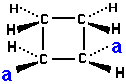 ,
a
= a
= CH3 (trans-1,2-dimethylcyclobutane isomer) ,
a
= a
= CH3 (trans-1,2-dimethylcyclobutane isomer)
Number of low resolution
NMR chemical shift
δ
signal peaks: 3 1H
and 3 13C (email
if disagree?)
1H NMR ratio of peaks: 4
(2+2) : 2 (1+1) : 6
(3+3) = 2
: 1 : 3 (for equivalent protons)
(19) 1,3-dimethylcyclobutane ,
 , ,
 ,
,
This molecule exhibits E/Z (geometric) isomerism
arising from the two ring methyl groups,
and also R/S isomerism.
Structural formulae of the E/Z stereoisomers shown below.
CIP assignment priority rule for
E/Z
(cis/trans) isomers:
6C6C >
6C1H > 1H
(E)-1,3-dimethylcyclobutane,
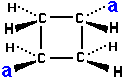 ,
a
= a
= CH3 (trans-1,3-dimethylcyclobutane isomer) ,
a
= a
= CH3 (trans-1,3-dimethylcyclobutane isomer)
(Z)-1,3-dimethylcyclobutane,
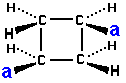 ,
a
= a
= CH3 (cis-1,3-dimethylcyclobutane isomer) ,
a
= a
= CH3 (cis-1,3-dimethylcyclobutane isomer)
Number of low resolution
NMR chemical shift
δ
signal peaks: 3 1H
and 3 13C (email
if disagree?)
1H NMR ratio of peaks: 6
(3+3) : 2 (1+1) : 4
(2+2) = 3
: 1 : 2 (for equivalent protons)
(20)
1-ethyl-1-methylcyclopropane,
 , ,
No R/S or E/Z isomers
Number of low resolution
NMR chemical shift
δ
signal peaks: 4 1H
and 5 13C (email
if disagree?)
1H NMR ratio of peaks: 4
(2+2) : 3 : 2 : 3
(for equivalent protons)
(21)
1-ethyl-2-methylcyclopropane,

This molecule exhibits both E/Z
(cis/trans geometric) and R/S (optical) isomerism, two chiral carbon atoms
of the
∆ ring, so,
very complicated, university
level. Structural formulae of the E/Z stereoisomers shown below.
CIP assignment priority rule for
E/Z isomers:
6C6C >
6C1H > 1H
(Z)-1-ethyl-2-methylcyclopropane,

a = CH2CH3 ,
b = CH3 (cis-1-ethyl-2-methylcyclopropane isomer)
(E)-1-ethyl-2-methylcyclopropane,
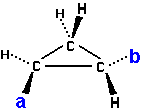
a = CH2CH3 ,
b = CH3
(trans-1-ethyl-2-methylcyclopropane isomer)
Number of low resolution
NMR chemical
shift
δ
signal peaks: 6
1H and 6
13C (email
if disagree?)
1H NMR ratio of peaks: 2 : 1 : 2 : 3
: 1 : 3 (for equivalent protons)
(22)
1,1,2-trimethycyclopropane,
 , ,
This exhibits R/S (optical) isomerism, bottom
right C of the ∆ ring is a
chiral carbon atom, a chiral centre.
Number of low resolution
NMR chemical shift
δ
signal peaks: 4 1H
and 5 13C (email
if disagree?)
1H NMR ratio of peaks: 2 : 6
(3+3) : 1 : 3
(for equivalent protons)
(23)
1,2,3-trimethycyclopropane,

Potentially both E/Z (geometric) and
R/S (optical) isomerism are possible, complicated, university level.
Number of low resolution
NMR chemical shift
δ
signal peaks: 2 1H
and 2 13C (email
if disagree?)
1H NMR ratio of peaks: 3
(3x1) : 9 (3x3) = 1 : 3
(for equivalent protons)
Fewer chemical shifts due to the high symmetry of the
molecule.
This molecule can exhibit E/Z isomerism (cis/trans
stereoisomerism) depending on the orientation of the methyl groups
attached to the cyclopropane ring.
(24)
propylcyclopropane
,
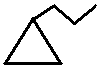 ,
no E/Z (geometric) or R/S (optical)
isomers. ,
no E/Z (geometric) or R/S (optical)
isomers.
Number of low resolution
NMR chemical shift
δ
signal peaks: 5 1H
and 5 13C (email
if disagree?)
1H NMR ratio of peaks: 4
(2+2) : 1 : 2 : 2
: 3 (for equivalent protons)
(25)
(1-methylethyl)cyclopropane (isopropylcyclopropane)
,
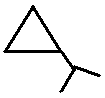
no E/Z (geometric) and no R/S (optical)
isomers
Number of low resolution
NMR chemical shift
δ
signal peaks: 4 1H
and 4 13C (email
if disagree?)
1H NMR ratio of peaks: 4
(2+2) : 1 : 1
: 6 (3+3) (for equivalent protons)
Are there any more isomers?
EXTRA NOTES on
the isomers of
C6H12 and some multiple choice practice questions with
answers
There are 25 constitutional isomers of
C6H12,
including both saturated cycloalkanes and unsaturated open chain alkenes.
These isomers exhibit chain, positional, ring and functional
group isomerism,
with varied physical and chemical properties due to differences in
structure, saturation, and substitution.
Some basic multiple choice practice questions
Molecular Formula:
C6H12
Types of Isomerism in
C6H12
|
Type of Isomerism |
Description |
|
Constitutional |
Different connectivity
(e.g. hex-1-ene versus methylcyclopentane) |
|
Positional |
Location of double
bond or substituent (e.g. hex-1-ene versus hex-2-ene) |
|
Chain
(skeletal) |
Straight versus
branched carbon skeletons (e.g. hexene versus methylpentene) |
|
Ring isomerism |
Different ring sizes
and substituents (e.g. cyclohexane versus dimethylcyclobutane) |
|
Geometric
(E/Z) |
For alkenes with two
different groups on each C=C (e.g. hex-2-ene) |
|
Conformational |
Chair/boat forms in
cyclohexane; rotamers in branched chains |
Representative Isomers of
C6H12
Alkenes
-
Hex-1-ene, Hex-2-ene (E/Z)
-
2-Methylpent-1-ene, 3-Methylpent-1-ene
-
3-Methylpent-2-ene (E/Z)
-
2,3-Dimethylbut-1-ene, 2,3-Dimethylbut-2-ene
Cycloalkanes
-
Cyclohexane
-
Methylcyclopentane, Ethylcyclobutane
-
1,1-Dimethylcyclobutane, 1,2-Dimethylcyclobutane
-
Propylcyclopropane, Isopropylcyclopropane
Differences in Physical Properties of the isomers
of
C6H12
|
Property |
Alkenes |
Cycloalkanes |
|
Boiling Point |
Higher in
straight-chain alkenes |
Lower in branched or
small rings |
|
Melting Point |
Higher in symmetrical
isomers |
Cyclohexane has
unusually high m.p. |
|
Density |
Slightly higher in
cyclic isomers |
Compact packing
increases density |
|
Spectroscopy |
C=C stretch ~1640 cm⁻¹
(IR); vinylic H ~5–6 ppm (NMR) |
Cycloalkanes show
saturated C–H signals |
Differences in Chemical Reactivity
of the isomers of
C6H12
|
Reaction Type |
Alkenes |
Cycloalkanes |
|
Electrophilic
Addition |
Undergo addition (e.g.
HBr, H2O) |
Generally inert unless
activated |
|
Hydrogenation |
Converts to alkane |
Cyclohexane is already
saturated |
|
Polymerisation |
Terminal alkenes
polymerise readily |
Cycloalkanes do not
polymerise |
Uses
and Applications
of the isomers of
C6H12
-
Alkenes: Precursors in polymer production
(e.g. polyethylene), intermediates in organic synthesis, fuel additives.
-
Cycloalkanes: Solvents, reference compounds
in spectroscopy, intermediates in ring-opening reactions.
Student Misconceptions
about the isomers of
C6H12
-
“All C6H12 isomers are alkenes” —
incorrect: many are cycloalkanes.
-
“Double bond position doesn’t affect reactivity” — False:
affects regioselectivity and stability.
-
“Cyclohexane is aromatic” — incorrect: it’s fully saturated
and non-aromatic.
-
“E/Z isomers are the same compound” — False: they are
distinct stereoisomers and can have both similar or different physical and chemical properties.
Exam
Revision Tips
for questions involving the isomers of
C6H12
Basic practice
questions and answers
Practice multiple-choice questions designed around the
isomers of molecular formula C6H12,
focusing on structural and spectroscopic differences.
These are tailored for
advanced pre-university chemistry courses (A-level, IB, AP), with accessible
language and subtle technical depth.
Multiple Choice Practice based on, but not exclusively, the isomers of
C6H12
Q1. Which molecule
is most likely to show a strong IR absorption near 1640 cm⁻¹?
-
Cyclohexane
-
2-Methylpentane
-
Hex-1-ene
-
Hexane
Q2. Which molecule would
show a singlet in its ¹H NMR spectrum due to equivalent protons in a symmetrical
ring?
-
2-Methylpentane
-
Cyclohexane
-
3-Methylpentene
-
1-Methylcyclopentane
Q3. Which molecule can exist as
E/Z (cis-trans geometrical) isomers?
-
Hexane
-
Cyclohexane
-
2-Methylpentane
-
Hex-2-ene
Q4. Which molecule would
show four ¹H chemical shifts in its NMR spectrum?
-
Cyclohexane
-
Hexane
-
Methylcyclopentane
-
Pent-2ene
Q5. Which molecule would
show a strong IR absorption near 1700 cm⁻¹?
-
Cyclohexanone
-
Hex-1-ene
-
Cyclohexane
-
2-Methylpentane
Q6. Which molecule contains
a tertiary carbon and would show reduced C–H stretching intensity in IR?
-
2-Methylpentane
-
Cyclohexane
-
Hexane
-
Hex-1-ene
Q7. Which molecule would
show five signals in its ¹³C NMR spectrum?
-
2-Methylpentane
-
Cyclohexane
-
Hexane
-
Hex-1-ene
Q8. Which molecule has 3
different hydrogen environments in its ¹H NMR spectrum?
-
Cyclohexane
-
Hex-1-ene
-
2-Methylpentane
-
Hex-3-ene
Q9 Which molecule will
react the fastest with bromine water?
-
Hex-1-ene
-
Cyclohexane
-
Hexane
-
2-Methylpentane
Q10. Which molecule
will give four 1H chemical shifts in its NMR spectrum?
-
Cyclohexane
-
1-Hexene
-
3-Methylpentane
-
Hex-2-ene
Learning objectives - questions to be answered?
How do you work out the structure
of the isomers of molecular formula C6H12?
How do you draw the structural formula
and skeletal formula of the isomers of molecular formula C6H12?
How many aliphatic structural isomers
are there of molecular formula C6H12?
How many aliphatic carbon chain isomers
are there of molecular formula C6H12?
How many positional isomers are there
of molecular formula C6H12?
How many E/Z (geometrical) isomers are
there of molecular formula C6H12?
How many R/S (optical) isomers
(enantiomers) of molecular formula C6H12?
Are there any aliphatic open chain
alkene isomers of molecular formula C6H12?
Are there any diene isomers of
molecular formula C6H12?
Are there any alkyne isomers of
molecular formula C6H12?
Are there any alicyclic cycloalkane
isomers of molecular formula C6H12?
Are there any alicyclic cycloalkene
isomers of molecular formula C6H12?
Are there any functional group isomers
with a molecular formula C6H12?
Are there any E/Z (geometrical) isomers
with a molecular formula C6H12?
Are there any R/S (optical) isomers
(enantiomers) with a molecular formula C6H12?
Does C6H12 have any stereoisomers?
Be able to work out the number of different 1H
proton NMR chemical shift signals for C6H12 isomers
Be able to work out the number of different 13C
NMR chemical shift signals for C6H12 isomers
This page
will answer these questions for molecular formula C6H12
ANSWERS
Q1. Which molecule
is most likely to show a strong IR absorption near 1640 cm⁻¹?
-
Cyclohexane
-
2-Methylpentane
-
Hex-1-ene
-
Hexane
Q1. Correct: C. Hex-1-ene
Explanation: The C=C stretch appears near 1640 cm⁻¹ in IR
spectra.
Tips:
Q2. Which molecule would
show a singlet in its ¹H NMR spectrum due to equivalent protons in a symmetrical
ring?
-
2-Methylpentane
-
Cyclohexane
-
3-Methylpentene
-
1-Methylcyclopentane
Q2. Correct: B. Cyclohexane
Explanation: All protons are equivalent due to ring symmetry
and rapid flipping.
Tips:
Q3. Which molecule can exist as
E/Z (cis-trans, geometrical) isomers?
-
Hexane
-
Cyclohexane
-
2-Methylpentane
-
Hex-2-ene
Q3. Correct: D. Hex-2-ene
Explanation: Geometric isomerism requires a C=C with
different groups on each carbon.
Tips:
Q4. Which molecule would
show four ¹H chemical shifts in its NMR spectrum?
-
Cyclohexane
-
Hexane
-
Methylcyclopentane
-
Pent-2-ene
Q4. Correct: C. Hexane
Explanation: Four different proton environments, 3 in the ring
and 1 for the methyl group
A 1, B 3 and D 5 different proton environments
Q5. Which molecule would
show a strong IR absorption near 1700 cm⁻¹?
-
Cyclohexanone
-
Hex-1-ene
-
Cyclohexane
-
2-Methylpentane
Q5. Correct: A. Cyclohexanone
Explanation: The C=O stretch in ketones appears near 1700
cm⁻¹.
Tips:
-
Alkenes absorb lower (~1640 cm⁻¹).
-
Alkanes lack double bonds.
-
You should get a wavenumber table in exams.
Q6. Which molecule contains
a tertiary carbon and would show reduced C–H stretching intensity in IR?
-
2-Methylpentane
-
Cyclohexane
-
Hexane
-
Hex-1-ene
Q6. Correct: A. 2-Methylpentane
Explanation: Tertiary carbons have fewer C–H bonds,
reducing IR intensity.
Tips:
Q7. Which molecule would
show five signals in its ¹³C NMR spectrum?
-
2-Methylpentane
5 13C signals
-
Cyclohexane
1 13C
Hexane
3 13C
Hex-1-ene
6 13C
Q7. Correct: A. 2-Methylpentane
Explanation: Branching creates distinct carbon environments.
Tips:
Q8. Which molecule has 3
different hydrogen environments in its ¹H NMR spectrum?
-
Cyclohexane
1 1H
-
Hex-1-ene
6 1H
-
2-Methylpentane
5 1H
-
Hex-3-ene
3 1H signals
Q8. Correct: D hex-3-ene
Explanation: symmetrical molecule with 3 pairs of equivalent
protons H3C-CH2-CH=CH-CH2-CH3
(proton ratio of 6 : 4 : 2)
Tips:
-
Alkenes and branched alkanes show more
environments than e.g. cyclohexane, but hex-3-ene is more symmetrical than B
or C.
-
A 1, B 6, C 4, D 3 1H principal chemical shifts
respectively
Q9 Which molecule will
react the fastest with bromine water?
-
Hex-1-ene
-
Cyclohexane
-
Hexane
-
2-Methylpentane
Q9. Correct: A. 1-Hexene
Explanation: Reactive C=C bond
Q10. Which molecule
will give four 1H chemical shifts in its NMR spectrum?
-
Cyclohexane
1 1H
-
1-Hexene
6 1H
-
3-Methylpentane
4 1H signals
-
Hex-2-ene
6 1H
Q10. Correct: C. 3-methylpantene
Explanation: A1, B 6, C 4, D 6
Associated organic chemistry links
Combined
multiple choice and type in name quiz on the structure and naming of alkenes Combined
multiple choice and type in name quiz on the structure
and naming of alkanes
Advanced Level pre-university
organic chemistry notes
IR, mass and H-1 and C-13 NMR
spectra of organic compounds
INDEX of nuclear magnetic resonance
spectroscopy: 1H NMR spectra of organic
compounds
INDEX of nuclear magnetic resonance
spectroscopy: 13C NMR spectra of organic
compounds
Index of sets of isomers for a given
molecular formula
The molecular structure and
naming of ALKANES (how
to name and draw alkane structures)
The molecular structure and naming
of ALKENES
(how to name and draw alkene structures)
Index of ALL revision notes
on the chemistry of ALKANES and the petrochemical
industry
INDEX of
ALL revision notes on the chemistry ALKENES
including reactions and polymersFor isomerism in organic chemistry, see also the
notes
Isomerism: introduction, structural isomerism - chain,
positional, functional group, tautomerism
Stereoisomerism:
introduction, definition,
priority rules, E/Z isomerism (cis/trans isomerism)
Stereoisomerism - R/S isomerism (optical
isomerism) -
definition - examples explained email doc
brown - comments - query?
This is a big chemistry website, please allow time
to explore it
Index of advanced
(pre-university) organic
chemistry revision notes
The chemistry of
alkanes and the petrochemical
industry
The
chemistry of alkenes
The
chemistry of organic halogen compounds
The
chemistry of
alcohols
The chemistry of
aldehydes
and ketones The
chemistry of carboxylic acids and derivatives
The chemistry of
organo-nitrogen compounds
The chemistry of
aromatic compounds

|
Website content © Dr Phil Brown 2000+. All copyrights reserved on revision
notes, images, quizzes, worksheets etc. Copying of Doc Brown's pre-university
advanced level chemistry website material is NOT permitted. Exam revision
summaries & references to science course specifications are unofficial. These
organic chemistry revision notes on isomerism are suitable for use of
pre-university students studying AQA advanced level chemistry, Edexcel advanced
level chemistry, OCR advanced level chemistry, IB advanced level chemistry, WJEC
(Eduqas) advanced level chemistry, CIE advanced level chemistry, US grade 11-12
AP honors chemistry courses and they will also prove useful to 1st year
undergraduate students of chemistry. |
|
Keywords or phrases: how many isomers are
there of molecular formula C6H12? how do you name the isomers of
molecular formula C6H12? what is the molecular structure of the
isomers of C6H12, what type of isomerism is exhibited by molecules
of formula C6H12, how do you work out the isomers of molecular
formula C6H12, what are the structural isomers of C6H12, the carbon chain
isomers of C6H12 in the homologous series of alkanes, comparing
the spectra of isomers of molecular formula C6H12 how many
structural isomers of C6H12 can you draw? how many structural
isomers does C6H12 have? what are the possible isomers of C6H12?
revision notes on isomerism of C6H12 molecules
E/Z isomers cis trans stereoisomers of C6H12,
isomers of C6H12 of molecular mass 84
cycloalkane molecules isomeric of molecular formula C6H12,
ester molecules isomeric with molecular formula C6H12, structural isomers of molecular
formula C6H12, optical isomers R/S enantiomers isomeric with molecular
formula C6H12, positional isomers isomeric with molecular formula
C6H12,
which types of isomerism are exhibited by molecules isomeric with
molecular formula C6H12 alkyl positional isomers of C6H12 branched
carbon chain cycloalkane isomers of molecular formula C6H12
E/Z isomers of molecular formula
C6H12 (geometric cis/trans
isomers) alkene molecules isomeric of molecular formula C6H12,
ester molecules isomeric with molecular formula C6H12, structural isomers of molecular
formula C6H12, optical isomers R/S enantiomers isomeric with molecular
formula C6H12, positional isomers isomeric with molecular formula
C6H12,
which types of isomerism are exhibited by molecules isomeric with
molecular formula C6H12 alkyl positional isomers of C6H12 branched
carbon chain alkene isomers of C6H12 cycloalkanes of molecular formula
C6H12 which are isomeric with alkenes of molecular formula C6H12 stereoisomers
of molecular formula C6H12 cyclic alkanes of formula C6H12 E/Z isomers of molecular formula
C6H12 (geometric cis/trans
isomers) alkene molecules isomeric of molecular formula C6H12,
molecules isomeric with molecular formula C6H12, structural isomers of molecular
formula C6H12, optical isomers R/S enantiomers isomeric with molecular
formula C6H12, positional isomers isomeric with molecular formula
C6H12,
alicyclic alkanes of formula C6H12 which types of isomerism are exhibited by molecules isomeric with
molecular formula C6H12 alkyl positional isomers of C6H12 branched
carbon chain alkene isomers of C6H12 cycloalkanes of molecular formula
C6H12 which are isomeric with alkenes of molecular formula C6H12
stereoisomers of molecular formula C6H12 cycloalkane functional
group isomers of C6H12 are there alkyne isomers of C6H12? are
there cycloalkanes of formula C6H12? are there cycloalkenes of
formula C6H12 chain isomers of C6H12 functional group isomers of
C6H12 substituent and functional group positional isomers of
C6H12 cyclic alkanes of formula C6H12 E/Z isomers of molecular formula
C6H12 (geometric cis/trans
isomers) alkene molecules isomeric of molecular formula C6H12,
molecules isomeric with molecular formula C6H12, structural isomers of molecular
formula C6H12, optical isomers R/S enantiomers isomeric with molecular
formula C6H12, positional isomers isomeric with molecular formula
C6H12,
alicyclic alkanes of formula C6H12 which types of isomerism are exhibited by molecules isomeric with
molecular formula C6H12 alkyl positional isomers of C6H12 branched
carbon chain alkene isomers of C6H12 cycloalkanes of molecular formula
C6H12 which are isomeric with alkenes of molecular formula C6H12
stereoisomers of molecular formula C6H12 cycloalkane functional
group isomers of C6H12 are there alkyne isomers of C6H12? are
there cycloalkanes of formula C6H12? are there cycloalkenes of
formula C6H12 chain isomers of C6H12 functional group isomers of
C6H12 substituent and functional group positional isomers of
C6H12
|
