|
Doc Brown's
Advanced Chemistry: Part 14.7:
Isomers and extra notes on their properties and uses
Structural isomers
and
stereoisomers of molecular formula
C4H7X (X
= halogen atom)
[Author
©
Dr WP Brown PhD:
Doc Brown's advanced level organic chemistry exam revision notes
suitable for students of UK advanced level chemistry courses, IB
advanced chemistry & US K12 grades
11-12 and AP honors chemistry courses: Molecular
spectroscopy and analysing the isomers of C4H7X
[updated
September 30th
2025]
Index of sets of isomers for a given
molecular formula
email doc
brown - comments - query?
*
[privacy policy, cookies
and disclaimer]
Associated organic chemistry page links
This is a big chemistry website, please allow time
to explore
12 selected
constitutional-structural isomers of molecular formula
C4H7X (X
= halogen)
Relative molecular mass and
percent composition of
C4H7X
(X = halogen) based on atomic masses:
C 12.01,
H 1.01, F 19.00, Cl 35.45,
Br 79.90, I 126.90
|
Formula of
compound |
Relative molecular mass |
% carbon |
% hydrogen |
% halogen |
|
C4H7F |
74.11 |
64.82 |
9.54 |
25.64 |
|
C4H7Cl |
90.56 |
53.04 |
7.81 |
39.15 |
|
C4H7Br |
135.01 |
35.58 |
5.24 |
59.18 |
|
C4H7I |
182.01 |
26.39 |
3.88 |
69.73 |
Empirical formula
=
molecular formula
= C4H7X
(where X = a single halogen atom)
Introduction to 12 constitutional isomers of
C4H7F,
C4H7Cl, C4H7Br and C4H7I

Structural isomerism
- isomers based on different connectivity's of the constituent atoms, so cannot
be spatially identical (but can be defined as having the same shape).
This includes (a)
carbon chain variation (usually need a minimum of 4 atoms),
(b) change in position of a substituent or functional group and
(c) functional group
isomerism where the atoms have a different connectivity configuration, usually with
significant differences in chemical and physical properties.
All three types of structural isomerism are
seen in the isomers of
C4H7X
(X = halogen)
(a) Carbon chain variation with alkenes and
open chain haloalkenes versus halocycloalkanes.
(b) Position of halogen substituent and the
C=C group in the haloalkenes varies.
(c) Open chain unsaturated alkenes versus
saturated halocycloalkane derivatives.
Stereoisomerism - isomers
based on the same connectivity of the atoms, but 2D or 3D spatially different,
non-superimposable images (e.g. E/Z isomers or mirror image R/S optical isomers)
This is
where molecules have the same basic constitutional structural formula, but
isomers differ in the 2D/3D arrangement of the atoms.
For stereoisomers, the (CIP) abbreviation means the
IUPAC Cahn-Ingold-Prelog priority
order rule for assigning E/Z (geometrical) and R/S (optical) stereoisomers.
Both types of
stereoisomerism are seen in the isomers of
C4H7X
(where X = halogen)
E/Z
stereoisomerism was called 'geometrical isomerism' e.g. cis
and trans isomers of alkenes or disubstituted cyclic alkanes
where there are 2D/3D spatial variations that are not mirror images and not
super imposable.
Three constituent haloalkene isomers and one
constituent halocycloalkane exhibit E/Z (geometrical) isomerism to
give a pair of E/Z isomers..
R/S
stereoisomerism was called 'optical isomerism', the pairs of
isomers are called enantiomers which are 3D non-superimposable
mirror image forms of the molecule (enantiomers). The molecule must have a
chiral centre
(a stereocentre), that is an asymmetric carbon atom with four
different atoms/groups attached to it.
One open chain haloalkene and one halocycloalkane
exhibit R/S (optical) isomerism to give a pair of enantiomers
(complex, overlaps with E/Z isomerism).
Note:
(1) Some of the
C4H7X
(X = halogen) isomers described may be highly reactive and thermodynamically unstable e.g. due to weak highly
strained bonds and some may not even exist at all (except
theoretically!).
(2) At a simple level there are six pairs of
stereoisomers (4 pairs of E/Z isomers and 2 pairs of R/S isomers), making a
total 18 distinct isomers.
(3) One constitutional isomer exhibits both E/Z and
R/S isomerism based on the two chiral centres and this is complicated and very much university level analysis!
(3) I have identified 12 constitutional isomers for
molecular formula
C4H7X
(X = halogen), but are there any more? and five of them exhibiting
stereoisomerism, there are at least 17 distinct isomers.
Details of the 12
constitutional structural isomers of
C4H7X (X
= halogen)
with additional
notes on the stereoisomers
(1)
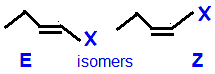 CH3CH2CH=CHX
a substituted linear alkene
CH3CH2CH=CHX
a substituted linear alkene
Skeletal formula and abbreviated structural formula for:
1-fluorobut-1-ene, 1-chlorobut-1-ene,
1-bromobut-1-ene, 1-iodobut-1-enetional group
These are functional group, chain,
positional and E/Z isomers.
Functional groups: alkene (>C=C<)
and halogen (C-X).
C1 and C2 form the stereocentre (restrict rotation) allowing the
possibility of E/Z (geometrical) isomers and
note that 6C, 9F, 17Cl,
35Br
and 53I all have a higher priority than 1H.
From the CIP assignment priority rule: ZX >
6C
> 1H (X = halogen, Z = 9, 17, 35 or 53)
Number of low resolution
NMR chemical shift
δ
signal peaks: 4 1H
and 4 13C
(email
if disagree?)
1H NMR ratio of peaks: 3 : 2 : 1 : 1 (for equivalent protons)
Index of
1H NMR spectra organic
compounds and
Index of
13C NMR spectra organic
compounds
(2)
 CH3CH2CX=CH2
a substituted linear alkene
CH3CH2CX=CH2
a substituted linear alkene
Skeletal formula and abbreviated structural formula for:
2-fluorobut-1-ene, 2-chlorobut-1-ene,
2-bromobut-1-ene, 2-iodobut-1-ene
These are functional group, chain, and
positional isomers.
Functional groups: alkene (>C=C<)
and halogen (C-X).
Number of low resolution
NMR chemical shift
δ
signal peaks: 4 1H
and 4 13C
(email
if disagree?)
1H NMR ratio of peaks: 3 : 2 : 2 (for equivalent protons)
(3)
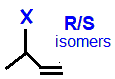 CH3CHXCH=CH2
a substituted linear alkene, a secondary haloalkane
CH3CHXCH=CH2
a substituted linear alkene, a secondary haloalkane
Skeletal formula and abbreviated structural formula for:
4-fluorobut-1-ene, 4-chlorobut-1-ene,
4-bromobut-1-ene, 4-iodobut-1-ene
These are functional group, chain,
positional and R/S isomers.
Functional groups: alkene (>C=C<)
and halogen (C-X).
The R/S (optical) isomers are
possible because C3 is chiral (asymmetric carbon
atom).
From the CIP assignment priority rule: ZX >
6C6C
> 6C > 1H (X = halogen, Z = 9, 17, 35 or 53)
Number of low resolution
NMR chemical shift
δ
signal peaks: 4 1H
and 4 13C
(email
if disagree?)
1H NMR ratio of peaks: 3 : 1 : 1 : 2 (for equivalent protons)
(5)
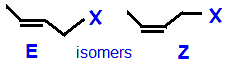 CH3CH=CHCH2X a
substituted linear alkene, a primary haloalkane
CH3CH=CHCH2X a
substituted linear alkene, a primary haloalkane
Skeletal formula and abbreviated structural formula for:
1-fluorobut-2-ene, 1-chlorobut-2-ene,
1-bromobut-2-ene, 1-iodobut-2-ene
These are functional group, chain,
positional and E/Z isomers.
Functional groups: alkene (>C=C<)
and halogen (C-X).
C2 and C3 form the stereocentre (restrict rotation) allowing the
possibility of E/Z (geometrical) isomers and
note that 6C has a higher priority than 1H.
From the CIP assignment priority rule: ZX >
6C
> 1H (X = halogen, Z = 9, 17, 35 or 53)
Number of low resolution
NMR chemical shift
δ
signal peaks: 4 1H
and 4 13C
(email
if disagree?)
1H NMR ratio of peaks: 3 : 1 : 1 : 2 (for equivalent protons)
(6)
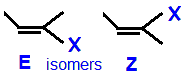 CH3CH=CXCH3
a substituted linear alkene
CH3CH=CXCH3
a substituted linear alkene
Skeletal formula and abbreviated structural formula for:
2-fluorobut-2-ene, 2-chlorobut-2-ene,
2-bromobut-2-ene, 2-iodobut-2-ene
These are functional group, chain,
positional and E/Z isomers.
Functional groups: alkene (>C=C<)
and halogen (C-X).
C2 and C3 form the stereocentre (restrict rotation) allowing the
possibility of E/Z (geometrical) isomers and
note that 6C, 9F, 17Cl,
35Br
and 53I all have a higher priority than 1H. AND 9F,
17Cl, 35Br
and 53I all have a higher priority than 6C.
From the CIP assignment priority rule: ZX >
6C
> 1H (X = halogen, Z = 9, 17, 35 or 53)
Number of low resolution
NMR chemical shift
δ
signal peaks: 3 1H
and 4 13C
(email
if disagree?)
1H NMR ratio of peaks: 3 : 1 : 3 (for equivalent protons)
(7)
 (CH3)2C=CHX
a substituted branched alkene
(CH3)2C=CHX
a substituted branched alkene
Skeletal formula and abbreviated structural formula for:
1-fluoro-2-methylpropene,
1-chloro-2-methylpropene, 1-bromo-2-methylpropene,
1-iodo-2-methylpropene
These are functional group, chain and
positional.
Functional groups: alkene (>C=C<)
and halogen (C-X).
Number of low resolution
NMR chemical shift
δ
signal peaks: 2 1H
and 3 13C
(email
if disagree?)
1H NMR ratio of peaks: 6 : 1 (for equivalent protons)
(8)
 XH2C(CH3)=CH2
a substituted branched alkene, a primary haloalkane
XH2C(CH3)=CH2
a substituted branched alkene, a primary haloalkane
Skeletal formula and abbreviated structural formula for:
3-fluoro-2-methylpropene,
3-chloro-2-methylpropene, 3-bromo-2-methylpropene,
3-iodo-2-methylpropene
These are functional group, chain and
positional.
Functional groups: alkene (>C=C<)
and halogen (C-X).
Number of low resolution
NMR chemical shift
δ
signal peaks: 3 1H
and 4 13C
(email
if disagree?)
1H NMR ratio of peaks: 3 : 2 : 2 (for equivalent protons)
(1) to (8) where open chain aliphatic compounds based halogen substituted
unsaturated propene and butene, but (9) to (12) are alicyclic compounds
based on halogen substituted saturated cyclobutane and cyclopropane.
(9)
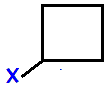 a substituted cycloalkane, an alicyclic secondary haloalkane
Skeletal formula for:
fluorocyclobutane, chlorocyclobutane,
bromocyclobutane, iodocyclobutane
These are functional group and chain
isomers.
Functional group: halogen (C-X).
Number of low resolution
NMR chemical shift
δ
signal peaks: 3 1H
and 3 13C
(email
if disagree?)
1H NMR ratio of peaks: 1 : 4
(2+2) : 2 (for equivalent protons)
(10)
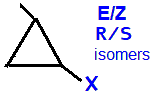 a substituted cycloalkane, an alicyclic secondary haloalkane
Skeletal formula for:
1-fluoro-2-methylcyclopropane,
1-chloro-2-methylcyclopropane,
1-bromo-2-methylcyclopropane,
1-iodo-2-methylcyclopropane
These are functional group, chain and
positional isomers (plus stereoisomers - see below).
Functional group: halogen (C-X).
AND can exhibit both E/Z
(geometrical) and R/S (optical) isomerism via the
C1 and C2 ring carbon atoms which as two different chiral
centres. Theoretically there are a pair of E/Z isomers and a
pair of R/S isomers (enantiomers). This means there a
various permutations requiring a complicated university
level analysis (possibly 2 x 2 x 2 = 8 stereoisomers?).
From the CIP assignment priority rule: ZX >
6C
> 1H (X = halogen, Z = 9, 17, 35 or 53)
Number of low resolution
NMR chemical shift
δ
signal peaks: 4 1H
and 4 13C
(email
if disagree?)
1H NMR ratio of peaks: 2 : 1 : 3 : 1 (for equivalent protons)
(11)
 a substituted cycloalkane, an alicyclic tertiary haloalkane
Skeletal formula for:
1-fluoro-1-methylcyclopropane,
1-chloro-1-methylcyclopropane,
1-bromo-1-methylcyclopropane,
1-iodo-1-methylcyclopropane
These are functional group, chain and
positional isomers.
Functional group: halogen (C-X).
Number of low resolution
NMR chemical shift
δ
signal peaks: 2 1H
and 3 13C
(email
if disagree?)
1H NMR ratio of peaks: 4
(2+2) : 3 (for equivalent protons)
(12)
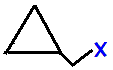 a substituted cycloalkane, an alicyclic primary haloalkane
Skeletal formula for:
(fluoromethyl)cyclopropane, (chloromethyl)cyclopropane,
(bromomethyl)cyclopropane, (iodomethyl)cyclopropane
These are functional group, chain and
positional isomers.
Functional group: halogen (C-X).
Number of low resolution
NMR chemical shift
δ
signal peaks: 3 1H
and 3 13C
(email
if disagree?)
1H NMR ratio of peaks: 4
(2+2) : 1 : 2 (for equivalent protons)
Note
how spectra can be used to distinguish which halogen
compound and which isomer
Summary of isomerism in C4H7X and extra comments on their
physical and chemical properties and uses
Isomerism in
C4H7X
Halides: Types, Properties, Reactivity, Uses, Misconceptions & Exam Tips
1.
Types of Isomerism
for the isomers of C4H7F, C4H7Cl, C4H7Br
or C4H7I
1.1
Structural (Constitutional) Isomerism
for the isomers of C4H7F, C4H7Cl, C4H7Br
or C4H7I
-
Chain Isomerism
Different carbon skeletons:
• Straight-chain (butenes)
• Branched (methylpropenes)
• Ring systems (cyclobutane, methylcyclopropane)
-
Positional Isomerism
Same skeleton but the C=C bond or halogen sits at different carbons.
-
Ring versus Unsaturation
A single DBE can be satisfied by either a C=C or a ring.
1.2
Stereoisomerism for
the isomers of C4H7F, C4H7Cl, C4H7Br
or C4H7I
-
Geometric (E/Z or cis/trans)
Across the C=C in alkenyl halides.
-
Optical (Enantiomers)
Occurs when a carbon bears four different substituents (e.g.,
3-halo-1-butene, some methylcyclopropane halides).
2.
Enumeration of Isomers
of C4H7F, C4H7Cl, C4H7Br
or C4H7I
All four halogens share the same framework.
Each family (C₄H₇Cl, C₄H₇Br, C₄H₇I, C₄H₇F) exhibits:
-
12 constitutional isomers
-
6 stereoisomers (2 enantiomer pairs + 4
geometric pairs)
-
Total: 18 distinct isomers (simplified view)
|
Skeleton for C4H7X |
Example Name |
Isomer Type |
Stereochemistry |
|
But-1-ene |
1-X-but-1-ene |
Positional alkene |
none |
|
|
2-X-but-1-ene |
Positional alkene |
none |
|
|
3-X-but-1-ene |
Positional alkene |
2 enantiomers
(optical) |
|
But-2-ene |
1-X-but-2-ene |
Positional alkene |
cis/trans (2) |
|
|
2-X-but-2-ene |
Positional alkene |
cis/trans (2) |
|
Cyclobutane |
1-X-cyclobutane |
Ring isomer |
none |
|
Methylcyclopropane |
1-X-1-methylcyclopropane |
Ring & chain |
none |
|
|
1-X-2-methylcyclopropane |
Ring & chain |
2 enantiomers
(optical) also acts as E/Z isomer chiral centre |
3.
Physical Properties
of
the isomers of C4H7F, C4H7Cl, C4H7Br
or C4H7I
-
Boiling Points (BP)
-
More branching → lower BP (less surface contact)
-
Ring systems → higher BP versus analogous chain
-
trans-alkenes pack better → higher melting points, lower
dipoles
-
Halogen effect: BP (I > Br > Cl > F) (mass +
polarizability)
-
Polarity & Solubility
• C–F bond: high dipole, low polarizability → moderate BP
• C–I bond: low dipole, high polarizability → highest BP
-
Density
Parallels molar mass: I-derivatives densest, F-derivatives lightest.
4.
Chemical Reactivity of
the isomers of C4H7F, C4H7Cl, C4H7Br
or C4H7I
-
Leaving-Group Ability (SN1/SN2):
I⁻ > Br⁻ > Cl⁻ >> F⁻. Vinyl/aryl C–X hardly undergo SN1; aryl-F is almost
inert.
-
Elimination versus Substitution:
• 2° & 3° halides: favour E2/E1
• Allylic halides: undergo SN1/SN2 and radical pathways
-
Ring Strain Effects:
Cyclopropyl/chlorobutanes ring-open faster under nucleophilic attack.
5.
Uses and Applications
of
the isomers of C4H7F, C4H7Cl, C4H7Br
or C4H7I
-
Vinyl Halides (e.g., 1-chloro-1-butene)
Polymer precursors; cross-coupling in pharma synthesis.
-
Allyl Halides (e.g., allyl chloride,
bromide, iodide)
Industrial intermediates (epichlorohydrin), allylation reagents.
-
Cycloalkyl Halides
Ring-opening to functionalize chains for agrochemicals and fragrances.
-
Fluoro-alkenes
Building blocks in medicinal chemistry (metabolic stability).
|
Compound |
Example Isomer |
Applications &
Uses |
|
C4H7Cl |
Chloroprene |
Used to make
neoprene rubber (wetsuits, adhesives) |
|
C4H7F |
Fluorobutene
isomers |
Potential in
fluorinated polymers,
pharmaceuticals |
|
C4H7I |
Iodobutene isomers |
Useful in
radio-labelling,
organic synthesis |
6.
Common Student Misconceptions about
the isomers of C4H7F, C4H7Cl, C4H7Br
or C4H7I
(see also below)
-
Treating different halogens as functional isomers
instead of homologues.
-
Forgetting to count ring alternatives when
DBE = 1.
-
Mixing up E/Z versus cis/trans
terminology.
-
Believing F is the best leaving group (it
isn't, it is I).
-
Overlooking optical isomerism in 'simple' halogenated alkenes.
7.
Exam Revision Tips for
questions involving
the isomers of C4H7F, C4H7Cl, C4H7Br
or C4H7I
(see also above)
-
Enumerate isomers in layers: skeleton → positional →
stereochemistry.
-
Drill CIP rules on examples like
3-X-but-1-ene and methylcyclopropane halides.
-
Build a comparison table for BP, density,
dipole across isomers & halogens.
-
Memorize the leaving-group trend and tie to
SN1/SN2/E2 preferences.
-
Time yourself naming/drawing all 12 constitutional isomers in under
3 minutes.
Learning objectives - questions to be answered?
Be able to deduce the isomers of
organic halogen molecules with the formula C4H7Cl, C4H7Br, C4H7I
and C4H7F.
Be able to draw and name the
substituted halogen compounds
isomers of molecular formula C4H7Cl C4H7Br C4H7I C4H7F.
Be able to deduce if the isomers of
C4H7Cl C4H7Br C4H7I C4H7F organic halogen compounds can exhibit R/S optical isomerism.
Be able to deduce if the isomers of
C4H7Cl C4H7Br C4H7I C4H7F can exhibit E/Z geometrical isomerism (do C4H7Cl C4H7Br C4H7I C4H7F have cis/trans geometric
isomers).
How do you draw the structural formula
and skeletal formula of the isomers of molecular formula C4H7Cl C4H7Br C4H7I C4H7F?
How many aliphatic structural isomers
are there of halogen compounds with molecular formula C4H7Cl C4H7Br C4H7I C4H7F?
How many aliphatic carbon chain isomers
are there of halogen compounds with molecular formula C4H7Cl C4H7Br C4H7I C4H7F?
How many positional isomers are there
of organic halogen molecules with molecular formula C4H7Cl C4H7Br C4H7I C4H7F?
How many E/Z (geometrical) isomers are
there of molecular formula C4H7Cl C4H7Br C4H7I C4H7F?
How many R/S (optical) isomers
(enantiomers) of molecular formula C4H7Cl C4H7Br C4H7I C4H7F?
Are there any cyclic haloalkene isomers
of formula C4H7Cl C4H7Br C4H7I C4H7F?
Are there any cyclo haloalkane isomers
of formula C4H7Cl C4H7Br C4H7I C4H7F?
Are there any halodiene isomers of
molecular formula C4H7Cl C4H7Br C4H7I C4H7F?
Are there any haloalkyne isomers of
molecular formula C4H7Cl C4H7Br C4H7I C4H7F?
Are there any functional group isomers
with a molecular formula C4H7Cl C4H7Br C4H7I C4H7F?
Do C4H7Cl C4H7Br C4H7I C4H7F organic halogen
molecules have any stereoisomers?
Are there any E/Z (geometrical) isomers
with a molecular formula C4H7Cl C4H7Br C4H7I C4H7F?
Are there any R/S (optical) isomers
(enantiomers) with a molecular formula C4H7Cl C4H7Br C4H7I C4H7F?
Be able to deduce the isomers of
organic halogen molecules with the formula C4H7Cl C4H7Br C4H7I C4H7F.
Be able to draw and name the
substituted halogen compounds
isomers of molecular formula C4H7Cl C4H7Br C4H7I C4H7F.
Be able to deduce if the isomers of
C4H7Cl C4H7Br C4H7I C4H7F organic halogen compounds can exhibit R/S optical isomerism.
Be able to deduce if the isomers of
C4H7Cl C4H7Br C4H7I C4H7F can exhibit E/Z geometrical isomerism (do C4H7Cl C4H7Br C4H7I C4H7F have cis/trans geometric
isomers).
This page
will answer these questions for molecular formula
C4H7Cl C4H7Br C4H7I C4H7F

Associated organic chemistry links
Index of sets of isomers for a given
molecular formula
Isomerism: introduction, structural isomerism - chain,
positional, functional group, tautomerism
Stereoisomerism:
introduction, definition,
priority rules, E/Z isomerism (cis/trans isomerism)
Stereoisomerism - R/S isomerism (optical
isomerism) -
definition - examples explained
Index of all IR, mass, 1H NMR
and 13C NMR spectroscopy
pages
This is a big chemistry website, please allow time
to explore
Index of advanced
(pre-university) organic
chemistry revision notes
The chemistry of
alkanes and the petrochemical
industry
The
chemistry of alkenes
The
chemistry of organic halogen compounds
The
chemistry of
alcohols
The chemistry of aldehydes
and ketones
The
chemistry of carboxylic acids and derivatives
The chemistry of organo-nitrogen compounds
The chemistry of
aromatic compounds
Keywords or phrases: how many
isomers are there of molecular formula C4H7Cl C4H7Br C4H7I C4H7F? how to draw the
skeletal formula of C4H7Cl C4H7Br C4H7I C4H7F isomers, how do you name the isomers of
molecular formula C4H7Cl C4H7Br C4H7I C4H7F? what is the molecular structure of the
isomers of C4H7Cl C4H7Br C4H7I C4H7F, what type of isomerism is exhibited by molecules
of formula C4H7Cl C4H7Br C4H7I C4H7F, how do you work out the isomers of molecular
formula C4H7Cl C4H7Br C4H7I C4H7F, what are the structural isomers of C4H7Cl C4H7Br C4H7I C4H7F, the carbon
chain isomers of C4H7Cl C4H7Br C4H7I C4H7F in the homologous series how many structural isomers of
C4H7Cl C4H7Br C4H7I C4H7F can you draw? how many structural isomers does C4H7Cl C4H7Br C4H7I C4H7F have?
what are the possible isomers of C4H7Cl C4H7Br C4H7I C4H7F? revision notes on
isomerism of C4H7Cl C4H7Br C4H7I C4H7F molecules, isomerism in
compounds of C4H7Cl C4H7Br C4H7I C4H7F how to draw the
structural formula of isomers of C4H7Cl C4H7Br C4H7I C4H7F, how to draw the skeletal formula of
isomers of C4H7Cl C4H7Br C4H7I C4H7F, how to name the isomers of molecular formula C4H7Cl C4H7Br C4H7I C4H7F,
are there any R/S optical isomers
enantiomers of C4H7Cl C4H7Br C4H7I C4H7F are there any E/Z isomers
cis trans stereoisomers of C4H7Cl C4H7Br C4H7I C4H7F
How do you work out the structure
of the isomers of molecular formula C4H7Cl C4H7Br C4H7I C4H7F? How do you draw the
structural formula and skeletal formula of the isomers of
molecular formula C4H7Cl C4H7Br C4H7I C4H7F? How do you name the isomers of molecular
formula C4H7Cl C4H7Br C4H7I C4H7F? How many positional isomers are there of molecular
formula C4H7Cl C4H7Br C4H7I C4H7F? Are there any functional group isomers with a
molecular formula C4H7Cl C4H7Br C4H7I C4H7F?
Does C4H7Cl C4H7Br C4H7I C4H7F have any stereoisomers?
Website content © Dr
Phil Brown 2000+. All copyrights reserved on revision notes, images,
quizzes, worksheets etc. Copying of website material is NOT
permitted. These organic chemistry revision notes are suitable
for use of pre-university students studying AQA advanced level chemistry,
Edexcel advanced level chemistry, OCR advanced level chemistry, IB advanced
level chemistry, WJEC (Eduqas) advanced level chemistry, CIE advanced level
chemistry, they will also prove useful to 1st year undergraduate students of
chemistry
|
