|
Doc Brown's
Advanced Chemistry: Part 14.7
Isomers and extra notes on their properties and uses
The constitutional
structural isomers of molecular formula C3H4
[Author
©
Dr
Phil Brown GRIC, PhD:
Doc Brown's advanced level organic chemistry exam revision notes
suitable for students of UK A level chemistry courses,
IB chemistry & US K12 grade
11, grade 12 and AP honors chemistry courses: Molecular
spectroscopy and analysing the isomers of C3H4
[isomerism page updated RE-EDIT]
Associated organic chemistry page links
Index of sets of isomers for a given
molecular formula
email doc
brown - comments - query?
* [policies,
cookies, disclaimer]
Index of sets of isomers for a given
molecular formula
The 3
constitutional
structural isomers of molecular formula C3H4
(Mr = 40)
Percent composition by mass of
C3H4 based on atomic masses C= 12.01 H =
1.01, Mr(C3H4) = 40.07
Element composition (to two dp): carbon = 89.92%
hydrogen = 10.08%
Empirical formula = molecular formula = C3H4
Introduction to isomerism for molecular formula
C3H4
(see also summary
diagram)

Structural isomerism
- isomers based on different connectivity's of the constituent atoms, so cannot
be spatially identical (but can be defined as having the same shape).
This includes (a) carbon chain variation (usually need a minimum of 4 C atoms),
(b) change in position of a substituent or functional group and (c) functional group
isomerism where the atoms have a different connectivity configuration, usually with
significant differences in chemical and physical properties.
In terms of isomers of
C3H4
the e carbon atoms can be a linear chain
(aliphatic) or cyclic (alicyclic)
(a) carbon atom chain can be linear or cyclic.
(c) There is functional group isomerism - an open chain alkyne
and diene and
a cycloalkene.
Stereoisomerism - isomers
based on the same connectivity of the atoms, but 2D or 3D spatially different,
non-superimposable images (e.g. E/Z isomers or mirror image R/S optical isomers)
This is
where molecules have the same basic constitutional structural formula, but
isomers differ in the 2D/3D arrangement of the atoms.
Neither possible for
C3H4
E/Z
stereoisomerism was called 'geometrical isomerism' e.g. cis
and trans isomers of alkenes or disubstituted cyclic alkanes
where there are 2D/3D spatial variations that are not mirror images and not
super imposable.
R/S
stereoisomerism was called 'optical isomerism', the pairs of
isomers are called enantiomers which are 3D non-superimposable
mirror image forms of the molecule. The molecule must have a chiral centre
(a stereocentre), that is an asymmetric carbon atom with four
different atoms/groups attached to it.
Note
All the isomers of
molecular formula C3H4 are open chain
aliphatic compounds (e.g. here an unsaturated alkene (diene) or
alkyne) or cyclic aliphatic compounds (e.g. here an
unsaturated cycloalkene), the latter sometimes referred
to as an alicyclic compound.
Since one is an alkyne and the other two alkenes, this is a
case of functional group isomerism.
There are
only 3 structural-constitutional isomers
of molecular formula C3H4.
All are unsaturated
hydrocarbons with at least one C=C
double bond or a triple bond C≡C,
but can't exhibit E/Z (geometric) isomerism (no cis/trans isomers), and non can exhibit R/S (optical)
isomerism (no enantiomers).
Details for the 3 constitutional
isomers of molecular formula C3H4
All three are
functional group isomers (alkyne versus diene versus cycloalkene)
(1) Propyne,
 ,
,
 , ,
 , once called methylacetylene
Molecular formula, abbreviated structural formula and
skeletal of this member of the alkyne homologous series of hydrocarbon molecules.
It is a linear molecule, C-C≡C
bond angle 180o.
Propyne is unsaturated
with a triple
C≡C
carbon-carbon bond, it can be named as 1-propyne or prop-1-yne,
but the 1 isn't really necessary, even though it is the 2nd
in the series of linear alkynes.
Propyne is the 2nd member of the homologous
series of alkyne unsaturated hydrocarbons.
No
E/Z or R/S isomerism possible for this isomer of C3H4.
Number of low resolution
NMR
chemical shift
δ
signal peaks: 2
1H and
3 13C
(email
if disagree?)
1H NMR ratio of peaks: 1 : 3
(for equivalent protons)
Chemistry comment:
You would expect the isomer propyne to be very reactive with a carbon-carbon
C≡C
triple bond and readily undergoes addition reactions. It forms the basis of
many intermediates in synthetic organic chemistry.
Index of
1H NMR spectra organic
compounds and
Index of
13C NMR spectra organic
compounds
Comparison of prominent wavenumber absorptions in the infrared spectra of
isomers of C3H4
(2) Propa-1,2-diene (allene),
 , ,
 , ,
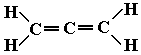 , ,

Molecular formula, abbreviated structural formula, displayed
formula, skeletal formula
Also known as
propadiene or 1,2-propadiene, a 'double alkene'
molecule and an example of an 'allene' molecule,
in fact it is sometimes called 'allene'.
It is referred to as an unsaturated diene
molecules because it contains two C=C carbon-carbon double
bonds and is the simplest/shortest possible diene molecule
i.e. an alkene with two C=C double bonds.
No
E/Z or R/S isomerism possible for this isomer of C3H4.
Number of low resolution
NMR
chemical shift
δ
signal peaks: 1
1H and
2 13C
(email
if disagree?)
Chemistry comment: The isomer propa-1,2-diene is
a very reactive molecule with two adjacent C=C double bonds.
(3) Cyclopropene,
,
 , ,
 , ,

Molecular formula, abbreviated structural formula, full
displayed formula and skeletal formula of cyclopropene
Cyclopropene is an unsaturated cycloalkene
molecule with a single C=C bond in the ring.
It is an alicyclic aliphatic alkene
with quite a strained molecule in terms of bond
angles of the planar triangle.
No
E/Z or R/S isomerism possible for this isomer of C3H4.
Number of low resolution
NMR
chemical shift
δ
signal peaks: 2
1H and
2 13C
(email
if disagree?)
1H NMR ratio of peaks: 2 : 2
(1+1) (for equivalent protons)
Chemistry comment: The isomer cyclopropene is a very
unstable and a very reactive molecule because of the alkene
C=C bond AND the very strained C-C=C bond angle of 90o,
which is far from the usual bond angles of 120o
or 109o in open chain alkenes and readily breaks
facilitating ring opening reactions
Note
These three molecules are good examples of functional group
isomerism, (1) alkyne and (2 diene)-(3 cycloalkene) are alkenes, each group having a
significantly different chemistry for a particular homologous series, though
some similarity too via the reactivity of the unsaturated double/triple bonds in
terms of e.g. addition reactions..
There only three
constitutional isomers of molecular formulaC3H4
None of the three isomers of molecular formula C3H4
can display E/Z
or R/S isomerism.
Summary of key points and extra exam revision notes on the isomers of molecular
formulae C3H4
and their properties and uses
A rich little molecule with a deceptively simple formula and
looking at the isomerism of C3H4 in a
way that’s structured, exam-focused, and misconception-proof.
Overview: Molecular Formula for the isomers of C3H4
Types
of Isomerism Exhibited
by the isomers of C3H4
|
Isomerism Type |
Explanation |
Applies to C3H4? |
Example |
|
Structural
(Constitutional) |
Different connectivity of
atoms |
Yes |
Propyne versus Propadiene |
|
→ Functional group |
Different functional
groups (alkyne versus diene versus cycloalkene) |
Yes |
Propyne versus
Cyclopropene |
|
→ Chain |
Variation in carbon
skeleton (linear versus cyclic) |
Yes |
Propadiene versus
Cyclopropene |
|
Stereoisomerism |
Same connectivity,
different spatial arrangement |
No |
Not applicable to C3H4 |
|
→ Geometric (E/Z) |
Requires C=C with two
different groups on each carbon |
No |
Not possible with C3H4 |
|
→ Optical (R/S) |
Requires chiral center (4
different groups on a carbon) |
No |
No chiral centres present |
Physical Property Differences between
the
isomers of C3H4
|
Isomer |
Boiling Point |
Polarity |
Volatility |
|
Propyne |
–23°C |
Slightly polar |
High - gas at RTP |
|
Propadiene |
–34°C |
Non-polar |
Very high -gas |
|
Cyclopropene |
–36°C |
Non-polar |
Extremely volatile |
-
Trend: More compact or symmetrical
structures (like cyclopropene) tend to be more volatile.
-
Hydrogen bonding: None of these
isomers can hydrogen bond, so dispersion forces dominate.
Chemical Property Differences between
the
isomers of C3H4
|
Isomer |
Reactivity |
Typical Reactions |
|
Propyne |
Electrophilic
addition to triple bond |
Electrophilic
addition, metal acetylides/ethynides (≡C-H
proton is slightly acidic),
|
|
Propadiene |
Reactive due to
cumulated double bonds |
Polymerization,
Diels–Alder (less common) |
|
Cyclopropene |
Highly strained
C-C=C ring
bonds, reactive ring |
Very reactive via
ring-opening, electrophilic addition |
Uses
and Applications of
for the isomers of C3H4
|
Isomer |
Uses |
|
Propyne |
Fuel gas
(component of MAPP gas), synthetic intermediate |
|
Propadiene |
Minor industrial
use, intermediate in polymer chemistry |
|
Cyclopropene |
Research chemical,
precursor in organic synthesis, fruit ripening control
(derivatives) |
For more on uses
Common
Misconceptions
about the isomers of C3H4
(see also below)
-
“C3H4 has geometric isomers”
→ False. No E/Z isomerism due to lack of suitable C=C with different
substituents.
-
“Cyclopropene is stable” → False. It’s
highly strained and reactive.
-
“All isomers have similar reactivity” →
False. Functional group differences lead to distinct reaction profiles.
Exam
Revision Tips for questions involving
for the
isomers of C3H4
(see also above)
-
Use degree of unsaturation to predict
possible structures.
-
Draw all isomers and label functional
groups clearly.
-
Compare boiling points and reactivity in
terms of structure.
-
Avoid assuming stereoisomerism unless
criteria are met (C=C with different groups or chiral centres).
-
Practice naming: IUPAC names like
prop-1-yne, prop-1,2-diene, cyclopropene.
More
on the uses of the isomers of C3H4
Uses
of Propyne (CH3–C≡CH)
|
Sector |
Use |
|
Metalworking |
Fuel gas in
MAPP gas (methylacetylene-propadiene propane)
for welding and cutting due to its high flame temperature |
|
Chemical
synthesis |
Intermediate in
making acrylic acid, used in coatings and
adhesives |
|
Pharmaceuticals |
Potential
precursor in drug development due to its reactive triple bond |
|
Plastics |
Feedstock for
specialty polymers and resins |
Uses
of Propadiene (CH2=C=CH2)
|
Sector |
Use |
|
Welding |
Component of
MAPP gas, used for specialized welding
applications |
|
Polymer
industry |
Intermediate in
polymer production, especially for high-performance materials |
|
Chemical
synthesis |
Used in making
specialty chemicals,
agrochemicals,
and pharmaceutical
intermediates |
|
Research |
Studied for its
unique cumulated diene structure and reactivity |
Uses of Cyclopropene
(triangle ring with one double bond)
|
Sector |
Use |
|
Agriculture |
Derivatives like
1-methylcyclopropene (1-MCP) used to
delay fruit ripening and extend shelf life |
|
Organic
synthesis |
Highly strained
ring makes it a valuable intermediate in making
pharmaceuticals, polymers, and agrochemicals |
|
Catalysis |
Used in
organocatalysis and ring-opening reactions
for constructing complex molecules |
|
Materials
science |
Research into
novel polymers and advanced materials due to its reactivity |
Summary Tips for Revision for uses of the isomers of C3H4
-
Propyne: Think triple bond → high
flame → welding gas.
-
Propadiene: Cumulated double bonds
→ reactive intermediate → polymers.
-
Cyclopropene: Strained ring →
unstable but useful → fruit ripening & synthesis.
Comparison of
infrared spectra of the isomers of molecular
formula C3H4
A comparative breakdown of the key IR absorption bands
for the three isomers of C3H4, focusing on
their functional groups and characteristic vibrations:
IR
Wavenumber Comparison Table
for the isomers of molecular formula C3H4
|
Isomer |
Key Functional Groups |
Characteristic IR Bands (cm⁻¹) |
Notes |
|
Propyne |
Terminal alkyne (≡C–H, C≡C) |
3300
(≡C–H stretch), 2100–2250 (C≡C stretch, weak) |
Sharp ≡C–H stretch; C≡C often weak due to low dipole moment |
|
Propadiene |
Cumulated diene (C=C=C) |
~1957 (central C=C stretch), 3020–3080 (=C–H stretch) |
Unique central C=C stretch; =C–H stretch indicates sp²
hybridization |
|
Cyclopropene |
Strained ring with C=C |
~1691 (C=C stretch), 2900–3140 (C–H stretches), 778–1056 (ring
modes) |
Ring
strain shifts C=C stretch slightly; multiple ring deformation
bands |
Revision
Tips for involving the infrared spectra of the isomers of C3H4
- Propyne: Look for the terminal alkyne
≡C–H stretch near 3300 cm⁻¹ - it’s sharp and
diagnostic.
- Propadiene: The cumulated double bond
gives a unique stretch near 1957 cm⁻¹, not typical
of regular alkenes.
- Cyclopropene: The C=C stretch
is lower than in linear alkenes due to ring strain; expect
multiple fingerprint region bands from ring deformation.
Learning objectives - questions to be answered?
Can you IUPAC name these isomers
of molecular formula C3H4
Can you deduce the number of principal 1H chemical
shifts and proton ratio you would expect to see in the NMR spectrum of
these
C3H4
isomers?
Can you deduce the number of principal 13C chemical
shifts you would expect to see in the NMR spectrum of these
C3H4
isomers?
Be able to describe and
write out the isomers of
C3H4
What are the possible
isomers of C3H4?
How do you work out the isomers of
molecular formula C3H4?
How do you draw the structural formula
and skeletal formula of the isomers of molecular formula C3H4?
How many aliphatic structural isomers
are there of molecular formula C3H4?
How many aliphatic carbon chain isomers
are there of molecular formula C3H4?
How many positional isomers are there
of molecular formula C3H4?
How many E/Z (geometrical) isomers are
there of molecular formula C3H4?
How many R/S (optical) isomers
(enantiomers) of molecular formula C3H4?
Are there any aliphatic open chain
alkene isomers of molecular formula C3H4?
Are there any alkene isomers of
molecular formula C3H4?
Are there any diene isomers of
molecular formula C3H4?
Are there any alkyne isomers of
molecular formula C3H4?
Are there any alicyclic cycloalkane
isomers of molecular formula C3H4?
Are there any functional group isomers
with a molecular formula C3H4?
Are there any E/Z (geometrical) isomers
with a molecular formula C3H4?
Are there any R/S (optical) isomers
(enantiomers) with a molecular formula C3H4?
Does C3H4 have any stereoisomers?
This page
will answer these questions for molecular formula C3H4 isomers
Associated organic chemistry links
Advanced Level pre-university
organic chemistry notes
IR, mass and H-1 and C-13 NMR
spectra of organic compounds
INDEX of nuclear magnetic resonance
spectroscopy: 1H NMR spectra of organic
compounds
INDEX of nuclear magnetic resonance
spectroscopy: 13C NMR spectra of organic
compounds
Index of sets of isomers for a given
molecular formula
The molecular structure and naming
of ALKENES
(how to name and draw alkene structures)
INDEX of
ALL revision notes on the chemistry ALKENES
including reactions and polymers
The molecular structure and
naming of ALKANES (how
to name and draw alkane structures)
Index of revision notes
on the chemistry of ALKANES and the petrochemical
industry
For isomerism in organic chemistry, see also the
notes
Isomerism: introduction, structural isomerism - chain,
positional, functional group, tautomerism
Stereoisomerism:
introduction, definition,
priority rules, E/Z isomerism (cis/trans isomerism)
Stereoisomerism - R/S isomerism (optical
isomerism) -
definition - examples explained
This is a big chemistry website, please allow time
to explore it
Index of my advanced
(pre-college/university) organic
chemistry revision notes
Index
of all my spectroscopy pages
Index
of all my isomerism pages
The chemistry of
alkanes and the petrochemical
industry
The
chemistry of alkenes
The
chemistry of haloalkanes
The
chemistry of
alcohols
The chemistry of
aldehydes
and ketones The
chemistry of carboxylic acids and derivatives The chemistry of
organo-nitrogen compounds
The chemistry of
aromatic compounds
Summary diagram of isomerism which
links to details of the types of isomerism

| Website content © Dr
Phil Brown 2000+. All copyrights reserved on revision notes, images,
quizzes, worksheets etc. Copying of website material is NOT
permitted. Exam revision summaries & references to science course specifications
are unofficial. |
Keywords or phrases: how many isomers are
there of molecular formula C3H4? how do you name the isomers of
molecular formula C3H4? what is the molecular structure of the
isomers of C3H4, what type of isomerism is exhibited by molecules
of formula C3H4, how do you work out the isomers of cycloalkenes
and alkynes of molecular
formula C3H4, what are the structural isomers of C3H4, the carbon chain
isomers of C3H4 in the homologous series of alkanes, comparing
the spectra of isomers of molecular formula C3H4 how many structural isomers of
C3H4 can you draw? how many structural isomers does C3H4 have?
what are the possible isomers of C3H4? revision notes on
isomerism of C3H4 molecules, isomerism in
alkane, alkene and alkane
isomers of C3H4, ester isomers of C3H4, the molecular structure of
the isomers of C3H4 how to draw the
structural formula of isomers of C3H4, how to draw the displayed
formula of isomers of C3H4, how to draw the skeletal formula of
isomers of C3H4 cycloalkenes and alkynes, how to name the isomers of molecular formula C3H4,
isomers of C3H4 of molecular mass ? R/S optical isomers
enantiomers of C3H4 cycloalkenes and alkynes E/Z isomers
cis trans stereoisomers of C3H4
E/Z isomers of molecular formula C3H4 (geometric cis/trans
isomers) alkene molecules isomeric of molecular formula C3H4,
molecules isomeric with molecular formula C3H4, structural isomers of molecular
formula C3H4, optical isomers R/S enantiomers isomeric with molecular
formula C3H4, positional isomers isomeric with cycloalkenes and
alkynes of molecular formula C3H4,
which types of isomerism are exhibited by molecules isomeric with
molecular formula C3H4 alkyl positional isomers of C3H4 branched
carbon chain alkene isomers of C3H4 cycloalkanes of molecular formula
C3H4 which are isomeric with alkenes of molecular formula C3H4
stereoisomers of molecular formula C3H4
cycloalkene molecules isomeric of molecular formula C3H4,
cycloalkenes and alkynes molecules isomeric with molecular formula C3H4, structural isomers of molecular
formula C3H4, optical isomers R/S enantiomers isomeric with molecular
formula C3H4, positional isomers isomeric with molecular formula C3H4,
which types of isomerism are exhibited by molecules isomeric with
molecular formula C3H4 alkyl positional isomers of C3H4 cycloalkenes
and alkynes branched
carbon chain cycloalkene isomers of molecular formula C3H4
|
