|
Doc Brown's
Advanced Chemistry: Part 14.7:
Isomers and extra notes on their properties and uses
Selected
constitutional structural isomers
and
stereoisomers of molecular formula C4H3X (X
= halogen)
[Author
©
Dr WP Brown PhD:
Doc Brown's advanced level organic chemistry exam revision notes
suitable for students of UK A level chemistry courses, IB advanced
chemistry & US K12 grade
11, grade 12 and AP honors chemistry courses: Molecular
spectroscopy and analysing the isomers of C4H3X
[updated
Feb 18th
2026 *]
Index of sets of isomers for a given
molecular formula
email doc
brown - comments - query?
*
[privacy policy, cookies
and disclaimer]
Associated organic chemistry page links
This is a big chemistry website, please allow time
to explore
9 Selected
constitutional-structural isomers of molecular formula
C4H3X
(X = halogen)
Relative molecular mass and
percent composition of
C4H3X
(X = halogen)
based on atomic masses:
C 12.01,
H 1.01, F 19.00, Cl 35.45,
Br 79.90, I 126.90
|
Formula of
compound |
Relative molecular mass |
% carbon |
% hydrogen |
% halogen |
|
C4H3F |
70.07 |
68.56 |
4.32 |
27.12 |
|
C4H3Cl |
86.52 |
55.53 |
3.50 |
40.97 |
|
C4H3Br |
130.97 |
36.68 |
2.31 |
61.01 |
|
C4H3I |
177.97 |
26.99 |
1.70 |
71.31 |
Empirical formula
=
molecular formula
= C4H3X
(where X = a single halogen atom)
Introduction to 10 constitutional-structural isomers of
C4H3X
(X
= halogen) Pyramidal (9) is added after (8) below !!!
No. 9, a pyramidal shaped molecule, is added at the end, beautiful
molecular symmetry!
Structural isomerism
- isomers based on different connectivity's of the constituent atoms, so cannot
be spatially identical (but can be defined as having the same shape).
This
includes (a)
carbon chain variation (usually need a minimum of 4 atoms),
(b) change in position of a substituent or functional group and
(c) functional group
isomerism where the atoms have a different connectivity configuration, usually with
significant differences in chemical and physical properties.
(a) There open chain linear or branched unsaturated
aliphatic compounds and alicyclic cyclodiene compounds.
(b) There is positional isomerism with the halogen
substituent positions and also with the positions of the alkene functional groups.
(c) and functional group isomerism e.g. cyclodienes
versus ene-ynes and a
triene.
Stereoisomerism - isomers
based on the same connectivity of the atoms, but 2D or 3D spatially different,
non-superimposable images (e.g. E/Z isomers or mirror image R/S optical isomers)
This
is
where molecules have the same basic constitutional structural formula, but
isomers differ in the 2D/3D arrangement of the atoms.
E/Z
stereoisomerism was called 'geometrical isomerism' e.g. cis
and trans isomers of alkenes or disubstituted cyclic alkanes
where there are 2D/3D spatial variations that are not mirror images and not
super imposable.
Only one selected constitutional isomer exhibits E/Z geometrical isomerism No.
6
R/S
stereoisomerism was called 'optical isomerism', the pairs of
isomers are called enantiomers which are 3D non-superimposable
mirror image forms of the molecule. The molecule must have a chiral centre
(a stereocentre), that is an asymmetric carbon atom with four
different atoms/groups attached to it.
R/S optical isomerism not possible for these
selected isomers.
Note
There are quite a few isomers, but most are very
unstable or cannot exist at all.
They are unlikely to be encountered
pre-university, BUT, you should be able to interpret their
structure and recognise the functional groups present.
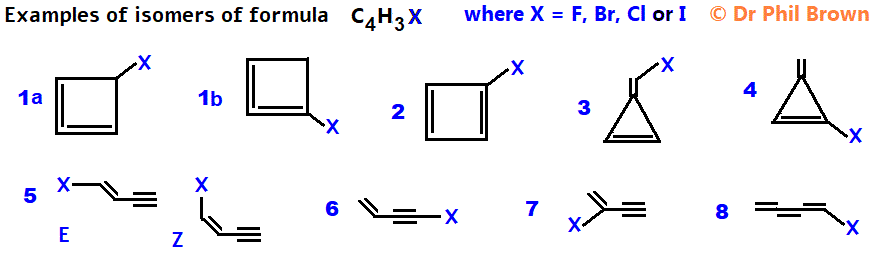
The above diagram illustrates a few of the
theoretical possibilities, of which (I think?) a few exist -
perhaps as unstable intermediates in the pyrolysis of
halogenated alkanes (brief glance at some research papers on the
internet isomers of C4H3Cl mentioned.
Isomers (1) to (4) have highly strained rings, because of the
reduced bond angles, making them highly reactive, very unstable and possibly do
NOT exist?
Isomers (5) to (8) are highly reactive due to 'extreme'
unsaturation and some may be too unstable to exist?
Many of these isomers
are too unstable to exist, so many structures-names are theoretical.
Types of isomerism in the theoretical isomers of
C4H3F,
C4H3Cl,
C4H3Br and
C4H3I
There are positional structural isomers e.g. position
of the halogen substituent in Nos. (1) to (5).
They are ALL functional group structural isomers base
on the cyclodiene, alkene and alkyne functional groups.
There are also examples of positional isomerism of the
halogen and alkene and alkyne functional groups..
Stereoisomerism
One example, No. (5), can form a pair of E/Z (geometrical)
isomers via the alkene >C=C< bond.
I can't see any R/S (optical) isomerism in these examples,
no asymmetric chiral carbon present in any of these molecules.
Details of selected 10 actual (or theoretical) constitutional isomers of
C4H3F,
C4H3Cl,
C4H3Br and
C4H3I
(1)
to (4) are unsaturated alicyclic compounds
(1a) is based on cyclobuta-1,2-diene e.g.
4-chlorocyclobuta-1,2-diene, 4-chloro-1,2-cyclobutadiene
Diene (C=C=C) and halogen
(X) functional groups.
Doubt if this exists due to a
theoretical extremely
strained ring system (C=C=C in a ring!).
4-fluorocyclobuta-1,2-diene, 4-bromocyclobuta-1,2-diene, 4-iodocyclobuta-1,2-diene
Theoretical number of low resolution
NMR
chemical shift
δ
signal peaks: 2
1H and
3 13C
1H NMR ratio of peaks: 2
(1+1) : 1
(for equivalent protons)
(email
if disagree?)
Note: Theoretically there is also
(1b) 1-halocyclobuta-1,2-diene (1-halo-1,2-cyclobutadiene)
molecules, all equally unlikely to exist, since
cyclobuta-1,2-diene can't exist anyway the ring bonds
are far to strained for the molecules to be isolated.
(2)
is based on cyclobuta-1,3-diene e.g. 1-chlorocyclobuta-1,3-diene,
1-chloro-1,3-cyclobutadiene
Maybe just simply called halocyclobutadienes.
Alkene (C=C) and halogen
(X) functional groups.
1-fluorocyclobuta-1,3-diene, 1-bromocyclobuta-1,3-diene,
1-iodocyclobuta-1,3-diene
Theoretical number of low resolution
NMR
chemical shift
δ
signal peaks: 3?
1H and
4? 13C
1H NMR ratio of peaks: 1 : 1 : 1
(for equivalent protons)
(email
if disagree?)
Non of these are likely to exist?
cyclobuta-1,3-diene is known to be a highly reactive, highly
unstable molecule that has a very short lifetime. -C=C-C=C- is less strained
than molecules 1a and 1b, but still unstable enough to barely exist, with or
without halogen atom substituents.
(3-4) are based on cyclopropene e.g. (4) could
be 1-chloro-3-methylenecyclopropene (does exist)
Both have alkene (C=C, one cyclo
and one open chain) and halogen (X) functional
groups.
(3) Theoretical number of low resolution
NMR
chemical shift
δ
signal peaks: 2
1H and
2 13C
1H NMR ratio of peaks: 2
(1+1) : 1
(for equivalent protons)
(email
if disagree?)
(4) Theoretical number of low resolution
NMR
chemical shift
δ
signal peaks: 2
1H and
3 13C
1H NMR ratio of peaks: 2
(1+1) : 1
(for equivalent protons)
(email
if disagree?)
(5-7) are based on 'dual'
alkene-alkyne functional group isomeric molecules
(5)
X-CH=CH-C≡C-H
e.g. 4-chlorobut-3-en-1-yne or
1-chlorobut-1-en-3-yne
4-fluorobut-3-en-1-yne or
1-fluorobut-1-en-3-yne, 4-bromobut-3-en-1-yne or
1-bromobut-1-en-3-yne, 4-iodobut-3-en-1-yne or
1-iodobut-1-en-3-yne
Halogen (X), alkene (C=C) and alkyne ( C≡C)
functional groups.
(5) can theoretically exhibit E/Z (geometrical) isomerism
via the C=C double bond alkene group.
6C, 9F, 17Cl, 35Br
and 53I are higher priority atoms than 6C > 1H
(about the >C=C< bond)
This is the only stereoisomers I can see with a formula C4H3X
(where X = halogen)
The halogens 9F, 17Cl, 35Br and
53I AND 6C have a higher priority than hydrogen 1H.
Theoretical number of low resolution
NMR
chemical shift
δ
signal peaks: 3
1H and
4 13C
1H NMR ratio of peaks: 1 : 1 : 1
(for equivalent protons)
(email
if disagree?)
(6)
H2C=CH-C≡C-X
e.g.
1-chlorobut-3-en-1-yne
or 4-chlorobut-3-en-1-yne
1-fluorobut-3-en-1-yne
or 4-fluorobut-3-en-1-yne,
1-bromobut-3-en-1-yne
or 4-bromobut-3-en-1-yne,
1-iodobut-3-en-1-yne
or 4-iodobut-3-en-1-yne
Halogen (X), alkene (C=C) and alkyne ( C≡C)
functional groups.
Theoretical number of low resolution
NMR
chemical shift
δ
signal peaks: 2
1H and
4 13C
1H NMR ratio of peaks: 2 : 1
(for equivalent protons)
(email
if disagree?)
(7)
H2C=C(X)-C≡C-H
e.g. could be 3-chlorobut-3-en-1-yne or
2-chloro-but-1-en-3-yne
3-fluorobut-3-en-1-yne or 2-fluoro-but-1-en-3-yne,
3-bromobut-3-en-1-yne or 2-bromo-but-1-en-3-yne,
3-iodobut-3-en-1-yne or 2-iodo-but-1-en-3-yne
Halogen (X), alkene (C=C) and alkyne ( C≡C)
functional groups.
Theoretical number of low resolution
NMR
chemical shift
δ
signal peaks: 2
1H and
4 13C
1H NMR ratio of peaks: 2 : 1
(for equivalent protons)
(email
if disagree?)
(8) is a triene molecule:
H2C=C=C=CH-X,
theoretically 1-halobuta-1,2,3-triene molecules
Triene and halogen functional groups.
e.g. 1-chlorobuta-1,2,3-triene,
1-chloro-1,2,3-butatriene (does exist)
1-fluorobuta-1,2,3-triene,
1-bromobuta-1,2,3-triene,
1-iodobuta-1,2,3-triene
Theoretical number of low resolution
NMR
chemical shift
δ
signal peaks: 2
1H and
4 13C
1H NMR ratio of peaks: 2 : 1
(for equivalent protons)
(email
if disagree?)
(9) 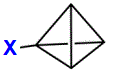 where X = F, Cl, Br and I
The structure is based on a tetrahedral pyramid arrangement
of the 4 carbon atoms. Cool !!!.
Some of the
C4H3X
(X = halogen) isomers described above may be highly reactive and very
thermodynamically unstable e.g. due to weak highly strained bonds and some may
not even exist at all (except theoretically of course!).
Summary of the
theoretical isomers of C4H3F, C4H3Cl,
C4H3Br and C4H3I
Isomers of C4H3X
(where X = F, Cl, Br, I) do exist, though they are relatively
uncommon and reactive due to the unsaturation and halogen
substitution.
These molecules typically feature alkyne or allene
backbones with halogen substitution, and their isomerism arises
from:
-
Positional isomerism: Halogen attached to
different carbon atoms.
-
Skeletal isomerism: Variations between
linear alkynes and cumulated dienes (allenes).
-
Functional group isomerism: Cyclodienes and open
chain diene or alkene-alkynes.
-
E/Z (geometrical) isomerism: These isomers can exist
for some of the alkene-alkyne molecules.
Why
are many of the isomers of C4H3X so unstable?
-
e.g. the four membered ring system molecules
-
A cyclobutadiene ring is a very strained ring system
(as are already cyclobutane and cyclobutene ring systems), with bond angles
of ~90o for C=C-C rather than 120o.
-
A cyclobutyne ring contains a
triple bond in a four-membered ring, which is already extremely
strained. The bond angles are C ≡C-C
~135o (rather than 180o) and
~80o for the C-C-C bond rather than 109o.
Adding a halogen substituent would further
destabilize the ring molecule.
No known synthesis or isolation of e.g. chlorocyclobutyne
has been reported in the literature or chemical databases.
Note that spectra can be used to distinguish which halogen
compound and which isomer
Reactivity and Synthetic Utility
of isomers of C4H3F, C4H3Cl,
C4H3Br or C4H3I
|
Halogen |
Leaving Group Ability |
Reactivity in SN/E Reactions |
Synthetic Role |
|
F |
Poor |
Low |
Stable, used in
fluoropolymers |
|
Cl |
Moderate |
SN1/SN2/E1/E2 |
Versatile
intermediate |
|
Br |
Good |
SN2/E2 favoured |
Used in Grignard
and coupling |
|
I |
Excellent |
Highly reactive |
Ideal for
radiolabeling and nucleophilic substitution |
Extra notes on isomerism in C4H3Cl compounds
Organic molecules with formula C4H3Cl
have two degrees of unsaturation (DBE = 2), allowing for conjugated
dienes, alkynes, and cyclic frameworks. Together, these give rise to
multiple constitutional and stereoisomeric forms.
Structural (Constitutional)
Isomerism in C4H3Cl compounds
C4H3Cl exhibits three main types of
constitutional isomerism:
- Chain and skeleton isomerism
Variations in the backbone: acyclic dienes, alkynes, or
cycloalkenes (e.g., cyclobutene chloride vs. linear butadiene
chloride).
- Positional isomerism
Movement of the chlorine atom among carbons 1–4 or shifting a
double/triple bond changes the connectivity
- Functional-group isomerism
Same formula but different unsaturation: haloalkene (C=C),
haloalkyne (C≡C), or cycloalkene chloride.
In total, six constitutional isomers
are possible at this level of unsaturation, ranging from chloroprene
(2-chloro-1,3-butadiene) to chloro-alkynes and cyclo derivatives.
Stereoisomerism
in C4H3Cl isomer compounds
- Geometric (E/Z) isomerism - need >=<, one
example, molecule (5)
- Optical isomerism,
not applicable here.
Chiral centres appear if a carbon is bonded to four distinct
groups (e.g., in certain substituted cyclobutane chlorides),
leading to non-superimposable mirror images (enantiomers).
Chemical Reactivity
of C4H3Cl isomeric compounds
Key reaction pathways for C4H3Cl
isomers:
- Electrophilic addition and
polymerization
Vinylacetylene adds HCl (in presence of CuCl catalyst at ~40–45
°C) to yield chloroprene, which undergoes free-radical emulsion
polymerization to polychloroprene (neoprene).
- Nucleophilic substitution
(SN1/SN2) and elimination (E1/E2)
The C–Cl bond can break to form carbocations (allylic systems
stabilize intermediates), enabling substitution or elimination
to give alkenes or dienes.
- Radical halogenation and
coupling
Allylic bromination or iodination on related C4 skeletons yields
functional handles for cross-coupling and heterocycle synthesis.
Common Misconceptions
about isomeric C4H3Cl compounds
- “All isomers have identical
properties.”
Physical and chemical behaviours diverge with connectivity,
geometry, and functional group placement.
- “Chlorine always makes compounds
inert.”
Many chlorinated dienes like chloroprene are highly reactive and
readily polymerize under radical conditions.
- “Optical activity only requires
four different substituents anywhere.”
Symmetry elements can nullify chirality even with four distinct
groups attached to a carbon.
Exam Revision Tips
for questions that may involve isomeric C4H3Cl
compounds
- Systematic isomer enumeration
- Draw all skeletons (acyclic
vs. cyclic).
- Place Cl at every carbon for
each skeleton.
- Introduce double/triple
bonds in all possible positions.
- Master nomenclature and CIP
rules
- Assign E/Z by ranking
substituents on doubly bonded carbons.
- Identify chiral
centres and
draw enantiomeric pairs.
- Memorize trends
- C–Cl bond strength (~339
kJ/mol) vs. leaving-group ability (Cl⁻ intermediate).
- Boiling point increases with
molecular weight and polarizability.
- Practice mechanism questions
- Write SN1 vs. SN2 pathways
for allylic halides.
- Predict polymerization steps
for conjugated dienes.
- Use flowcharts
- Isomer → classification
(constitutional vs. stereoisomer) → predicted
properties/reactivity.
Isomerism, Properties, Reactivity,
Uses, Misconceptions, and Revision Tips for C4H3Br Isomers
Types of Isomerism
exhibited by C4H3Br Isomers
Organic molecules with formula C4H3Br
have two degrees of unsaturation, allowing alkenes, alkynes, and
rings.
They exhibit both constitutional and stereoisomerism.
Structural (Constitutional)
Isomerism in C4H3Br isomers
- Chain isomerism
Variations in the carbon skeleton (straight-chain vs. branched
derivatives) change the backbone of the molecule.
- Positional isomerism
The bromine atom can occupy different carbon atoms, or the
positions of double/triple bonds can shift along the chain.
- Functional-group isomerism
The same formula can give haloalkenes (dienes or allenes),
haloalkynes, or cycloalkenes, each with distinct bonding
patterns.
Stereoisomerism
in C4H3Br isomeric compounds
- Geometric (E/Z) isomerism
Occurs in monobrominated alkenes when each end of the C=C double
bond has two different substituents, giving non-interconvertible
E and Z forms.
- Optical isomerism
Arises if a carbon atom bears four different groups (for
example, certain substituted cyclopropanes), leading to
enantiomers that rotate plane-polarized light.
Differences in Chemical Reactivity
of C4H3Br Isomers
Key factors governing reactivity of
C–Br isomers:
- Bond strength and activation
energy
The sp-hybridized C–Br bond in bromoalkynes is stronger than the
sp² C–Br bond in haloalkenes.
- Leaving-group ability
Bromide is a good leaving group, so SN1 and SN2 reactions
proceed readily, especially at allylic or benzylic sites.
Common Misconceptions
about the isomers of C4H3Br isomers
- All isomers share identical
properties.
In reality, connectivity and geometry profoundly affect boiling
points, solubility, and reactivity.
- Brominated alkenes are inert.
Allylic and vinylic bromides often undergo rapid radical or
ionic transformations under mild conditions.
- Only functional-group changes
count as isomerism.
Positional and stereochemical variations are equally valid and
can dominate behavior in reactions.
Exam Revision Tips
for questions that may involve isomers of C4H3Br
- Systematic enumeration
- List possible skeletons
(alkene, alkyne, ring)
- Place Br at each unique
carbon
- Assign E/Z configurations
where applicable
- Mechanism map
Sketch SN1 vs. SN2 vs. E1 vs. E2 for each isomer, highlighting
allylic vs. vinylic centres.
- Property trends
Use the mnemonic “sp > sp² > sp³” for bond strength and
“branching ↓ boiling point.”
- Practice problems
Draw all C4H3Br isomers, name them IUPAC-correctly, predict
major products with nucleophiles/bases, and compare physical
data.

Associated organic chemistry links
Index of sets of isomers for a given
molecular formula
Isomerism: introduction, structural isomerism - chain,
positional, functional group, tautomerism
Stereoisomerism:
introduction, definition,
priority rules, E/Z isomerism (cis/trans isomerism)
Stereoisomerism - R/S isomerism (optical
isomerism) -
definition - examples explained
Index of all IR, mass, 1H NMR
and 13C NMR spectroscopy
pages
This is a big chemistry website, please allow time
to explore
Index of advanced
(pre-university) organic
chemistry revision notes
The chemistry of
alkanes and the petrochemical
industry
The
chemistry of alkenes
The
chemistry of organic halogen compounds
The
chemistry of
alcohols
The chemistry of aldehydes
and ketones
The
chemistry of carboxylic acids and derivatives
The chemistry of organo-nitrogen compounds
The chemistry of
aromatic compounds
Keywords or phrases: how many
isomers are there of molecular formula C4H3Cl C4H3Br C4H3F C4H3I? how to draw the
skeletal formula of C4H3Cl C4H3Br C4H3F C4H3I isomers, how do you name the isomers of
molecular formula C4H3Cl C4H3Br C4H3F C4H3I? what is the molecular structure of the
isomers of C4H3Cl C4H3Br C4H3F C4H3I, what type of isomerism is exhibited by molecules
of formula C4H3Cl C4H3Br C4H3F C4H3I, how do you work out the isomers of molecular
formula C4H3Cl C4H3Br C4H3F C4H3I, what are the structural isomers of C4H3Cl C4H3Br C4H3F C4H3I, the carbon
chain isomers of C4H3Cl C4H3Br C4H3F C4H3I in the homologous series how many structural isomers of
C4H3Cl C4H3Br C4H3F C4H3I can you draw? how many structural isomers does C4H3Cl C4H3Br C4H3F C4H3I have?
what are the possible isomers of C4H3Cl C4H3Br C4H3F C4H3I? revision notes on
isomerism of C4H3Cl C4H3Br C4H3F C4H3I molecules, isomerism in
compounds of C4H3Cl C4H3Br C4H3F C4H3I how to draw the
structural formula of isomers of C4H3Cl C4H3Br C4H3F C4H3I, how to draw the skeletal formula of
isomers of C4H3Cl C4H3Br C4H3F C4H3I, how to name the isomers of molecular formula C4H3Cl C4H3Br C4H3F C4H3I,
are there any R/S optical isomers
enantiomers of C4H3Cl C4H3Br C4H3F C4H3I are there any E/Z isomers
cis trans stereoisomers of C4H3Cl C4H3Br C4H3F C4H3I
How do you work out the structure
of the isomers of molecular formula C4H3Cl C4H3Br C4H3F C4H3I? How do you draw the
structural formula and skeletal formula of the isomers of
molecular formula C4H3Cl C4H3Br C4H3F C4H3I? How do you name the isomers of molecular
formula C4H3Cl C4H3Br C4H3F C4H3I? How many positional isomers are there of molecular
formula C4H3Cl C4H3Br C4H3F C4H3I? Are there any functional group isomers with a
molecular formula C4H3Cl C4H3Br C4H3F C4H3I?
Does C4H3Cl C4H3Br C4H3F C4H3I have any stereoisomers?
Website content © Dr
Phil Brown 2000+. All copyrights reserved on revision notes, images,
quizzes, worksheets etc. Copying of website material is NOT
permitted.
|
