|
Doc Brown's
Advanced Chemistry: Part 14.7:
Isomers and extra notes on their properties and uses
Structural isomers
and
stereoisomers of molecular formula C3H8O2
[Author
©
Dr WP Brown PhD:
Doc Brown's advanced level organic chemistry exam revision notes
suitable for students of UK A level chemistry courses, IB advanced
chemistry and US K12 grade
11, grade 12 and AP honors chemistry courses: Molecular
spectroscopy and analysing the isomers of C3H8O2
[updated Feb 18th 2026 *]
*
Index of sets of isomers for a given
molecular formula
*
email doc
brown - comments - query?
*
[privacy policy]
*
Associated organic chemistry page links
*
This is a big chemistry website, please allow time
to explore
11 Selected
constitutional-structural isomers of molecular formula
C3H8O2
Percent mass composition of
C3H8O2
based on
the relative atomic masses
C= 12.01 H =
1.01 O = 16.00 and Mr(C3H8O2) =
76.11
Element composition of
C3H8O2
by mass: 47.33% carbon * 10.61%
hydrogen * 42.06% oxygen
Empirical formula = molecular formula
C3H8O2
Introduction
to isomerism for molecular formula
C3H8O2
(see also isomerism summary
diagram)
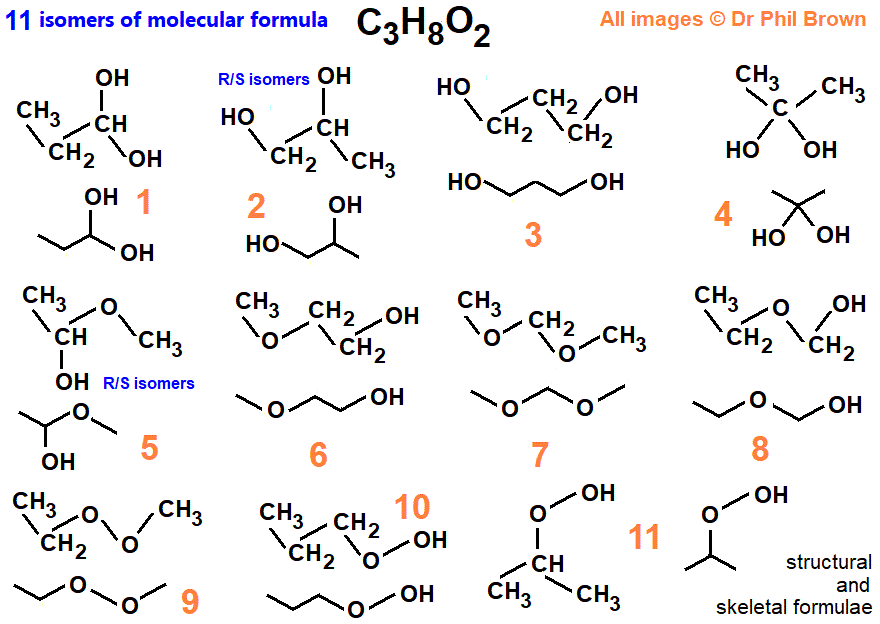
Structural isomerism
- isomers based on different connectivity's of the constituent atoms, so cannot
be spatially identical (but can be defined as having the same shape).
This includes (a)
carbon chain variation (usually need a minimum of 4 atoms),
(b) change in position of a substituent or functional group and
(c) functional group
isomerism where the atoms have a different connectivity configuration, usually with
significant differences in chemical and physical properties.
(a) You do get variation of the chain in
terms of C and O e.g. C-C-C-O or C-C-O-C
(b) Positional isomers from difference in -OH and
-OOH substituent positions
(c) Functional group isomers, diols versus ethers
versus peroxides
Stereoisomerism - isomers
based on the same connectivity of the atoms, but 2D or 3D spatially different,
non-superimposable images (e.g. E/Z isomers or mirror image R/S optical isomers)
This is
where molecules have the same basic constitutional structural formula, but
isomers differ in the 2D/3D arrangement of the atoms.
E/Z
stereoisomerism was called 'geometrical isomerism' e.g. cis
and trans isomers of alkenes or disubstituted cyclic alkanes
where there are 2D/3D spatial variations that are not mirror images and not
super imposable.
Not possible for C3H8O2
R/S
stereoisomerism was called 'optical isomerism', the pairs of
isomers are called enantiomers which are 3D non-superimposable
mirror image forms of the molecule. The molecule must have a chiral centre
(a stereocentre), that is an asymmetric carbon atom with four
different atoms/groups attached to it.
Does apply to isomers
C2 for 2 and C1 5 are chiral (asymmetric) carbon atoms giving two
pairs of enantiomers for C3H8O2
Note
Some of these isomers are highly reactive
and very unstable and some may not exist at all (except
theoretically).
I've identified 11 constitutional isomers (actual &
theoretical).
So, including the R/S enantiomer pairs means I've identified
13 distinct isomers.
Details of the
isomers of molecular formula C3H8O2
4
DIOLS based on propane (1) to (4)
(1)
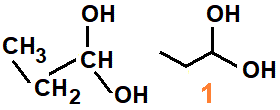 CH3CH2CH(OH)2, propane-1,1-diol
(1,1-propanediol)
CH3CH2CH(OH)2, propane-1,1-diol
(1,1-propanediol)
A functional group structural isomer
(alcohol, diol) and a positional isomer based on the
positions of the hydroxyl groups.
One of four positional isomers based on
pairs of OH hydroxyl groups.
Having two hydroxyl groups on the same
carbon atom will make this a very unstable molecule, so I'm
not sure if it exists?
Theoretical number of low resolution
NMR chemical shift
δ
signal peaks: 4 1H
and 3 13C
(email
if disagree?)
1H NMR ratio of integrated chemical shift peak areas:
3
: 2 : 1 : 2 (for equivalent protons)
Comparison of prominent
wavenumber absorptions of the infrared spectra of isomers of
C3H8O2
Comparison of the
prominent diagnostic ions of the mass spectra of the isomers
of C3H8O2
(2)
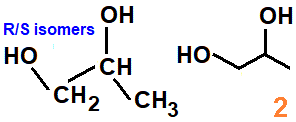 HOCH2CH(OH)CH3, propane-1,2-diol (1,2-propanediol)
A functional group structural isomer
(alcohol, diol) and a positional isomer based on the
positions of the hydroxyl groups.
One of four positional isomers based on
pairs of OH hydroxyl groups.
This will exhibit R/S (optical) isomerism,
carbon atom 2 is a chiral stereocentre (asymmetric carbon).
From the CIP assignment priority rule for R/S
isomers:
8O > 6C8O > 6C6C
> 6C1H
Number of low resolution
NMR chemical shift
δ
signal peaks: 5 1H
and 3 13C
(email
if disagree?)
1H NMR ratio of integrated chemical shift peak areas:
1
: 2 : 1 : 1 : 3 (for equivalent protons)
Comparison of prominent
wavenumber absorptions of the infrared spectra of isomers of
C3H8O2
Comparison of the
prominent diagnostic ions of the mass spectra of the isomers
of C3H8O2
(3)
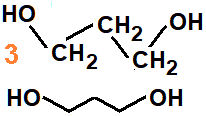 HOCH2CH2CH2OH, propane-1,3-diol
(1,3-propanediol)
HOCH2CH2CH2OH, propane-1,3-diol
(1,3-propanediol)
A functional group structural isomer
(alcohol, diol) and a positional isomer based on the
positions of the hydroxyl groups.
One of four positional isomers based on
pairs of OH hydroxyl groups.
A symmetrical molecule.
Theoretical number of low resolution
NMR chemical shift
δ
signal peaks: 3 1H
and 2 13C
(email
if disagree?)
1H NMR ratio of integrated chemical shift peak areas:
2
: 4 : 2 (for equivalent protons)
Comparison of prominent
wavenumber absorptions of the infrared spectra of isomers of
C3H8O2
Comparison of the
prominent diagnostic ions of the mass spectra of the isomers
of C3H8O2
(4)
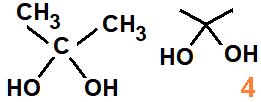 CH3C(OH)2CH3, propane-2,2-diol
(2,2-propanediol)
CH3C(OH)2CH3, propane-2,2-diol
(2,2-propanediol)
A functional group structural isomer
(alcohol, diol) and a positional isomer based on the
positions of the hydroxyl groups.
One of four positional isomers based on
pairs of OH hydroxyl groups.
A very symmetrical molecule.
Number of low resolution
NMR chemical shift
δ
signal peaks: 2 1H
and 2 13C
(email
if disagree?)
1H NMR ratio of integrated chemical shift peak areas:
6 : 2 (for equivalent protons)
Comparison of prominent
wavenumber absorptions of the infrared spectra of isomers of
C3H8O2
Comparison of the
prominent diagnostic ions of the mass spectra of the isomers
of C3H8O2
4
ALKOXY ALCOHOLS and ETHERS (5) to (8)
(5)
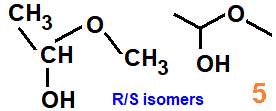 CH3CH(OH)OCH3, 1-methoxyethanol
A functional group structural isomer
with hydroxyl group (alcohol) and a C-O-C ether linkage.
This will exhibit R/S (optical) isomerism,
carbon atom 1 is a chiral stereocentre (asymmetric carbon).
From the CIP assignment priority rule for R/S
isomers:
8O6C > 8O1H >
6C6C > 6C1H
Theoretical number of low resolution
NMR chemical shift
δ
signal peaks: 4 1H
and 3 13C
(email
if disagree?)
1H NMR ratio of integrated chemical shift peak areas:
3
: 1 : 1 : 3 (for equivalent protons)
Comparison of prominent
wavenumber absorptions of the infrared spectra of isomers of
C3H8O2
Comparison of the
prominent diagnostic ions of the mass spectra of the isomers
of C3H8O2
(6)
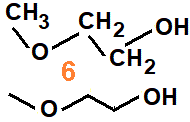 CH3OCH2CH2OH, 2-methoxyethanol
A functional group structural isomer with a
hydroxyl group (alcohol)
and a C-O-C ether linkage.
Number of low resolution
NMR chemical shift
δ
signal peaks: 4 1H
and 3 13C
(email
if disagree?)
1H NMR ratio of integrated chemical shift peak areas:
3
: 2 : 2 : 1 (for equivalent protons)
Comparison of prominent
wavenumber absorptions of the infrared spectra of isomers of
C3H8O2
Comparison of the
prominent diagnostic ions of the mass spectra of the isomers
of C3H8O2
(7)
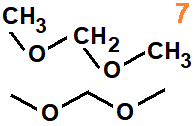 CH3OCH2OCH3, dimethoxymethane
A functional group structural isomer a
double C-O-C ether linkage.
A symmetrical molecule.
Number of low resolution
NMR chemical shift
δ
signal peaks: 2 1H
and 2 13C
(email
if disagree?)
1H NMR ratio of integrated chemical shift peak areas:
6
: 2 (for equivalent protons)
Comparison of prominent
wavenumber absorptions of the infrared spectra of isomers of
C3H8O2
Comparison of the
prominent diagnostic ions of the mass spectra of the isomers
of C3H8O2
(8)
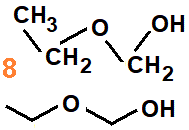 CH3CH2OCH2OH, ethoxymethanol
A functional group structural isomer with a
hydroxyl group,
primary alcohol group and a C-O-C ether
linkage.
Number of low resolution
NMR chemical shift
δ
signal peaks: 4 1H
and 3 13C
(email
if disagree?)
1H NMR ratio of integrated chemical shift peak areas:
3 : 2
: 2 : 1 (for equivalent protons)
Comparison of prominent
wavenumber absorptions of the infrared spectra of isomers of
C3H8O2
Comparison of the
prominent diagnostic ions of the mass spectra of the isomers
of C3H8O2
3
PEROXIDES (9) to (11)
(9)
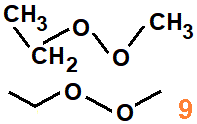 CH3CH2OOCH3, ethyl methyl
peroxide
CH3CH2OOCH3, ethyl methyl
peroxide
A functional group structural isomer, with
an organic -O-O- peroxide linkage.
Number of low resolution
NMR chemical shift
δ
signal peaks: 3 1H
and 3 13C
(email
if disagree?)
1H NMR ratio of integrated chemical shift peak areas:
3 : 2
: 3 (for equivalent protons)
Comparison of prominent
wavenumber absorptions of the infrared spectra of isomers of
C3H8O2
Comparison of the
prominent diagnostic ions of the mass spectra of the isomers
of C3H8O2
(10)
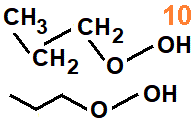 CH3CH2CH2OOH, propyl
hydroperoxide
CH3CH2CH2OOH, propyl
hydroperoxide
A functional group structural isomer, with a
-O-O-
peroxide linkage.
Its a positional (-OOH) isomer with
isopropyl hydroperoxide.
Number of low resolution
NMR chemical shift
δ
signal peaks: 4 1H
and 3 13C
(email
if disagree?)
1H NMR ratio of integrated chemical shift peak areas:
3 : 2
: 2 : 1 (for equivalent protons)
Comparison of prominent
wavenumber absorptions of the infrared spectra of isomers of
C3H8O2
Comparison of the
prominent diagnostic ions of the mass spectra of the isomers
of C3H8O2
(11)
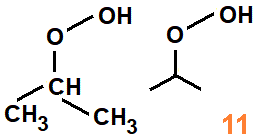 (CH3)2CHOOH, isopropyl hydroperoxide
A functional group structural isomer, with a
-O-O-
peroxide linkage.
Its a positional (-OOH) isomer with
propyl hydroperoxide.
Number of low resolution
NMR chemical shift
δ
signal peaks: 3 1H
and 2 13C
(email
if disagree?)
1H NMR ratio of integrated chemical shift peak areas:
6 : 1 : 1 (for equivalent protons)
Comparison of prominent
wavenumber absorptions of the infrared spectra of isomers of
C3H8O2
Comparison of the
prominent diagnostic ions of the mass spectra of the isomers
of C3H8O2
Note
that spectral analysis can help distinguish between isomers of
C3H8O2
Summary of key points and extra notes on the isomers of molecular
formula
C3H8O2
Molecules with the formula
C3H8O2
(e.g. propanediols, methoxyethanols, peroxides) exhibit a rich variety of
isomerism. Here's a structured breakdown tailored to your
analytical style:
Types of isomerism in
C3H8O2
Isomers
|
Isomerism Type |
Description |
Examples |
|
Structural
Isomerism |
Same molecular
formula, different connectivity of atoms |
1,2-Propanediol
versus 1,3-Propanediol |
|
→ Chain Isomerism |
Variation in
carbon backbone |
Rare in C3H8O2 due
to short chain |
|
→ Functional
Isomerism |
Different
functional groups |
Diols versus
ethers versus peroxides |
|
→ Position
Isomerism |
Same functional
group, different position |
OH on C1 versus C2
versus C3 |
|
→ Metamerism |
Different alkyl
groups around ether/peroxide link |
CH₃-O-CH₂CH₂
versus CH₃CH₂-O-CH₂ |
|
Stereoisomerism |
Same connectivity,
different spatial arrangement |
(R)/(S)-1,2-Propanediol |
|
→ Optical
Isomerism |
Chiral centres
lead to enantiomers |
1,2-Propanediol
(chiral at C2) |
Differences in Physical
Properties of the isomers of
C3H8O2
|
Property |
Diols
(e.g. 1,2-Propanediol) |
Ethers
(e.g. 2-Methoxyethanol) |
Peroxides |
|
Boiling Point |
High (due to
H-bonding) |
Moderate |
Lower (less
H-bonding) |
|
Solubility in
Water |
Very soluble |
Soluble |
Variable |
|
Viscosity |
High |
Lower |
Lower |
|
Density |
Slightly higher |
Moderate |
Lower |
Differences in Chemical
Properties of the isomers of
C3H8O2
|
Reactivity |
Diols |
Ethers |
Peroxides |
|
Oxidation |
Can form
aldehydes/ketones |
Relatively stable |
Highly reactive,
radical source |
|
Esterification |
Forms diesters |
Forms monoesters |
Less common |
|
Dehydration |
Can form cyclic
ethers or alkenes |
Less prone |
Unstable under
heat |
|
Acid/Base Reaction |
Weakly acidic OH
groups |
Inert |
May decompose |
Common Misconceptions
involving the isomers of
C3H8O2
-
“All isomers have similar properties” →
False. Functional group changes drastically affect boiling point,
reactivity, and solubility.
-
“Optical isomers are always easy to identify”
→ Not unless there's a chiral center and no internal symmetry.
-
“C3H8O2
only forms diols” → It can also form ethers, peroxides, and
hemiacetals.
Exam Tips for questions
involving the isomers of
C3H8O2
-
Always draw full structures to spot
functional and positional isomers.
-
Check for chirality: Look for tetrahedral
carbons with four different groups.
-
Use boiling point trends to justify
physical property differences.
-
Link functional groups to reactions: Diols
→ oxidation; ethers → cleavage; peroxides → radical reactions.
-
Watch out for overlooked isomers like
geminal diols or hemiacetals.
A comparison of the
prominent wavenumber absorptions of the infrared spectra
of the isomers of C3H8O2
A comparative summary of the prominent IR absorption
bands for the main isomeric types of
C3H8O2, including alcohols,
ethers, peroxides, and hydroperoxides. These functional groups
exhibit distinct vibrational modes in the IR spectrum, allowing
differentiation.
Reminder of isomer types of
C3H8O2
and their functional groups relevant to their infrared spectra
|
Isomer
Type |
Example Compound |
Functional Groups |
|
Alcohols |
1,2-Propanediol |
Two –OH groups |
|
Ethers |
Methoxyethanol |
–OH and –O–CH3 |
|
Peroxides |
Methyl
hydroperoxide |
–O–O– and –CH3 |
|
Hydroperoxides |
2-Hydroperoxypropanol |
–OOH and –OH |
IR
Spectral Comparison: Prominent Wavenumbers of the infrared spectra of the
isomers of
C3H8O2
|
Functional Group |
Stretching Mode |
Typical Wavenumber (cm⁻¹) |
Notes |
|
O–H
(alcohol) |
Broad stretch |
3200–3600 |
Broad due to
H-bonding |
|
C–O
(alcohol/ether) |
Stretch |
1000–1150 |
Sharp, medium
intensity |
|
C–H
(alkyl) |
Stretch |
2850–2960 |
Common to all
isomers |
|
O–O
(peroxide) |
Stretch |
~850 |
Weak, diagnostic
for peroxides |
|
O–H
(hydroperoxide) |
Broad stretch |
~3350 |
Very broad,
hydrogen bonded |
|
O–O–H
(hydroperoxide) |
Bend/stretch combo |
~877 |
Weak, but
characteristic |
Tips
for interpreting the
infrared spectra of the isomers of
C3H8O2
-
Alcohols show broad O–H stretches
and strong C–O stretches. Diols may show broader bands due
to intramolecular hydrogen bonding.
-
Ethers lack O–H stretch (unless combined
with alcohol) and show C–O stretches near 1100 cm⁻¹.
-
Peroxides are identified by a weak
O–O stretch near 850 cm⁻¹, often overlooked without context.
-
Hydroperoxides exhibit both O–H and
O–O stretches, with the O–H being very broad and intense,
and the O–O appearing as a weak band near 877 cm⁻¹.
A comparison of the prominent diagnostic ions of the
mass spectra of the isomers of C3H8O2
A comparative summary of the diagnostic mass
spectral fragments (m/z values) for the major isomer types
of
C3H8O2, including alcohols,
ethers, peroxides, and hydroperoxides. These fragments arise from
characteristic cleavage patterns and losses
during electron ionization.
Isomer
Types of
C3H8O2
and Fragmentation Behavior
|
Isomer
Type |
Example Compound |
Functional Groups |
Molecular Ion (M⁺) |
|
Alcohols |
1,2-Propanediol |
Two –OH groups |
m/z = 76 |
|
Ethers |
Methoxyethanol |
–OH and –O–CH3 |
m/z = 76 |
|
Peroxides |
Methyl
hydroperoxide |
–O–O– and –CH3 |
m/z = 76 |
|
Hydroperoxides |
2-Hydroperoxypropanol |
–OOH and –OH |
m/z = 76 |
Diagnostic Fragment Ions (m/z) by Isomer type for the mass spectra of C3H8O2
isomers
|
Isomer Type |
Key Fragment
Ions (m/z) |
Fragment
Description |
Notes |
|
Alcohols
|
31 |
CH2OH+ |
Common base peak |
|
59 |
C3H7O+
(loss of H•) |
Seen in propan-1-ol |
|
42 |
C3H6+
(loss of H2O) |
Dehydration peak |
|
Ethers
|
45 |
CH3OCH2+
or CH3CH2O+ |
α-cleavage next to ether
oxygen |
|
31 |
CH2OH+
(if –OH present) |
Only in hydroxy ethers |
|
Peroxides
|
61 |
Loss of CH3•
from methyl hydroperoxide |
Weak molecular ion,
unstable |
|
31 |
HO2+
or CH3O+
depending on cleavage |
O–O bond cleavage
dominates |
|
Hydroperoxides
|
59 |
C3H7O+
(loss of HO• or H•) |
Similar to alcohols |
|
33 or 17 |
HO2+ or OH+ |
O–O–H fragmentation |
Interpretation tips for
the mass spectra of the isomers of C3H8O2
-
Alcohols often show m/z 31 (CH2OH⁺)
and m/z 59, with M–18 (loss of H2O)
being common.
-
Ethers fragment via α-cleavage,
giving alkoxy ions like CH3O+
or CH3CH2O+
-
Peroxides have weak molecular ions
and fragment via O–O bond cleavage, producing HO2+
or CH3O+
-
Hydroperoxides show combined
alcohol and peroxide fragmentation, with m/z 33–47
being diagnostic.
Learning objectives - questions to be answered?
How many constitutional structural isomers are there of
molecular formula C3H8O2?
Are there any positional isomers of molecular formula of
C3H8O2?
Are there any E/Z (cis/trans) geometrical isomers of molecular
formula C3H8O2?
Are there any R/S optical isomers of molecular
formula C3H8O2?
How do you draw the skeletal structure of isomers of
molecular formula C3H8O2?
How do you draw the structural formula of the isomers of
molecular formula C3H8O2?
Can you recognise the different functional groups in the isomers
of molecular formula
C3H8O2?
How do you name the isomers of molecular formula
C3H8O2?
This page will answer
these questions
for molecular formulae
C3H8O2
A summary chart of isomerism

Associated organic chemistry links
Index of sets of isomers for a given
molecular formula
Isomerism: introduction, structural isomerism - chain,
positional, functional group, tautomerism
Stereoisomerism:
introduction, definition,
priority rules, E/Z isomerism (cis/trans isomerism)
Stereoisomerism - R/S isomerism (optical
isomerism) -
definition - examples explained
The molecular structure and naming
of ALKENES
The molecular structure and naming of aliphatic ALCOHOLS including isomeric ethers
The molecular structure and
Naming of ALDEHYDES and KETONES
Index of all IR, mass, 1H NMR
and 13C NMR spectroscopy
pages
This is a big chemistry website, please allow time
to explore
Index of advanced
(pre-university) organic
chemistry revision notes
The chemistry of
alkanes and the petrochemical
industry
The
chemistry of alkenes
The
chemistry of organic halogen compounds
The
chemistry of
alcohols
The chemistry of aldehydes
and ketones
The
chemistry of carboxylic acids and derivatives
The chemistry of organo-nitrogen compounds
The chemistry of
aromatic compounds
Keywords or phrases: how many
isomers are there of molecular formula C3H8O2? how to draw the
skeletal formula of C3H8O2 isomers, how do you name the isomers of
molecular formula C3H8O2? what is the molecular structure of the
isomers of C3H8O2, what type of isomerism is exhibited by molecules
of formula C3H8O2, how do you work out the isomers of molecular
formula C3H8O2, what are the structural isomers of
C3H8O2, the carbon
chain isomers of C3H8O2 in the homologous series how many structural isomers of
C3H8O2 can you draw? how many structural isomers does
C3H8O2 have?
what are the possible isomers of C3H8O2? revision notes on
isomerism of C3H8O2 molecules, isomerism in
compounds of C3H8O2 how to draw the
structural formula of isomers of C3H8O2, how to draw the skeletal formula of
isomers of C3H8O2, how to name the isomers of molecular formula
C3H8O2,
are there any R/S optical isomers
enantiomers of C3H8O2 are there any E/Z isomers cis trans
stereoisomers of C3H8O2
How do you work out the structure
of the isomers of molecular formula C3H8O2? How do you draw the
structural formula and skeletal formula of the isomers of
molecular formula C3H8O2? How do you name the isomers of molecular
formula C3H8O2? How many positional isomers are there of molecular
formula C3H8O2? Are there any functional group isomers with a
molecular formula C3H8O2?
Does C3H8O2 have any stereoisomers?
Diagrams of the constitutional isomers of formula C3H8O2, drawings the
skeletal structure of isomers of C3H8O2, drawings of the structural
formula of isomers of C3H8O2, describing the different functional
groups in the isomers of C3H8O2? names of the isomers of
C3H8O2?
Website content © Dr
Phil Brown 2000+. All copyrights reserved on revision notes, images,
quizzes, worksheets etc. Copying of website material is NOT
permitted.
|
