|
Doc Brown's
Advanced Chemistry: Part 14.7
Isomers and extra notes on their properties and uses
The
9 constitutional structural isomers
and
E/Z (geometrical)
and R/S (optical) stereoisomers of molecular formula
C3H6O
[Author
©
Dr
Phil Brown PhD:
Doc Brown's advanced level organic chemistry exam revision notes
suitable for students of UK A level chemistry courses, IB advanced
chemistry & US K12 grade
11, grade 12 and AP honors chemistry courses: Molecular
spectroscopy and analysing the isomers of C3H6O
[updated
RE-EDIT]
Sub-index for this
page on the isomers of C3H6O
Details
of the isomerism exhibited by molecular formula C3H6O
Extra
notes and key points about the isomers of C3H6O
Practice
multiple choice exam questions based on the isomers of
C3H6O
(with answers!)
Index of sets of isomers for a given
molecular formula
email doc
brown - comments - query?
* [policies,
cookies and disclaimer]
Associated organic chemistry page links
This is a big chemistry website, please allow time
to explore
The
9
constitutional-structural isomers of molecular formula
C3H6O
Here I have
identified 9 constitutional structural isomers of molecular formula C3H6O,
excluding E/Z (geometrical) and R/S (optical) stereoisomers (note, one of each
type is identified below), there may be more?
Percent mass composition of
C3H6O based on
the relative atomic masses
C= 12.01 H =
1.01 O = 16.00 and Mr(C3H6O) =
58.09
Element composition of
C3H6O by mass: 62.02 % carbon *
10.43%
hydrogen * 27.55% oxygen
Empirical formula = molecular formula
=
C3H6O
Introduction
to isomerism for molecular formula
C3H6O
(see also summary
diagram)

Structural isomerism
- isomers based on different connectivity's of the constituent atoms, so cannot
be spatially identical (but can be defined as having the same shape).
This includes (a) carbon chain variation (usually need a minimum of
4 atoms),
(b) change in position of a substituent or functional group and (c) functional group
isomerism where the atoms have a different connectivity configuration, usually with
significant differences in chemical and physical properties.
In terms of isomers of
C3H6O
there are
(a) Chain variations based on the C and O atoms,
linear (aliphatic) and cyclic structures (alicyclic and
heterocyclic),
(b) positional isomers e.g. the -OH groups in the
unsaturated alcohols,
(c) most are all functional group isomers of each
other
e.g. aldehyde, ketone, unsaturated alcohols, cyclic ethers (epoxy
compounds).
Stereoisomerism - isomers
based on the same connectivity of the atoms, but 2D or 3D spatially different,
non-superimposable images (e.g. E/Z isomers or mirror image R/S optical isomers)
This is
where molecules have the same basic constitutional structural formula, but
isomers differ in the 2D/3D arrangement of the atoms.
E/Z
stereoisomerism was called 'geometrical isomerism' e.g. cis
and trans isomers of alkenes or disubstituted cyclic alkanes
where there are 2D/3D spatial variations that are not mirror images and not
super imposable.
One isomer exhibits E/Z geometrical isomerism No.
(5)
R/S
stereoisomerism was called 'optical isomerism', the pairs of
isomers are called enantiomers which are 3D non-superimposable
mirror image forms of the molecule. The molecule must have a chiral centre
(a stereocentre), that is an asymmetric carbon atom with four
different atoms/groups attached to it.
One isomer exhibits R/S optical isomerism No.
(4)
Of the structural formulae: 1 aldehyde, 1 ketone, 2
heterocyclic cyclic ethers (epoxy compounds), 3 alkene-alcohols ('enols'), 1 alkene-ether and
1 cycloalkanol (aliphatic cyclic alcohol).
Isomers of
C3H6O
are a very good example of functional group isomerism.
Some of these isomers are highly reactive
and very unstable and some may not exist at all (except
theoretically), but sure all these exist.
If you count the R/S optical isomers and the E/Z geometrical
isomers, you have a total of 11 distinct isomers, but remember that
constitutional isomers are only the distinct different bonding arrangements
i.e. here there are only 9
constitutional isomers i.e. those of different connectivities of the C, H and O atoms
irrespective of any spatial variations.
Details of the 9
constitutional
isomers of molecular formula C3H6O
Including the E/Z geometrical and R/S optical isomers, I have
identified 11 distinct isomers of C3H6O
(1)
 propanal, an aliphatic aldehyde
A functional group isomer with an
aldehyde group, isomeric with propanone and the rest of
(3) to (9).
Number of low resolution
NMR chemical shift
δ
signal peaks: 3 1H
and 3 13C
(email
if disagree?)
1H NMR proto ratio of integrated peak areas: 3
: 2 : 1 (for equivalent protons)
Comparison of the infrared spectra of the
structural isomers of C3H6O
The infrared spectrum of
propanal (propionaldehyde)
The mass spectrum of propanal (propionaldehyde)
The H-1 NMR spectrum of propanal (propionaldehyde)
The C-13 NMR spectrum of propanal (propionaldehyde)
(2)
 propanone, an aliphatic ketone ('acetone'),
very symmetrical
propanone, an aliphatic ketone ('acetone'),
very symmetrical
A functional group isomer with a ketone
group, isomeric with propanal and the rest of (3) to (9).
Number of low resolution
NMR chemical shift
δ
signal peaks: 1 1H
and 2 13C
(email
if disagree?)
Comparison of the infrared spectra of
the structural isomers of C3H6O
The infrared spectrum of
propanone (acetone)
The mass spectrum of
propanone (acetone)
The infrared spectrum of
propanone (acetone)
The mass spectrum of
propanone (acetone)
(3)
 oxetane, 1,3-epoxypropane, 1,3-propylene oxide
Functional group and cyclic ring isomerism.
It is a cyclic ether functional group
(epoxy compound), classified as heterocyclic compound with a ring of 3
carbon atoms and an oxygen atom.
Number of low resolution
NMR chemical shift
δ
signal peaks: 2 1H
and 2 13C
(email
if disagree?)
1H NMR proton ratio of integrated peak areas:
2
: 4 (2+2) (for equivalent protons)
Comparison of the infrared spectra of
the structural isomers of C3H6O
(4)
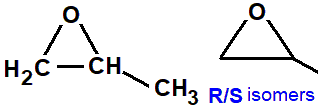 methyloxirane, 1,2-epoxypropane, 1,2-propylene oxide
Functional group isomer and ring structure
isomer, has a chiral centre (ring
C of the >CH-CH3).
This cyclic ether (epoxy compound) exhibits R/S optical isomerism, the
ring carbon atom of
C-CH3 bond is asymmetric
(chiral) and so gives rise to a pair of enantiomers.
Number of low resolution
NMR chemical shift
δ
signal peaks: 3 1H
and 3 13C
(email
if disagree?)
1H NMR proton ratio of integrated peak areas:
2: 1 : 3 (for equivalent protons)
Comparison of the infrared spectra of
the structural isomers of C3H6O
(5)
 prop-1-en-1-ol, 1-propenol, 1-propen-1-ol, propen-1-ol
Functional group isomer and positional
isomer (OH).
Unstable, may revert to propanal? see (6) an
example of tautomerism.
Two functional groups: alcohol (OH)
and alkene (>C=C<)
Exhibits E/Z geometrical isomerism based on
the C=C alkene group which restricts rotation.
On the left the E isomer because the
carbon of the CH3 group and the oxygen of the OH
group have a higher priority than a solitary H.
From the CIP assignment priority rule:
8O > 6C > 1H (about the
>C=C< bond)
Number of low resolution
NMR chemical shift
δ
signal peaks: 4 1H
and 3 13C
(email
if disagree?)
1H NMR ratio of integrated peak areas:
3 : 1 : 1 : 1 (for equivalent protons)
Comparison of the infrared spectra of
the structural isomers of C3H6O
(6)
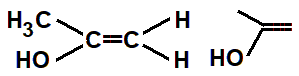 prop-1-en-2-ol, 1-propen-2-ol, propen-2-ol
Functional group isomer and positional
isomer (OH).
Two functional groups: alcohol (OH)
and alkene (>C=C<), so known as an enol.
It exhibits an example of tautomerism,
because prop-1-en-2-ol readily isomerises to propanone.
prop-1-en-2-ol
 propanone (an example of an isomerisation
reaction)
propanone (an example of an isomerisation
reaction)

Number of low resolution
NMR chemical shift
δ
signal peaks: 3 1H
and 3 13C
(email
if disagree?)
1H NMR proton ratio of integrated peak areas:
3
: 1 : 2 (for equivalent protons)
BUT, for the 'end' =CH2 alkene protons,
you can get two chemical shifts close together, if there are two
different groups attached to the other carbon of the C=C bond i.e. R"R'C=CH2 where R" and R' are different. This causes the
two =CH2 protons to experience slightly different fields.
This is a university level analysis.
Comparison of the infrared spectra of
the structural isomers of C3H6O
(7)
 prop-2-en-1-ol, 2-propen-1-ol, allyl alcohol
Functional group isomer and positional (OH)
isomer.
Two functional groups: primary alcohol
(CH2OH) and alkene (>C=C<)
Number of low resolution
NMR chemical shift
δ
signal peaks: 4 1H
and 3 13C
(email
if disagree?)
1H NMR proton ratio of integrated peak areas:
1 : 2 : 1 : 2 (for equivalent protons)
BUT, for the 'end' =CH2 alkene protons,
you can get two chemical shifts close together, if there are two
different groups attached to the other carbon of the C=C bond i.e. R"R'C=CH2 where R" and R' are different. This causes the
two =CH2 protons to experience slightly different fields.
Comparison of the infrared spectra of
the structural isomers of C3H6O
(8)
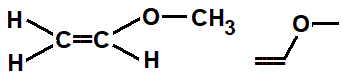 methoxyethene (methyl vinyl ether)
Functional group isomer and positional (OH)
isomer.
Two functional groups: alkene (>C=C<)
and ether (C-O-C linkage)
Number of low resolution
NMR chemical shift
δ
signal peaks: 3 1H
and 3 13C
(email
if disagree?)
1H NMR proton ratio of integrated peak areas:
2 : 1 : 3 (for equivalent protons)
BUT, for the 'end' =CH2 alkene protons,
you can get two chemical shifts close together, if there are two
different groups attached to the other carbon of the C=C bond i.e. R"R'C=CH2 where R" and R' are different. This causes the
two =CH2 protons to experience slightly different fields.
Comparison of the infrared spectra of
the structural isomers of C3H6O
(9)
 cyclopropanol
Secondary alcohol functional group
(OH, hydroxyl, cyclo alcohol), functional group and cyclo
isomer.
Number of low resolution
NMR chemical shift
δ
signal peaks: 3 1H
and 2 13C
(email
if disagree?)
1H NMR proton ratio of integrated peak areas:
4 (2+2) : 1 : 1 (for equivalent protons)
Comparison of the infrared spectra of
the structural isomers of C3H6O
Note
that spectral analysis can help distinguish between isomers of
C3H6O
Summary of
key points and extra exam revision notes on the isomers of molecular
formulae
C3H6O
and their properties and use
Types
of Isomerism in the 9 structural isomers of
C3H6O
|
Isomer Type |
Example(s) |
Explanation |
|
Functional
Isomerism |
Propanal (aldehyde) versus
Propanone (ketone) versus cyclopropanol |
Same molecular formula,
different functional groups (–CHO versus –CO–) |
|
Positional
Isomerism |
Prop-1-en-2-ol versus
Prop-2-en-1-ol |
–OH and C=C located at
different positions on the chain |
|
Central chain
Isomerism |
Propanoic acid and
methoxypropene |
Different carbon skeletons
(straight versus branched or cyclic) C-C-C and C-O-C-C |
|
Tautomerism |
Propanone versus
Prop-1-en-2-ol |
Keto-enol equilibrium
between ketone and enol forms |
|
Ring Isomerism |
Oxetane, Methyl oxirane,
Cyclopropanol |
Cyclic structures with
oxygen or hydroxyl groups |
Physical Property Differences of
the structural isomers of
C3H6O
|
Isomer |
Boiling Point (°C) |
Polarity |
Hydrogen Bonding |
State
at Room Temp |
|
Propanal |
~49 |
Polar |
Weak H-bonding |
Liquid |
|
Propanone
(Acetone) |
~56 |
Polar |
No H-bonding |
Liquid |
|
Prop-2-en-1-ol |
~97 |
Polar |
Strong H-bonding |
Liquid |
|
Methoxyethene
(methyl vinyl ether) |
~28 |
Weakly polar |
No H-bond donor |
Very volatile
liquid |
|
Oxetane |
~57 |
Weakly polar |
Weak H-bonding |
Liquid |
Key Insight: Alcohols generally have higher
boiling points due to hydrogen bonding. Ethers and ketones are more
volatile, though aldehydes and ketones are more polar (δ+C=Oδ-)
than their isomeric ethers, x-ref methoxyethene and propanal/propanone.
Chemical Reactivity Differences between
isomers of
C3H6O
|
Isomer |
Reactivity |
Key
Reactions |
|
Propanal |
Easily oxidized to
propanoic acid |
Tollen's’ test,
Fehling’s test |
|
Propanone
(acetone) |
Undergoes
nucleophilic addition, iodoform test (a -2-one) |
Aldol
condensation, I2/NaOH → yellow ppt |
|
Prop-2-en-1-ol |
Can oxidize to
aldehyde or acid |
Mild oxidation,
electrophilic addition |
|
Methoxyethene (methyl vinyl ether) |
Susceptible to
acid hydrolysis |
Ether cleavage,
polymerization |
|
Cyclopropanol |
Ring strain makes
it reactive |
Ring-opening
reactions |
Misconception Alert: Students often assume
all isomers of C3H6O are either aldehydes or ketones. In reality, cyclic
alcohols, enols, and ethers are valid and exam-relevant.
Uses
and Applications of
selected isomers of
C3H6O
|
Isomer |
Applications |
|
Propanone
(acetone) |
Solvent in nail
polish remover, plastics, pharmaceuticals |
|
Propanal |
Intermediate in
fragrance and pharmaceutical synthesis |
|
Prop-2-en-1-ol |
Used in organic
synthesis, potential biofuel precursor |
|
Methoxyethene (methyl vinyl ether) |
Monomer in polymer
production |
|
Oxetane
(1,3-epoxypropane) |
Used in
high-performance polymers and photoresists |
Exam
Revision Tips for questions involving
selected isomers of
C3H6O
-
Draw all isomers: Include linear, branched,
cyclic, and enol forms.
-
Use IUPAC names: Examiners reward correct
nomenclature.
-
Compare boiling points: Link to
intermolecular forces.
-
Practice reaction tests: Tollens’,
Fehling’s, Iodoform.
-
Clarify tautomerism: Especially keto-enol
equilibrium.
-
Avoid confusing C3H6O with C3H6O2:
The latter includes carboxylic acids and esters.
A
comparison of the
infrared spectral features of selected isomers
of C3H6O
|
Isomer |
Structure Type |
Key IR
Absorptions (cm⁻¹) |
Functional
Group Notes |
|
Propanal |
Aldehyde |
~1725 (C=O stretch), ~2720
& ~2820 (aldehyde C–H) |
Aldehyde C–H stretch
appears as twin peaks |
|
Propanone
(Acetone) |
Ketone |
~1715 (C=O stretch), no
aldehyde C–H peaks |
Slightly lower C=O stretch
than aldehyde |
|
Allyl alcohol |
Primary alcohol + alkene |
~3300 (O–H stretch), ~1640
(C=C stretch), ~1050 (C–O) |
Broad O–H stretch; C=C
stretch may be weak |
|
Methoxyethene |
Ether + alkene |
~1100 (C–O stretch), ~1640
(C=C stretch) |
No O–H or C=O; C–O stretch
is sharp and strong |
|
Cyclopropanol |
Cyclic alcohol |
~3300 (O–H stretch), ~1050
(C–O stretch) |
Ring strain may shift O–H
slightly |
Interpretation Tips for the infrared spectra of
selected isomers of C3H6O
-
Carbonyl groups (C=O): Strong, sharp peaks
around 1715–1725 cm⁻¹. Aldehydes show additional C–H stretches near
2700–2900 cm⁻¹.
-
Alcohols (O–H): Broad, intense absorption
around 3200–3600 cm⁻¹ due to hydrogen bonding.
-
Alkenes (C=C): Medium intensity peaks near
1640 cm⁻¹.
-
Ethers (C–O): Sharp peaks around 1050–1150
cm⁻¹, no O–H or C=O
IR
Absorptions versus Physical Properties
for selected isomers of C3H6O
|
Isomer |
Infrared spectra
Key IR
Features |
Boiling Point
(°C) |
Volatility |
Water
Solubility |
Why It Matters |
|
Propanal |
C=O ~1725, aldehyde C–H
~2720–2820 |
~49 |
High |
Moderate |
Polar C=O allows dipole
interactions, but no H-bonding from aldehyde group |
|
Propan-2-one
(Acetone) |
C=O ~1715, no O–H |
~56 |
High |
Very high |
Strong dipole moment from
C=O; miscible with water due to polarity |
|
Propenol (Allyl
alcohol) |
O–H ~3300 (broad), C=C
~1640 |
~97 |
Moderate |
Very high |
O–H enables hydrogen
bonding, raising boiling point and solubility |
|
Methoxyethene |
C–O ~1100, C=C ~1640 |
~38 |
Very high |
Low to moderate |
No H-bonding; ether
linkage lowers boiling point despite polarity |
|
Cyclopropanol |
O–H ~3300, C–O ~1050 |
~100 (est.) |
Moderate |
High |
Ring strain may affect
volatility; O–H promotes hydrogen bonding |
Key Connections
-
O–H Stretch (Alcohols) → Broad peak =
hydrogen bonding → ↑ boiling point & solubility
-
C=O Stretch (Carbonyls) → Strong dipole = ↑
polarity → ↑ solubility, but less H-bonding
-
C=C Stretch (Alkenes) → Weak polarity = ↓
solubility, ↑ volatility
-
C–O Stretch (Ethers) → Polar but no
H-bonding → ↓ boiling point
Practice multiple choice questions based on
the isomers of
C3H6O
Here’s a set of
multiple-choice questions based on the 9 valid
constitutional isomers of C3H6O,
including stereoisomers and key spectroscopic, structural, and
chemical differences.
These are tailored for advanced
pre-university chemistry courses (e.g. A-level, IB, AP, Honors).
You may
have to sketch out some molecular structures to work out the
answer.
Jot
down your responses and check out the answers
ANSWERS
to the questions based on the isomers of C3H6O
If you think there are
any errors, please email me asap at
chem55555@hotmail.com
Q1.
Which isomer shows a strong IR absorption near 1720 cm⁻¹ due to a
carbonyl stretch?
- Cyclopropanol
- Propanone
- Prop-2-en-1-ol
- Methyloxirane
Q2.
Which isomer exhibits E/Z stereoisomerism?
- Propanal
-
Propanone
- Oxetane
-
Prop-1-en-1-ol
Q3.
Which isomer has a single singlet near 2.1 ppm in its 1H
NMR spectrum due to methyl protons adjacent to a carbonyl?
- Propanone
- Propanal
- Prop-2-en-1-ol
- Oxetane
Q4.
Which isomer is most reactive with Tollens’ reagent?
- Propanone
- Propanal
- Methyloxirane
- Cyclopropanol
Q5.
Which isomer has a broad IR peak around 3300 cm⁻¹ due to an OH
group?
- Propanone
-
Oxetane
- Methyloxirane
-
Prop-2-en-1-ol
Q6.
Which isomer has a highly strained three-membered ring with an
oxygen atom?
- Oxetane
- Methyloxirane
- Propanal
- Propanone
Q7.
Which isomer is likely to react the fastest with bromine water?
- Propanal
- Propanone
- Prop-2-en-1-ol
- Cyclopropanol
Q8.
Which isomer has only two signals in its
13C
NMR spectrum due to symmetry?
- Propanone
- Propanal
- Methyloxirane
- Prop-2-en-1-ol
Q9.
Which isomer has the highest boiling point due to hydrogen bonding?
- Propanone
- Propanal
- Prop-2-en-1-ol
- Methyloxirane
Q10.
Which isomer will only give three distinct chemical shifts in
13C NMR spectrum?
- Propanal
- Propanone
- Cyclopropanol
- Oxetane
Q11.
Which isomer is most likely to undergo nucleophilic attack at the
carbonyl carbon?
- Propanone
- Oxetane
- Methyloxirane
- Prop-2-en-1-ol
Q12.
Which isomer shows four distinct 1H environments and three
13C environments?
- Propanone
- Propanal
- Prop-2-en-1-ol
- Methyloxirane
ANSWERS
to the questions based on the isomers of C3H6O
|
Learning objectives - questions to be answered?
How many constitutional isomers are there of formula
C3H6O?
How do you draw the skeletal structure of isomers of C3H6O?
How do you draw the structural formula of isomers of C3H6O?
Can you recognise the different functional groups in the isomers
of C3H6O?
How do you name the isomers of C3H6O?
Are there any stereoisomers of C3H6O?
Are there functional group isomers of C3H6O?
Be able to work out the number of different 1H
proton NMR chemical shift signals for C3H6O isomers
Be able to work out the number of different 13C
NMR chemical shift signals for C3H6O isomers
This page will answer
these questions
for molecular formulae
C3H6O
ANSWERS to the Practice multiple choice
questions based on the isomers of
C3H6O
If you think there are
any errors, please email me asap at
chem55555@hotmail.com
Q1.
Which isomer shows a strong IR absorption near 1720 cm⁻¹ due to a
carbonyl stretch?
- Cyclopropanol
- Propanone
- Prop-2-en-1-ol
- Methyloxirane
Answer: B. Propanone
Explanation: Ketones show a strong C=O
stretch near 1720 cm⁻¹.
Tip: Aldehydes appear slightly higher (~1740 cm⁻¹).
Misconception: Students may confuse OH stretch
(~3300 cm⁻¹) with carbonyl.
Q2.
Which isomer exhibits E/Z stereoisomerism?
- Propanal
-
Propanone
- Oxetane
- Prop-1-en-1-ol
Answer: D. Prop-1-en-1-ol
Explanation: The restricted rotation C=C
bond with different substituents allows E/Z forms.
Tip: Use CIP rules to assign E/Z.
Misconception: Students often confuse E/Z with
cis/trans.
Q3.
Which isomer has a single singlet near 2.1 ppm in its 1H
NMR spectrum due to methyl protons adjacent to a carbonyl?
- Propanone
- Propanal
- Prop-2-en-1-ol
- Oxetane
Answer: A. Propanone
Explanation: CH3 next to C=O
gives a singlet due to symmetry.
Tip: Integration and chemical shift help identify.
Misconception: Expecting splitting due to adjacent
protons.
Q4.
Which isomer is most reactive with Tollens’ reagent?
- Propanone
- Propanal
- Methyloxirane
- Cyclopropanol
Answer: B. Propanal
Explanation: Aldehydes are most easily oxidized
by Tollens’ reagent, distinguishes aldehydes from ketones.
Tip: Ketones do not react with Tollen's reagent.
Misconception: Confusing aldehydes and ketones in
oxidation tests.
Q5.
Which isomer has a broad IR peak around 3300 cm⁻¹ due to an OH
group?
- Propanone
-
Oxetane
- Methyloxirane
-
Prop-2-en-1-ol
Answer: D. Prop-2-en-1-ol
Explanation: OH stretch is broad and strong.
Tip: Alcohols also show C–O stretch near 1050 cm⁻¹.
Misconception: Mistaking CH stretches for OH.
Q6.
Which isomer has a highly strained three-membered ring with an
oxygen atom?
- Oxetane
- Methyloxirane
- Propanal
- Propanone
Answer: B. Methyloxirane
Explanation: Epoxides are three-membered
cyclic ethers.
Tip: Strain affects reactivity.
Misconception: Confusing with four-membered
oxetane.
Q7.
Which isomer is likely to react the fastest with bromine water?
- Propanal
- Propanone
- Prop-2-en-1-ol
- Cyclopropanol
Answer: C. Prop-2-en-1-ol
Explanation: Has the reactive >C=C< bond
Q8.
Which isomer has only two signals in its
13C
NMR spectrum due to symmetry?
- Propanone
2 13C chemical shifts
- Propanal
3 13C chemical shifts
- Methyloxirane
2 13C chemical shifts
- Prop-2-en-1-ol
3 13C chemical shifts
Answer: A. Propanone
Explanation: CH3 groups are
equivalent, the others have three 13C signals.
Tip: Count chemically distinct environments.
Misconception: Expecting three signals for three
carbons.
Q9.
Which isomer has the highest boiling point due to hydrogen bonding?
- Propanone
- Propanal
- Prop-2-en-1-ol
- Methyloxirane
Answer: C. Prop-2-en-1-ol
Explanation: Alcohols form hydrogen bonds.
Tip: Compare intermolecular forces.
Misconception: Assuming polarity alone determines
boiling point.
Q10.
Which isomer will only give three distinct chemical shifts in
13C NMR spectrum?
- Propanal
3 13C chemical shifts
- Propanone
2 13C chemical shifts
- Cyclopropanol
2 13C chemical shifts
- Oxetane
2 13C chemical shifts
Answer: A. Propanal
Explanation: All the others only give two
13C chemical shifts - check out the symmetry, the more
symmetrical, generally less shifts -same applies to 1H
NMR spectra, always look for equivalence.
Q11.
Which isomer is most likely to undergo nucleophilic attack at the
carbonyl carbon?
- Propanone
- Oxetane
- Methyloxirane
- Prop-2-en-1-ol
Answer: A. Propanone
Explanation: Ketones are electrophilic at
C=O, same for propanal.
Tip: Use resonance and polarity logic.
Misconception: Assuming alcohols are reactive in
same way.
Q12.
Which isomer shows four distinct 1H environments and three
13C environments?
- Propanone
- Propanal
- Prop-2-en-1-ol
- Methyloxirane
Answer: C. Prop-2-en-1-ol
Explanation: Least symmetrical of these four
molecules
Tip: Look for symmetry to predict NMR signals -
usually decreases number of NMR signals.
Misconception: Always expecting three carbon
signals for three atoms.
|
A summary chart of isomerism

Associated organic chemistry links
Index of sets of isomers for a given
molecular formula
Isomerism: introduction, structural isomerism - chain,
positional, functional group, tautomerism
Stereoisomerism:
introduction, definition,
priority rules, E/Z isomerism (cis/trans isomerism)
Stereoisomerism - R/S isomerism (optical
isomerism) -
definition - examples explained
The molecular structure and naming
of ALKENES
The molecular structure and naming of aliphatic ALCOHOLS including isomeric ethers
The molecular structure and
Naming of ALDEHYDES and KETONES
Index of all IR, mass, 1H NMR
and 13C NMR spectroscopy
pages
email doc
brown - comments - query?
This is a big chemistry website, please allow time
to explore
Index of advanced
(pre-university) organic
chemistry revision notes
The chemistry of
alkanes and the petrochemical
industry
The
chemistry of alkenes
The
chemistry of organic halogen compounds
The
chemistry of
alcohols
The chemistry of
aldehydes
and ketones The
chemistry of carboxylic acids and derivatives
The chemistry of
organo-nitrogen compounds
The chemistry of
aromatic compounds
Keywords or phrases: how many
isomers are there of molecular formula C3H6O? how to draw the
skeletal formula of C3H6O isomers, how do you name the isomers of
molecular formula C3H6O? what is the molecular structure of the
isomers of C3H6O, what type of isomerism is exhibited by molecules
of formula C3H6O, how do you work out the isomers of molecular
formula C3H6O, what are the structural isomers of C3H6O, the carbon
chain isomers of C3H6O in the homologous series how many structural isomers of
C3H6O can you draw? how many structural isomers does C3H6O have?
what are the possible isomers of C3H6O? revision notes on
isomerism of C3H6O molecules, isomerism in
compounds of C3H6O how to draw the
structural formula of isomers of C3H6O, how to draw the skeletal formula of
isomers of C3H6O, how to name the isomers of molecular formula C3H6O,
are there any R/S optical isomers
enantiomers of C3H6O are there any E/Z isomers
cis trans stereoisomers of C3H6O
How do you work out the structure
of the isomers of molecular formula C3H6O? How do you draw the
structural formula and skeletal formula of the isomers of
molecular formula C3H6O? How do you name the isomers of molecular
formula C3H6O? How many positional isomers are there of molecular
formula C3H6O? Are there any functional group isomers with a
molecular formula C3H6O?
Does C3H6O have any stereoisomers? Diagrams of the
constitutional isomers of formula C3H6O, drawings the skeletal
structure of isomers of C3H6O, drawings of the structural
formula of isomers of C3H6O, describing the different functional
groups in the isomers of C3H6O? names of the isomers of
C3H6O?
Website content © Dr Phil Brown 2000+. All copyrights reserved on revision
notes, images, quizzes, worksheets etc. Copying of Doc Brown's pre-university
advanced level chemistry website material is NOT permitted. Exam revision
summaries & references to science course specifications are unofficial. These
organic chemistry revision notes on isomerism (isomers of C3H6O)
are suitable for use of
pre-university students studying AQA advanced level chemistry, Edexcel advanced
level chemistry, OCR advanced level chemistry, IB advanced level chemistry, WJEC
(Eduqas) advanced level chemistry, CIE advanced level chemistry, US grade 11-12
AP honors chemistry courses and they will also prove useful to 1st year
undergraduate students of chemistry.
|
