|
Doc Brown's
Advanced Chemistry: Part 14.7
including isomers of the given molecular formula
C7H14
53 Selected
constitutional-structural isomers
and stereoisomers of molecular formula C7H14
[Author
©
Dr
Phil Brown GRIC, PhD:
Doc Brown's advanced level organic chemistry exam revision notes
suitable for students of UK advanced level chemistry courses, IB advanced
chemistry & US K12 grades
11-12 and AP honors chemistry courses: Molecular
spectroscopy and analysing the isomers of C7H14
[page updated
RE-EDIT]
Sub-index for
this page on the isomers of C7H14
(A)
Introduction to the isomers of molecular
formula C7H14
(B)
Details of 53 selected isomers of C7H14
(C)
Extra information on the isomers of C7H14
(D)
Learning objectives for isomerism of
molecular formula C7H14
(E)
Practise exam questions on the isomers of C7H14
email doc
brown - comments - query?
*
[privacy policy, cookies
and disclaimer]
Associated organic chemistry page links
Index of sets of isomers for a given
molecular formula
This is a big chemistry website, please allow time
to explore it
(A)
Introduction to 53 examples
of non-cyclic alkene and cycloalkane structural isomers of molecular
formula C7H14

Percent composition of
C7H14 based on atomic masses C = 12.01 H =
1.01 and Mr(C6H12) = 98.21
Element composition (to two dp): carbon = 85.60%
hydrogen = 14.40%
Empirical formula = CH2 and
molecular formula = C7H14
Structural isomerism
- isomers based on different connectivity's of the constituent atoms, so cannot
be spatially identical (but can be defined as having the same shape).
This includes (a)
carbon chain variation (usually need a minimum of 4 atoms),
(b) change in position of a C atoms in the ring). or functional group and
(c) functional group
isomerism where the atoms have a different connectivity configuration, usually with
significant differences in chemical and physical properties e.g.
(a) chain variation in the alkenes e.g. linear
and branched, many varieties cyclic alkanes (C3-7)
(b) position of the alkene group in the open
chain aliphatic alkenes,
(c) they are all examples of unsaturated open
chain aliphatic alkenes versus saturated alicyclic cycloalkane molecules.
Stereoisomerism - isomers
based on the same connectivity of the atoms (same constitutional formula), but
in some way, they are 2D or 3D spatially different non-superimposable images (e.g. E/Z
'geometrical' isomers or mirror image R/S 'optical' isomers)
This is
where molecules have the same basic constitutional structural formula, but
isomers differ in the 2D/3D arrangement of the atoms.
For stereoisomers, the (CIP) abbreviation means the
IUPAC Cahn-Ingold-Prelog priority
order rule for assigning E/Z (geometrical) and R/S (optical) stereoisomers.
E/Z
stereoisomerism was called 'geometrical isomerism' e.g. cis
and trans isomers of alkenes or disubstituted cyclic alkanes
where, due to restricted rotation, there are 2D/3D spatial variations that are not mirror images and not
super imposable.
There are examples in the alkenes AND in the
disubstituted cycloalkane ring molecules.
R/S
stereoisomerism was called 'optical isomerism', the pairs of
isomers are called enantiomers which are 3D non-superimposable
mirror image forms of the same molecule (enantiomers). The molecule must have a chiral centre
(a stereocentre), that is an asymmetric carbon atom with four
different atoms/groups attached to it.
R/S optical isomerism is seen in both alkenes
AND disubstituted cycloalkane ring molecules, AND, in the
case of the latter, you can get complex stereoisomerism with the
overlap of both E/Z and R/S isomers - university level analysis
required.
NOTE
There are
at least 53
constitutional-structural isomers based on C7H14,
excluding E/Z and R/S isomers, all 53 of them are illustrated below, together
with their E/Z (cis/trans) isomers if applicable.
There are at least 26 pairs of E/Z
or R/S stereoisomers, so the total distinct unique isomers for C7H14 is
at least 66 !!!
I've identified 25
alkenes, (open chain aliphatic compounds) giving their
constitutional-structural formulae, but excluding E/Z and R/S
isomers.
There are carbon chain isomers and positional isomers of the C=C
double bond.
I've identified 28 cycloalkanes (alicyclic
compounds) based on cycloheptane, cyclohexane, cyclopentane,
cyclobutane and cyclopropane.
Apart from cycloheptane, they all
involve alkyl substituents in the ring.
There are functional group isomers alkene/cycloalkane,
and lots of
R/S ('optical') and E/Z
isomers (cis/trans geometrical stereoisomers)
There are also brief notes on the number of
principal 1H NMR spectra chemical shift and proton ratio
data and the number of principal 13C NMR resonances for the
isomers of
C7H14.
(B)
Details of 53 selected constitutional isomers and stereoisomers of molecular formula C7H14
Some images are duplicated as I'm
developing a new database of skeletal formulae.
Firstly the open
chain unsaturated aliphatic alkenes with one C=C double bond.
All
of these open chain aliphatic alkenes will show a characteristic, relatively
strong and sharp absorption band in their infrared spectrum, around wavenumbers
1640-1680 cm-1 for the stretching vibration of the C=C bond.
(1)
hept-1-ene,
 , ,
 , ,
 (1-heptene)
 ,
skeletal formula
,
skeletal formula
A linear alkene with no E/Z 'geometrical'
or R/S 'optical' stereoisomers
Number of low resolution
NMR chemical shift
δ
signal peaks: 7 1H
and 7 13C
(email
if disagree?)
1H NMR ratio of integrated proton
peak areas: 3 : 2 : 2 : 2
: 2
: 1 : 2 (for equivalent protons)
BUT, for the 'end' =CH2 alkene protons,
you can get two chemical shifts close together, if there are two
different groups attached to the other carbon of the C=C bond i.e.
R"R'C=CH2 where R" and R' are different. This causes the
two =CH2 protons to experience slightly different fields.
Index of
1H NMR spectra organic
compounds and
Index of
13C NMR spectra organic
compounds
There are no E/Z
isomers of -1-enes because there are two identical groups (H) attached to
the same carbon of the end double bond.
(2)
hept-2-ene,
,
 ,
abbreviated structural formula ,
abbreviated structural formula
 ,
skeletal formula
,
skeletal formula
has two E/Z isomers:
Z/cis-
 , (Z)-hept-ene, (Z)-2-heptene
and
E/trans-
 , (E)-hept-2-ene. (E)-2-heptene
(cis and trans 2-heptene)
From the CIP assignment priority rule for
E/Z isomers:
6C > 1H
CIP rule for the four atoms/groups around the >C=C< double bond
Number of low resolution
NMR chemical shift
δ
signal peaks: 7 1H
and 7 13C
(email
if disagree?)
1H NMR ratio of integrated proton
peak areas: 3 : 2 : 2 : 2
: 1
: 1 : 3 (for equivalent protons)
(3)
hept-3-ene,
,

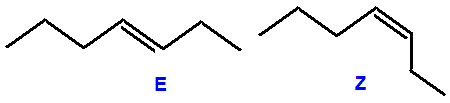 ,
skeletal formula
,
skeletal formula
has two E/Z
geometrical isomers:
Z/cis-
 , (Z)-hept-3-ene, (Z)-3-heptene
and
E/trans-
 , (E)-hept-3-ene, (E)-3-heptene
(cis and trans 3-heptene)
From the CIP assignment priority rule for
E/Z isomers:
6C > 1H about the
C=C bond.
CIP rule for the four atoms/groups around the >C=C< double bond
Number of low resolution
NMR chemical shift
δ
signal peaks: 7 1H
and 7 13C
(email
if disagree?)
1H NMR ratio of integrated proton
peak areas: 3 : 2 : 2 :
1
: 1
: 2 : 3 (for equivalent protons)
(4) 2-methylhex-1-ene,
 , ,  (2-methyl-1-hexene) (2-methyl-1-hexene)
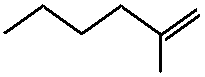 ,
skeletal formula
,
skeletal formula
A branched alkene with no E/Z
'geometrical' or R/S 'optical' stereoisomers
Number of low resolution
NMR chemical shift
δ
signal peaks: 6 1H
and 7 13C
(email
if disagree?)
1H NMR ratio of integrated proton
peak areas: 3 : 2 : 2 : 2
: 2 : 3 (for equivalent protons)
BUT, for the 'end' =CH2 alkene protons,
you can get two chemical shifts close together, if there are two
different groups attached to the other carbon of the C=C bond i.e.
R"R'C=CH2 where R" and R' are different. This causes the
two =CH2 protons to experience slightly different fields.
(5) 3-methylhex-1-ene,
 , ,
 (3-methyl-1-hexene) (3-methyl-1-hexene)
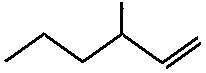 ,
skeletal formula, R/S 'optical' isomers (enantiomers)
,
skeletal formula, R/S 'optical' isomers (enantiomers)
Stereoisomers as carbon atom C3
is chiral (asymmetric, stereocentre)
Number of low resolution
NMR chemical shift
δ
signal peaks: 7 1H
and 7 13C
(email
if disagree?)
1H NMR ratio of integrated proton
peak areas: 3 : 2 : 2 :
3 : 1
: 1 : 2 (for equivalent protons)
BUT, for the 'end' =CH2 alkene protons,
you can get two chemical shifts close together, if there are two
different groups attached to the other carbon of the C=C bond i.e.
R"R'C=CH2 where R" and R' are different. This causes the
two =CH2 protons to experience slightly different fields.
(6) 4-methylhex-1-ene,
 , ,
 (4-methyl-1-hexene) (4-methyl-1-hexene)
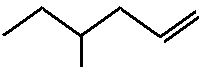 ,
skeletal formula, R/S 'optical' isomers (enantiomers)
,
skeletal formula, R/S 'optical' isomers (enantiomers)
Stereoisomers as carbon atom C4
is chiral (asymmetric, stereocentre)
Number of low resolution
NMR chemical shift
δ
signal peaks: 7 1H
and 7 13C
(email
if disagree?)
1H NMR ratio of integrated proton
peak areas: 3 : 2 : 1 :
3
: 2 : 1 : 2 (for equivalent protons)
BUT, for the 'end' =CH2 alkene protons,
you can get two chemical shifts close together, if there are two
different groups attached to the other carbon of the C=C bond i.e.
R"R'C=CH2 where R" and R' are different. This causes the
two =CH2 protons to experience slightly different fields.
(7) 5-methylhex-1-ene,
 , ,
 (5-methyl-1-hexene)
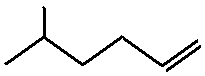 ,
skeletal formula
,
skeletal formula
A branched alkene with no E/Z
'geometrical' or R/S 'optical' stereoisomers
Number of low resolution
NMR chemical shift
δ
signal peaks: 6 1H
and 6 13C
(email
if disagree?)
1H NMR ratio of integrated proton
peak areas: 6
(3+3) : 1 : 2 : 2
: 1 : 2 (for equivalent protons)
BUT, for the 'end' =CH2 alkene protons,
you can get two chemical shifts close together, if there are two
different groups attached to the other carbon of the C=C bond i.e.
R"R'C=CH2 where R" and R' are different. This causes the
two =CH2 protons to experience slightly different fields.
(8)
2-methylhex-2-ene,
 , ,
 (2-methyl-2-hexene)
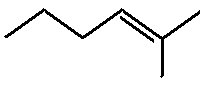 ,
skeletal formula
,
skeletal formula
A branched alkene with no E/Z
'geometrical' or R/S 'optical' stereoisomers
Number of low resolution
NMR chemical shift
δ
signal peaks: 5 1H
and 6 13C
(email
if disagree?)
1H NMR ratio of integrated proton
peak areas: 3 : 2 : 2
: 1 : 6 (3+3) (for equivalent protons)
(9)
3-methylhex-2-ene,
 ,
skeletal formula, 3-methyl-2-hexene
,
skeletal formula, 3-methyl-2-hexene

has two E/Z
geometrical isomers: E-
 and
Z- and
Z-

From the CIP assignment priority rule for
E/Z isomers:
6C6C >
6C1H > 1H
CIP rule for the four atoms/groups around the >C=C< double bond
(E)-3-methylhex-2-ene, (E)-3-methyl-2-hexene,
(Z)-3-methylhex-2-ene, (Z)-3-methyl-2-hexene
Number of low resolution
NMR chemical shift
δ
signal peaks: 6 1H
and 7 13C
(email
if disagree?)
1H NMR ratio of integrated proton
peak areas: 3 : 2 : 2
: 3
: 1 : 3 (for equivalent protons)
(10)
4-methylhex-2-ene,
 ,
skeletal formula ,
skeletal formula
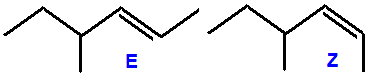
has two E/Z
geometrical isomers: Z/cis-
 , (Z)-4-methylhex-2-ene, (Z)-4-methyl-2-hexene and
E/trans-
, (Z)-4-methylhex-2-ene, (Z)-4-methyl-2-hexene and
E/trans-
 ,
(E)-4-methylhex-2-ene,
(E)-4-methyl-2-hexene
,
(E)-4-methylhex-2-ene,
(E)-4-methyl-2-hexene
From the CIP assignment priority rule for
E/Z isomers:
6C > 1H
CIP rule for the four atoms/groups around the >C=C< double bond
both E/Z
isomers can also theoretically exhibit R/S 'optical' isomerism, complicated
- university level.
R/S
stereoisomers as carbon atom C4
is chiral (asymmetric, stereocentre)
Number of low resolution
NMR chemical shift
δ
signal peaks: 7 1H
and 7 13C
(email
if disagree?)
1H NMR ratio of integrated proton
peak areas: 3 : 2 : 1
: 3
: 1 : 1 : 3 (for equivalent protons)
(11)
5-methylhex-2-ene,
 ,
skeletal formula ,
skeletal formula
has two
E/Z geometrical isomers:
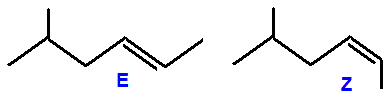
(E)-5-methylhex-2-ene,
(E)-5-methyl-2-hexene,
(Z)-5-methylhex-2-ene, (Z)-5-methyl-2-hexene
From the CIP assignment priority rule for
E/Z isomers:
6C > 1H
CIP rule for the four atoms/groups around the >C=C< double bond
Number of low resolution
NMR chemical shift
δ
signal peaks: 6 1H
and 6 13C
(email
if disagree?)
1H NMR ratio of integrated proton
peak areas: 6
(3+3) : 1 : 2 : 1
: 1 : 3 (for equivalent protons)
Z/cis-
 and
E/trans- and
E/trans-

(12)
2-methylhex-3-ene,
 ,
skeletal formula ,
skeletal formula
has
E/Z geometrical isomers:

(E)-2-methylhex-3-ene,
(E)-2-methyl-3-hexene, (Z)-2-methylhex-3-ene, (Z)-2-methyl-3-hexene
Z-
 and
E- and
E-
 (cis
and trans 2-methyl-3-hexene) (cis
and trans 2-methyl-3-hexene)
From the CIP assignment priority rule for
E/Z isomers:
6C6C >
6C1H > 1H
CIP rule for the four atoms/groups around the >C=C< double bond
Number of low resolution
NMR chemical shift
δ
signal peaks: 6 1H
and 6 13C
(email
if disagree?)
1H NMR ratio of integrated proton
peak areas: 3 : 2 : 1
: 1
: 1 : 6 (3+3) (for equivalent protons)
(13)
3-methylhex-3-ene,
 ,
skeletal formula
,
skeletal formula
has E/Z geometrical isomers:
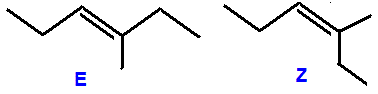
(E)-3-methylhex-3-ene,
(E)-3-methyl-3-hexene, (Z)-3-methylhex-3-ene, (Z)-3-methyl-3-hexene
Z-
 and
E- and
E-
 (cis and trans 3-methyl-3-hexene)
From the CIP assignment priority rule for
E/Z isomers:
6C6C >
6C1H > 1H
CIP rule for the four atoms/groups around the >C=C< double bond
Number of low resolution
NMR chemical shift
δ
signal peaks: 6 1H
and 7 13C
(email
if disagree?)
1H NMR ratio of integrated proton
peak areas: 3 : 2 : 1
: 3
: 2 : 3 (for equivalent protons)
(14) 2,3-dimethypent-1-ene,
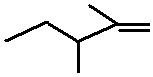 ,
skeletal formula, 2,3-dimethyl-1-pentene ,
skeletal formula, 2,3-dimethyl-1-pentene
R/S 'optical' isomers (pair of
enantiomers)
R/S s tereoisomers
as carbon atom C3 is chiral (asymmetric, stereocentre)
Number of low resolution
NMR chemical shift
δ
signal peaks: 6 1H
and 7 13C
(email
if disagree?)
1H NMR ratio of integrated proton
peak areas: 3 : 2 : 1
: 3
: 3 : 2 (for equivalent protons)
BUT, for the 'end' =CH2 alkene protons,
you can get two chemical shifts close together, if there are two
different groups attached to the other carbon of the C=C bond i.e.
R"R'C=CH2 where R" and R' are different. This causes the
two =CH2 protons to experience slightly different fields.
(15) 2,4-dimethylpent-1-ene,
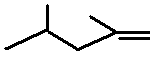 ,
skeletal formula, 2,4-dimethyl-1-pentene ,
skeletal formula, 2,4-dimethyl-1-pentene
A branched alkene with no E/Z
'geometrical' or R/S 'optical' stereoisomers
Number of low resolution
NMR chemical shift
δ
signal peaks: 5 1H
and 6 13C
(email
if disagree?)
1H NMR ratio of integrated proton peak areas: 6
(3+3) : 1 : 2 : 3
: 2 (for equivalent protons)
BUT, for the 'end' =CH2 alkene protons,
you can get two chemical shifts close together, if there are two
different groups attached to the other carbon of the C=C bond i.e. R"R'C=CH2 where
R" and R' are different. This causes the
two =CH2 protons to experience slightly different fields.
(16) 3,3-dimethylpent-1-ene,
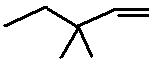 ,
skeletal formula, 3,3-dimethyl-1-pentene ,
skeletal formula, 3,3-dimethyl-1-pentene
A branched alkene with no E/Z
'geometrical' or R/S 'optical' stereoisomers
Number of low resolution
NMR chemical shift
δ
signal peaks: 5 1H
and 6 13C
(email
if disagree?)
1H NMR ratio of integrated proton peak areas: 3 : 2 : 6
(3+3) : 1
: 2 (for equivalent protons)
BUT, for the 'end' =CH2 alkene protons,
you can get two chemical shifts close together, if there are two
different groups attached to the other carbon of the C=C bond i.e. R"R'C=CH2 where
R" and R' are different. This causes the
two =CH2 protons to experience slightly different fields.
(17) 3,4-dimethylpent-1-ene,
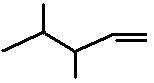 ,
skeletal formula, 3,4-dimethyl-1-pentene ,
skeletal formula, 3,4-dimethyl-1-pentene
A branched alkene with no E/Z
'geometrical' but has R/S 'optical' stereoisomers
because C3 is chiral stereocentre.
Number of low resolution
NMR chemical shift
δ
signal peaks: 6 1H
and 6 13C
(email
if disagree?)
1H NMR ratio of integrated proton peak areas: 6
(3+3) : 1 : 1 : 3 : 1
: 2 (for equivalent protons)
BUT, for the 'end' =CH2 alkene protons,
you can get two chemical shifts close together, if there are two
different groups attached to the other carbon of the C=C bond i.e. R"R'C=CH2 where
R" and R' are different. This causes the
two =CH2 protons to experience slightly different fields.
(18) 4,4-dimethylpent-1-ene,
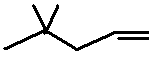 ,
skeletal formula, 4,4-dimethyl-1-pentene ,
skeletal formula, 4,4-dimethyl-1-pentene
A branched alkene with no E/Z
'geometrical' or R/S 'optical' stereoisomers
Number of low resolution
NMR chemical shift
δ
signal peaks: 4 1H
and 6 13C
(email
if disagree?)
1H NMR ratio of integrated proton peak areas: 9
(3x3) : 2 : 1 : 2 (for equivalent protons)
BUT, for the 'end' =CH2 alkene protons,
you can get two chemical shifts close together, if there are two
different groups attached to the other carbon of the C=C bond i.e. R"R'C=CH2 where
R" and R' are different. This causes the
two =CH2 protons to experience slightly different fields.
(19) 2-ethylpent-1-ene
(3-methylenehexane),
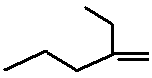 ,
skeletal formula, 2-ethyl-1-pentene ,
skeletal formula, 2-ethyl-1-pentene
A branched alkene with no E/Z
'geometrical' or R/S 'optical' stereoisomers
Number of low resolution
NMR chemical shift
δ
signal peaks: 6 1H
and 7 13C
(email
if disagree?)
1H NMR ratio of integrated proton peak
areas: 3 : 2 : 2 : 2
: 3
: 2 (for equivalent protons)
BUT, for the 'end' =CH2 alkene protons,
you can get two chemical shifts close together, if there are two
different groups attached to the other carbon of the C=C bond i.e. R"R'C=CH2 where
R" and R' are different. This causes the
two =CH2 protons to experience slightly different fields.
(20)
3-ethylpent-1-ene,
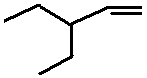 ,
skeletal formula, 3-ethyl-1-pentene ,
skeletal formula, 3-ethyl-1-pentene
A branched alkene with no E/Z
'geometrical' or R/S 'optical' stereoisomers
Number of low resolution
NMR chemical shift
δ
signal peaks: 5 1H
and 5 13C
(email
if disagree?)
1H NMR ratio of integrated proton peak
areas: 6
(3+3) : 4
(2+2)
: 1 : 1
: 2 (for equivalent protons)
BUT, for the 'end' =CH2 alkene protons,
you can get two chemical shifts close together, if there are two
different groups attached to the other carbon of the C=C bond i.e. R"R'C=CH2 where
R" and R' are different. This causes the
two =CH2 protons to experience slightly different fields.
(21) 2,3-dimethylpent-2-ene,
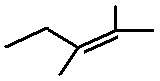 ,
skeletal formula, 2,3-dimethy-2-pentene ,
skeletal formula, 2,3-dimethy-2-pentene
A branched alkene with no E/Z
'geometrical' or R/S 'optical' stereoisomers
Number of low resolution
NMR chemical shift
δ
signal peaks: 4 1H
and 6 13C
(email
if disagree?)
1H NMR ratio of integrated proton peak
areas: 3 : 2 : 3 : 6
(3+3) (for equivalent protons)
(22)
2,4-dimethylpent-2-ene,
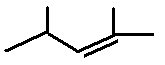 ,
skeletal formula, 2,4-dimethyl-2-pentene
,
skeletal formula, 2,4-dimethyl-2-pentene
A branched alkene with no E/Z
'geometrical' or R/S 'optical' stereoisomers.
Like a number of the isomers, the two end methyl
groups attached to C2 of the C=C bond, prohibit E/Z isomerism.
Number of low resolution
NMR chemical shift
δ
signal peaks: 4 1H
and 5 13C
(email
if disagree?)
1H NMR ratio of integrated proton peak
areas: 6
(3+3) : 1 : 1 : 6 (3+3) (for equivalent protons)
(23) 3,4-dimethylpent-2-ene,
 , 3,4-dimethyl-2-pentene , 3,4-dimethyl-2-pentene
E/Z isomerism (pair of geometrical isomers)
skeletal formula of: (E)-3,4-dimethypent-2-ene,
(E)-3,4-dimethyl-2-pentene,
(Z)-3,4-dimethypent-2-ene, (Z)-3,4-dimethyl-2-pentene
From the CIP assignment priority rule for
E/Z isomers:
6C6C >
6C1H > 1H
CIP rule for the four atoms/groups around the >C=C< double bond
Number of low resolution
NMR chemical shift
δ
signal peaks: 5 1H
and 6 13C
(email
if disagree?)
1H NMR ratio of integrated proton
peak areas: 6
(3+3) : 1 : 3 : 1 : 3 (for equivalent protons)
(24) 4,4-dimethylpent-2-ene,
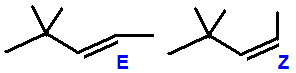 ,
4,4-dimethyl-2-pentene ,
4,4-dimethyl-2-pentene
E/Z isomerism (pair of geometrical isomers)
From the CIP assignment priority rule for
E/Z isomers:
6C > 1H
CIP rule for the four atoms/groups around the >C=C< double bond
Number of low resolution
NMR chemical shift
δ
signal peaks: 4 1H
and 5 13C
(email
if disagree?)
1H NMR ratio of integrated proton
peak areas: 9
(3x3) : 1 : 1 : 3 (for equivalent protons)
skeletal formula of: (E)-4,4-dimethypent-2-ene,
(E)-4,4-dimethyl-2-pentene,
(Z)-4,4-dimethypent-2-ene, (Z)-4,4-dimethyl-2-pentene
(25) 2,3,3-trimethylbut-1-ene,
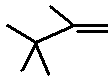 ,
skeletal formula, 2,3,3-trimethyl-1-butene
,
skeletal formula, 2,3,3-trimethyl-1-butene
A branched alkene with no E/Z
'geometrical' or R/S 'optical' stereoisomers
Number of low resolution
NMR chemical shift
δ
signal peaks: 3 1H
and 5 13C
(email
if disagree?)
1H NMR ratio of integrated proton peak
areas: 9
(3x3) : 3 : 2 (for equivalent protons)
BUT, for the 'end' =CH2 alkene protons,
you can get two chemical shifts close together, if there are two
different groups attached to the other carbon of the C=C bond i.e. R"R'C=CH2 where
R" and R' are different. This causes the
two =CH2 protons to experience slightly different fields.
Secondly, saturated aliphatic
cycloalkanes (alicyclic) compounds with a carbon ring of 3-7 carbon atoms
These are functional group isomers of the alkenes above.
Since
these cycloalkanes have no C=C bond, none of these will show a characteristic,
relatively strong and sharp absorption band in their infrared spectrum, around
wavenumbers 1640-1680 cm-1 for the stretching vibration of the C=C
bond.
(26) cycloheptane,
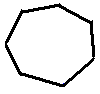 ,
skeletal formula ,
skeletal formula
NO stereoisomerism i.e.
no E/Z 'geometrical' isomers and no R/S 'optical' isomers
(enantiomers).
A very symmetrical molecule.
Number of low resolution
NMR chemical shift
δ
signal peaks: 1 1H
and 1 13C
(email
if disagree?)
 (27)
methylcyclohexane, (27)
methylcyclohexane,
 ,
,
 =
=
 !!!
skeletal formula
!!!
skeletal formula
NO stereoisomerism i.e.
no E/Z 'geometrical' isomers and no R/S 'optical' isomers
(enantiomers). Number of low resolution
NMR chemical shift
δ
signal peaks: 5 1H
and 5 13C
(email
if disagree?)
1H NMR ratio of integrated proton peak areas: 2 : 4
(2+2) : 4 (2+2) : 1 : 3 (for equivalent protons)
 (28)
ethylcyclopentane , (28)
ethylcyclopentane ,
 , ,
 ,
skeletal formula
,
skeletal formula
NO stereoisomerism i.e.
no E/Z 'geometrical' isomers and no R/S 'optical' isomers
(enantiomers).Number of low resolution
NMR chemical shift
δ
signal peaks: 5 1H
and 5 13C
(email
if disagree?)
1H NMR ratio of integrated proton peak areas: 4
(2+2) : 4 (2+2) : 1 : 2 : 3 (for equivalent protons)
 (29)
1,1-dimethylcyclopentane , (29)
1,1-dimethylcyclopentane ,
 , ,
 ,
skeletal formula
,
skeletal formula
NO stereoisomerism i.e.
no E/Z 'geometrical' isomers and no R/S 'optical' isomers
(enantiomers).Number of low resolution
NMR chemical shift
δ
signal peaks: 3 1H
and 4 13C
(email
if disagree?)
1H NMR ratio of integrated proton peak areas: 4
(2+2) : 4 (2+2) : 6
(3+3) (for equivalent protons)
 (30)
1,2-dimethylcyclopentane , (30)
1,2-dimethylcyclopentane ,
 , ,
 ,
skeletal formula
,
skeletal formula
Theoretically E/Z and R/S isomers - complicated - university level
Number of low resolution
NMR chemical shift
δ
signal peaks: 4 1H
and 4 13C
(email
if disagree?)
1H NMR ratio of integrated proton peak areas: 2 : 4
(2+2) : 2 (1+1) : 6
(3+3) (for equivalent protons)
 (31)
1,3-dimethylcyclopentane , (31)
1,3-dimethylcyclopentane ,
 , ,
 ,
skeletal formula
,
skeletal formula
E/Z and R/S isomers
- complicated - university level
Number of low resolution
NMR chemical shift
δ
signal peaks: 4 1H
and 4 13C
(email
if disagree?)
1H NMR ratio of integrated proton peak areas: 4
(2+2) : 2 (1+1) : 2 : 6
(3+3) (for equivalent protons)
(32) propylcyclobutane,
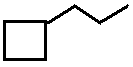 , skeletal formula , skeletal formula
NO stereoisomerism i.e.
no E/Z 'geometrical' isomers and no R/S 'optical' isomers
(enantiomers).Number of low resolution
NMR chemical shift
δ
signal peaks: 6 1H
and 6 13C
(email
if disagree?)
1H NMR ratio of integrated proton peak areas: 2 : 4
(2+2) : 1 : 2 : 2 : 3 (for equivalent protons)
(33) isopropylcyclobutane,
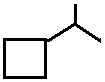 , skeletal formula , skeletal formula
NO stereoisomerism i.e.
no E/Z 'geometrical' isomers and no R/S 'optical' isomers
(enantiomers).Number of low resolution
NMR chemical shift
δ
signal peaks: 5 1H
and 5 13C
(email
if disagree?)
1H NMR ratio of integrated proton peak areas: 2 : 4
(2+2) : 1 : 1 : 6 (3+3) (for equivalent protons)
(34) 1-ethyl-1-methylcyclobutane,
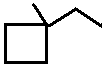 , skeletal formula , skeletal formula
NO stereoisomerism i.e.
no E/Z 'geometrical' isomers and no R/S 'optical' isomers
(enantiomers).Number of low resolution
NMR chemical shift
δ
signal peaks: 5 1H
and 6 13C
(email
if disagree?)
1H NMR ratio of integrated proton peak areas: 2 : 4
(2+2) : 3 : 2 : 3 (for equivalent protons)
(35) 1-ethyl-2-methylcyclobutane,
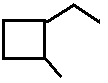 , skeletal formula , skeletal formula
E/Z and R/S isomers possible - university level analysis.
Number of low resolution
NMR chemical shift
δ
signal peaks: 7 1H
and 7 13C
(email
if disagree?)
1H NMR ratio of integrated proton peak areas: 2 : 2 : 1 : 2 : 3
: 1 : 3 (for equivalent protons)
(36)
1-ethyl-3-methylcyclobutane,
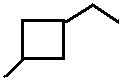 , skeletal formula , skeletal formula
E/Z geometrical isomers.
Number of low resolution
NMR chemical shift
δ
signal peaks: 6 1H
and 6 13C
(email
if disagree?)
1H NMR ratio of integrated proton peak areas: 3 : 1 :
4(2+2) : 1 : 2 : 3 (for equivalent protons)
(37) 1,1,2-trimethylcyclobutane,
 , skeletal formula , skeletal formula
R/S isomerism possible, C2 is chiral.
Number of low resolution
NMR chemical shift
δ
signal peaks: 5 1H
and 6 13C
(email
if disagree?)
1H NMR ratio of integrated proton peak areas: 2 : 2 : 6
(3+3) : 1 : 3 (for equivalent protons)
(38) 1,1,3-trimethylcyclobutane,
 , skeletal formula , skeletal formula
NO stereoisomerism i.e.
no E/Z 'geometrical' isomers and no R/S 'optical' isomers
(enantiomers).Number of low resolution
NMR chemical shift
δ
signal peaks: 4 1H
and 5 13C
(email
if disagree?)
1H NMR ratio of integrated proton peak areas: 3 : 1 : 4
(2+2) : 6 (3+3) (for equivalent protons)
(39) 1,2,3-trimethylcyclobutane,
 , skeletal
formula , skeletal
formula
'geometrical' E/Z and 'optical' R/S isomerism
possible - complicated analysis - university level
Number of low resolution
NMR chemical shift
δ
signal peaks: 7 1H
and 7 13C
(email
if disagree?)
1H NMR ratio of integrated proton peak areas: 3 : 1 : 2 : 1 : 3 : 1
: 3 (for equivalent protons)
(40) butylcyclopropane,
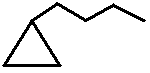 ,
skeletal formula ,
skeletal formula
NO stereoisomerism i.e.
no E/Z 'geometrical' isomers and no R/S 'optical' isomers
(enantiomers).Number of low resolution
NMR chemical shift
δ
signal peaks: 6 1H
and 6 13C
(email
if disagree?)
1H NMR ratio of integrated proton peak areas: 4
(2+2) : 1 : 2 : 2 : 2 : 3 (for equivalent protons)
(41) 2-cyclopropylbutane,
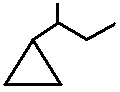 , skeletal formula , skeletal formula
R/S 'optical' isomerism, carbon atom 2 of the butane chain
is chiral.
Number of low resolution
NMR chemical shift
δ
signal peaks: 6 1H
and 6 13C
(email
if disagree?)
1H NMR ratio of integrated proton peak areas: 4
(2+2) : 1 : 1 : 3 : 2 : 3 (for equivalent protons)
(42) (2-methylpropyl)-cyclopropane,
1-cyclopropyl-2-methylpropane,
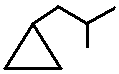 , skeletal
formula , skeletal
formula
NO stereoisomerism i.e.
no E/Z 'geometrical' isomers and no R/S 'optical' isomers
(enantiomers).Number of low resolution
NMR chemical shift
δ
signal peaks: 5 1H
and 5 13C
(email
if disagree?)
1H NMR ratio of integrated proton peak areas: 4
(2+2) : 1 : 2 : 1 : 6
(3+3) (for equivalent protons)
(43) 1-methyl-1-isopropylcyclobutane,
1-cyclopropyl-1-methylpropane,
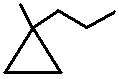 , skeletal
formula , skeletal
formula
NO stereoisomerism i.e.
no E/Z 'geometrical' isomers and no R/S 'optical' isomers
(enantiomers).Number of low resolution
NMR chemical shift
δ
signal peaks: 5 1H
and 6 13C
(email
if disagree?)
1H NMR ratio of integrated proton peak areas: 4
(2+2) : 3 : 2 : 2 : 3 (for equivalent protons)
(44) 1-methyl-2-propylcyclopropane,
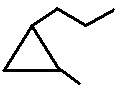 , skeletal
formula , skeletal
formula
'geometrical' E/Z and 'optical' R/S isomerism
possible - complicated analysis - university level
Number of low resolution
NMR chemical shift
δ
signal peaks: 7 1H
and 7 13C
(email
if disagree?)
1H NMR ratio of integrated proton peak areas: 2 : 1 : 2 : 2 : 3 : 1
: 3 (for equivalent protons)
(45) 1-methyl-1-isopropylcyclopropane,
 , skeletal
formula , skeletal
formula
NO stereoisomerism i.e.
no E/Z 'geometrical' isomers and no R/S 'optical' isomers
(enantiomers).Number of low resolution
NMR chemical shift
δ
signal peaks: 4 1H
and 5 13C
(email
if disagree?)
1H NMR ratio of integrated proton peak areas: 4
(2+2) : 3 : 1 : 6 (3+3) (for equivalent protons)
(46) 1-methyl-2-isopropylcyclopropane,
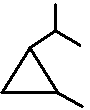 , skeletal
formula , skeletal
formula
'geometrical' E/Z and 'optical' R/S isomerism
possible - complicated analysis - university level
Number of low resolution
NMR chemical shift
δ
signal peaks: 6 1H
and 6 13C
(email
if disagree?)
1H NMR ratio of integrated proton peak areas: 2 : 1 : 1 : 6
(3+3) : 1 : 3 (for equivalent protons)
(47) 1,1-diethylcyclopropane,
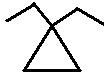 , skeletal formula , skeletal formula
NO stereoisomerism i.e.
no E/Z 'geometrical' isomers and no R/S 'optical' isomers
(enantiomers).Number of low resolution
NMR chemical shift
δ
signal peaks: 3 1H
and 4 13C
(email
if disagree?)
1H NMR ratio of integrated proton peak areas: 4
(2+2) : 4 (2+2) :
6 (3+3) (for equivalent protons)
Reduced number of NMR peaks due to the very high
symmetry of the molecule.
(48) 1,2-diethylcyclopropane,
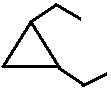 , skeletal formula , skeletal formula
'geometrical' E/Z and 'optical' R/S isomerism
possible - complicated analysis - university level
Number of low resolution
NMR chemical shift
δ
signal peaks: 4 1H
and 4 13C
(email
if disagree?)
1H NMR ratio of integrated proton peak areas: 2 : 2
(1+1) : 4 (2+2) : 6
(3+3) (for equivalent protons)
Reduced number of NMR peaks due to the very high
symmetry of the molecule.
(49) 1-ethyl-1,2-dimethylcyclopropane,
2-ethyl-1,2-dimethylcyclopropane,
 , skeletal formula , skeletal formula
'geometrical' E/Z and 'optical' R/S isomerism
possible - complicated analysis - university level
Number of low resolution
NMR chemical shift
δ
signal peaks: 6 1H
and 7 13C
(email
if disagree?)
1H NMR ratio of integrated proton peak areas: 2 : 3 : 2 : 3 : 1 : 3 (for equivalent protons)
(50) 2-ethyl-1,1-dimethylcyclopropane,
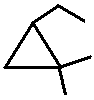 , skeletal
formula , skeletal
formula
NO stereoisomerism
i.e. no E/Z 'geometrical' isomers and no R/S 'optical'
isomers (enantiomers).Number of low resolution
NMR chemical shift
δ
signal peaks: 5 1H
and 6 13C
(email
if disagree?)
1H NMR ratio of integrated proton peak areas: 2 : 1 : 2 : 3 : 6
(3+3) (for equivalent protons)
(51) 1-ethyl-2,3-dimethylcyclopropane,
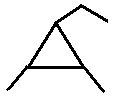 , skeletal
formula , skeletal
formula
'geometrical' E/Z and 'optical' R/S isomerism
possible - complicated analysis - university level
Number of low resolution
NMR chemical shift
δ
signal peaks: 5 1H
and 5 13C
(email
if disagree?)
1H NMR ratio of integrated proton peak areas: 6
(3+3) : 2 (1+1) : 1 : 2 : 3 (for equivalent protons)
(52) 1,1,2,2-tetramethylcyclopropane,
 , skeletal
formula , skeletal
formula
Number of low resolution
NMR chemical shift
δ
signal peaks: 2 1H
and 3 13C
(email
if disagree?)
1H NMR ratio of integrated proton peak areas: 2 : 12
(4x3) = 1 : 6 (for equivalent protons)
NO stereoisomerism i.e.
no E/Z 'geometrical' isomers and no R/S 'optical' isomers
(enantiomers).
Reduced number of NMR peaks due to the very high symmetry of the molecule.
(53) 1,1,2,3-tetramethylcyclopropane,
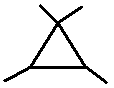 , skeletal
formula , skeletal
formula
'geometrical' E/Z and 'optical' R/S isomerism
possible - complicated analysis - university level
Number of low resolution
NMR chemical shift
δ
signal peaks: 3 1H
and 4 13C
(email
if disagree?)
1H NMR ratio of integrated proton peak areas: 6
(3+3) : 2 (1+1) : 6
(3+3) = 2 : 1 : 3 (for equivalent protons)
Reduced number of NMR peaks due to the very high
symmetry of the molecule.
(C) EXTRA NOTES
selected isomers of C7H14
There are many constitutional isomers of C7H14,
including straight-chain and branched alkenes, as well as cycloalkanes.
These exhibit chain,
position, and functional group isomerism, with distinct physical and
chemical properties, reactivities, and applications.
Constitutional Isomers of C7H14
C7H14 has one degree of
unsaturation, allowing for either:
Straight and
Branched Alkenes (Acyclic)
|
Isomer Type |
Example Name |
Description |
|
Straight-chain alkene |
1-heptene, 2-heptene |
Double bond at
different positions |
|
Branched alkene |
2-methylhexene,
3-methylhexene |
Methyl branch with
varying C=C position |
|
Geometric isomers |
cis-/trans-2-heptene |
Restricted rotation
around C=C |
Cycloalkanes
|
Isomer Type |
Example Name |
Description |
|
Cycloheptane |
Unbranched ring |
Saturated ring |
|
Methylcyclohexane |
One methyl substituent |
Position affects
isomer type |
|
Ethylcyclopentane |
Five-membered ring +
ethyl |
Ring size variation |
Types of Isomerism Exhibited by the isomers of C7H14
-
Chain Isomerism: Different carbon skeletons
(e.g., straight vs. branched).
-
Position Isomerism: Location of double bond
or substituent varies.
-
Functional Group Isomerism: Alkenes vs.
cycloalkanes.
-
Geometric (cis-trans) Isomerism: In alkenes
with restricted rotation around C=C.
Differences in Physical Properties of the isomers
of C7H14
|
Property |
Alkenes |
Cycloalkanes |
|
Boiling Point |
Slightly lower |
Slightly higher |
|
Density |
Lower |
Higher |
|
Reactivity |
More reactive (C=C) |
Less reactive |
|
Solubility in water |
Insoluble |
Insoluble |
Differences in Chemical
Reactions and Reactivity of
isomers of C7H14
-
Alkenes:
-
Undergo electrophilic addition (e.g.,
bromination, hydration).
-
Can form polymers (e.g., polyethylene from ethene).
-
React with KMnO4 (oxidation) and HBr
(Markovnikov/anti-Markovnikov).
-
Cycloalkanes:
-
Undergo substitution reactions.
-
Less reactive than alkenes due to lack of π-bond.
-
Can undergo ring-opening under specific conditions.
Relative Reactivity:
Alkenes > Cycloalkanes
(π-bond in alkenes makes them more reactive toward electrophiles.)
Uses and Applications of isomers of C7H14
-
Alkenes: Precursors to plastics, alcohols,
and industrial chemicals.
-
Cycloalkanes: Used in fuel additives,
solvents, and synthetic intermediates.
Common Student Misconceptions about isomers of C7H14
-
Confusing chain isomerism with
position isomerism.
-
Forgetting cis-trans isomerism applies only
to alkenes with two different groups on each C of the double bond.
-
Assuming cycloalkanes are aromatic—they are
not.
-
Believing all isomers have similar boiling points—branching
lowers boiling point.
Exam Revision Tips for questions that may involve
isomers of C7H14
-
Draw all isomers: Use skeletal structures
to visualize chain and ring variations.
-
Practice IUPAC naming: Focus on longest
chain, position of double bond, and substituents.
-
Use reaction maps: Compare addition
reactions of alkenes vs. substitution in cycloalkanes.
-
For spectroscopy:
-
Model kits: Help visualize cis-trans
isomerism and ring strain.
-
Past papers: Focus on isomer
identification, naming, and reaction mechanisms.
(D)
Learning objectives - questions to be answered?
Can you IUPAC name these
C7H14 isomers?
Can you deduce the number of principal 1H chemical shifts and
proton ratio you would expect to see in the NMR spectrum of these
C7H14
isomers?
Can you deduce the number of principal 13C chemical shifts you
would expect to see in the NMR spectrum of these
C7H14
isomers?
How many isomers are there of
molecular formula C7H14?
How do you work out the structure
of the isomers of molecular formula C7H14?
How do you draw the constitutional-structural
formula of the isomers of molecular formula
C7H14?
How do you draw the skeletal formula of the isomers of molecular formula
C7H14?
How do you name the isomers of molecular formula
C7H14?
How many aliphatic structural
isomers are there of molecular formula C7H14?
How many aliphatic carbon chain
isomers are there of molecular formula C7H14?
How many positional isomers are
there of molecular formula C7H14?
Does C7H14 have any stereoisomers?
Are there any E/Z (geometrical) or
RS (optical) stereoisomers (enantiomers) of C7H14?
Are there any aliphatic open chain
alkene isomers of molecular formula C7H14?
Are there any alkane/cycloalkane isomers of
molecular formula C7H14?
Are there any alkene/cycloalkene/diene/alkyne isomers of
molecular formula C7H14?
Are there any alicyclic cycloalkane
isomers of molecular formula C7H14?
Are there any functional group
isomers with a molecular formula C7H14?
This page will answer these questions for molecular formula C7H14
(E) QUESTIONS
|
Practise exam questions
based on isomers of molecular formula
the isomers of C7H14
Jot
down your responses with explanations.
ANSWERS
to the questions based on the isomers of
C7H14
If you think there are
any errors, please email me asap at
chem55555@hotmail.com
I don't mind if students/teachers do a selected printout
of these questions and answers.
Given these six selected isomers of molecular formula
C7H14
....
Q1 Name as many of isomers A to F as you can with
a correct IUPAC name.
Q2 (a) Which of A, B, C and E is an E/Z
(geometrical) isomer of C7H14?
(b) is it the E or Z isomer?
(c) Why can't E be an E/Z isomer?
Q3 Which of A, B, C and E is an R/S (optical)
isomer of C7H14?
Q4 Which of these C7H14
isomers will not readily react with bromine in an
organic solvent at room temperature?
Q5 In its NMR spectra, which C7H14
isomer will display four 1H and four 13C
chemical shifts?
Q6 In its NMR spectra, which C7H14
isomer will display three 1H and four
13C chemical shifts?
Q7 What would the most significant difference in
the infrared spectra of A, B, C and E compared to D and
F?
Jot
down your responses with explanations.
ANSWERS
to the questions based on the isomers of
C7H14
If you think there are
any errors, please email me asap at
chem55555@hotmail.com
I don't mind if students/teachers do a selected printout
of these questions and answers.
|
Associated organic chemistry links
Advanced Level pre-university
organic chemistry notes
IR, mass and H-1 & C-13 NMR
spectra of organic compounds
See also
Examples of the effects of isomerism on the similarity or difference
in the physical and chemical properties of structural isomers
and
Examples of comparing the physical and
chemical properties of alkene E/Z isomers
Index of sets of isomers for a given
molecular formula
The molecular structure and
naming of ALKANES
The molecular structure and naming
of ALKENES
Index of revision notes
on the chemistry of ALKANES and the petrochemical
industry
INDEX of
ALL revision notes on the chemistry ALKENES
including reactions and polymers
Isomerism: introduction, structural isomerism - chain,
positional, functional group, tautomerism
Stereoisomerism:
introduction, definition,
priority rules, E/Z isomerism (cis/trans isomerism)
Stereoisomerism - R/S isomerism (optical
isomerism) -
definition - examples explained
This is a big chemistry website, please allow time
to explore it
Index of my advanced
(pre-college/university) organic
chemistry revision notes
Index
of all my spectroscopy pages
Index
of all my isomerism pages
The chemistry of
alkanes and the petrochemical
industry
The
chemistry of alkenes
The
chemistry of haloalkanes
The
chemistry of
alcohols
The chemistry of aldehydes
and ketones
The
chemistry of carboxylic acids and derivatives
The chemistry of organo-nitrogen compounds
The chemistry of
aromatic compounds

|
Website content © Dr
Phil Brown 2000+. All copyrights reserved on revision notes, images,
quizzes, worksheets etc. Copying of Doc Brown's pre-university
advanced level chemistry website material is NOT
permitted. Exam revision summaries & references to science course specifications
are unofficial. These organic chemistry revision notes on
isomerism are
suitable for use of pre-university students studying AQA advanced level
chemistry, Edexcel advanced level chemistry, OCR advanced level
chemistry, IB advanced level chemistry, WJEC (Eduqas) advanced level
chemistry, CIE advanced level chemistry, US grade 11-12 AP honors
chemistry courses and they will also prove useful to
1st year undergraduate students of chemistry.
The isomerism of molecules of formulae
C7H14,
structural constitutional isomers, E/Z geometrical isomers and R/S
optical stereoisomers |
Keywords or phrases: how many isomers are
there of molecular formula C7H14? how do you name the isomers of
molecular formula C7H14? what is the molecular structure of the
isomers of C7H14, what type of isomerism is exhibited by molecules
of formula C7H14, how do you work out the isomers of molecular
formula C7H14, what are the structural isomers of C7H14, the carbon chain
isomers of C7H14 in the homologous series of alkanes, comparing
the spectra of isomers of molecular formula C7H14 how many structural isomers of C7H14 can
you draw? how many structural isomers does C7H14 have? what are
the possible isomers of C7H14? revision notes on isomerism of
C7H14 molecules E/Z isomers cis trans stereoisomers of C7H14,
isomers of C7H14 of molecular mass 98
cyclic
alkanes of formula C7H14 E/Z isomers of molecular formula C7H14 (geometric cis/trans
isomers) alkene molecules isomeric of molecular formula C7H14,
molecules isomeric with molecular formula C7H14, structural isomers of molecular
formula C7H14, optical isomers R/S enantiomers isomeric with molecular
formula C7H14, positional isomers isomeric with molecular formula
C7H14, alicyclic alkanes of formula C7H14 which types of isomerism are exhibited by molecules isomeric with
molecular formula C7H14 alkyl positional isomers of C7H14 branched
carbon chain alkene isomers of C7H14 cycloalkanes of molecular formula
C7H14 which are isomeric with alkenes of molecular formula C7H14
stereoisomers of molecular formula C7H14 cycloalkane functional
group isomers of C7H14
open carbon chain aliphatic alkane molecules isomeric of molecular formula
C7H14,
hydrocarbon molecules isomeric with molecular formula C7H14, structural isomers of molecular
formula C7H14, optical isomers R/S enantiomers isomeric with molecular
formula C7H14, positional isomers isomeric with molecular formula
C7H14,
which types of isomerism are exhibited by molecules isomeric with
molecular formula C7H14 alkyl positional isomers of C7H14 branched
carbon chain alkane isomers of C7H14
cycloalkane molecules isomeric of molecular formula C7H14,
cycloalkane molecules isomeric with molecular formula C7H14, structural isomers of molecular
formula C7H14, optical isomers R/S enantiomers isomeric with molecular
formula C7H14, positional isomers isomeric with molecular formula
C7H14,
which types of isomerism are exhibited by molecules isomeric with
molecular formula C7H14 alkyl positional isomers of C7H14 branched
carbon chain cycloalkane isomers of molecular formula C7H14
cycloalkene molecules isomeric of molecular formula C7H14,
cycloalkene molecules isomeric with molecular formula C7H14, structural isomers of molecular
formula C7H14, optical isomers R/S enantiomers isomeric with molecular
formula C7H14, positional isomers isomeric with molecular formula
C7H14,
which types of isomerism are exhibited by molecules isomeric with
molecular formula C7H14 alkyl positional isomers of C7H14
cycloalkenes branched carbon chain cycloalkene isomers of
molecular formula C7H14
cyclic alkanes of formula C7H14 E/Z isomers of molecular formula
C7H14 (geometric cis/trans
isomers) alkene molecules isomeric of molecular formula C7H14,
molecules isomeric with molecular formula C7H14, structural isomers of molecular
formula C7H14, optical isomers R/S enantiomers isomeric with molecular
formula C7H14, positional isomers isomeric with molecular formula
C7H14,
alicyclic alkanes of formula C7H14 which types of isomerism are exhibited by molecules isomeric with
molecular formula C7H14 alkyl positional isomers of C7H14 branched
carbon chain alkene isomers of C7H14 cycloalkanes of molecular formula
C7H14 which are isomeric with alkenes of molecular formula C7H14
stereoisomers of molecular formula C7H14 cycloalkane functional
group isomers of C7H14 are there alkyne isomers of C7H14? are
there cycloalkanes of formula C7H14? are there cycloalkenes of
formula C7H14 chain isomers of C7H14 functional group isomers of
C7H14 substituent and functional group positional isomers of
C7H14
|
ANSWERS
Practise exam questions
based on isomers of molecular formula
the isomers of C7H14
If you think there are
any errors, please email me asap at
chem55555@hotmail.com
I don't mind if students/teachers do a selected printout
of these questions and answers.
Given these six selected isomers of molecular formula
C7H14
....
Q1 Name as many of isomers A to F as you can with
a correct IUPAC name.
ANSWERS
A
hept-1-ene,
B
hept-2-ene,
C 3,4-dimethylpent-1-ene
D
1,2-dimethylcyclopentane,
E
2,4-dimethylpent-2-ene,
F
1,1,2,3-trimethylcyclopropane
Q2 (a) Which of A, B, C and E is an E/Z
(geometrical) isomer of C7H14?
(b) is it the E or Z isomer?
(c) Why can't E be an E/Z isomer?
ANSWERS
(a) The B
isomer because of the asymmetry at both ends of the C=C
bond.
(b) It is the
E isomer of hept-2ene, from the Cahn,
Ingold and Prolog priority rule, the longer alkyl chain
is > CH3 > H about the C=C bond.
(c) The symmetry of two methyl groups on the
right-hand end of the C=C bond.
Note: The alicyclic C7H14
isomers D and F exhibit an overlap of E/Z and R/S
isomerism, but can you see why? (university level
analysis needed here!)
Q3 Which of A, B, C and E is an R/S (optical)
isomer of C7H14?
ANSWER:
Isomer C, C3 is chiral, asymmetric, four
different atoms/groups attached to the same carbon atom,
therefore non-superimposable mirror images are possible
(enantiomers).
Again, note: The alicyclic C7H14
isomers D and F exhibit a complex overlap of E/Z and R/S
isomerism.
Q4 Which of these C7H14
isomers will not readily react with bromine in an
organic solvent at room temperature?
ANSWER:
D and F,
they have no reactive C=C bond.
Q5 In its NMR spectra, which C7H14
isomer will display four 1H and four 13C
chemical shifts?
ANSWER:
isomer D,
symmetrical molecule
Q6 In its NMR spectra, which C7H14
isomer will display three 1H and four
13C chemical shifts?
ANSWER:
isomer F,
symmetrical molecule, but one less 1H peak
because the C1 of the cyclopropane ring has no proton
attached to it.
Q7 What would the most significant difference in
the infrared spectra of A, B, C and E compared to D and
F?
ANSWER: D and F would not show the prominent
absorption band at ~1650 cm-1 due to the
presence of a
C=C group in the molecule.
If you think there are
any errors, please email me asap at
chem55555@hotmail.com
I don't mind if students/teachers do a selected printout
of these questions and answers.
|
|
