|
Part 6.
The Chemistry of Carboxylic Acids and their Derivatives
6.1 The molecular
structure
and nomenclature of carboxylic acids & derivatives - how to IUPAC name
them is explained with examples
Many examples
explained-
for the naming of carboxylic acids and their derivatives
e.g.
The
organic chemistry nomenclature of how to name carboxylic acids,
acid/acyl chlorides, acid/acyl amides, esters, acyl/acid anhydrides,
substituted carboxylic acids, nitriles and amino acids
[Author
©
Dr Phil Brown PhD:
Doc Brown's advanced level organic chemistry exam revision notes
suitable for students of UK A level chemistry courses & US K12 grade
11, grade 12 and AP honors chemistry courses:
How to name carboxylic acids and their derivatives
[updated May 26th 2026 *]
email doc
brown - comments - query?
*
[privacy, cookies and disclaimer]
All my revision notes on the
chemistry of carboxylic acids and derivatives
All my advanced A level organic
chemistry revision notes
Index of GCSE/IGCSE level oil and basic organic chemistry notes
Multiple choice/type
in name quiz on naming carboxylic acids and derivatives
Part 6
NAMING CARBOXYLIC ACIDS and DERIVATIVES


 Carboxylic acid nomenclature - names & structures
of aliphatic and aromatic carboxylic acids and derivatives and substituted derivatives of carboxylic
acids - How do you name carboxylic acids? How to name acid
chlorides (acyl chlorides)? How to name amides? How to name esters? How
to name amino acids? how to name amides? How to name substituted
carboxylic acids? Examples of displayed formula of carboxylic
acids, esters, amides, acid chlorides, acid anhydrides, graphic
formula, molecular formula, skeletal formula, structural formula, all of them
named and nomenclature explained.
Carboxylic acid nomenclature - names & structures
of aliphatic and aromatic carboxylic acids and derivatives and substituted derivatives of carboxylic
acids - How do you name carboxylic acids? How to name acid
chlorides (acyl chlorides)? How to name amides? How to name esters? How
to name amino acids? how to name amides? How to name substituted
carboxylic acids? Examples of displayed formula of carboxylic
acids, esters, amides, acid chlorides, acid anhydrides, graphic
formula, molecular formula, skeletal formula, structural formula, all of them
named and nomenclature explained.
Organic
Chemistry Part 6.1 sub-index for this page:
How to name Acids RCOOH
.. Acyl chlorides RCOCl ..
Amides RCONH2 ..
Esters RCOOR'
.. Acid anhydride
(RCO)2O
.. Substituted
RCOOH Acids .. acid nitriles RCN ..
Amino acids
Further examples
of:
(i) monocarboxylic
acids and their derivatives
(ii) aliphatic
saturated and unsaturated dicarboxylic acids
(iii)
aromatic acids and their derivatives
Practice Question -
can you name these more complex substituted carboxylic
acids?
Abbreviations used: mpt =
melting point; bpt = boiling point; dec = thermally
decomposes
Introduction to naming aliphatic
carboxylic acids and their derivatives
Carboxylic acids and their derivatives
are based on the O=C(X)R group
where R = H, alkyl or aryl and X is also
a variable e.g. OH, Cl, NH2 or OR' (R = alkyl or aryl)
OH is the hydroxyl/hydroxy group, and has the
acidic hydrogen, the proton source on ionisation.
The C=O is called the carbonyl group, as
in aldehydes and ketones, but the X grouping considerably modifies its behaviour with
respect to aldehydes and ketones.
A monocarboxylic acid, only has
one carboxylic acid grouping, usually at the end of the longest carbon
chain.
Dicarboxylic/tricarboxylic acids with
have 2/3 -COOH groups in the molecule.
A pictorial summary of five O=C(X)R types
of molecule is given below with a section on how to name them
individually. Note: For RCOCl (X = Cl) there is no stable acid
chloride HCOCl. Nitriles have quite a different structure.


TOP of
the page or try the practice exam questions via
Multiple choice/type in name quiz on naming carboxylic acids and derivatives
 1.
How do you name CARBOXYLIC ACIDS? 1.
How do you name CARBOXYLIC ACIDS?
-COOH is the carboxyl (carboxylic
acid) functional group of the
homologous series of carboxylic acids.
The primary suffix name for a carboxylic acid is based on the "longest carbon chain name
" plus the suffix "oic acid" for the COOH acidic bond system
e.g. methanoic acid, ethanoic acid etc.
The prefix of the IUPAC name comes
from the
parent alkane without the end 'e', to which is added ...oic acid. The e is
retained for dicarboxylic acids and prefixed to ...dioic acid.
Aromatic
carboxylic acids are named from the parent aromatic hydrocarbon.
Note: Derivative types 2. to 5. are carboxylic acid derivatives where the OH group is replaced by another group.
1st example
methanoic acid.
Aromatic acids have the same functional group, but directly
attached to a benzene (aromatic) ring and are therefore named on the basis of
being an 'aromatic' compound.
e.g.
aliphatic carboxylic acid
ethanoic acid,
aliphatic dicarboxylic acid,
 ethanedioic acid,
aromatic carboxylic acid
 2-methylbenzoic acid,
where the carboxylic acid functional group (O=C-OH) is directly attached to the benzene
(aromatic) ring (see 6. for more examples of substituted carboxylic acids. 2-methylbenzoic acid,
where the carboxylic acid functional group (O=C-OH) is directly attached to the benzene
(aromatic) ring (see 6. for more examples of substituted carboxylic acids.
 is an aromatic dicarboxylic acid
TOP of
the page or try the practice exam questions via
Multiple choice/type in name quiz on naming carboxylic acids and derivatives
 2.
How do you name
ACYL or ACID CHLORIDES? 2.
How do you name
ACYL or ACID CHLORIDES?
-COCl is the functional group of the homologous
series of acid/acyl chlorides.
The primary suffix name for an acid chloride or acyl chloride is based on the "longest carbon chain name"
plus the suffix "oyl chloride" for the COCl bond system.
e.g. ethanoyl chloride, propanoyl chloride etc. (there is no stable methanoyl
chloride). 1st
example
ethanoyl chloride
The prefix of the IUPAC name comes from the
parent alkane without the end 'e', to which is added ...oyl chloride]
Examples: aliphatic carboxylic acid chlorides (acyl chlorides)
 ethanoyl
chloride,
ethanoyl
chloride,
and
 butanoyl chloride,
The aromatic acid chloride
 , benzoyl chloride, the acyl chloride group (O=C-Cl) is directly attached to the
benzene ring.
, benzoyl chloride, the acyl chloride group (O=C-Cl) is directly attached to the
benzene ring.
TOP of
the page or try the practice exam questions via
Multiple choice/type in name quiz on naming carboxylic acids and derivatives
 3.
How do you name
ACYL or
ACID AMIDES? 3.
How do you name
ACYL or
ACID AMIDES?
-CONH2 is the functional group of the
homologous series of acid/acyl amides.
The primary suffix name for an acid amide is based on the "longest carbon chain name"
plus the suffix "amide" for the CONH2
bond system e.g. methanamide, ethanamide etc.
1st example
methanamide.
The prefix of the IUPAC name comes from the
parent alkane without the end 'e', to which is added ...amide e.g.
aliphatic acid amide
 butanamide and
 ethanamide ethanamide
aromatic acid amide
 benzamide, the amide group (O=C-NH2) is directly attached to the benzene (aromatic)
ring.
benzamide, the amide group (O=C-NH2) is directly attached to the benzene (aromatic)
ring.
TOP of
the page or try the practice exam questions via
Multiple choice/type in name quiz on naming carboxylic acids and derivatives
 4.
How do you name
ESTERS? 4.
How do you name
ESTERS?
-COOC is the functional group of the homologous
series of carboxylic acid esters.
The prefix part of the name
of an ester is derived from the alkyl (or aryl) part of the alcohol (or phenol).
The suffix part of the
ester name is based on the carboxylic acid, but the "…oic acid" becomes "…oate"
e.g. ethyl
ethanoate, methyl ethanoate, pentyl butanoate etc.
In the diagrams above, the R group is derived from the carboxylic acid and the R' group from the alcohol or phenol.
1st example methyl methanoate.
The first part of an ester's name is
derived from the alcohol/phenol e.g. methyl from methanol, ethyl from ethanol, propyl from propanol
and phenyl from phenol etc.
The second part of the name comes from the
carboxylic acid and ends in ...oate e.g. methanoate from methanoic
acid, ethanoate from ethanoic acid, propanoate from propanoic acid
and benzoate from benzoic acid etc.
Aliphatic esters e.g.
 methyl propanoate (from methanoic acid and methanol),
and
 ethyl ethanoate (from ethanol and ethanoic acid),
A (totally) aromatic ester
would be
 phenyl benzoate (from benzoic acid and phenol)
TOP of
the page or try the practice exam questions via
Multiple choice/type in name quiz on naming carboxylic acids and derivatives
 5. How do you name ACYL or ACID ANHYDRIDES? 5. How do you name ACYL or ACID ANHYDRIDES?
The primary suffix name for an acid anhydride is the "longest carbon chain name"
plus, as a separate word, the suffix "anhydride" for the (O=C)2O bond system
e.g. ethanoic anhydride, propanoic anhydride etc.
Note:
(i)
There is no stable methanoic anhydride
(ii) an acid anhydride is equal to two carboxylic acid molecules minus a water molecule
e.g. 2 RCOOH - H2O = (RCO)2O
1st
example ethanoic anhydride.
The prefix of the IUPAC name comes
from the
parent alkane without the end 'e', to which is added ...oic anhydride, so an aliphatic acid anhydride
is e.g.
 ethanoic anhydride
TOP of
the page or try the practice exam questions via
Multiple choice/type in name quiz on naming carboxylic acids and derivatives
 6.
How do you name
SUBSTITUTED CARBOXYLIC ACIDS? 6.
How do you name
SUBSTITUTED CARBOXYLIC ACIDS?
The
possible positions of the substituent(s) in an aliphatic carboxylic acid are denoted by carbons 2,3,4 etc. with
a prefix e.g. amino, hydroxy, halo… or alkyl… groups etc., and using the lowest possible numbers.
The 'lowest' numbers are determined by assigning number 1 to the carbon of the carboxylic acid (or other derived) group at the end of the longest C atom chain.
If there is more than one 'type' of substituent
e.g. using the prefixes: amino..., bromo…, chloro…, hydroxy ..., methyl… etc., they are written out in alphabetical order irrespective of carbon atom number (note:
di, tri are ignored in using this rule) e.g. 2-chloropropanoic acid CH3CHClCOOH.
1st example
chloroethanoic acid
aliphatic mono-substituted aliphatic acids
 chloroethanoic acid (halogen substituent, no number needed)
 4-methylhexanoic acid (alkyl group substituent, number needed)
 aminoethanoic acid (amino group substituent, no number needed)
3-aminopropanoic acid , (amino group substituent,
number needed)
(amino group substituent,
number needed)
 3-hydroxybutanoic acid
(hydroxy group substituent, number
needed)
3-hydroxybutanoic acid
(hydroxy group substituent, number
needed)
TOP of
the page or try the practice exam questions via
Multiple choice/type in name quiz on naming carboxylic acids and derivatives
7.
How do you name nitriles?
The nitrile functional group
consists of a carbon to nitrogen triple bond
-C≡N.
The name is based on the longest
carbon chain, including the C of the nitrile group and in this case the
'e of the ane' is retained. In case you didn't notice, this e is
absent in examples 1. to 6.
methanenitrile (methanonitrile, hydrogen
cyanide),
 , ,
 , ,

Note the linear H-C≡N
bond, bond angle 180o, a linear shaped molecule.
ethanenitrile (ethanonitrile,
acetonitrile), C2H3N,
 , ,
 , ,
 , ,
 , ,
 , ,

propanenitrile (propanonitrile, ethyl
cyanide), C3H5N,
 , ,
 , ,

skeletal formula versions for propanenitrile:
 , ,
 , ,

Note the linear C-C≡N
bond, bond angle 180o, but all the other bond angles are
~109o i.e. C-C-C, C-C-H, H-C-C, H-C-C.
Examples of hydroxy substituted nitriles
2-hydroxypropanenitrile, CH3CH(OH)CN,

2-hydroxy-2-methylpropanenitrile

2-hydroxy-2-methylbutanenitrile,

TOP of
the page or try the practice exam questions via
Multiple choice/type in name quiz on naming carboxylic acids and derivatives
(i) Examples of mono carboxylic acids and their derivatives
Acid and derivatives in order of:
1. methanoic, 2.
ethanoic, 3. propanoic, 4.
butanoic, 5. pentanoic,
6. hexanoic
and some 'old' names
are quoted in (italics).
1a. methanoic Acid
(formic acid), molecular formula CH2O2, structural
formulae  , , 
displayed formula
 ,
skeletal formula ,
skeletal formula
1b. methanamide
(formamide), molecular formula CH3NO,
structural formula  , , 
displayed formula
 ,
skeletal formula ,
skeletal formula

1c. methyl methanoate
(methyl formate), C2H4O2, structural
formula  , , 
displayed formula
 ,
skeletal formula ,
skeletal formula

1d. ethyl methanoate,
molecular formula C3H6O2, structural formulae  , , 
displayed formula
 ,
skeletal formula ,
skeletal formula

1e. propyl methanoate,
molecular formula C4H8O2, abbreviated structural formulae 
structured formula
 ,
skeletal formula ,
skeletal formula

an isomer of this is HCOOCH(CH3)2 1-methylethyl methanoate
derived from methanoic acid and propan-2-ol
1f.
butyl methanoate,
HCOOCH2CH2CH2CH3 ,
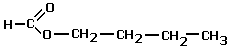 ,
,
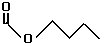
1g. 1-methypropyl methanoate,
HCOOCH(CH3)CH2CH3 ,
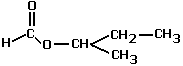 , ,

1h. 2-methylpropyl methanoate,
HCOOCH2CH(CH3)2 ,
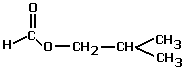 , ,

1i. 1,1-dimethylethyl methanoate,
HCOOC(CH3)3 ,
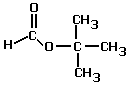 , ,

TOP of
the page or try the practice exam questions via
Multiple choice/type in name quiz on naming carboxylic acids and derivatives
2a. ethanoic acid
C2H4O2,
(acetic acid),  , , , , , ,
2b. ethanoyl chloride
(acetyl chloride),  , , , , , , 
2c. ethanamide
(acetamide), , ,  , , 
2d. ethanoic anhydride
(acetic anhydride),  , , , , 
2e. methyl ethanoate
(methyl acetate),  , , , ,  , , 
2f. ethyl ethanoate
(ethyl acetate),  , , , , , , 
2g. propyl ethanoate ,  ,
,  , , 
an isomer of this is
CH3COOCH(CH3)2 1-methylethyl
ethanoate derived from ethanoic acid and propan-2-ol, see below
2h. phenyl ethanoate , CH3COOC6H5
, 
2i. chloroethanoic acid
(chloroacetic acid),  , , , ,  (2-chloroethanoic acid, but 2 not necessary)
2j. aminoethanoic acid (aminoacetic acid), ,  , ,
(2-aminoethanoic
acid, but 2 not necessary, this is the simplest 'amino acid' known as glycine in
biochemistry)
2k. hydroxyethanoic acid
(hydroxyacetic
acid), HO-CH2-COOH,
HOCH2COOH (2-hydroxyethanoic acid, but 2 not
necessary)
2l. 1-methylethyl ethanoate,
CH3COOCH(CH3)2 ,
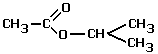 ,
,

TOP of
the page or try the practice exam questions via
Multiple choice/type in name quiz on naming carboxylic acids and derivatives
3a. propanoic acid
(propionic acid),  , ,  , , 
3b. propanoyl chloride ,  , , , , 
3c. propanamide
(propionamide),  , ,  , , 
3d. propanoic anhydride ,  , ,  , , 
3e. methyl propanoate
(methyl propionate),  , , , , 
3f. ethyl propanoate,  , ,  , , 
3g. propyl propanoate,  , ,  , , 
an isomer of this is
CH3CH2COOCH(CH3)2
1-methylethyl propanoate derived from propanoic acid and
propan-2-ol
3h. 2-chloropropanoic acid ,  , ,  , , 
3i. 3-chloropropanoic acid ,  , ,  , , 
3j. 2-aminopropanoic acid,  , ,  , , 
3k. 3-aminopropanoic acid, , , , , 
3l. 2-methylpropanoic acid (isobutyric acid),  , ,  , , 
and methyl
2-methylpropanoate,
(CH3)2CHCOOCH3
3m. propenoic acid (acrylic acid), CH2=CH-COOH, an unsaturated mono carboxylic acid
3n. 2-hydroxypropanoic acid,
CH3CH(OH)COOH,
 , ,

3o. 3-hydroxypropanoic acid,
HO-CH2-CH2-COOH,
HOCH2CH2COOH
3p.
2-hydroxypropanenitrile,
CH3CH(OH)CN,
3q. 2-hydroxypropanoic acid
and the corresponding carboxylate anion
 2-hydroxypropanoate ion
note the suffix naming of the carboxylate anion ...oate
3r. 2-hydroxy-2-methylpropane nitrile
3s. 2-hydroxy-2-methylpropanoic acid

and the corresponding carboxylate anion
 the
2-hydroxy-2-methylpropanoate ion the
2-hydroxy-2-methylpropanoate ion
3t.
2,2-dimethylpropanoic acid ,
(CH3)3CCOOH
,
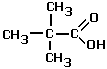 ,
,

3u. methyl 2-methylpropanoate,
(CH3)2CHCOOCH3 ,
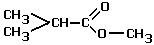 ,
,

TOP of
the page or try the practice exam questions via
Multiple choice/type in name quiz on naming carboxylic acids and derivatives
4a. butanoic acid
(butyric acid),  , ,  , , 
4b. butanoyl chloride,  , ,  , , 
4c. butanamide,  , , , , 
4d. butanoic anhydride,  , , 
4e. methyl butanoate
(methyl butyrate),  , ,  , , 
4f. ethyl butanoate ,  , ,  , , 
4g. propyl butanoate ,  , ,  , , 
an isomer of this is
CH3CH2CH2COOCH(CH3)2
1-methylethyl butanoate derived from butanoic acid and
propan-2-ol
4h. butyl butanoate ,  , ,
 , , 
4i. 2-methylbutanoic acid ,  , , 
4j. 3-methylbutanoic acid ,  , , 
4k. 2-hydroxybutanoic acid ,  , , 
4l. 3-hydroxybutanoic acid , , 
4m. 4-hydroxybutanoic acid , , , 
4n. 2-chlorobutanoic acid , , , 
4o. 3-chlorobutanoic acid , , , 
4p. 4-chlorobutanoic acid , , , 
4q. 2-hydroxy-2-methylbutanenitrile,
4s. 2-hydroxy-2-methylbutanoic acid 
and the corresponding carboxylate anion,
 2-hydroxy-2-methylbutanoate ion
TOP of
the page or try the practice exam questions via
Multiple choice/type in name quiz on naming carboxylic acids and derivatives
5a. pentanoic acid ,  , ,  , , 
5b. pentanoyl chloride , ,  , , 
5c. pentanamide ,  , ,  , , 
5d. pentanoic anhydride ,  , , 
5e. methyl pentanoate ,  , ,  , , 
5f. ethyl pentanoate ,  , ,
 , , 
5g. propyl pentanoate ,  , ,
 , , 
5h. butyl pentanoate ,  , , 
5i. 2-methylpentanoic acid ,  , , 
5j. 3-methylpentanoic acid ,  , , 
5k. 4-methylpentanoic acid ,  , , 
5l. 2-ethylpentanoic acid ,  , , 
5m. 3-ethylpentanoic acid ,  , , 
TOP of
the page or try the practice exam questions via
Multiple choice/type in name quiz on naming carboxylic acids and derivatives
6a. hexanoic acid ,  , ,  ,
, 
6b. 2-methylhexanoic acid ,  , , 
6c. 3-methylhexanoic acid ,  , , 
6d. 4-methylhexanoic acid , , 
6e. 5-methylhexanoic acid ,  , , 
6f. 2-ethylhexanoic acid ,  , , 
6g. 3-ethylhexanoic acid ,  , , 
6h. 4-ethylhexanoic acid ,  , , 
TOP of
the page or try the practice exam questions via
Multiple choice/type in name quiz on naming carboxylic acids and derivatives
(ii)(a) Examples of aliphatic saturated dicarboxylic acids
and a tricarboxylic acid
1. ethanedioic acid
(oxalic acid),  , ,  , ,  , , 
2. propanedioic acid
(malonic acid),  , , , ,  , , 
(sometimes 'more systematically called
propane-1.4-dioic acid)
3. butanedioic acid
(succinic acid),  , ,  , ,  , ,
 (sometimes 'more systematically called butane-1.4-dioic acid or 1,4-butanedioic acid)
4. 2-hydroxybutanedioic acid (malic acid),
 , this
will exhibit R/S stereoisomerism (optical isomers) , this
will exhibit R/S stereoisomerism (optical isomers)
5. 2,3-dihydroxybutanedioic acid (tartaric
acid) ,

this has two chiral carbons and forms three
stereoisomers (see
R/S isomerism for details).
6.
 citric acid
is a tricarboxylic acid (and a tertiary alcohol too!) citric acid
is a tricarboxylic acid (and a tertiary alcohol too!)
(ii)(b) Example of an aliphatic unsaturated dicarboxylic acid
But-2-ene-1,4-dioic acid,
HOOC-CH=CH-COOH, which
has the geometric isomers
Z-but-2-ene-1,4-dioic acid,
(maleic acid)
 (cis)
(cis)
and
E-but-2-ene-1,4-dioic acid, (fumaric
acid) (trans)
more details on E/Z isomerism of these acids
TOP of
the page or try the practice exam questions via
Multiple choice/type in name quiz on naming carboxylic acids and derivatives
(iii) Examples of aromatic acids and their derivatives

The
infrared
spectrum of benzoic acid showing the characteristic wavenumbers
for the carbonyl (C=O) and hydroxyl (OH) which constitute the carboxylic acid functional groups.
Therefore the functional chemistry of aromatic acids will be
similar to that of the aliphatic carboxylic acids described
above.
The -COOH functional
group is directly
attached to the benzene ring
1.
 , ,
 ,
, ,
,
 , benenecarboxylic acid, benzoic acid , benenecarboxylic acid, benzoic acid
 sodium benzoate (the sodium salt of
benzoic acid)
sodium benzoate (the sodium salt of
benzoic acid)
2.
 , ,
 ,
, ,
,
 , benzenecarbonyl chloride,
benzoyl chloride , benzenecarbonyl chloride,
benzoyl chloride
3.
 , ,
 ,
, ,
, ,
benzenecarboxamide, benzamide, ,
benzenecarboxamide, benzamide,
4a.
 , ,
 , ,
 ,
methyl benzenecarboxylate, methyl benzoate ,
methyl benzenecarboxylate, methyl benzoate
4b.
 , ,
 , ,
 , ethyl benzenecarboxylate, ethyl benzoate , ethyl benzenecarboxylate, ethyl benzoate
4c.
 , ,
 , ,
 , propyl benzenecarboxylate, propyl benzoate , propyl benzenecarboxylate, propyl benzoate
4d.
C6H5COOC6H5
,
, phenyl benzoate
5a.
 , 2-hydroxybenzenecarboxylic acid, 2-hydroxybenzoic acid
(salicylic acid) , 2-hydroxybenzenecarboxylic acid, 2-hydroxybenzoic acid
(salicylic acid)
5b. 2-ethanoylhydroxybenzoic acid
(acetylsalicylic acid, Aspirin)
2-ethanoylhydroxybenzoic acid
(acetylsalicylic acid, Aspirin)
5c.
 , 3-hydroxybenzenecarboxylic acid, 3-hydroxybenzoic acid , 3-hydroxybenzenecarboxylic acid, 3-hydroxybenzoic acid
5d.
 , 4-hydroxybenzenecarboxylic acid, 4-hydroxybenzoic acid , 4-hydroxybenzenecarboxylic acid, 4-hydroxybenzoic acid
5e. ,  , ,  . 2-, 3- and
4-methylbenzoic acid . 2-, 3- and
4-methylbenzoic acid
5f.  ,
,
 . .
 2-, 3- and
4-chlorobenzoic acid
2-, 3- and
4-chlorobenzoic acid
5g.
 , ,
 ,
,
 , 2-, 3- and
4-nitrobenzoic acid
, 2-, 3- and
4-nitrobenzoic acid
5h.
 ,
,
 , ,
 , 2-, 3- and
4-aminobenzoic acid
, 2-, 3- and
4-aminobenzoic acid
6a.  , benzene-1,2-dicarboxylic acid , benzene-1,2-dicarboxylic acid
6b. , benzene-1,3-dicarboxylic acid
6c.  , benzene-1,4-dicarboxylic acid , benzene-1,4-dicarboxylic acid
Example of a condensation polymer from a
dicarboxylic acid
Ethane-1,2-diol
(ethylene glycol, glycol),
C2H6O2,
 , ,
 , two primary
alcohol groups
, two primary
alcohol groups
benzene-1,4-dicarboxylic acid forms a
condensation polymer with ethane-1,2-diol, the polyester Terylene


TOP of
the page or try the practice exam questions via
Multiple choice/type in name quiz on naming carboxylic acids and derivatives
AMINO ACIDS
and ZWITTERIONS
The primary suffix name for an aliphatic carboxylic acid
is based on the "longest carbon chain name
*" for the -COOH bond
system e.g. ethanoic acid, propanoic acid etc. The amino group
-NH2, with its C-atom position number, is added as a prefix. [*
without the end 'e']
Many amino-acids in aqueous solution, or in the
crystalline state, exist as 'zwitterions' where the proton migrates from the
acidic carboxylic -COOH group to the basic -NH2 amino group to form
the ionic groups -NH3+ and -COO–
BUT within the same 'molecule' - the two forms exist in equilibrium.
H2N-CHR-COOH
 +H3N-CHR-COO–
Three examples are shown below as structural formula
and skeletal formula for the molecule and zwitterion.
aminoethanoic acid, C2H5NO2,
 , ,
 , ,
 , ,
 , ,

2-aminopropanoic acid, C3H7NO2,
,
,
,
 , ,

3-aminopropanoic acid , , ,
,

TOP of
the page or try the practice exam questions via
Multiple choice/type in name quiz on naming carboxylic acids and derivatives
Question - can you name these more complex
substituted carboxylic acids

ANSWERS
LINKS TO ASSOCIATED ADVANCED ORGANIC CHEMISTRY PAGES
 Multiple choice/type in name quiz on naming carboxylic acids and derivatives
 All Advanced Organic
Chemistry Notes All Advanced Organic
Chemistry Notes
Summary of Organic Functional Groups Notes
Quiz on Organic Structure Recognition
Summary of organic
chemistry functional group tests
Intermolecular forces & boiling points of
carboxylic acids
The shapes
and bond angles of simple organic molecules
[Website SEARCH
BOX]
ANSWERS to the Question on naming more complex substituted carboxylic acids
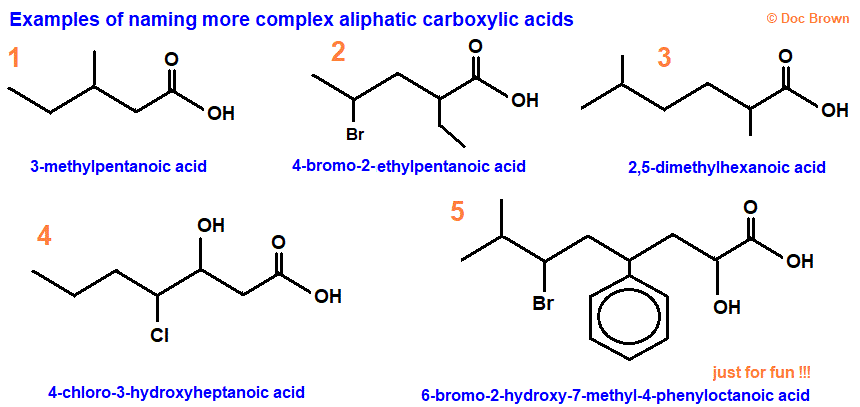
The skeletal formula showing the molecular structure
of
(1) 3-methylpentanoic acid (2)
4-bromo-2-ethylpentanoic acid (3)
2,5-dimethylhexanoic acid
(4) 4-chloro-3-hydroxyheptanoic acid and
(6) 6-bromo-2-hydroxy-4-phenyloctanoic acid
and watch out for numbering, the C of COOH is 1 and
note the alphabetical order of substituents
|
This page covers aliphatic carboxylic acids IUPAC
nomenclature acyl/acid chlorides IUPAC nomenclature acyl/acid amides IUPAC
nomenclature esters IUPAC nomenclature carboxylic acid anhydride IUPAC
nomenclature substituted carboxylic acids, mono carboxylic acids and their
derivatives, aliphatic saturated dicarboxylic acids, unsaturated
dicarboxylic acids, aromatic carboxylic acids and their derivatives
Website content © Dr Phil Brown 2000+. All copyrights reserved
on revision notes, images, quizzes, worksheets etc. Copying of
Doc Brown's pre-university advanced level chemistry website
material is NOT permitted. Exam revision summaries & references
to science course specifications are unofficial. These organic
chemistry revision notes on organic chemistry nomenclature - how
to name carboxylic acids, acyl chlorides, amides, esters, acid
anhydrides, substituted carboxylic acids, nitriles, amino acids)
are suitable for use of pre-university students studying AQA
advanced level chemistry, Edexcel advanced level chemistry, OCR
advanced level chemistry, IB advanced level chemistry, WJEC
(Eduqas) advanced level chemistry, CIE advanced level chemistry,
CCEA advanced level chemistry, US grade 11-12 AP honors
chemistry courses and they will also prove useful to 1st year
undergraduate students of chemistry,
keywords formulae: how to name naming nomenclature empirical
molecular formula graphic formula displayed formula skeletal formula
structural isomers isomerism Acid .. Chloride .. acid acyl Amide ..
Ester .. acid Anhydride .. Substituted carboxylic Acids and (i) mono
carboxylic acids and their derivatives (ii) aliphatic
saturated/unsaturated dicarboxylic acids (iii) aromatic acids and
their derivatives HCOOH HCONH2 HCOOCH3 HCOOCH2CH3 HCOOCH2CH2CH3
CH3COOH HOCH2COOH CH3COCl CH3CONH2 (CH3CO)2O CH3COOCH3 CH3COOCH2CH3
CH3COOCH2CH2CH3 CH3COOC6H5 ClCH2COOH H2NCH2COOH C2H5COOH CH3CH2COOH
CH3CHOHCOOH CH3CH(OH)COOH HOCH2CH2COOH CH3CH2COCl CH3CH2CH2CONH2
(CH3CH2CO)2O CH3CH2COOCH3 CH3CH2COOCH2CH3 CH3CH2COOCH2CH2CH3
CH3CHClCOOH ClCH2CH2COOH H2NCH2CH2COOH CH3CH(NH2)COOH (CH3)2CHCOOH
CH2=CHCOOH C3H7COOH CH3CH2CH2COOH CH3CH2CH2CH2COCl CH3CH2CH2CH2CONH2
CH3CH2CH2CH2COOCH3 CH3CH2CH2CH2COOCH2CH3 CH3CH2CH2CH2COOCH2CH2CH3
CH3CH2CH2CH2COOH CH3(CH2)3COOH CH3(CH2)4COOH HOOCCOOH (COOH)2
HOOCCH2COOH CH2(COOH)2 HOOC-CH=CH-COOH HOOCCH=CHCOOH C6H5COOH
CH3C6H4COOH C6H5COCl C6H5CONH2 C6H5COOCH3 C6H5COOCH2CH3
C6H5COOCH2CH2CH3 HOC6H4COOH HCOOCH(CH3)2 CH3COOCH(CH3)2
CH3CH2COOCH(CH3)2 CH3CH2CH2COOCH(CH3)2 These detailed notes on the
structure and naming of carboxylic acids include the general formula
of carboxylic acids molecules, empirical formula of carboxylic acid
molecules, structural formula of carboxylic acid molecules, skeletal
formula of carboxylic acid molecules, displayed formula of
carboxylic acid molecules, shapes of carboxylic acid molecules,
isomers of carboxylic acids molecule These detailed notes on the
structure and naming of esters include the general formula of ester
molecules, empirical formula of ester molecules, structural formula
of ester molecules, skeletal formula of ester molecules, displayed
formula of ester molecules, shapes of ester molecules, isomers of
esters molecules These detailed notes on the structure and naming of
acid amides include the general formula of amide molecules,
empirical formula of amide molecules, structural formula of amide
molecules, skeletal formula of amide molecules, displayed formula of
amide molecules, shapes of amide molecules, isomers of amides
molecules These detailed notes on the structure and naming of
acid/acyl chlorides include the general formula of acid/acyl
chloride molecules, empirical formula of acid/acyl chloride
molecules, structural formula of acid/acyl chloride molecules,
skeletal formula of acid/acyl chloride molecules, displayed formula
of acid/acyl chloride molecules, shapes of acid/acyl chloride
molecules, isomers of acid/acyl chlorides molecules IUPAC rules for
carboxylic acid nomenclature. Students should be able to draw
structural formula of carboxylic acids, displayed and skeletal
formulas for carboxylic acid organic compounds apply IUPAC rules for
nomenclature to name carboxylic acid organic compounds including
chains and rings and be able to apply IUPAC rules for nomenclature
to draw the structural, displayed or skeletal structure of
carboxylic acid organic compounds from the carboxylic acid IUPAC
name IUPAC rules for ester nomenclature. Students should be able to
draw structural formula of ester, displayed and skeletal formulas
for ester organic compounds apply IUPAC rules for nomenclature to
name ester acid organic compounds including chains and rings and be
able to apply IUPAC rules for nomenclature to draw the structural,
displayed or skeletal structure of ester organic compounds from the
ester IUPAC name from the homologous series of esters IUPAC rules
for amide nomenclature. Students should be able to draw structural
formula of amide, displayed and skeletal formulas for amide organic
compounds apply IUPAC rules for nomenclature to name amide acid
organic compounds including chains and rings and be able to apply
IUPAC rules for nomenclature to draw the structural, displayed or
skeletal structure of amide organic compounds from the amide IUPAC
name from the homologous series of amides IUPAC rules for acyl/acid
chloride nomenclature. Students should be able to draw structural
formula of acyl/acid chloride, displayed and skeletal formulas for
acyl/acid chloride organic compounds apply IUPAC rules for
nomenclature to name acyl/acid chloride acid organic compounds
including chains and rings and be able to apply IUPAC rules for
nomenclature to draw the structural, displayed or skeletal structure
of acyl/acid chloride organic compounds from the acyl/acid chloride
IUPAC name from the homologous series of acyl/acid chlorides IUPAC
rules for substituted carboxylic acids nomenclature. Students should
be able to draw structural formula of substituted carboxylic acids,
displayed and skeletal formulas for substituted carboxylic acids
organic compounds apply IUPAC rules for nomenclature to name
substituted carboxylic acids acid organic compounds including chains
and rings and be able to apply IUPAC rules for nomenclature to draw
the structural, displayed or skeletal structure of substituted
carboxylic acids organic compounds from the substituted carboxylic
acids IUPAC name from the homologous series of substituted
carboxylic acids,
All
copyrights reserved on these organic chemistry exam revision
notes on how to name carboxylic acids & derivatives, these A level chemistry revision notes are suitable for use of pre-university students studying AQA advanced level
organic chemistry revision notes on how to name carboxylic acids &
derivatives, Edexcel advanced level
organic chemistry revision notes on how to name carboxylic acids &
derivatives, OCR advanced level
organic chemistry revision notes on how to name carboxylic acids &
derivatives, IB advanced level
organic chemistry revision notes on how to name carboxylic acids &
derivatives, WJEC (Eduqas) advanced level
organic chemistry revision notes on how to name carboxylic acids &
derivatives, CIE Cambridge advanced level
organic chemistry revision notes on how to name carboxylic acids &
derivatives, CCEA advanced level
organic chemistry revision notes on how to name carboxylic acids &
derivatives, and useful for US grade 11 grade 12 AP honors
organic chemistry courses involving how to name carboxylic acids
& derivatives,
Explaining the importance of
how to name esters, amides, anhydrides, acid chlorides
in organic chemistry, What you need to know about how to name esters,
amides, anhydrides, acid chlorides for organic
chemistry,
Explaining the use of how to name esters, amides, anhydrides, acid
chlorides knowledge in organic chemistry, Examples of how to
name esters, amides, anhydrides, acid chlorides explained
when studying organic chemistry, What is
the significance of how to name esters, amides, anhydrides, acid
chlorides in organic chemistry, What is the use of how to name
esters, amides, anhydrides, acid chlorides
in organic chemistry Describing and
explaining the theory of how to name esters, amides, anhydrides, acid
chlorides when studying organic chemistry, exam revision
notes for how to name esters, amides, anhydrides, acid chlorides in exams, online help for
how to name esters, amides, anhydrides, acid chlorides, revision notes for
how to name esters, amides, anhydrides, acid chlorides,
what do I need to learn for how to name esters, amides, anhydrides, acid
chlorides in exams? revision summary for how to name esters,
amides, anhydrides, acid chlorides, help in
teaching how to name esters, amides, anhydrides, acid chlorides, learning notes for
how to name esters, amides, anhydrides, acid chlorides, help to pass the
how to name esters, amides, anhydrides, acid chlorides exam, how to
prepare for examination questions on how to name esters, amides,
anhydrides, acid chlorides?
[SEARCH
BOX]
advanced pre-university/college chemistry links
My advanced level carboxylic acid
notes index
All my advanced level organic
chemistry notes
All my advanced level
inorganic chemistry notes
All my advanced level
theoretical chemistry notes
TOP
of the page or try the practice exam questions via
Multiple choice/type
in name quiz on naming carboxylic acids and derivatives
|
|
