|
Doc Brown's
Advanced Chemistry: Part 14.7
The 4 constitutional
isomers of molecular formula C4H9F, C4H9Cl,
C4H9Br
and
C4H9I
(and stereoisomers)
[Author
©
Dr
Phil Brown GRIC, PhD:
Doc Brown's advanced level organic chemistry exam revision notes
suitable for students of UK advanced level chemistry courses, IB
chemistry & US K12 grade
11, grade 12 and AP honors chemistry courses: Molecular
spectroscopy and analysing the isomers of C4H9X
(X = halogen)
[page updated
RE-EDIT]
Sub-index
for this page on the isomers of
C4H11X
(X = halogen)
(a)
Introduction to the constitutional-structural
isomers of formula C4H9X
(b)
Details of
the constitutional isomers of molecules of formulae
C4H9X
(c)
Extra notes
on the constitutional isomers of molecules of C4H9X
(X = halogen)
(d)
Learning objectives - questions to be answered?
(e)
Practise exam questions
based on isomers of
C4H9X
(X = halogen)
Associated organic chemistry page links
Index of sets of isomers for a given
molecular formula
This is a big chemistry website, please allow time
to explore it
email doc
brown - comments - query?
*
[privacy policy, cookies
and disclaimer]
(a)
Introduction to isomerism in molecules of formulae
C4H9F,
C4H9Cl, C4H9Br
and
C4H9I
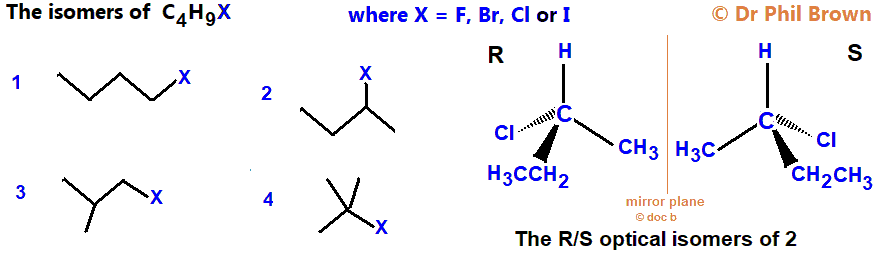
The 4 constitutional structural
isomers of molecular formula
C4H9F,
C4H9Cl, C4H9Br
or
C4H9I
Relative molecular mass and
percent composition based on atomic masses:
C 12.01,
H 1.01, F 19.00, Cl 35.45, Br 79.90,
I 126.90
|
Formula of compound |
Relative molecular
mass |
%
carbon |
%
hydrogen |
%
halogen |
|
C4H9F |
76.13 |
63.10 |
11.94 |
24.96 |
|
C4H9Cl |
92.58 |
51.89 |
9.82 |
38.29 |
|
C4H9Br |
137.03 |
35.06 |
6.63 |
58.31 |
|
C4H9I |
184.03 |
26.10 |
4.94 |
68.96 |
Isomerism applicable
(see also isomerism
summary at the end of the page)
Structural isomerism
- isomers based on different connectivity's of the constituent atoms, so cannot
be spatially identical (but can be defined as having the same shape).
This includes (a)
carbon chain variation (usually need a minimum of 4 atoms),
(b) change in position of a substituent or functional group and
(c) functional group
isomerism where the atoms have a different connectivity configuration, usually with
significant differences in chemical and physical properties.
Stereoisomerism - isomers
based on the same connectivity of the atoms (same constitutional formula), but
in some way, they are 2D or 3D spatially different non-superimposable images (e.g. E/Z
'geometrical' isomers or mirror image R/S 'optical' isomers)
E/Z
stereoisomerism was called 'geometrical isomerism' e.g. cis
and trans isomers of alkenes or disubstituted cyclic alkanes
where there are 3D spatial variations that are not mirror images and not
super imposable.
Not applicable here.
R/S
stereoisomerism was called 'optical isomerism', the pairs of
isomers are called enantiomers which are 3D non-superimposable
mirror image forms of the molecule. The molecule must have a chiral centre
(a stereocentre), that is an asymmetric carbon atom with four
different atoms/groups attached to it.
The is one example of R/S optical isomerism, only one
constituent isomer (per haloalkane formula) can form a pair of enantiomers.
Note
For
images of the isomers of
C4H9X, X =
F, Cl, Br, I halogens of group 7/17 of the periodic table.
They all have a
single halide functional group
of a haloalkane i.e. C-X
The images of
C4H9X (X =
F, Cl, Br and I)
presented are theoretical, in the sense that some may be
so unstable as not to exist, but you will find most, and sometimes all of them,
on the internet.
The are 4
constitutional-structural isomers of molecular formula
C4H9X (X =
F, Cl, Br and I),
irrespective of any E/Z or R/S isomerism that may be possible.
Including the two R/S isomers, there are a total of
5
distinct unique isomers of C4H9X
They are all halogen substitution products of the
hydrocarbon alkanes butane and methylpropane and are examples of the group of
organic compounds known as haloalkanes or halogenoalkanes.
However, one structural isomer can exhibit R/S ('optical') isomerism, so
there are actually a total of 5 distinct isomers for the halogen compound molecular
formula C4H9X. E/Z isomerism is not possible for these
compounds.
(b)
Details of the 4 isomers of molecular formulae
C4H9F,
C4H9Cl, C4H9Br
and
C4H9I
(1) CH3CH2CH2CH2X,
abbreviated structural formula ,
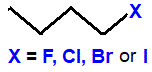 ,
skeletal formula ,
skeletal formula
1-fluorobutane, 1-chlorobutane, 1-bromobutane,
1-iodobutane
Primary haloalkanes
They cannot exhibit E/Z or R/S stereoisomerism and
are primary haloalkanes.
e.g.
 , ,
 , ,
 , primary haloalkane
structural formula, full displayed molecular structure
and skeleton formula of 1-chlorobutane.
Number of low resolution
NMR chemical shift
δ
signal peaks: 4 1H
and 4 13C
(email
if disagree?)
1H NMR ratio of peaks: 3 : 2 : 2 : 2 (for equivalent protons)
Index of
1H NMR spectra organic
compounds and
Index of
13C NMR spectra organic
compounds
(2) CH3CH2CHXCH3,
abbreviated structural formula
,
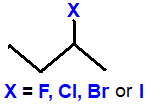 ,
skeletal formula
,
skeletal formula
2-fluorobutane, 2-chlorobutane, 2-bromobutane, 2-iodobutane,
they are
secondary haloalkanes.
Number of low resolution
NMR chemical shift
δ
signal peaks: 4 1H
and 4 13C
(email
if disagree?)
1H NMR ratio of peaks: 3 : 2 : 1 : 3 (for equivalent protons)
These molecules exhibit R/S stereoisomerism, diagrams of enantiomers are shown below.
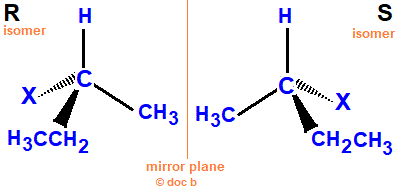 , CH3CH2CHXCH3
chiral carbon
C
, CH3CH2CHXCH3
chiral carbon
C
Carbon atom 2 is a chiral (asymmetric) with four different
groups attached to it.
e.g.
 ,
,
 ,
,
 , secondary haloalkane
structural formula, full displayed molecular structure
and skeleton formula of 2-chlorobutane.
 , CH3CH2CHClCH3
chiral carbon
C
, CH3CH2CHClCH3
chiral carbon
C
So the full IUPAC name would be e.g.
(R)-2-chlorobutane and (S)-2-chlorobutane
From the CIP assignment priority rule for R/S
isomers of all four formulae:
ZX > 6C6C >
6C > 1H
based on the groups connected to the chiral carbon,
X = halogen, and Z = 9, 17, 35 or 53)
These R/S assignments are based on the Cahn-Ingold-Prelog priority rules.
(3)
(CH3)2CHCH2X,
abbreviated structural formula
, 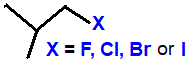 ,
skeletal formula ,
skeletal formula
1-fluoro-2-methylpropane, 1-chloro-2-methylpropane,
1-bromo-2-methylpropane, 1-iodo-2-methylpropane
They cannot exhibit E/Z or R/S stereoisomerism. They are
primary haloalkanes.
Number of low resolution
NMR chemical shift
δ
signal peaks: 3 1H
and 3 13C
(email
if disagree?)
1H NMR ratio of peaks: 6
(3+3) : 1 : 2 (for equivalent protons)
e.g.
 , ,
 , ,
 , primary haloalkane
structural formula, full displayed molecular structure
& skeleton formula of 1-chloro-2-methylpropane
(3) and (4) have a branched carbon chain.
(4) (CH3)3CX,
abbreviated structural formula
, 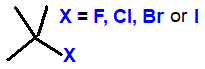 ,
skeletal formula ,
skeletal formula
2-fluoro-2-methylpropane, 2-chloro-2-methylpropane,
2-bromo-2-methylpropane, 2-iodo-2-methylpropane
They cannot exhibit E/Z or R/S stereoisomerism. They are
tertiary haloalkanes.
Number of low resolution
NMR chemical shift
δ
signal peaks: 1 1H
and 2 13C
(email
if disagree?)
 , ,
 , ,
 ,
2-chloro-2-methylpropane, tertiary haloalkane ,
2-chloro-2-methylpropane, tertiary haloalkane
structural formula, full displayed molecular structure
& skeleton formula of 2-chloro-2-methylpropane
Note how spectra can be used to distinguish which halogen
compound and which isomer
(c) Summary and extra
information on the isomers of
molecular formulae
C4H9F,
C4H9Cl, C4H9Br and C4H9I
There are 4 constitutional isomers for
each of the halobutanes.
These arise from substitution on two different
carbon skeletons (butane and 2-methylpropane) and the halogen atom at
different positions.
Constitutional Isomers of
C4H9X (X = F, Cl, Br, I)
|
Carbon Skeleton |
Substituted isomer
Name |
Structure Type |
|
n-butane |
1-halobutane |
Primary haloalkane |
|
n-butane |
2-halobutane |
Secondary haloalkane |
|
2-methylpropane |
1-halo-2-methylpropane |
Primary haloalkane |
|
2-methylpropane |
2-halo-2-methylpropane |
Tertiary haloalkane |
These are 4 constitutional (structural) isomers
because they differ in the connectivity of atoms.
Types of Isomerism
Exhibited
-
Constitutional Isomerism: Different
connectivity of atoms (as above).
-
Stereoisomerism: One isomer of each formula
has a chiral centre, i.e. one isomer exhibits R/S optical isomerism, but no
restricted rotation in these simple haloalkanes, so E/Z geometrical
isomerism is not possible..
Differences in Physical
Properties
-
Boiling Points: Increase with halogen size
(F < Cl < Br < I) due to stronger van der Waals forces.
-
Density: Heavier halogens yield denser
compounds.
-
Solubility: All are insoluble in water but
soluble in organic solvents.
-
Volatility: Tertiary isomers are generally
more volatile due to lower boiling points.
Differences in Chemical
Reactivity
-
Bond Strength: C–F is strongest, C–I
weakest → C4H9I is most reactive in
nucleophilic substitution.
-
Steric Hindrance: Tertiary halides (e.g.,
2-halo-2-methylpropane) favour SN1 reactions; primary
halides favour SN2.
-
Reaction Types:
Examples of uses
and Applications
-
1-chlorobutane: Solvent and intermediate in
organic synthesis.
-
2-bromobutane: Used in stereochemistry
studies due to potential chirality.
-
2-iodo-2-methylpropane: Common in SN1
mechanism demonstrations.
-
Fluorinated isomers: Precursors in
pharmaceutical and agrochemical synthesis.
Common Student Misconceptions
-
Confusing constitutional isomers with
conformers (rotational forms).
-
Assuming all halobutanes react the same way—ignoring steric
and electronic effects.
-
Forgetting that C–F bonds are less reactive
despite being polar.
Exam Revision Tips
(AQA, Edexcel, OCR, WJEC, CCEA, CIE, IB, AP)
-
Draw all isomers clearly—highlight primary,
secondary, tertiary classifications.
-
Practice SN1 versus SN2 mechanisms with
different isomers.
-
Compare boiling points and reactivity
across halogens and isomer types.
-
Use reaction maps to show conversions
(e.g., halide → alcohol → alkene).
-
Mnemonic: “Big Iodine Breaks Bonds” → C–I
is weakest, most reactive.
(d)
Learning objectives - questions to be answered?
Can you IUPAC name these isomers
of molecular formula
C4H9F, C4H9Cl ,C4H9Br and C4H9I?
Can you deduce the number of principal 1H chemical
shifts and proton ratio you would expect to see in the NMR spectrum of
these
C4H9F, C4H9Cl, C4H9Br and C4H9I?
isomers?
Can you deduce the number of principal 13C chemical
shifts you would expect to see in the NMR spectrum of these
C4H9F,
C4H9Cl, C4H9Br and C4H9I?
isomers?
How do you draw the structural formula
and skeletal formula of the isomers of molecular formula C4H9F C4H9Cl
C4H9Br C4H9I?
How many aliphatic structural isomers
are there of halogen compounds with molecular formula C4H9F C4H9Cl
C4H9Br C4H9I?
How many aliphatic carbon chain isomers
are there of halogen compounds with molecular formula C4H9F C4H9Cl
C4H9Br C4H9I?
How many positional isomers are there
of organic halogen molecules with molecular formula C4H9F C4H9Cl C4H9Br
C4H9I?
How many E/Z (geometrical) isomers are
there of molecular formula C4H9F C4H9Cl C4H9Br C4H9I?
How many R/S (optical) isomers
(enantiomers) of molecular formula C4H9F C4H9Cl C4H9Br C4H9I?
Are there any halocycloalkene isomers of
formula C4H9F C4H9Cl C4H9Br C4H9I?
Are there any cyclic haloalkene isomers
of formula C4H9F C4H9Cl C4H9Br C4H9I?
Are there any cyclo haloalkane isomers
of formula C4H9F C4H9Cl C4H9Br C4H9I?
Are there any halodiene isomers of
molecular formula C4H9F C4H9Cl C4H9Br C4H9I?
Are there any haloalkyne isomers of
molecular formula C4H9F C4H9Cl C4H9Br C4H9I?
Are there any functional group isomers
with a molecular formula C4H9F C4H9Cl C4H9Br C4H9I?
Do C4H9F C4H9Cl C4H9Br
C4H9I organic halogen
molecules have any stereoisomers?
Are there any E/Z (geometrical) isomers
with a molecular formula C4H9F C4H9Cl C4H9Br C4H9I?
Are there any R/S (optical) isomers
(enantiomers) with a molecular formula C4H9F C4H9Cl C4H9Br C4H9I?
This page
will answer these questions for molecular formula
C4H9F
C4H9Cl C4H9Br and
C4H9I
(e)
QUESTIONS
| Practise exam questions
based on isomers of molecular formula
C4H9X,
X = F, Cl, Br and I
Jot
down your responses
with explanations!
ANSWERS to the questions based on the isomers of
C4H9X,
X = F, Cl, Br and I
If you think there are
any errors, please email me asap at
chem55555@hotmail.com
I don't mind if students/teachers do a selected printout
of these questions and answers.
Q1
Derive the structural formula and skeletal formula and names of
the isomers of molecular C4H9Cl and
classify them in terms of their functional group.
Q2 Based
on the number of expected principal chemical shifts in the
1H and 13C NMR of the isomers of C3H7Br,
how far could you distinguish between these isomers?
Think 'chemical environments' and the integrated proton
signal ratio.
Q3 (a)
Which isomer will react the fastest and which the slowest when
refluxed with aqueous sodium hydroxide and why?
(b) Write an equation for the two reactions, name the
products and state the type of reaction mechanism involved.
Q4
Do any of the isomers of C4H9Br exhibit
E/Z (geometrical) or R/S (optical)
stereoisomerism?
Extra molecular spectroscopy questions
You are given
the infrared spectrum, mass spectrum, 1H NMR spectrum and
13C NMR
spectrum for an unknown molecule and one additional clue to help deduce the identity
and molecular structure of the molecule. These questions and
answers are all on separate ages.
Question 03 Four spectra of molecule
03, monohalogenated-alkane *
ANSWER
Question 05 Four spectra of molecule
05, monohalogenated-alkane *
ANSWER
Question 07 Four spectra of molecule 07,
monohalogenated-alkane *
ANSWER
Question 10 Four spectra of molecule 10,
monohalogenated-alkane *
ANSWER
If you think there are
any errors, please email me asap at
chem55555@hotmail.com
|
Associated organic chemistry links
Index of sets of isomers for a given
molecular formula
The molecular structure and naming of
HALOALKANES (how
to name and draw alkane structures)
The molecular structure and
naming of ALKANES (how
to name and draw alkane structures)
The molecular structure and naming
of ALKENES
(how to name and draw alkene structures)
Index of revision notes on the chemistry
HALOALKANES
including reactions
Index of revision notes
on the chemistry of ALKANES and the petrochemical
industry
Index of revision notes on the chemistry ALKENES
including reactions and polymers Advanced Level pre-university
organic chemistry notes
IR, mass and H-1 and C-13 NMR
spectra of organic compounds
For isomerism in organic chemistry, see also the
notes
Isomerism: introduction, structural isomerism - chain,
positional, functional group, tautomerism
Stereoisomerism:
introduction, definition,
priority rules, E/Z isomerism (cis/trans isomerism)
Stereoisomerism - R/S isomerism (optical
isomerism) -
definition - examples explained This is a big chemistry website, please allow time
to explore it
Index of my advanced
(pre-college/university) organic
chemistry revision notes
Index
of all my spectroscopy pages
Index
of all my isomerism pages
The chemistry of
alkanes and the petrochemical
industry
The
chemistry of alkenes
The
chemistry of haloalkanes
The
chemistry of
alcohols
The chemistry of
aldehydes
and ketones The
chemistry of carboxylic acids and derivatives The chemistry of
organo-nitrogen compounds
The chemistry of
aromatic compounds
A summary chart of isomerism

|
Website content © Dr
Phil Brown 2000+. All copyrights reserved on revision notes, images,
quizzes, worksheets etc. Copying of Doc Brown's pre-university
advanced level organic chemistry website material is NOT
permitted. Exam revision summaries & references to science course specifications
are unofficial. These organic chemistry revision notes on
isomerism are
suitable for use of pre-university students studying AQA advanced level
chemistry, Edexcel advanced level chemistry, OCR advanced level
chemistry, IB advanced level chemistry, WJEC (Eduqas) advanced level
chemistry, CIE advanced level chemistry, US grade 11-12 AP honors
chemistry courses and they will also prove useful to
1st year undergraduate students of chemistry.
The isomerism of molecules of formulae
C4H9F,
C4H9Cl, C4H9Br
and
C4H9I,
constitutional isomers and R/S optical stereoisomers |
Keywords or phrases: how many isomers are
there of halogen compounds of molecular formula C4H9F C4H9Cl
C4H9Br C4H9I? what is the
structure of the halogen compound isomers of molecular formula how do you name the isomers of
molecular formula C4H9F C4H9Cl C4H9Br C4H9I? what is the molecular structure of the
isomers of C4H9F C4H9Cl C4H9Br C4H9I, what type of isomerism is exhibited by molecules
of formula C4H9F C4H9Cl C4H9Br C4H9I, how do you work out the isomers of haloalkanes
formula C4H9F C4H9Cl C4H9Br C4H9I, what are the structural isomers of
C4H9F C4H9Cl C4H9Br C4H9I, the carbon chain
isomers of C4H9F C4H9Cl C4H9Br C4H9I in the homologous series of alkanes, comparing
the many structural isomers does C4H9F C4H9Cl C4H9Br C4H9I have?
what are the possible isomers of C4H9F C4H9Cl C4H9Br C4H9I? revision notes on
isomerism of C4H9F C4H9Cl C4H9Br C4H9I molecules, the molecular structure of
the isomers of C4H9F C4H9Cl C4H9Br C4H9I how to draw the
structural formula of isomers of C4H9F C4H9Cl C4H9Br C4H9I, how to draw the displayed
formula of isomers of C4H9F C4H9Cl C4H9Br C4H9I, how to draw the skeletal formula of
halogenoalkane compound isomers of formula C4H9F C4H9Cl C4H9Br
C4H9I, how to name the isomers of molecular formula C4H9F C4H9Cl
C4H9Br C4H9I,
R/S optical isomers enantiomers of C4H9F C4H9Cl C4H9Br C4H9I isomeric with molecular formula
C4H9F C4H9Cl C4H9Br C4H9I, structural isomers of molecular
formula C4H9F C4H9Cl C4H9Br C4H9I, optical isomers R/S enantiomers isomeric with molecular
formula C4H9F C4H9Cl C4H9Br C4H9I, positional isomers isomeric with halocycloalkenes,
haloalkanes, haloalkynes, haloalkenes of molecular formula C4H9F
C4H9Cl C4H9Br C4H9I,
which types of isomerism are exhibited by molecules of formula
C4H9F C4H9Cl C4H9Br C4H9I alkyl positional isomers of C4H9F
C4H9Cl C4H9Br C4H9I branched carbon chain
isomers of C4H9F C4H9Cl C4H9Br C4H9I,
stereoisomers of molecular formula C4H9F C4H9Cl C4H9Br C4H9I,
optical isomers R/S enantiomers isomeric with molecular formula
C4H9F C4H9Cl C4H9Br C4H9I, positional isomers isomeric with
molecular formula C4H9F C4H9Cl C4H9Br C4H9I, which types of
isomerism are exhibited by C4H9F C4H9Cl C4H9Br C4H9I halogen
atom positional isomers of C4H9F C4H9Cl C4H9Br C4H9I, how to
work out the halogen compound names of isomers of C4H9F
C4H9Cl C4H9Br C4H9I
|
ANSWERS If you think there are
any errors, please email me asap at
chem55555@hotmail.com
Q1
Derive the structural formula and skeletal formula and names of
the isomers of molecular C4H9Cl and
classify them in terms of their functional group.
ANSWERS
a)
 ,
,
1-chlorobutane (primary haloalkane) ,
,
1-chlorobutane (primary haloalkane)
(b)
 ,
,
2-chlorobutane (secondary haloalkane) ,
,
2-chlorobutane (secondary haloalkane)
(c)
 ,
,
1-chloro-2-methylpropane (primary haloalkane) ,
,
1-chloro-2-methylpropane (primary haloalkane)
(d)
 ,
,
2-chloro-2-methylpropane (tertiary haloalkane) ,
,
2-chloro-2-methylpropane (tertiary haloalkane)
Q2
Based on the number of expected principal chemical shifts in the 1H
and 13C NMR of the isomers of C3H7Br,
how far could you distinguish between these isomers?
Think 'chemical environments' and the integrated proton
signal ratio.
ANSWERS
(1) CH3CH2CH2CH2Cl,
will give four 1H and four 13C NMR
chemical shifts, proton ratio 3:2:2:2.
(2)
CH3CH2CHClCH3,
will give four 1H and four 13C NMR
chemical shifts, proton ratio 3:2:1:3.
(3) (CH3)2CHCH2Cl,
will give three 1H and three 13C
NMR chemical shifts, proton ratio 6:1:2.
(3) (CH3)3CCl,
will give one
1H and two 13C NMR chemical shifts, no
proton ratio!
In terms of number of signals, (1) and (2) can
be distinguished from each other and from (1) and (2).
BUT, they can all be distinguished from each
other by their proton ratios from their 1H NMR
spectra.
Q3 (a)
Which isomer will react the fastest and which the slowest when
refluxed with aqueous sodium hydroxide and why?
(b) Write an equation for the two reactions, name the
products and state the type of reaction mechanism involved.
ANSWERS
(a)
Reactivity order is: Tertiary > Secondary > Primary haloalkanes
which aligns with stability trends of carbocations which is the same
i.e the stability trend Tertiary > Secondary > Primary
carbocations.
So
2-chloro-2-methylpropane will react
the fastest and CH3CH2CH2CH2Cl
the slowest.
(b) (CH3)3CCl
+ OH- ===> (CH3)3COH
+ Cl-
CH3CH2CH2CH2Cl
+ OH- ===>
CH3CH2CH2CH2OH
+ Cl-
The products are 2-methylpropan-2-ol and
butan-1-ol via nucleophilic substitution mechanisms.
Q4
Do any of the isomers of C4H9Br exhibit
E/Z (geometrical) or R/S (optical)
stereoisomerism?
ANSWERS
YES,
but there is no C=C bond, so no E/Z isomers possible.
However, 2-bromobutane has a chiral (asymmetric) carbon atom.
There are four different atoms/groups attached to atom C2, so
non-superimposable mirror images (enantiomers) can exist.
Extra molecular spectroscopy questions
Question 03 Four spectra of molecule
03, monohalogenated-alkane *
ANSWER
Question 05 Four spectra of molecule
05, monohalogenated-alkane *
ANSWER
Question 07 Four spectra of molecule 07,
monohalogenated-alkane *
ANSWER
Question 10 Four spectra of molecule 10,
monohalogenated-alkane *
ANSWER
If you think there are
any errors, please email me asap at
chem55555@hotmail.com
|
|
