|
2. Data for 10.12. Chemistry
of Zinc Zn, Z=30, 1s22s22p63s23p63d104s2
Data comparison of zinc
with the other members of the 3d–block and transition metals
|
Z
and symbol |
21
Sc |
22
Ti |
23
V |
24
Cr |
25
Mn |
26
Fe |
27
Co |
28
Ni |
29
Cu |
30
Zn |
|
property\name |
scandium |
titanium |
vanadium |
chromium |
manganese |
iron |
cobalt |
nickel |
copper |
zinc |
|
melting
point/oC |
1541 |
1668 |
1910 |
1857 |
1246 |
1538 |
1495 |
1455 |
1083 |
420 |
|
density/gcm–3 |
2.99 |
4.54 |
6.11 |
7.19 |
7.33 |
7.87 |
8.90 |
8.90 |
8.92 |
7.13 |
|
atomic
radius/pm |
161 |
145 |
132 |
125 |
124 |
124 |
125 |
125 |
128 |
133 |
|
M2+
ionic radius/pm |
na |
90 |
88 |
84 |
80 |
76 |
74 |
72 |
69 |
74 |
|
M3+
ionic radius/pm |
81 |
76 |
74 |
69 |
66 |
64 |
63 |
62 |
na |
na |
|
common oxidation
states |
+3
only |
+2,3,4 |
+2,3,4,5 |
+2,3,6 |
+2,3,4,6,7 |
+2,3,6 |
+2,3 |
+2,+3 |
+1,2 |
+2
only |
|
outer electron config. [Ar]... |
3d14s2 |
3d24s2 |
3d34s2 |
3d54s1 |
3d54s2 |
3d64s2 |
3d74s2 |
3d84s2 |
3d104s1 |
3d104s2 |
|
EØ M(s)/M2+(aq) |
na |
–1.63V |
–1.18V |
–0.90V |
–1.18V |
–0.44V |
–0.28V |
–0.26V |
+0.34V |
–0.76V |
|
EØ M(s)/M3+(aq) |
–2.03V |
–1.21V |
–0.85V |
–0.74V |
–0.28V |
–0.04V |
+0.40 |
na |
na |
na |
|
EØ M2+(aq)/M3+(aq) |
na |
–0.37V |
–0.26V |
–0.42V |
+1.52V |
+0.77V |
+1.87V |
na |
na |
na |
Elect.
pot. = standard electrode potential data for zinc
(EØ at 298K/25oC, 101kPa/1 atm.)
na = data not applicable to zinc
Extended data table for ZINC
|
property of zinc/unit |
value for Zn |
|
melting
point Zn/oC |
420 |
|
boiling
point Zn/oC |
907 |
|
density Zn/gcm–3 |
7.13 |
|
1st
Ionisation Energy/kJmol–1 |
906 |
|
2nd
IE/kJmol–1 |
1733 |
|
3rd
IE/kJmol–1 |
3832 |
|
4th
IE/kJmol–1 |
5730 |
|
5th
IE/kJmol–1 |
7970 |
|
Zn atomic
radius/pm |
133 |
|
Zn2+
ionic radius/pm |
74 |
|
Relative polarising power Zn2+ ion |
2.7 |
|
oxidation
state of Zn |
+2
only |
|
simple electron
configuration of Zn |
2,8,18,2 |
|
outer electrons of Zn [beyond
argon core] |
[Ar]3d104s2 |
|
Electrode
potential Zn(s)/Zn2+(aq) |
–0.76V |
|
Electronegativity of Zn |
1.65 |
3. Uses of zinc and its biological role
-
Uses of ZINC
-
Zinc is a greyish
silvery white metal which is quite brittle at room temperature.
-
Zinc is a good conductor of
heat and electricity.
-
Zinc slowly reacts with oxygen
and water, but quite fast with acids.
-
Zinc is used in zinc–carbon batteries, as is zinc chloride, ZnCl2. (in
the 'paste')
-
Zinc is alloyed with copper
to make brass.
-
Zinc sulfide, ZnS, is used
in paint manufacture.
-
Zinc oxide, ZnO is used in
rubber manufacture.
-
Covalent organometallic zinc
compounds (ZnR2) are used as catalysts in polymer production.
-
A solution of zinc sulfate,
ZnSO4, is used in zinc plating as anti–corrosion treatment of
other metals like steel.
-
Zinc chloride is also used
in wood preservatives.
-
The phosphor Zn2SiO4:Mn
is involved in the manufacture of night vision devices.
-
Biological role of zinc
-
Zinc is an essential trace
element and is a co–factor in the operation of many enzymes such as
lactic dehydrogenase.
-
In plants, zinc ions
activate carboxylases and leaves may be malformed if there is a zinc
deficiency in a plant.
4.
The colour of zinc compounds
-
Most zinc compounds and
complex ions (Zn only exhibits a +2 oxidation state in them) are white or
colourless.
-
You can add different
ligands, apart from water [Zn(H2O)4]2+,
like ammonia [Zn(NH3)4]2+, or
chloride ion [ZnCl4]2- , or cyanide ion
[Zn(CN)4]2-, but no coloured complex is
observed, simple experiments to do (but NOT with cyanide!).
-
Even with hydroxide ions,
the initial hydroxide precipitate complex is white, and with excess alkali you
get the colourless 'zincate' ion [Zn(OH)4]2-.
-
The lack of scope for a
variety of coloured compounds arises from the fundamental electronic
configuration of the Zn2+ ion, namely [Ar]3d10,
giving a completely filled 3d sub–shell.
-
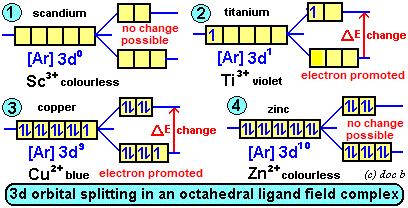
i.e. there is no
electron that can be promoted to a higher level when the 3d
sub–shell is split when the central metal ion interacts with the
ligands. See 1st
electronic diagram below.
-

-
Bottom right shows
the ground state of the zinc(II) ion, and clearly, no electron
can be promoted in the 3d sub-levels, so no absorption of
visible light photons, no colour from transmitted visible light!
-
-
The 2nd
electronic diagram (above), shows the possible electronic
transitions, whose
∆E photon
absorption is in the visible region of the electromagnetic spectrum.
-
Even though zinc is
a member of the 3d block of elements, this is why zinc is NOT
a true member of the first transition metal series, it forms no
ion with a partly filled 3d sub–shell.
-
For more details see
Appendix 4.
Electron configuration &
complex ion colour theory
5. The
Chemistry of
ZINC - electron configuration,
oxidation states and electrode potentials
Some basic reactions of zinc
metal, oxide and carbonate are on the GCSE Reactivity Series of Metals Notes
|
Pd |
s block |
d blocks (3d
block
zinc)
and
f
blocks of
metallic elements |
p block elements |
|
Gp1 |
Gp2 |
Gp3/13 |
Gp4/14 |
|
1 |
1H
|
|
2 |
3Li |
4Be |
Part of the modern Periodic Table of Elements:
ZSymbol, z = atomic or proton
number
Sc to Zn are now
considered the head-top elements of groups 3 to 12
3d
block of metallic elements: Scandium to
Zinc Sc-Zn
focus on zinc |
5B |
6C |
|
3 |
11Na |
12Mg |
13Al |
14Si |
|
4 |
19K |
20Ca |
21Sc
[Ar]3d14s2
scandium |
22Ti
[Ar]3d24s2
titanium |
23V
[Ar] 3d34s2
vanadium |
24Cr
[Ar] 3d54s1
chromium |
25Mn
[Ar] 3d54s2
manganese |
26Fe
[Ar] 3d64s2
iron |
27Co
[Ar] 3d74s2
cobalt |
28Ni
[Ar] 3d84s2
nickel |
29Cu
[Ar] 3d104s1
copper |
30Zn
[Ar] 3d104s2
zinc |
31Ga |
32Ge |
|
5 |
37Rb |
38Sr |
39Y |
40Zr |
41Nb |
42Mo |
43Tc |
44Ru |
45Rh |
46Pd |
47Ag |
48Cd |
49In |
50Sn |
|
6 |
55Cs |
56Ba |
57,58-71 |
72Hf |
73Ta |
74W |
75Re |
76Os |
77Ir |
78Pt |
79Au |
80Hg |
81Tl |
82Pb |
|
7 |
87Fr |
88Ra |
89,90-103 |
104Rf |
105Db |
106Sg |
107Bh |
108Hs |
109Mt |
110Ds |
111Rg |
112Cn |
113Nh |
114Fl |
|
Summary of
oxidation states of the 3d block
metals (least important) Ti to Cu are true transition metals |
|
Group 3 |
Group 4 |
Group 5 |
Group 6 |
Group 7 |
Group 8 |
Group 9 |
Group 10 |
Gp 11 |
Group 12 |
|
Sc |
Ti |
V |
Cr |
Mn |
Fe |
Co |
Ni |
Cu |
Zn |
| |
|
|
|
|
|
|
|
+1 |
|
| |
(+2) |
(+2) |
(+2) |
+2 |
+2 |
+2 |
+2 |
+2 |
+2 (3d10) |
|
+3 |
+3 |
+3 |
+3 |
(+3) |
+3 |
+3 |
(+3) |
(+3) |
|
| |
+4 |
+4 |
|
+4 |
|
|
(+4) |
|
|
| |
|
+5 |
|
|
|
|
|
|
|
| |
|
|
+6 |
(+6) |
(+6) |
|
|
|
|
| |
|
|
|
+7 |
|
|
|
|
|
|
3d14s2 |
3d24s2 |
3d34s2 |
3d54s1 |
3d54s2 |
3d64s2 |
3d74s2 |
3d84s2 |
3d104s1 |
3d104s2 |
|
Outer
electron configurations beyond [Ar] for the ground state of the simple
atom (ion configuration)
Note that when 3d block
elements form ions,
the 4s electrons are 'lost' first. |
The oxidation state (+2 only) and electron
configuration of zinc in
the context of the 3d block of elements
Electrode potential chart
for zinc the context of the 3d block transition metals
 zinc zinc
The
electrode potential chart highlights the value for the one positive
oxidation state of zinc.
PLEASE note:
The electrode potentials (EØ)
for zinc chemistry in the text sometimes vary from the chart
above - apologies, but data sources for zinc chemistry can vary!
Any discrepancy shouldn't significantly affect any electrode potential calculation
outcomes e.g feasibility (email
if concerned?).
6. The
chemistry of zinc and its simple compounds and complexes
-
Although a member
of the 3d–block, zinc is NOT a true transition metal.
-
 Zinc
metal readily dissolves in dilute hydrochloric acid or dilute sulfuric
acid reducing hydrogen ions to hydrogen gas. Zinc
metal readily dissolves in dilute hydrochloric acid or dilute sulfuric
acid reducing hydrogen ions to hydrogen gas.
-
The Zn2+
ion has a full sub–shell, 3d10, which does not allow the
electronic transitions which account for the colour in transition metal
compounds.
-
In aqueous solution zinc forms the
colourless stable hydrated zinc ion, [Zn(H2O)6]2+(aq)
and most complexes of the zinc ion have a co–ordination number of 6.
-
The alkalis sodium
hydroxide or ammonia, produce the hydrated white gelatinous
zinc
hydroxide precipitate. There is a further reaction with excess
of NaOH or NH3.
-
Zn2+(aq)
+ 2OH–(aq) ===> Zn(OH)2(s)
(can be written as
[Zn(OH)2(H2O)2]0
-
or
[Zn(H2O)6]2+(aq) +
2OH–(aq)
 Zn(OH)2(aq) + 6H2O(l)
-
A
precipitation reaction which you can expression via various
equations!
-
 Zinc ions with excess sodium
hydroxide: Zinc ions with excess sodium
hydroxide:
-
(i)
[Zn(H2O)6]2+(aq) + 4OH–(aq)
[Zn(OH)4]2–(aq) + 6H2O(l)
(from original aqueous ion)
-
or
(ii)
Zn(OH)2(s) + 2OH–(aq)
[Zn(OH)4]2–(aq) (from
hydroxide ppt.)
-
For (i) the formation of tetrahydroxozincate ion
is a ligand exchange reaction (hydroxide ion for water) with
change in shape (octahedral to tetrahedral), change in
co-ordination number (from 6 to 4), but no change in oxidation state
of zinc (+2). However the overall charge on
the zinc complex changes from 2+ to 2- (2+ 4x-1).
-
In fact zinc
oxide is a classic amphoteric oxide e.g. giving a 'zincate' ion with
alkali and a chloride salt with hydrochloric acid.
-
Zinc ions with excess ammonia:
-
[Zn(H2O)6]2+(aq)
+ 4NH3(aq)
[Zn(NH3)4]2+(aq)
+ 6H2O(l)
-
(formation from original aqueous ion)
-
The formation of the tetraammine
zinc(II) ion is a ligand exchange reaction (ammonia for water)
with change in shape (octahedral to tetrahedral), co-ordination
number changes (from 6 to 4), but no change in the oxidation
state of zinc (+2) or overall change in the net charge on the
zinc complex ion (2+, since both ligands involved are neutral).
-
or
Zn(OH)2(s) + 4NH3(aq)
[Zn(NH3)4]2+(aq)
+ 2OH–(aq) (from hydroxide precipitate)
-
With aqueous of
sodium carbonate
zinc ion solutions produce a precipitate of white
zinc carbonate, but its a basic carbonate, i.e. the carbonate
precipitate is mixed with zinc hydroxide, Zn(OH)2.
-
Zn2+(aq)
+ CO32–(aq) ===> ZnCO3(s)
-
better
prepared using less alkaline NaHCO3:
-
Zn2+(aq)
+ 2HCO3–(aq) ===> ZnCO3(s) +
H2O(l) +
CO2(g)
-
Some examples of
zinc complex ion
formation
-
The variation of the stability
constant with change in ligand is illustrated with the zinc ion.
-
The data set for zinc compares
five different monodentate ligands and the polydentate ligand EDTA.
-
Apart from the
EDTA complex the stability constant (Kstab) equilibrium expression
is
-
Kstab
= [[ZnL4]2+/2–(aq)] / [[Zn(H2O)4]2+(aq)]
[[L(aq)]4] mol–4dm12
(equations below)
-
Remember [H2O] is not included in the
equilibrium expression.
-
The data also assumes a ligand coordination
number of 4 for all the complexes involved.
-
Many of the species involving the hydrated zinc ion
can be partially substituted and hydrated and exist as octahedral
complexes, but I've ignored these complications and denoted the end
product in terms of the ligand substitution i.e. the water ligand
exchanged for CN-, NH3, X-
(halide).
|
Ligand
substitution reaction to give new complex ion |
Kstab |
lg Kstab |
|
[Zn(H2O)4]2+(aq)
+ 4CN–(aq) ==> Zn(CN)4]2–(aq) + 4H2O(l) |
5.0 x 10¹⁶ |
16.7 |
|
[Zn(H2O)4]2+(aq)
+ 4NH3(aq) ==> Zn(NH3)4]2–(aq)
+ 4H2O(l) |
3.8 x 10⁹ |
9.58 |
|
[Zn(H2O)4]2+(aq)
+ 4Cl–(aq) ==> [ZnCl4]2–(aq) + 4H2O(l) |
1.0 |
0.0 |
|
[Zn(H2O)4]2+(aq)
+ 4Br–(aq) ==> [ZnBr4]2–(aq) + 4H2O(l) |
10–1 |
–1.0 |
|
[Zn(H2O)4]2+(aq)
+ 4I–(aq) ==> [ZnI4]2–(aq) + 4H2O(l) |
10–2 |
–2.0 |
|
[Zn(H2O)4]2+(aq)
+ EDTA4–(aq) ==> [ZnEDTA]2–(aq) + 4H2O(l) |
3.2 x 10¹⁶ |
16.5 |
-
The very high value for the
tetracyanozincate(II) in reflects the strong of central
metal ion (Zn2+) - ligand (CN) bond.
-
The lower Kstab value for
ammonia indicates on average a weaker dative covalent bond.
-
The ligand bonds are even weaker
for the halide ions possibly due to their larger radius, since there is a
steady decrease in Kstab as the halide radius increases, making the Zn–X
dative covalent bond longer and weaker.
-
The stability constant for the
zinc–EDTA complex is a very high value, typical for a polydentate ligand (see
Appendix 8).
|
7. The Extraction and Purification of
Zinc
- Zinc is extracted from either zinc
blende/sphalerite ore (zinc sulfide) or sometimes calamine/Smithsonite ore (zinc
carbonate).
- (1)
The zinc sulfide ore is roasted in air to give
impure zinc oxide.
-
2ZnS(s) + 3O2(g)
==> 2ZnO(s) + 2SO2(g)
- Note: calamine ore can be used
directly in a zinc smelter because on heating it also forms zinc
oxide.
-
ZnCO3(s) ==>
ZnO(s) + CO2(g) (endothermic
thermal decomposition)
- (2)
The impure zinc oxide can be treated
in two ways to extract the zinc:
- (a)
It is roasted in a
smelting furnace
with carbon (coke, reducing agent) and limestone (to remove the
acidic impurities).
-
C(s) + O2(g)
==> CO2(g) (very exothermic oxidation,
raises temperature considerably)
-
C(s) + CO2(g)
==> 2CO(g) (C oxidised, CO2
reduced)
-
ZnO(s) + CO(g)
==> Zn(l) + CO2(g) (zinc oxide
reduced by CO, Zn undergoes O loss)
- or direct reduction
by carbon:
-
ZnO(s) +
C(s)
==> Zn(l) + CO(g)
(ZnO
reduced, C oxidised)
- The carbon monoxide
acts as the reducing agent i.e. it removes the oxygen from the
oxide.
- The impure zinc is
then fractionally
distilled from the mixture of slag and other metals like
lead and cadmium out of the top of the furnace in an
atmosphere rich in carbon monoxide which stops any zinc from
being oxidised back to zinc oxide.
- The slag and lead (with other
metals like cadmium) form two layers which can be tapped off at the base
of the furnace.
- The zinc can be further
purified by a 2nd fractional distillation or more
likely by dissolving it in dilute sulfuric acid and purified
electrolytically as described below.
- (b) Two stages
- (i)
It is dissolved and
neutralised with dilute sulfuric acid to form impure zinc
sulfate solution.
- ZnO(s) + H2SO4(aq)
==> ZnSO4(aq) + H2O(l)
- or using calamine ore/zinc
carbonate directly:
-
ZnCO3(s)
+ H2SO4(aq) ==> ZnSO4(aq)
+ H2O(l)+ CO2(g)
-
(ii)
Quite pure zinc is produced
from the solution by electrolysis. It can be deposited on a
pure zinc negative electrode (cathode) in the same way
copper can be purified. The other electrode,
must be inert e.g. for laboratory experiments,
carbon (graphite) can be used and oxygen is formed.
-
Zn2+(aq) + 2e–
==> Zn(s)
- A reduction process, electron
gain, as zinc metal is deposited on the (–) electrode.
- You can't use solid zinc
oxide directly because its insoluble and the ions must
free to carry the current and migrate to the electrodes
in some sort of solution.
- For more details of the
type of electrolysis system used, see
purification of copper (just swap Zn for Cu in the
method/diagram).
- PLEASE note: In the
industrial production of zinc by electrolysis (called electro–winning) the negative (–) cathode is made of
aluminium (Al, where zinc deposits) and the positive (+)
electrode is made of a lead–silver alloy (Pb–Ag, where oxygen
gas is formed). Why these particular electrode metals are used
in this 'electrowinning' process I'm not quite sure, but
aluminium is so unreactive that it is effectively inert, and
lead and silver are also of low activity, but ... ???
|
8.
The vertical connection of zinc with the other d-block elements of Group 12
(IUPAC designation)
|
Modern IUPAC group numbers of 3-12 |
Outer electron
structure of d-block elements which includes the transition metals
Zinc
is the head element of Group 12 plus Cadmium, Mercury and
Copernicium
Their
outer electron
configurations are nd10(n+1)s2
(n = 3 to 6)
|
|
[e- core] |
Gp 3 |
Group
4 |
Group
5 |
Group
6 |
Group
7 |
Group
8 |
Group
9 |
Group
10 |
Group
11 |
Gp
12 |
|
P'd 4,
3d block [Ar] core |
21Sc
3d14s2 |
22Ti
3d24s2 |
23V
3d34s2 |
24Cr
3d54s1 |
25Mn
3d54s2 |
26Fe
3d64s2 |
27Co
3d74s2 |
28Ni
3d84s2 |
29Cu
3d104s1 |
30Zn
3d104s2 |
|
P'd 5, 4d block (Kr] core |
39Y
4d15s2 |
40Zr
4d25s2 |
41Nb
4d45s1 |
42Mo
4d55s1 |
43Tc
4d55s2 |
44Ru
4d75s1 |
45Rh
4d85s1 |
46Pd
4d10 |
47Ag
4d105s1 |
48Cd
4d105s2 |
|
P'd 6,
5d
b'k [Xe] core |
57La
5d16s2 |
72Hf
4f145d26s2 |
73Ta
4f145d36s2 |
74W
4f145d46s2 |
75Re
4f145d56s2 |
76Os
4f145d66s2 |
77Ir
4f145d76s2 |
78Pt
4f145d96s1 |
79Au
4f145d106s1 |
80Hg
4f145d106s2 |
|
P'd 7, 6d b'k
[Rn] core |
89Ac
6d17s2 |
104Rf
5f146d27s2 |
105Db
5f146d37s2 |
106Sg
5f146d47s2 |
107Bh
5f146d57s2 |
108Hs
5f146d67s2 |
109Mt
5f146d77s2 |
110Ds
5f146d87s2 |
111Rg
5f146d97s2 |
112Cn
5f146d107s2 |
You would expect some
similarities between the chemistry of zinc, cadmium and mercury, but
there are many significant differences too.
They have an outer electron
configuration of d10s2.
Learning objectives for the chemistry of the 3d block metal zinc
Zinc is the top-head element of group 3 (modern IUPAC
convention).
Know that zinc is a 3d block element because it has an
electron in the 3d inner shell.
Know that zinc has relatively high melting point, boiling point
and density.
Zinc does NOT comply with the
definition of a transition metal,
because it cannot form at least one
ion with partially filled d sub–shell containing at least one electron.
Know how to work out the
electron configurations of zinc and its ion, Zn2+.(the only
+2 oxidation state)
Know that zinc does NOT display compounds or ions in
several oxidation states.
Be able to relate the oxidation state of
zinc
to its electron configuration.
Know that most zinc
ions/compounds are usually colourless because the Zn2+
has a 3d10 configuration and absorption in the visible
spectrum is not possible, any colour will be due to a coloured anion
or ligand.
It is quite
electropositive metal and readily dissolves in acids to give zinc
salts.
Zinc sulfate is used
in electroplating to provide an anti-rusting coated on iron/steel
surfaces.
The zinc ion is an
important ingredient in our diet and is at the heart of the active
site in several enzymes.
Know that zinc can form complex ions,
but not with the variety of ligands and colours of true transition metal
ions.
Know that aqueous
solutions of zinc salts give a white hydroxide precipitate that
dissolves in excess hydroxide ion or ammonia, and be able to write
equations for these reactions.
Know that zinc and its
compounds do NOT display the
catalytic properties of true transition metals.
|
WHAT NEXT?
GCSE Level Notes on Transition
Metals (for the basics)
The chemistry of
Scandium
* Titanium * Vanadium
* Chromium
* Manganese
The chemistry of
Iron * Cobalt
* Nickel
* Copper *
Zinc
*
Silver & Platinum
Introduction 3d–block Transition Metals * Appendix
1.
Hydrated salts, acidity of
hexa–aqua ions * Appendix 2. Complexes
& ligands * Appendix 3. Complexes and isomerism * Appendix 4.
Electron configuration & colour theory * Appendix 5. Redox
equations, feasibility, Eø * Appendix 6.
Catalysis * Appendix 7.
Redox
equations
* Appendix 8. Stability Constants and entropy
changes *
Appendix 9. Colorimetric analysis
and complex ion formula * Appendix 10 3d block
– extended data
* Appendix 11 Some 3d–block compounds, complexes, oxidation states
& electrode potentials * Appendix 12
Hydroxide complex precipitate 'pictures',
formulae and equations
Some
pages have a matching sub-index
Advanced
Level Inorganic Chemistry Periodic Table Index:
Part 1
Periodic Table history
Part 2
Electron configurations, spectroscopy,
hydrogen spectrum,
ionisation energies *
Part 3
Period 1 survey H to He *
Part 4
Period 2 survey Li to Ne * Part
5 Period 3 survey Na to Ar *
Part 6
Period 4 survey K to Kr AND important
trends down a group *
Part 7
s–block Groups 1/2 Alkali Metals/Alkaline Earth Metals *
Part 8
p–block Groups 3/13 to 0/18 *
Part 9
Group 7/17 The Halogens *
Part 10
3d block elements & Transition Metal Series
*
Part 11
Group & Series data & periodicity plots
All
11 Parts have
their own sub-indexes near the top of the pages
Group numbering and the modern periodic
tableThe original group numbers of
the periodic table ran from group 1 alkali metals to group 0
noble gases. To account for the d block elements and their
'vertical' similarities, in the modern periodic table, groups 3
to group 0 are numbered 13 to 18. So, the p block elements are
referred to as groups 13 to group 18 at a higher academic level,
though the group 3 to 0 notation is still
used, but usually at a lower academic level. The 3d block
elements (Sc to Zn) are now considered the head (top) elements
of groups 3 to 12.
keywords redox reactions ligand
substitution displacement balanced equations
formula complex ions complexes ligands colours oxidation states: zinc ions Zn(0)
Zn2+ Zn(+2) ZnSO4 ZnCl2 ZnO [Zn(H2O)4]2+ + 4 OH– [Zn(OH)4]2– Zn(OH)2 +
2OH– [Zn(OH)4]2– [Zn(H2O)4]2+ + 4 NH3 [Zn(NH3)4]2+ + 4H2O Zn(OH)2 + 4NH3
[Zn(NH3)4]2+ + 2OH– Zn2+ + 2 HCO3– ==> ZnCO3 + H2O + CO2 Ligand substitution
reaction to give new complex ion [Zn(H2O)4]2+ + 4CN– ==> Zn(CN)4]2– + 4H2O
[Zn(H2O)4]2+ + 4NH3 ==> Zn(NH3)4]2– + 4H2O [Zn(H2O)4]2+ + 4Cl– ==> [ZnCl4]2– +
4H2O [Zn(H2O)4]2+ + 4Br– ==> [ZnBr4]2– + 4H2O [Zn(H2O)4]2+ + 4 CN– ==>
[Zn(CN)4]2– + 4H2O [Zn(H2O)4]2+ + EDTA4– ==> [ZnEDTA]2– + 4H2O oxidation
states of zinc, redox reactions of zinc, ligand substitution displacement
reactions of zinc, balanced equations of zinc chemistry, formula of zinc complex
ions, shapes colours of zinc complexes Na2CO3 NaOH NH3
Website content © Dr Phil Brown
2000+. All copyrights reserved on revision notes, images, quizzes,
worksheets etc. Copying of website material is NOT permitted. Doc
Brown's Chemistry inorganic chemistry revision notes for
pre-university level students on 3d-block elements including the
physical and chemical properties reactions equations and trends
explained for the 3d-block of transition metals series
Explaining the importance of chemistry of
zinc
in inorganic chemistry, What you need to know about chemistry of zinc for inorganic
chemistry,
Explaining the use of chemistry of zinc knowledge in inorganic chemistry, Examples of
chemistry of zinc explained
when studying inorganic chemistry, What is
the significance of chemistry of zinc in inorganic chemistry, What is the use of
chemistry of zinc
in inorganic chemistry Describing and
explaining the theory of chemistry of zinc when studying inorganic chemistry, exam revision
notes for chemistry of zinc in exams, online help for chemistry of zinc, revision notes for
chemistry of zinc,
what do I need to learn for chemistry of zinc in exams? revision summary for
chemistry of zinc, help in
teaching chemistry of zinc, learning notes for chemistry of zinc, help to pass the
chemistry of zinc exam, how to
prepare for examination questions on chemistry of zinc?
Website content © Dr Phil Brown 2000+. All
copyrights reserved on revision notes, images, quizzes, worksheets etc. Copying
of website material is NOT permitted. Exam revision summaries & references to
science course specifications are unofficial.
Website content © Dr Phil Brown 2000+. All
copyrights reserved on these organic chemistry exam revision
notes on chemistry of zinc, these A level chemistry revision notes are suitable for use of pre-university students studying AQA
advanced A level inorganic chemistry revision notes on chemistry of zinc, Edexcel advanced A
level inorganic chemistry revision notes on chemistry of zinc, OCR advanced A level inorganic
chemistry revision notes on chemistry of zinc, IB advanced A level inorganic chemistry revision notes on
chemistry of zinc, WJEC (Eduqas)
advanced A level inorganic chemistry revision notes on chemistry of zinc, CIE Cambridge
advanced A level inorganic chemistry revision notes on chemistry of zinc, CCEA advanced A
level inorganic chemistry revision notes on chemistry of zinc, and useful for US
grade 11 grade 12 AP honors inorganic chemistry courses involving chemistry of
zinc
|
|
|

