|


3d-block Transition Metal Advanced A Level
Inorganic Chemistry:
Appendix 2. Explaining complex
ions, bonding, ligands and coordination number
[Author
© Dr
Phil Brown PhD: Doc
Brown's exam revision notes suitable
for advanced A level chemistry students of taking pre-university/college level
inorganic chemistry courses:
[apps-trans- page updated April 20th 2026 *]
Sub-index for
this page on complex formation and technical terms used in their
description
Periodic
Table - Transition Metal Chemistry - Doc
Brown's Chemistry
Revising
Advanced Level Inorganic Chemistry Periodic Table
Revision Notes
Explaining the technical terms ligands, ligand bonds,
coordination number and shape of 3d block transition metal ion complexes
(1)
Technical terms
used and illustrated with descriptions of complex ions
(2)
Reminders
and more examples of complexes using the technical terms described
in (1)
(3)
A simplified view of the bonding in an octahedral complex ion
(4)
More examples of unidentate/monodentate
ligands
(5)
Examples of bidentate
ligand complexes - chelation process
(6)
Examples of
multidentate (>2) or polydentate ligands - chelation complex formation
Email doc
brown - comment? - query?
* [privacy
policy, cookies and disclaimer]
INDEX of advanced revision notes on 3d block
and transition metal chemistry
All my advanced UK A level
(~US grades 11-12 honors)
inorganic
chemistry notes
GCSE level (~US grade 9-10)
basic Transition Metal Chemistry Revision Notes
Appendix
2.
Technical terms used and illustrated with descriptions of complex ions
(1)
Complexes – introduction: ligands, bonding, co–ordination number, charge on complex ions
Complexes
of 3d block transition metals: An introduction to explain
ligands, coordinate covalent bonding (dative covalent bonds), coordination number,
overall charge and shape of complex ions
and how to name them
Introduction
What is a complex ion?
What is a ligand?
What do the terms monodentate ligand, bidentate ligand
and polydentate ligand mean?
What is the co–ordination number of a
complex ion?
The structure of transition metal (3d–block) complexes is described
with displayed formula diagrams and explanations
include the formation of central metal ion – ligand dative covalent
bonds.
What shapes can complexes be? e.g. octahedral, tetrahedral,
square planar and linear examples are presented.
Three crucial
definitions and terms to learn
in connection with complex formation and understanding
A ligand is a molecule or ion that
forms a co-ordinate (dative covalent) bond with a central transition metal
atom or ion by donation of a pair of electrons.
The ligand is effectively a Lewis
base - an electron pair donor (: on formulae below), for the 1st transition series, the pair
of bonding electrons is accepted into a vacant 3d, 4s or 4p orbital.
A unidentate (monodentate) ligand forms
one
co-ordinate bond per ligand with the central metal atom or ion.
e.g. water H2O:,
ammonia :NH3, cyanide ion :CN-,
chloride ion :Cl-, hydroxide :OH-
A bidentate ligand forms two co-ordinate (dative
covalent) bonds per
ligand with the central metal atom or ion.
e.g. ethanedioate ion
-OOC-COO-
and the 1,2-diamoethane molecule H2NCH2CH2NH2
More detailed diagrams of
these two ligands and their complex further down the page.
A polydentate ligand forms more than two co-ordinate
(dative covalent) bonds
per ligand with the central atom or ion.
e.g. (EDTA)4-, full
structure of the (4-) ion, capable of donating 6 pairs of electrons
to form 6 single covalent dative bonds.
If the ligand has more than one atom, the bonds
within the ligand ion/molecule are sigma covalent and may also involve
pi bonding.
A complex
is the result of a central metal atom
or ion (often a transition metal) surrounded by, and bonded to, a number of
ligands e.g. often 2, 3, 4 or 6.
The metal ligand bond is a dative
covalent bond (coordinate covalent bond), i.e. the bond is formed by an
electron pair donation from the ligand (M :L
bond). :L
bond).
Complexes can be cationic (+) e.g.
[Ni(H2O)6]2+,
anionic (-) e.g. [NiCl4]2–, or neutral (0)
e.g. Ni(CO)4.


The style of the three diagrams above
emphasizes the shape of the complex and bond angles and the three diagrams below
emphasise the number of the coordinate ligand bonds, but should still
convey the 2D/3D shape of the complex.
[H3N→Ag←NH3]+

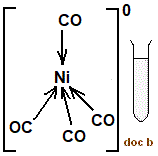

The co-ordination number is the number of
co-ordinate bonds to the central metal atom or ion of the specific complex
e.g. most often 2, 4 or 6, irrespective whether the ligand is a monodentate,
bidentate or polydentate.
Note that the co-ordination number is
only the same as the number of ligands if they are monodentate ligands.
These definitions and explanations are
irrespective of the oxidation state of the central metal atom or ion.
All these
points are illustrated below with lots of examples
|
|
(2) Reminders and more examples of complexes using the
technical terms described in (1)
A
complex is
formed by the combination of a central
metal ion surrounded by, and bonded to, neutral molecules or ions
acting as 'ligands' (bits stuck on or appendages).
-
If you have already
read
Appendix 1. you should note that it is riddled with
hydrated aqueous complex ions
and the central metal ion does NOT have to be a transition element.
-
The
two ligands involved were H2O and OH–.
A
ligand
is an
atom, ion
or molecule which can act as an electron pair donor (Lewis base) and usually
forms a dative covalent or 'co–ordinate' bond with the central
metal ion.
-
The lone pair
donation is usually from an O, N or halogen atom of the ligand
in this covalent co–ordinate bonding.
-
The central metal
atom or ion acts as a Lewis Acid, that is, an electron pair
acceptor from the ligand by way of vacant 3d, 4s, 4p and even 4d
orbitals for the 3d–block transition elements.
-
The ligand acts as
a Lewis Base, that is, an electron pair donor e.g.
-
neutral ligands like
H2O: (water
molecule, aqua in
complex name)
e.g. the familiar blue
hexaaquacopper(II) [Cu(H2O)6]2+
it has an
octahedral
shape, co-ordination number 6, charge 2+
Since the ligand is neutral, the
overall charge is the same as that of the central transition metal
ion.
-
or :NH3 (ammonia
molecule, ammine in
complex name, neutral ligand)
-
-
e.g. the hexaamminenickel(II) ion
[Ni(NH3)6]2+
-
it has an octahedral shape,
co-ordination number 6, charge 2+
-
or the diamminesilver(I) ion
[Ag(NH3)2]+
or [H3N AgNH3]+ AgNH3]+
-
which is a linear shape with a
co-ordination number of 2, charge +
-
Note that
and
indicate the two co-ordinate bonds and the specific direction of
electron pair donation to form the dative covalent bonds between the ligands
and the central metal atom or ion.
-
The uncharged water
and ammonia are similar sized ligand molecules and
smaller than the chloride ion
below.
-
The size of ligands can have a
bearing on the resulting shape of the complex ion.
-
Again, these two other examples
of neutral ligands mean the overall charge on the complex is the
same as the central metal ion.
-
The carbon monoxide molecule can
act as a neutral ligand electron pair donor.
-
-
e.g. in the neutral complex, nickel
carbonyl Ni(CO)4
-
it has a
tetrahedral
shape, co-ordination number 4, no overall electrical charge
-
Here you have a neutral central
atom (not an ion), a neutral ligand, so overall an electrically
neutral complex.
-
and negatively charged ligands like
:OH–
(hydroxide, hydroxo or hydroxy in complex name)
-
-
e.g. the hexahydroxochromate(III)
ion [Cr(OH)6]3–
-
it has an octahedral shape,
co-ordination number 6, overall charge 3- (+3 -6)
-
or Cl–
(chloride ion, chloro in complex name)
-
e.g. the tetrachloronickelate(II)
ion, [NiCl4]2–
-
it has a tetrahedral shape,
co-ordination number 4, overall charge 2- (+2 -4 = -2)
-
or the neutral diamminedichloroplatinum(II),
[Pt(NH3)2Cl2]
-
which has co-ordination number of
4 and a square planar shape
-

-
no overall charge, 0 (+2 -2)
-
Note the presence of two
different monodentate ligands and two
E/Z
isomers!
-
All six ligands mentioned above
are monodentate ligands, forming one bond each with the
central metal atom or ion.
-
Complex ions undergo
ligand
exchange reactions (ligand displacement or ligand substitution
reactions) e.g.
-
[Cu(H2O)4(OH)2](s)
+ 4NH3(aq)  [Cu(NH3)4(H2O)2]2+(aq)
+ 2OH–(aq) + 4H2O(l)
[Cu(NH3)4(H2O)2]2+(aq)
+ 2OH–(aq) + 4H2O(l)
-
[Co(H2O)6]2+(aq) + 4Cl–(aq)
[CoCl4]2–(aq) + 6H2O(l)
-
I've deliberately included in the
examples above, the most typical monodentate ligands you will come
across and the shapes and co-ordination numbers you are also most
likely to encounter.
(3)
A simplified view of the bonding in an octahedral complex ion
-
More on these examples and others
below. (More details on
molecule/ion shapes)
-

-
A an example of
the bonding in a complex ion is shown in the above diagram. The
negative cyanide ion is a monodentate ligand (forms one bond
per ligand) and donates an electron pair into a vacant 3d, 4s or 4p
orbital in the iron(III) ion to form six dative covalent bonds.
-
The resulting
ion has the formula [Fe(CN)6]3–, the overall charge of 3– is the aggregate of 6– (cyanide ions) plus
3+ (iron ion)
-
The co–ordination number of 6, which means there are 6 central metal
ion – ligand bonds. It doesn't necessarily mean six ligands, you can
get a co–ordination number of 6 from three co–ordinated bidentate
ligands (2 bonds per ligand), two tridentate ligands and from EDTA
just one ligand can form 6 dative covalent bonds with a central
metal ion.
-
More on this below.
-
The most common
complex ion you will come across is the hexaaqua cation of many
metals.
-
It has the
general formula [M(H2O)6]n+
-
n, the charge on
the central metal ion and hence the overall charge on the complex
ion n is usually 2 or 3
-
e.g. n = 2 for
titanium(II), vanadium(II), iron(II), cobalt(II), nickel(II),
copper(II) and also the Group 2 alkaline Earth metals magnesium,
calcium etc.
-
and n is 3 for
scandium, titanium(III), vanadium(III), chromium(III), iron(III),
cobalt(III) and also aluminium from Group 3.
-
The six
neutral water ligands form 6 dative covalent bonds with the central
metal ion because the bonding pair of electrons comes from
donation of a lone pair from the oxygen atom of the water molecule.
-
Therefore the
co–ordination number is 6 and it has a symmetrical octahedral shape.
-
The O–M–O bond
angles are all 90o or 180o.
The ligand may attach
itself by one or more bonds. The suffix '...dentate',
prefixed by mono/uni/bi/ploy/multi e.g. monodentate (unidentate),
bidentate, or
polydentate (multidentate)
is used to denote the number of bonds each ligand makes with the
central metal ion.
The total number of
ligand bonds to the central metal ion is called the co–ordination
number.
-
It is not the number
of ligands, unless it is a monodentate ligand.
-
There is no firm
rules relating shape to a particular ligand.
-
The six ligands
don't have to be the same
-
e.g. the cis/Z
isomer of [CrCl2(H2O)4]+
complex ion. the cis/Z
isomer of [CrCl2(H2O)4]+
complex ion.
-
... which is the
dichlorotetraaquachromium(III) ion. This octahedral complex with a
co–ordination number of 6, and note this has an overall ion charge of (2
x – from 2Cl–) + (3+ from Cr3+) = +, water is an
electrically neutral ligand ...
-
... and in equations
the complex ion would be written as [Cr(H2O)4Cl2]+
(4) More examples of unidentate/monodentate
ligands:
-
 and
and

-
e.g. above are shown
two complexes with electrically neutral ligands:
water H2O:, ammonia :NH3 and primary aliphatic
amines like butylamine CH3CH2CH2CH2NH2,
-
These ligands
often form octahedral
 shaped
complexes with a co–ordination number of 6. shaped
complexes with a co–ordination number of 6.
-
 e.g.
negative
ligands: chloride Cl– and cyanide CN–
ions (lone pair donors).. e.g.
negative
ligands: chloride Cl– and cyanide CN–
ions (lone pair donors)..
-
Above is the structure of the
complex ion hexacyanocobaltate(III), [Co(CN)6]3-.
-
 The chloride
ion Cl– can form the tetrahedral The chloride
ion Cl– can form the tetrahedral e.g. the
tetrachlorocuprate(II) complex ion ... e.g. the
tetrachlorocuprate(II) complex ion ...
-
[CuCl4]2–,
note the overall charge is (2+) + (4 x –) = 2– and the
co–ordination number of is 4.
-
The chloride ion
can be too bulky to form an
octahedral complex or a square planar complex, though there is no firm rules relating
complex shape to
ligand.
-
and CN–
square planar
 e.g.
the tetracyanonickelate(II) complex ion ... e.g.
the tetracyanonickelate(II) complex ion ...
-
[Ni(CN)4]2–,
note the overall charge is (2+) + (4 x –) = 2– and the
co–ordination number is 4.
-
Note that
[Cu(H2O)4]2+,
is in the hydrated salt CuSO4.5H2O, the tetraaquacopper(II) ion, with the less bulky water molecule
ligand, forms a blue square planar complex, whereas with the larger
chloride ion, a tetrahedral complex is formed.
-
The 5th water molecule hydrogen
bonds between the copper complex ions in the blue crystals.
-
A linear shaped
complex is formed between a silver ion the ligands ammonia or
cyanide. shaped
complex is formed between a silver ion the ligands ammonia or
cyanide.
-
[Ag(NH3)2]+
is formed in 'ammoniacal' silver nitrate solution used in the
test for aldehydes.
(5) Examples of bidentate
ligand complexes - chelation process of complex formation

The two diagrams (above/below)
illustrate the chelation of a central transition metal ion by three
bidentate ligands as described in the two examples above, namely
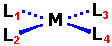
the ethanedioate an ion and the neutral 1,2-diaminoethane molecule. The
L____L
represents the bidentate ligand forming two dative coordinate covalent bonds
with the central metal ion.

 2-hydroxybenzoic acid can act as a bidentate ligand via the oxygen atoms of
the OH groups. The actual chelating bidentate ligand can be simply
represented as -O-C6H4-COO-.
It is effectively the same as the anion formed from ethanedioic acid
described above. 1,2-dihydroxybenzene can also act in a similar way as
a bidentate ligand. HO-C6H4-OH giving rise to the
chelating anion -O-C6H4-O-
(diagrams to follow)
2-hydroxybenzoic acid can act as a bidentate ligand via the oxygen atoms of
the OH groups. The actual chelating bidentate ligand can be simply
represented as -O-C6H4-COO-.
It is effectively the same as the anion formed from ethanedioic acid
described above. 1,2-dihydroxybenzene can also act in a similar way as
a bidentate ligand. HO-C6H4-OH giving rise to the
chelating anion -O-C6H4-O-
(diagrams to follow)
(6) Examples of
multidentate (>2) or polydentate ligands - chelation complex formation
-
More examples of
multidentate or polydentate ligands:
-
EDTA is an acronym abbreviation for the old name
of
EthyleneDiamineTetraAcetic acid a
-
It used in the form of its
disodium hydrated salt which is soluble in water (structure
below).
-
(Na+-OOCCH2)(HOOCCH2)NCH2CH2N(CH2COOH)(CH2COO-Na+).2H2O
-
In solution it forms the
chelating agent which can be considered to have the following
structure
-
(-OOCCH2)2NCH2CH2N(CH2COO-)2
(diagram below of the 6 electron pair donor sites)
-
The anion from the sodium salt of
EDTA is often shown as EDTA4–
(for simplicity) and forms six co-ordinate bonds with a central
metal ion and tends to displace most other ligands,
mainly due to the increase in entropy
-
e.g. for these nickel(II) complex
ions
-
[Ni(H2O)6]2+(aq) +
EDTA4–(aq)
 [Ni(EDTA)]2–(aq) + 6H2O(l)
-
[Ni(NH3)6]2+(aq) +
EDTA4–(aq)
[Ni(EDTA)]2–(aq) + 6NH3(aq)
-
The EDTA anion will displace most ligands from
most transition metal ions.

-
The above diagram illustrates
structure of the (EDTA)4- anion which can form 6
dative covalent bonds with a central metal ion to give a complex ion
in which the 6 bonds form an octahedral arrangement around the
central metal ion.
-
EDTA can be used to estimate the
concentration of many metal ions in solution with a volumetric
titration. An indicator is used which forms a weak complex
with the metal ion. When all the free metal ions have been
titrated with an EDTA solution and hence more strongly complexed,
the indicator is displaced from its weak metal complex and a new
colour is observed at the end-point.
-
For an examples of an EDTA
titration questions see
Q9(c) on
non-redox titration problem solving
![structure of the complex ion [NiEDTA]2- formed between the aqueous nickel(II) ion, Ni2+(aq) and the EDTA anion [EDTA]4-](SSquestions/EDTA-complex-Ni.gif)
The structure of the complex ion
[NiEDTA]2-
formed between the aqueous nickel(II) ion, Ni2+(aq) and
the EDTA anion [EDTA]4-
The process is called a chelation of the central metal
ion.
-
The haemoglobin (haem)
molecule acts as a multi/polydentate ligand with iron(II) ions in
blood chemistry.
-
Ligand displacement
reactions
-
One ligand can replace
another depending on the relative bond strengths
in a reaction called a ligand exchange reaction.
-
When a bidentate
or polydentate
ligand is added to a pre–existing complex of monodentate
ligands, it is highly likely
a more stable complex will be formed.
-
This called the
chelate
effect, and the process is called chelation.
-
The overall enthalpy changes in
breaking and making these co-ordinate bonds is not that great,
so why the overpowering effect of bidentate and polydentate
ligand molecules?
-
The principal reason
for this, (ignoring bond strengths/energies), is the positive entropy
change accompanying the 'release' of 4 or 6 small molecules
which offer a greater variation of ways of arranging the particles
or energy
distribution.
-
If the ligands are easily
exchanged, the complex is described as 'unstable' and if the ligands
are more strongly bound, the complex would be described as stable.
-
Complex ion
stability is also related to the oxidation state of the
transition metal in the presence of a particular ligand.
-
See Appendix 3.
for more on complex ion shape and isomerism.
-
See Appendix 5.
for more on electrode potentials, oxidation state
and complex ion stability.
-
See Appendix 8.
for more on complex ion stability, entropy changes and stability equilibrium constants
-
See the individual transition metal
pages below for examples of ligand exchange reactions.
|
INORGANIC Part
10 3d block TRANSITION METALS sub–index:
10.1–10.2
Introduction to 3d–block Transition Metal
chemistry
10.3
Chemistry of Scandium
* 10.4
Chemistry of Titanium
10.5
Chemistry of Vanadium
* 10.6
Chemistry of Chromium
10.7
Chemistry of Manganese
* 10.8
Chemistry of Iron
10.9
Chemistry of Cobalt
* 10.10
Chemistry of Nickel
10.11
Chemistry of Copper
* 10.12
Chemistry of Zinc
10.13
Selected chemistry of other Transition Metals e.g. Ag and Pt
Appendix 1.
Hydrated salts, acidity of
hexa–aqua ions
Appendix 2. Complexes
and ligands
Appendix 3. Complexes and isomerism
Appendix 4.
Electron configuration and colour theory
Appendix 5.
Redox
equations, feasibility of reaction, Eø
calculations
Appendix 6.
Catalysis - types and
effectiveness
Appendix 7.
Redox
equations - construction and balancing
Appendix 8. Stability
constants
of complexes and entropy
changes
Appendix 9. Colorimetric analysis
and determining a complex ion formula
Appendix 10 3d block
– extended data table
Appendix 11
3d–block transition metal complexes, oxidation states
& electrode potentials
Appendix 12
Hydroxide complex precipitate 'pictures',
formulae and equations
Advanced
Level Inorganic Chemistry Periodic Table Index: Part 1
Periodic Table history
* Part 2
Electron configurations, spectroscopy,
hydrogen spectrum,
ionisation energies *
Part 3
Period 1 survey H to He *
Part 4
Period 2 survey Li to Ne * Part
5 Period 3 survey Na to Ar *
Part 6
Period 4 survey K to Kr and important trends down a
group *
Part 7
s–block Groups 1/2 Alkali Metals/Alkaline Earth Metals *
Part 8
p–block Groups 3/13 to 0/18 *
Part 9
Group 7/17 The Halogens *
Part 10
3d block elements & Transition Metal Series
*
Part 11
Group & Series data & periodicity plots * All
11 Parts have
their own sub–indexes near the top of the pages
|
Periodic
Table - Transition Metal Chemistry - Doc
Brown's Chemistry. Revising
Advanced Level Inorganic Chemistry Periodic Table
Revision Notes.
Website content © Dr
Phil Brown 2000+. All copyrights reserved on Doc Brown's chemistry revision notes, images,
quizzes, worksheets etc. Copying of Doc Brown's website material is
NOT permitted of Revision notes on the 3d-block and transition
metals series
Website content © Dr Phil Brown 2000+. All
copyrights reserved on revision notes, images, quizzes, worksheets etc. Copying
of website material is NOT permitted. Exam revision summaries & references to
science course specifications are unofficial.
Website content © Dr Phil Brown 2000+. All
copyrights reserved on these organic chemistry exam revision
notes on explaining transition metal complex ions shapes & technical terms, these A level chemistry revision notes are suitable for use of pre-university students studying AQA
advanced A level inorganic chemistry revision notes on explaining transition
metal complex ions shapes & technical terms, Edexcel advanced A
level inorganic chemistry revision notes on explaining transition metal complex
ions shapes & technical terms, OCR advanced A level inorganic
chemistry revision notes on explaining transition metal complex ions shapes &
technical terms, IB advanced A level inorganic chemistry revision notes on
explaining transition metal complex ions shapes & technical terms, WJEC (Eduqas)
advanced A level inorganic chemistry revision notes on explaining transition
metal complex ions shapes & technical terms, CIE Cambridge
advanced A level inorganic chemistry revision notes on explaining transition
metal complex ions shapes & technical terms, CCEA advanced A
level inorganic chemistry revision notes on explaining transition metal complex
ions shapes & technical terms, and useful for US grade 11 grade 12
AP honors inorganic chemistry courses involving explaining
transition metal complex ions shapes & technical terms
Explaining the importance of explaining
dative covalent bonding in transition metal complex ions -
monodentate, bidentate and polydentate ligands, coordination number
in inorganic chemistry, What you need to know about explaining dative
covalent bonding in transition metal complex ions -
monodentate, bidentate and polydentate ligands, coordination number for inorganic
chemistry,
Explaining the use of explaining dative covalent bonding in
transition metal complex ions - monodentate, bidentate and
polydentate ligands, coordination number knowledge in inorganic chemistry, Examples of
explaining dative covalent bonding in transition metal complex
ions - monodentate, bidentate and polydentate ligands, coordination
number explained
when studying inorganic chemistry, What is
the significance of explaining dative covalent bonding in
transition metal complex ions - monodentate, bidentate and
polydentate ligands, coordination number in inorganic chemistry, What is the use of
explaining dative covalent bonding in transition metal complex
ions - monodentate, bidentate and polydentate ligands, coordination
number
in inorganic chemistry Describing and
explaining the theory of explaining dative covalent bonding in
transition metal complex ions - monodentate, bidentate and
polydentate ligands, coordination number when studying inorganic chemistry, exam revision
notes for explaining dative covalent bonding in transition metal
complex ions - monodentate, bidentate and polydentate ligands,
coordination number in exams, online help for explaining dative
covalent bonding in transition metal complex ions -
monodentate, bidentate and polydentate ligands, coordination number, revision notes for
explaining dative covalent bonding in transition metal complex
ions - monodentate, bidentate and polydentate ligands, coordination
number,
what do I need to learn for explaining dative covalent bonding in
transition metal complex ions - monodentate, bidentate and
polydentate ligands, coordination number in exams? revision summary for
explaining dative covalent bonding in transition metal complex
ions - monodentate, bidentate and polydentate ligands, coordination
number, help in
teaching explaining dative covalent bonding in transition metal
complex ions - monodentate, bidentate and polydentate ligands,
coordination number, learning notes for explaining dative covalent
bonding in transition metal complex ions - monodentate, bidentate
and polydentate ligands, coordination number, help to pass the
explaining dative covalent bonding in transition metal complex
ions - monodentate, bidentate and polydentate ligands, coordination
number exam, how to
prepare for examination questions on explaining dative covalent
bonding in transition metal complex ions - monodentate, bidentate
and polydentate ligands, coordination number?
Index
of all my 3d block and Transition Metal Notes
Advanced level organic chemistry revision notes
Advanced level inorganic chemistry revision notes
Advanced level physical-theoretical revision notes |
[SEARCH
BOX]
|
|
 is derived from ethanedioic acid (oxalic acid),
 ,
so two co-ordinate bonds are formed by lone pair donation of
electrons from two oxygen atoms.
,
so two co-ordinate bonds are formed by lone pair donation of
electrons from two oxygen atoms. shows three bidentate ligands co–ordinated to a
central metal ion (co–ordination number 6, 'octahedral' in bond arrangement).
shows three bidentate ligands co–ordinated to a
central metal ion (co–ordination number 6, 'octahedral' in bond arrangement).