|
GCSE level chemistry
rates 3b. What is the effect
of changing pressure
on the rate of a reaction involving gaseous reactants?
GCSE level
Chemistry Revision Notes:
The effect of pressure on reaction rate (speed)
[Author
©
Dr Phil Brown PhD:
Doc Brown's chemistry exam revision notes on
rates of reaction - effect of
changing pressure on a gaseous reaction suitable for students of UK
IGCSE & GCSE level chemistry courses & ~ US grades 9-10
chemistry
[rates of reaction page updated Mar 5th 2026 *]
email doc
brown - comments - query?
*
[privacy policy, cookies
and disclaimer]
Rates of
reaction notes INDEX
What next?
Associated Pages
GCSE level 'Rates of Reaction' multiple
choice quiz
 3.
Factors affecting the Rate of Chemical Reactions 3.
Factors affecting the Rate of Chemical Reactions
REACTION RATE and GAS PRESSURE
of REACTANTS
Varying the PRESSURE of a reactant gas
3b
The effect of Pressure
(important
in the Haber process for manufacturing ammonia)
For each factor I've presented
several particle diagrams to help you follow the text explaining how the
particle collision theory accounts for your observations of reaction rate
varying with the pressure of reactant gases (some 'work' better than others!)
-
WHAT IS THE EFFECT OF CHANGING PRESSURE ON THE
SPEED OF A REACTION?
-
DOES INCREASING THE PRESSURE ALWAYS HAVE AN
EFFECT?
-
If there are no gaseous reactant
molecules, then pressure has no effect on the rate of reaction because
liquids and solids are almost impossible to compress to increase the
concentration - so no effect on the rate of collision determining the speed
of the reaction.
-
Why does an increase in pressure speed up a
reaction with a gaseous reactant?
-
If one or more of the reactants is a gas then
increasing pressure will effectively increase the concentration of the reactant molecules and
speed up the reaction (as described in
section
3a.).
-
So, for gaseous reactants only,
pressure is essentially a concentration factor.
-
Increasing pressure has
virtually no effect on solids or solutions engaged in a chemical reaction.
-
The particles are, therefore on average,
closer together and collisions between the particles will occur more
frequently.
-
The particle diagrams
below could represent lower to higher pressure situations, resulting in
lesser to
greater concentration and so a slower to
faster reaction.
-
This all because of the increased chance of a
'fruitful' collision, on increasing the total pressure of the
reaction system.
-
The arguments based on increased
reaction rate with increased pressure to gases reacting freely in the
gaseous state (gas phase),
-
OR, gaseous reactants impact on
a solid catalyst surface because the increase in pressure increases the
collision rate of the reactant molecules with the catalyst surface.
-
 Increased pressure is used in
the
Haber Synthesis of Ammonia,
not only to increase the yield of ammonia, but to also increase the rate of
nitrogen combining with hydrogen to form ammonia. Increased pressure is used in
the
Haber Synthesis of Ammonia,
not only to increase the yield of ammonia, but to also increase the rate of
nitrogen combining with hydrogen to form ammonia.
- (e.g. starting with a 1:3 ratio of N2 : H2), and measure
the yield with time (until it settles out to the constant maximum equilibrium yield,
graph horizontal) for range of pressures, it shows that ...
- ... the greater the total pressure, the greater the
rate of reaction (steeper initial gradient) - due to effectively an
increase in the concentration of gas molecules, increasing the probability
of a fruitful collision leading to products - in this case ammonia.
Solid reactants and solutions
are NOT affected by change in pressure, their concentration is unchanged, so
no change in the rate of the reaction.
More details of laboratory investigations
('labs') involving 'rates of reaction' i.e. experimental methods for
observing the speed of a reaction are given in
the INTRODUCTION.
GCSE level 'Rates of Reaction' multiple
choice quiz
THEORETICAL INTERPRETATION of CHANGING
THE PRESSURE of a REACTING GAS MIXTURE

Red + green represent
reactants, blue + purple represent products, white represents reactants gone!
Fruitful collisions =
chemical change, if only it were that simple!, lots of factors to consider!
Applying particle models and
collision theory
The first diagram gives an idea of how to think about the probability of fruitful
collisions.
Pictures of a gaseous particles
(molecules) undergoing changes in a gaseous chemical reaction
 ==
increase pressure ==> ==
increase pressure ==>

This illustrates a
mixture of gases A and B colliding and potentially reacting
The greater the
concentration (pressure) of the gas molecules, the greater the
probability of a fruitful collision producing the product
The product molecules are
not shown, but just imagine how more collisions will occur in the
right-hand diagram!

Pictures of a gaseous particles
(molecules) undergoing chemical changes on the surface of a catalyst
(e.g. the Haber process in synthesising ammonia)
 ==
increase P => ==
increase P =>
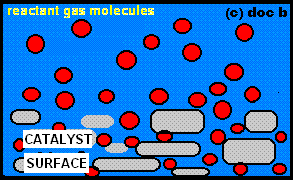
This illustrates a gas reacting
on the surface of a solid catalyst, increase in pressure ==> increase in
concentration of reactant molecules ==> rate of reaction i.e.
more product formed per unit of time.
Again, the product
molecules are not shown, but just imagine how more collisions will occur
in the right-hand diagram on the catalyst surface.
As you increase the
pressure, you effectively increase the concentration of the reactants
and thereby increase the chance of a fruitful collision.
Industrial note on the effect
of gas pressure - or rather the concentration of potentially reactant gases
on the rate of reaction:
If the flammable/explosive
gas is in low concentration, there may be no risk, but you need to know
the safe limits!
e.g. Methane gas in
mines, petrol vapour etc. are all potentially dangerous situations
so knowledge of 'explosion/ignition threshold
concentrations',
ignition temperatures and activation energies are all
important knowledge to help design systems of operation to
minimise risks.
GCSE level 'Rates of Reaction' multiple
choice quiz
Key revision
points about the
effect of
changing gaseous reactant pressure on reaction rates
Tailored for WJEC,
CCEA, CIE IGCSE, AQA, Edexcel, OCR Gateway, and OCR 21st Century
GCSE Chemistry specifications.
Revision Notes:
Effect of Pressure on Rates of Gaseous Reactions
1.
Core Concept
2. Collision
Theory Explanation
3. Experimental
Context
4. Graphical
Representation
Typical Exam
Board Requirements
6. Student Exam
Tips
Always state that
pressure affects gases only.
Link pressure changes to
collision frequency, not particle energy.
Use precise terms: “particles
are closer together” rather than “particles move faster.”
In industrial examples (e.g.,
Haber process), mention economic compromise (high pressure
increases rate but is costly/dangerous).
When analysing graphs, comment
on steepness of gradient and time taken for
reaction to complete.
7. Typical
Misconceptions
“Increasing pressure
gives particles more energy.”
“Pressure affects solids
and liquids.”
“All collisions at high
pressure lead to reaction.”
“Rate graphs are always
straight lines.”
8. Quick
Summary Table
|
Factor (Gas Reaction) |
Observation |
Collision Theory
Explanation |
|
↑ Pressure |
Faster reaction (steeper
graph, shorter time) |
Particles closer → more
frequent successful collisions |
|
↓ Pressure |
Slower reaction (flatter
graph, longer time) |
Particles further apart →
fewer collisions per unit time |
GCSE level 'Rates of Reaction' multiple
choice quiz
What next?
Associated Pages
Rates of
reaction notes INDEX
(for students age ~14-16, ~US grades 9-10)
GCSE
Level (~US grade 8-10) School Chemistry Notes
(students age ~14-16, ~US grades 9-10)
ALL my Advanced Level pre-university
Chemistry Notes
(students age ~16-18, ~US grades 11-12)
Advanced Level Chemistry KINETICS
index
(students age ~16-19, ~US grades 11-12, K12 AP Honors)
Find your GCSE
science course for more help links to revision notes
[SEARCH
BOX]
email doc
brown
GCSE level 'Rates of Reaction' multiple
choice quiz
|
Website content © Dr
Phil Brown 2000+. All copyrights reserved on Doc Brown's Chemistry revision notes, images,
quizzes, worksheets etc. Copying of website material is NOT
permitted. Exam revision summaries & references to science course specifications
are unofficial. keywords and phrases:
revision study notes based on the
syllabus-specifications for students taking the IGCSE/GCSE level chemistry
examinations revision notes on methods of investigating the effect of changing
pressure on a gaseous reactant on the rate of a reaction and using
collision theory to explain the results,
revision notes on
methods
of investigating the effect of changing pressure on a gaseous
reactant on the rate of a reaction and using collision theory to
explain the results,
based on the syllabus-specifications for students
taking the IGCSE/GCSE level chemistry examinations practice exam questions on
rates of reaction of
changing pressure on a
gaseous reactant for the gcse chemistry revision notes on
methods of investigating the effect of changing pressure on a
gaseous reactant on the rate of a reaction and explaining the
results
, AQA igcse/gcse chemistry
methods of
investigating the effect of changing pressure on a gaseous reactant
on the rate of a reaction and using collision theory to explain the
results, Edexcel gcse
notes on
methods of investigating the effect of changing pressure on a
gaseous reactant on the rate of a reaction and using collision
theory to explain the results,
OCR 21st century chemistry revision notes on
methods of
investigating the effect of pressure on a gaseous reactant on the
rate of a reaction and using collision theory to explain the results,
OCR gateway GCSE chemistry revision notes on
methods of investigating the effect of changing pressure on a
gaseous reactant on the rate of a reaction and using collision
theory to explain the results,
CIE Cambridge igcse chemistry revision notes on
methods of investigating the effect of pressure on a gaseous
reactant on the rate of a reaction and using collision theory to
explain the results,
WJEC gcse chemistry revision notes on
methods of
investigating the effect of changing pressure on a gaseous reactant
on the rate of a reaction and using collision theory to explain the
results, CCEA gcse
revision notes for students on
methods of investigating the effect of
changing pressure on a gaseous reactant on the rate of a reaction
and using collision theory to explain the results, rates
of reaction notes for US grade 9-10 chemistry courses
methods of
investigating the effect of pressure on a gaseous reactant on the
rate of a reaction and using collision theory to explain the results
What next?
Associated Pages
|
|
 2NH
2NH