Question on the Rates of Chemical Reactions - investigations and factors
For type in answers, use lower case only, press CHECK
(if not bothered about scoring, do in your head and just click on CHECK). @ doc brown's chemistry
[Updated Feb 15th 2026 *]. Scoring a bit weird? Go by correct answers 1st time! Any query? or error? please email chem55555@hotmail.com asap.
For reactions to occur, the particles of the reactants must collide in a fruitful
collision. The fewer the collisions that take place, the slower the rate of a reaction. Which DECREASES the frequency of collision between reactant particles? [rr-1]
For reactions involving gaseous reactants, decrease the pressure of the gases
For reactions involving solutions, raise the concentration of the solution
If a solid is reacting with a liquid, break the solid into smaller pieces
Raise the temperature of the reaction mixture
For reactions to occur, the particles of the reactants must collide in a fruitful
collision. The fewer the collisions that take place, the slower the rate of reaction. Which DECREASES the frequency of collision between reactant particles? [rr-2]
For reactions involving gaseous reactants, increase the pressure of the gases
For reactions involving solutions, decrease the concentration of the solution
If a solid is reacting with a liquid, break the solid into smaller pieces
Raise the temperature of the reaction mixture
For reactions to occur, the particles of the reactants must collide in a fruitful
collision. The fewer the collisions that take place, the slower the rate of reaction. Which INCREASES the frequency of collision between reactant particles? [rr-3]
For reactions involving gaseous reactants, decrease the pressure of the gases
For reactions involving solutions, decrease the concentration of the solution
If a solid is reacting with a liquid, break the solid into smaller pieces
Lower the temperature of the reaction mixture
For reactions to occur, the particles of the reactants must collide in a fruitful
collision. The fewer the collisions that take place, the slower the rate of reaction. Which INCREASES the frequency of collision between reactant particles? [rr-4]
For reactions involving gaseous reactants, decrease the pressure of the gases
For reactions involving solutions, decrease the concentration of the solution
If a solid is reacting with a liquid, use large pieces of the solid
Increase the temperature of the reaction mixture
Calcium carbonate in the form of limestone dissolves in hydrochloric acid and giving off carbon dioxide gas. Which conditions would produce the fastest reaction? [rr-5]
temperature of 40°C and 10cm3 of dilute acid
temperature of 20°C and 10cm3 of dilute acid
temperature of 40°C and 5cm3 of dilute acid and 5cm3 of water
temperature of 20°C and 5cm3 of dilute acid and 5cm3 of water
Calcium carbonate in the form of limestone dissolves in hydrochloric acid and giving off carbon dioxide gas. Which conditions would produce the slowest reaction? [rr-6]
temperature of 40°C and 10cm3 of dilute acid
temperature of 20°C and 10cm3 of dilute acid
temperature of 40°C and 5cm3 of dilute acid and 5cm3 of water
temperature of 20°C and 5cm3 of dilute acid and 5cm3 of water
Iron reacts with hydrochloric acid to form iron(II) chloride and hydrogen gas. 2g of iron is added to 100cm3 of dilute hydrochloric acid. Which conditions produces the fastest reaction? [rr-7]
iron pieces at 25°C
iron pieces at 50°C
iron powder at 25°C
iron powder at 50°C
Iron reacts with hydrochloric acid to form iron(II) chloride and hydrogen gas. 2g of iron is added to 100cm3 of dilute hydrochloric acid. Which conditions produces the slowest reaction? [rr-8]
iron pieces at 25°C
iron pieces at 50°C
iron powder at 25°C
iron powder at 50°C
A group of students carried out an experiment in which they added manganese dioxide to rapidly decompose a solution of hydrogen peroxide. To show that the manganese dioxide was acting as a catalyst, what must they do before and after the experiment? [rr-9]
BEFORE: weigh the hydrogen peroxide solution and manganese dioxide in separate containers before mixing AFTER: weigh both of the containers again
BEFORE: weigh the hydrogen peroxide solution in a beaker and then add the manganese dioxide to the beaker AFTER: weigh the beaker and its contents
BEFORE: weigh the manganese dioxide and then add the hydrogen peroxide solution to the beaker AFTER: weigh the beaker and its contents
BEFORE: weigh the manganese dioxide and a dry filter paper AFTER: filter the solution, dry the filter paper and the solid residue, weigh the filter paper
When marble chips dissolve in acid, the reaction can be speeded up by? [rr-10]
grinding up the marble chips
lowering the temperature
using a larger flask
using more dilute acid
When marble chips dissolve in acid, the reaction can be slowed down by? [rr-11]
grinding up the marble chips
increasing the temperature
using a larger flask
using more dilute acid
Copper(II) oxide catalyses the decomposition of hydrogen peroxide to form oxygen. In acting as a catalyst the copper(II) oxide? [rr-12]
causes the decomposition to begin
increases the total amount of oxygen formed
increases the rate at which oxygen is formed
prevents the decomposition of the oxygen formed
Which mixture will enable the fastest reaction to take place between solid calcium carbonate (marble chips) and dilute hydrochloric acid? [rr-13]
large chips, concentrated acid, low temperature
low temperature, small chips, dilute acid
concentrated acid, high temperature, small chips
high temperature, small chips, dilute acid
Which mixture will produce the slowest reaction to take place between solid calcium carbonate (marble chips) and dilute hydrochloric acid? [rr-14]
large chips, concentrated acid, low temperature
low temperature, large chips, dilute acid
concentrated acid, high temperature, small chips
high temperature, small chips, dilute acid
Platinum catalyses the reaction between sulphur dioxide SO2 and oxygen O2 to form sulphur trioxide SO3. Which of the statements 1, 2 or 3 is/are correct? [rr-15] 1. more sulphur trioxide is formed when more catalyst is used 2. the catalyst increases the rate of reaction between sulphur dioxide and oxygen 3. when the reaction is complete the platinum catalyst has not lost any mass
1 and 2
1 and 3
2 and 3
1, 2 and 3
Platinum catalyses the reaction between sulphur dioxide SO2 and oxygen O2 to form sulphur trioxide SO3. Which statement(s) 1, 2 or 3 is NOT correct? [rr-16] 1. less sulphur trioxide is formed when more catalyst is used 2. the catalyst decreases the rate of reaction between sulphur dioxide and oxygen 3. when the reaction is complete the platinum catalyst has gained mass
only 1
only 1 and 3
only 2 and 3
1, 2 and 3
The rate of reaction between acid and marble chips can be decreased by? [rr-17]
warming
stirring
using larger chips
using more acid
A small quantity of marble chips is added to a large excess acid. Carbon dioxide gas is formed. Which,
on doubling, will double the amount of carbon dioxide formed? [rr-18]
mass of acid
mass of marble chips
mass of water
volume of acid
Limestone reacts with hydrochloric acid to produce carbon dioxide. A student set up four experiments A to D. Which experiment would you expect to go the fastest? [rr-19]
limestone powder, dilute acid at 20°C
limestone lumps, dilute acid at 40°C
limestone lumps, concentrated acid at 20°C
limestone powder, concentrated acid at 40°C
Limestone reacts with hydrochloric acid to produce carbon dioxide. A student set up four experiments A to D. Which experiment would you expect to go the slowest? [rr-20]
limestone powder, dilute acid at 20°C
limestone lumps, dilute acid at 20°C
limestone lumps, concentrated acid at 40°C
limestone powder, concentrated acid at 40°C
A small quantity of calcium carbonate is added to a large excess acid. Carbon dioxide gas is formed. Which of the following will halve the amount of carbon dioxide formed? [rr-21]
doubling the temperature of the acid
doubling the volume of acid
halving the mass of the acid
halving the mass of the calcium carbonate
Sodium
thiosulfate solution reacts with hydrochloric acid to form sodium chloride, sulphur dioxide, sulphur and water. The reaction can be followed by measuring the time it takes for enough of the sulphur precipitate to form to obscure a black cross marked on white paper. Which will decrease the time it takes for the black cross to disappear? [rr-22]
increase the concentration of the hydrochloric acid
decrease the concentration of the sodium thiosulfate
cool the mixture
add more water to the mixture
Sodium
thiosulfate solution reacts with hydrochloric acid to form sodium chloride, sulphur dioxide, sulphur and water. The reaction can be followed by measuring the time it takes for enough of the sulphur precipitate to form to obscure a black cross marked on white paper. Which will decrease the time it takes for the black cross to disappear? [rr-23]
decrease the concentration of the hydrochloric acid
increase the concentration of the sodium thiosulfate
cool the mixture
add more water to the mixture
Sodium
thiosulfate solution reacts with hydrochloric acid to form sodium chloride, sulphur dioxide, sulphur and water. The reaction can be followed by measuring the time it takes for enough of the sulphur precipitate to form to obscure a black cross marked on white paper. Which will decrease the time it takes for the black cross to disappear? [rr-24]
decrease the concentration of the hydrochloric acid
decrease the concentration of the sodium thiosulfate
heat the mixture
add more water to the mixture
An experiment was carried out at a temperature of 25oC by dissolving 0.2g of small limestone granules into 30cm3 of hydrochloric acid. The acid concentration was 1.0 mol/dm3 and in excess so all the limestone dissolved. The reaction was followed by measuring the volume of carbon dioxide given off over a period of 6 minutes. A 2nd experiment was done in an identical manner but using 0.2g of limestone lumps. Which of the graphs W, X, Y or Z might you expect for the results? [rr-25]
graph line W
graph line X
graph line Y
graph line Z
An experiment was carried out at a temperature of 25oC by dissolving 0.2g of small limestone granules into 30cm3 of hydrochloric acid. The acid concentration was 1.0 mol/dm3 and in excess so all the limestone dissolved. The reaction was followed by measuring the volume of carbon dioxide given off over a period of 6 minutes. A 2nd experiment was done in an identical manner but using 0.4g of the same limestone granules. Which of the graphs W, X, Y or Z might you expect for the results? [rr-26]
graph line W
graph line X
graph line Y
graph line Z
An experiment was carried out at a temperature of 25oC by dissolving 0.2g of small limestone granules into 30cm3 of hydrochloric acid. The acid concentration was 1.0 mol/dm3 and in excess so all the limestone dissolved. The reaction was followed by measuring the volume of carbon dioxide given off over a period of 6 minutes. A 2nd experiment was done in an identical manner but using acid of 2.0mol/dm3 concentration. Which of the graphs W, X, Y or Z might you expect for the results? [rr-27]
graph line W
graph line X
graph line Y
graph line Z
An experiment was carried out at a temperature of 25oC by dissolving 0.2g of small limestone granules into 30cm3 of hydrochloric acid. The acid concentration was 1.0 mol/dm3 and in excess so all the limestone dissolved. The reaction was followed by measuring the volume of carbon dioxide given off over a period of 6 minutes. A 2nd experiment was done in an identical manner but using 0.1g of the same limestone granules. Which of the graphs W, X, Y or Z might you expect for the results? [rr-28]
graph line W
graph line X
graph line Y
graph line Z
An experiment was carried out at a temperature of 25oC by dissolving 0.2g of small limestone granules into 30cm3 of hydrochloric acid. The acid concentration was 1.0 mol/dm3 and in excess so all the limestone dissolved. The reaction was followed by measuring the volume of carbon dioxide given off over a period of 6 minutes. A 2nd experiment was done in an identical manner but at a temperature of 50oC. Which of the graphs W, X, Y or Z might you expect for the results? [rr-29]
graph line W
graph line X
graph line Y
graph line Z
An experiment was carried out at a temperature of 25oC by dissolving 0.2g of small limestone granules into 30cm3 of hydrochloric acid. The acid concentration was 1.0 mol/dm3 and in excess so all the limestone dissolved. The reaction was followed by measuring the volume of carbon dioxide given off over a period of 6 minutes. A 2nd experiment was done in an identical manner but using acid of 0.5mol/dm3 concentration. Which of the graphs W, X, Y or Z might you expect for the results? [rr-30]
graph line W
graph line X
graph line Y
graph line Z
Which will react the fastest with hydrochloric acid? [rr-31]
marble chips at 40oC
marble chips at 25oC
powdered marble at 40oC
powdered marble at 25oC
Which will react the slowest with hydrochloric acid? [rr-32]
marble chips at 40oC
marble chips at 25oC
powdered marble at 40oC
powdered marble at 25oC
An acid reacts with some tablets. The rate of reaction is decreased by? [rr-33]
cooling the tablets and the acid
crushing the tablets before adding the acid
stirring the tablets in the acid
using a more concentrated acid
A catalyst can increase the rate of a chemical reaction. Which of the following is also TRUE about catalysts? [rr-34]
their appearance is always unchanged at the end of the reaction
they have to be a metal
they have to be a solid
they are chemically the same at the end of the reaction
A large amount of calcium carbonate (excess) is added to a small amount of dilute hydrochloric acid. Which will double the volume of carbon dioxide finally formed? [rr-35]
doubling the mass of calcium carbonate
doubling the volume of the hydrochloric acid
halving the mass of the hydrochloric acid
doubling the temperature
A large amount of calcium carbonate (excess) is added to a small amount of dilute hydrochloric acid. Which will double the volume of carbon dioxide finally formed? [rr-36]
doubling the mass of calcium carbonate
halving the volume of the hydrochloric acid
doubling the temperature
doubling the concentration of the acid
A large amount of calcium carbonate (excess) is added to a small amount of dilute hydrochloric acid. Which will halve the volume of carbon dioxide finally formed? [rr-37]
halving the mass of calcium carbonate
halving the volume of the hydrochloric acid
halving the temperature
doubling the concentration of the acid
A large amount of calcium carbonate (excess) is added to a small amount of dilute hydrochloric acid. Which will halve the volume of carbon dioxide finally formed? [rr-38]
doubling the mass of calcium carbonate
doubling the volume of the hydrochloric acid
halving the temperature
halving the concentration of the acid
Potatoes cook more quickly in boiling vegetable oil than in boiling water. This is because oil? [rr-39]
boils at a higher temperature than water
catalyses the cooking process
contains water
replaces the water in the potatoes
In a rates experiment the following carbon dioxide gas volumes were recorded by a student resulting from an acid-limestone reaction. The gas volume of CO2 formed at 1.5 min was omitted by accident.
time (min)
0.0
0.5
1.0
1.5
2.0
2.5
3.0
3.5
4.0
4.5
5.0
5.5
6.0
Vol (cm3)
0
8
15
?
26
30
33
36
38
39
40
40
40
What is the most likely value of the missing reading in cm3 of carbon dioxide? [rr-40]
18
21
23
24
In a rates experiment the following carbon dioxide gas volumes were recorded by a student resulting from an acid-limestone reaction.
time (min)
0.0
0.5
1.0
1.5
2.0
2.5
3.0
3.5
4.0
4.5
5.0
5.5
6.0
Vol (cm3)
0
8
15
21
26
30
33
36
38
39
40
40
40
At what time did the reaction stop? [rr-41]
4.5 min
6.0 min
5.0 min
5.5 min
In a rates experiment the following carbon dioxide gas volumes were recorded by a student resulting from an acid-limestone reaction.
time (min)
0.0
0.5
1.0
1.5
2.0
2.5
3.0
3.5
4.0
4.5
5.0
5.5
6.0
Vol (cm3)
0
8
15
21
26
30
33
36
38
39
40
40
40
At what approximate time is the speed of the reaction 8cm3gas/min? [rr-42]
2.0 to 2.5 min
0.0 t0 0.5 min
1.0 to 1.5 min
5.0 to 5.5 min
A gas was produced in a chemical reaction. The total volume of gas formed was measured at regular time intervals. Which graph would you expect the results to be like? [rr-43]
graph Q
graph W
graph Y
graph Z
Which is a chemical test for the gas hydrogen? [rr-44]
pops with lit splint
turns limewater cloudy
relights a glowing splint
bleaches damp litmus paper
Which is a chemical test for the gas carbon dioxide? [rr-45]
pops with a lit splint
turns limewater cloudy
relights a glowing splint
bleaches damp litmus paper
Which is a chemical test for the gas oxygen? [rr-46]
pops with a lit splint
turns limewater cloudy
relights a glowing splint
bleaches damp litmus paper
Which is a chemical test for the gas chlorine? [rr-47]
pops with a lit splint
turns limewater cloudy
relights a glowing splint
bleaches damp litmus paper
Which of the following gases is formed when a metal reacts with an acid? [rr-48]
hydrogen
carbon dioxide
oxygen
chlorine
Which of the following gases is formed when an acid reacts with a carbonate? [rr-49]
hydrogen
carbon dioxide
oxygen
chlorine
Which of the following is formed when a metal reacts with an acid? [rr-50]
O2
Cl2
H2
CO2
Which of the following is formed when a carbonate reacts with an acid? [rr-51]
O2
Cl2
H2
CO2
A solid was produced in a chemical reaction. The total mass of solid formed was measured at regular time intervals. Which graph would you expect the results to be like? [rr-52]
graph Y
graph W
graph Q
graph Z
A solid and a liquid reacted to produce a solution. The mass of the solid reactant was measured at regular time intervals. Which graph would you expect the results to be like? [rr-53]
graph W
graph Q
graph Y
graph Z
Two solids were heated and reacted to form another solid. The total mass of the solids was measured at regular time intervals. Which graph would you expect the results to be like? [rr-54]
graph W
graph Q
graph Y
graph Z
On mixing two reacting solutions a solid precipitate was formed. The mass of the solid precipitate was measured at regular time intervals. Which graph would you expect the results to be like? [rr-55]
graph W
graph Q
graph Y
graph Z
Limestone chips were reacted with acid in a beaker placed on a one pan electric balance. The mass of the reacting mixture was measured at regular time intervals. Which graph would you expect the results to be like? [rr-56]
graph W
graph Q
graph Y
graph Z
An experiment was carried out to dissolve small limestone granules into hydrochloric acid. Carbon dioxide gas is formed and was collected in a gas syringe. The initial results are marked as the 'original experiment'. The experiment was repeated after varying the reaction conditions (i.e. mass of limestone, size of limestone pieces, temperature or acid concentration). The speed of the reaction can be given in cm3/min,
i.e. the speed at which carbon dioxide is formed. Which experiment is going at an approximate average speed of 30 cm3/min in the first half minute of the reaction? [rr-57]
graph line for experiment W
graph line for experiment X
graph line for experiment Y
graph line for experiment Z
An experiment was carried out to dissolve small limestone granules into hydrochloric acid. Carbon dioxide gas is formed and was collected in a gas syringe. The initial results are marked as the 'original experiment'. The experiment was repeated after varying the reaction conditions (i.e. mass of limestone, size of limestone pieces, temperature or acid concentration). The speed of the reaction can be given in cm3/min,
i.e. the speed at which carbon dioxide is formed. Which experiment is going at an approximate average speed of 22 cm3/min in the first half minute of the reaction? [rr-58]
graph line for experiment W
graph line for experiment X
graph line for experiment Y
graph line for experiment Z
An experiment was carried out to dissolve small limestone granules into hydrochloric acid. Carbon dioxide gas is formed and was collected in a gas syringe. The initial results are marked as the 'original experiment'. The experiment was repeated after varying the reaction conditions (i.e. mass of limestone, size of limestone pieces, temperature or acid concentration). The speed of the reaction can be given in cm3/min,
i.e. the speed at which carbon dioxide is formed. Which experiment is going at an approximate average speed of 6 cm3/min in the first minute of the reaction? [rr-59]
graph line for experiment W
graph line for experiment X
graph line for experiment Y
graph line for experiment Z
An experiment was carried out to dissolve small limestone granules into hydrochloric acid. Carbon dioxide gas is formed and was collected in a gas syringe. The initial results are marked as the 'original experiment'. The experiment was repeated after varying the reaction conditions (i.e. mass of limestone, size of limestone pieces, temperature or acid concentration). The speed of the reaction can be given in cm3/min,
i.e. the speed at which carbon dioxide is formed. Which experiment is going at an approximate average speed of 3 cm3/min in the first minute of the reaction? [rr-60]
graph line for experiment W
graph line for experiment X
graph line for experiment Y
graph line for experiment Z
What would you increase, to increase the kinetic energy of particles involved in a chemical reaction? [rsa-1]
What would you decrease, to decrease the kinetic energy of particles involved in a chemical reaction? [rsa-2]
What must particles do with each other before they can react? [rsa-3]
What do you increase to make two gases react together faster at the same temperature? [rsa-4]
What do you decrease to make two gases react together more slowly at the same temperature? [rsa-5]
Limestone or marble chips are made of the chemical calcium carbonate (1). They both dissolve in hydrochloric acid (2), to produce a solution of calcium chloride (3), water (4) and carbon dioxide (5). Which of 1 to 5 is seen as the 'fizzing'? [rsa-6]
Limestone or marble chips are made of the chemical calcium carbonate (1). They both dissolve in hydrochloric acid (2), to produce a solution of calcium chloride (3), water (4) and carbon dioxide (5). Which of 1 to 5 is the 'salt' in the reaction? [rsa-7]
Limestone or marble chips are made of the chemical calcium carbonate (1). They both dissolve in hydrochloric acid (2), to produce a solution of calcium chloride (3), water (4) and carbon dioxide (5). Which of 1 to 5 has the formula HCl? [rsa-8]
Limestone or marble chips are made of the chemical calcium carbonate (1). They both dissolve in hydrochloric acid (2), to produce a solution of calcium chloride (3), water (4) and carbon dioxide (5). Which of 1 to 5 has the formula CaCO3? [rsa-9]
Limestone or marble chips are made of the chemical calcium carbonate (1). They both dissolve in hydrochloric acid (2), to produce a solution of calcium chloride (3), water (4) and carbon dioxide (5). Which of 1 to 5 has the formula CaCl2? [rsa-10]
Limestone lumps or marble chips are made of the chemical calcium carbonate (1). They both dissolve in hydrochloric acid (2), to produce a solution of calcium chloride (3), water (4) and carbon dioxide (5). In what form would you add the marble to speed up the reaction? [rsa-11]
Limestone powder is made of the chemical calcium carbonate (1). It dissolves in hydrochloric acid (2), to produce a solution of calcium chloride (3), water (4) and carbon dioxide (5). In what form would you add the limestone to slow down the reaction? [rsa-12]
Limestone or marble chips are made of the chemical calcium carbonate (1). They both dissolve in hydrochloric acid (2), to produce a solution of calcium chloride (3), water (4) and carbon dioxide (5). What could you reduce for the acid to slow the initial reaction down at the same temperature? [rsa-13]
Limestone or marble chips are made of the chemical calcium carbonate (1). They both dissolve in hydrochloric acid (2), to produce a solution of calcium chloride (3), water (4) and carbon dioxide (5). What could you increase for the acid to speed up the initial rate of reaction at the same temperature? [rsa-14]
Calcium carbonate (limestone) were dissolved in hydrochloric acid under five different experimental conditions.
The carbon dioxide gas formed was collected in a gas syringe and the total volume of gas was recorded for the first six minutes.
The speed or 'rate of reaction' can be expressed as the rate of formation of carbon dioxide in cm3/min.
What is the average speed of the reaction in experiment W between 1 and 2 minutes in cm3/min? [rsa-15]
Calcium carbonate (limestone) were dissolved in hydrochloric acid under five different experimental conditions.
The carbon dioxide gas formed was collected in a gas syringe and the total volume of gas was recorded for the first six minutes.
The speed or 'rate of reaction' can be expressed as the rate of formation of carbon dioxide in cm3/min.
What is the average speed of the reaction in experiment X in the first half minute in cm3/min? [rsa-16]
>
Explaining the importance of exam questions
on rates of reaction
in GCSE level chemistry, What you need to know about exam questions on
rates of reaction for
GCSE level
chemistry,
Explaining the use of exam questions on rates of reaction knowledge in GCSE level chemistry, Examples of
exam questions on rates of reaction explained
when studying GCSE level chemistry, What is
the significance of exam questions on rates of reaction in GCSE level chemistry, describing and
explaining the theory of exam questions on rates of reaction when studying GCSE level chemistry, revision
notes for exam questions on rates of reaction in exams, online help for understanding
exam questions on rates of reaction, exam revision
notes for exam questions on rates of reaction, what do I need to learn about
exam questions on rates of reaction? revision summary for exam questions
on rates of reaction, learning notes for exam questions on rates of
reaction, help to pass the exam questions on rates of reaction
topic in an exam question, how to prepare for questions on exam
questions on rates of reaction in a GCSE
chemistry examination? Based on the syllabus-specifications
for students taking the IGCSE/GCSE level chemistry examinations summary
revision notes and key points on exam questions on rates of reaction for students taking the AQA
igcse/gcse chemistry notes on exam questions on rates of reaction, Edexcel gcse
chemistry notes on exam questions on rates of reaction, OCR 21st century GCSE
chemistry notes on exam questions on rates of reaction, OCR gateway
GCSE chemistry notes on exam questions on rates of reaction, WJEC gcse chemistry notes on
exam questions on rates of reaction, CCEA
gcse chemistry notes on exam questions on rates of reaction for students taking CIE Cambridge igcse
chemistry, or any other GCSE or IGCSE level chemistry exams notes on
exam questions on rates of reaction, useful for US grade 9-10 chemistry courses
 For reactions to occur, the particles of the reactants must collide in a fruitful
collision. The fewer the collisions that take place, the slower the rate of a reaction. Which DECREASES the frequency of collision between reactant particles? [rr-1]
For reactions to occur, the particles of the reactants must collide in a fruitful
collision. The fewer the collisions that take place, the slower the rate of a reaction. Which DECREASES the frequency of collision between reactant particles? [rr-1] Calcium carbonate in the form of limestone dissolves in hydrochloric acid and giving off carbon dioxide gas. Which conditions would produce the fastest reaction? [rr-5]
 Iron reacts with hydrochloric acid to form iron(II) chloride and hydrogen gas. 2g of iron is added to 100cm3 of dilute hydrochloric acid. Which conditions produces the fastest reaction? [rr-7]
 A group of students carried out an experiment in which they added manganese dioxide to rapidly decompose a solution of hydrogen peroxide. To show that the manganese dioxide was acting as a catalyst, what must they do before and after the experiment? [rr-9]
 When marble chips dissolve in acid, the reaction can be speeded up by? [rr-10]
 Which mixture will enable the fastest reaction to take place between solid calcium carbonate (marble chips) and dilute hydrochloric acid? [rr-13]
 Platinum catalyses the reaction between sulphur dioxide SO2 and oxygen O2 to form sulphur trioxide SO3. Which of the statements 1, 2 or 3 is/are correct? [rr-15]

 Sodium
thiosulfate solution reacts with hydrochloric acid to form sodium chloride, sulphur dioxide, sulphur and water. The reaction can be followed by measuring the time it takes for enough of the sulphur precipitate to form to obscure a black cross marked on white paper. Which will decrease the time it takes for the black cross to disappear? [rr-22]
Sodium
thiosulfate solution reacts with hydrochloric acid to form sodium chloride, sulphur dioxide, sulphur and water. The reaction can be followed by measuring the time it takes for enough of the sulphur precipitate to form to obscure a black cross marked on white paper. Which will decrease the time it takes for the black cross to disappear? [rr-22]  An experiment was carried out at a temperature of 25oC by dissolving 0.2g of small limestone granules into 30cm3 of hydrochloric acid. The acid concentration was 1.0 mol/dm3 and in excess so all the limestone dissolved. The reaction was followed by measuring the volume of carbon dioxide given off over a period of 6 minutes. A 2nd experiment was done in an identical manner but using 0.2g of limestone lumps. Which of the graphs W, X, Y or Z might you expect for the results? [rr-25]
 In a rates experiment the following carbon dioxide gas volumes were recorded by a student resulting from an acid-limestone reaction. The gas volume of CO2 formed at 1.5 min was omitted by accident.


 Which is a chemical test for the gas hydrogen? [rr-44]


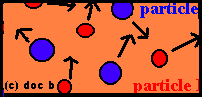 What would you increase, to increase the kinetic energy of particles involved in a chemical reaction? [rsa-1]
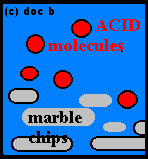 Limestone or marble chips are made of the chemical calcium carbonate (1). They both dissolve in hydrochloric acid (2), to produce a solution of calcium chloride (3), water (4) and carbon dioxide (5). Which of 1 to 5 is seen as the 'fizzing'? [rsa-6]
  Calcium carbonate (limestone) were dissolved in hydrochloric acid under five different experimental conditions.