|
Doc Brown's Advanced A
level theoretical chemistry revision notes
8.2.5 Explaining permanent dipole – induced dipole
intermolecular bonding forces, examples of Debye or
induction forces described
[Author
© Dr
Phil Brown PhD: Doc
Brown's Chemistry exam revision notes suitable
for advanced A level chemistry students studying pre–university/college advanced level
theoretical–physical chemistry courses:
Debye forces [page updated May 2nd 2026 *]
email doc
brown - comments - query?
*
[privacy, cookies and disclaimer
policies]
INDEX of notes on intermolecular
attractive forces (intermolecular bonding)
8.2.5
Examples of permanent dipole –
induced dipole intermolecular bonding interactions
-
Also called Debye forces or induction forces.
-
These permanent dipole
- induced dipole forces get little mentioned in pre-university
courses.
-
In terms of Van der
Waals forces, they are weaker than permanent dipole - permanent
dipole forces (Keesom forces) but stronger than instantaneous dipole
- induced dipole forces (London dispersion forces) on a molecule to
molecule basis.
-
A polar molecule is
the result of having at least one polar bond due to a significance
difference in electronegativity of the two bonded atoms.
- A list of accurate
Pauling electronegativities is given
below
-
|
element |
H |
Si |
P |
C |
S |
I |
Br |
Cl |
N |
O |
F |
|
electronegativity |
2.20 |
1.90 |
2.19 |
2.55 |
2.58 |
2.66 |
2.96 |
3.16 |
3.04 |
3.44 |
3.98 |
-
A polar molecule i.e.
with a permanent dipole,
produces an electric field which can distort the electron cloud of a
neighbouring molecule.
-
So, if for example, a non-polar
molecule is brought near a polar molecule, the electric dipole field
from the polar molecule will induce a dipole moment in the non-polar
molecule causing an attraction between the molecules.
-
The permanent dipole - induced dipole attractions are called the
Debye forces.
-
Note that
this applies to any pure
polar molecule or in a mixture of a polar and non-polar
molecules as illustrated below.
-
However, in most
cases, the Debye forces
tends to be the minor contribution to a molecule's total intermolecular
bonding forces.
-
The permanently polar
bond in one molecule can induce a dipole in a different neighbouring molecule
in a mixture, whether the other molecule is polar or non–polar, it makes no
difference, induction happens!
-
Example 1.
-
Hydrogen chloride gas dissolved in a hydrocarbon solvent
-

 non-polarized hydrocarbon molecule
-
••••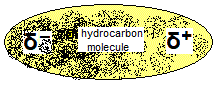 polarized hydrocarbon molecule -
attraction
polarized hydrocarbon molecule -
attraction
-
Remember, here,
hydrogen chloride retains its covalent molecular character (unlike
the ionisation that occurs in water).
-
-
-
Example 2.
-
A
mixture of propanone and a hydrocarbon
-
 ••••
polarized hydrocarbon molecule -
attraction ••••
polarized hydrocarbon molecule -
attraction
-
This intermolecular
bonding based on Debye forces allows a mutual solubility, if not
complete miscibility.
-
-
-
Example
3.
-
Why non-polar gas molecules
can dissolve in water (albeit with a very low solubility)
-
This type of induced
dipole force is why of oxygen (a non-polar molecule) is slightly soluble in
water.
-
The highly polar water
molecule, with its permanent dipole, induces a dipole in the
non-polar oxygen molecule creating a weak intermolecular bonding
force that enables some oxygen to dissolve.
-
 •••• ••••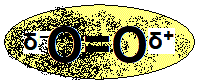 Debye force interaction
-
The oxygen solubility
is low, but it isn't zero!
-
This
limited solubility of oxygen is extremely important for all aerobic
aquatic life.
-
The solubilities of
non-polar gases in water are relatively low because the hydrogen
bonds of water are disrupted and little compensation attractive
forces between the water and gas molecules.
See also section
8.7 Solubility of covalent compounds, miscible and
immiscible liquids
and related
pages on intermolecular bonding
comparing 8 organic molecule boiling points
and
homologous series comparison
and
other case studies of
boiling points related to intermolecular forces
Some
learning objectives for Debye forces
Know that a permanent dipole
molecule (polar molecules) results at least one polar bond due to a
difference of electronegativity of the atoms.
Know that a polar molecule
i.e. with a permanent dipole, can induce a dipole in a neighbouring
molecule, which may itself be non-polar beforehand.
Know that permanent dipole -
induced dipole attractions between molecules are called Debye forces.
Be able to predict where Debye
forces may arise and draw diagrams to explain the effect.
WHAT NEXT?
8.2
INDEX for intermolecular
bonding (intermolecular attractive forces) and examples explained
Sub-index for this page on intermolecular forces an intermolecular
bonding
(1)
Three introductory sections important to read (a) to (c) first
(a)
Introduction to intermolecular forces – Van der
Waals forces
(b)
Dipole
moments and the polarizability of a molecule
(c)
Electronegativity, covalent bond character
and
polar molecules
Four types of
intermolecular attractive force sections (2) to (4) are the most important
(2)
Instantaneous
dipole – induced dipole interactions (London forces or dispersive
forces)
(3)
Permanent dipole
– permanent dipole interactions (Keesom forces/orientation forces)
(4)
Hydrogen bonding
intermolecular forces
(5)
Permanent dipole
– induced dipole interactions (Debye forces or induction forces)
email doc
brown - comments - query?
INDEX for Part 8.
Phase equilibria–vapour
pressure, boiling point and intermolecular forces
Index of ALL my chemical equilibrium
context revision notes Index
ALL my advanced A
level theoretical
chemistry revision study notes
INDEX Part 8.
Phase equilibria–vapour
pressure, boiling/melting points, solubility and intermolecular forces
Index of ALL my chemical equilibrium
context revision notes Index
Part 8 sub–index:
8.1 Vapour pressure, nature, origin and examples
explained * 8.2.1
Introduction to the types of intermolecular forces
and examples explained (index) * 8.2.2 Detailed comparative discussion of boiling points of 8 organic molecule
of similar molecular mass * 8.3
Boiling point plots of six
organic
homologous series - graphs and explanation * 8.4
Other case studies of
boiling points related to intermolecular forces * 8.5
Steam
distillation – theory and practice * Evidence and theory
for hydrogen bonding in simple covalent hydride *
8.7 Solubility of covalent compounds, miscible and
immiscible liquids
Advanced Equilibrium Chemistry Notes Part 1. Equilibrium,
Le Chatelier's Principle–rules * Part 2. Kc and Kp equilibrium expressions and
calculations * Part 3.
Equilibrium and industrial processes * Part 4.
Partition,
solubility product and ion–exchange * Part 5.
pH, weak–strong acid–base theory and
calculations * Part 6. Salt hydrolysis,
Acid–base titrations–indicators, pH curves and buffers *
Part 7.
Redox equilibria, half–cell electrode potentials,
electrolysis and electrochemical series
Explaining the importance of Permanent dipole –
induced dipole intermolecular bonding Debye forces
in intermolecular bonding chemistry What you need to know about
Permanent dipole – induced dipole intermolecular bonding Debye forces for
intermolecular bonding chemistry Explaining the use of Permanent dipole
– induced dipole intermolecular bonding Debye forces knowledge in
intermolecular bonding chemistry Examples of Permanent dipole – induced
dipole intermolecular bonding Debye forces explained
when studying intermolecular bonding chemistry What is
the significance of Permanent dipole – induced dipole intermolecular
bonding Debye forces in intermolecular bonding chemistry What is the use of
knowing about Permanent dipole – induced dipole intermolecular bonding
Debye forces in
intermolecular bonding chemistry Describing and
explaining the theory of Permanent dipole – induced dipole
intermolecular bonding Debye forces when studying intermolecular bonding
chemistry revision notes
for Permanent dipole – induced dipole intermolecular bonding Debye
forces in exams AQA A level chemistry Edexcel A level chemistry OCR A
level chemistry content © Dr
Phil Brown 2000+. All copyrights reserved on
Doc Brown's Chemistry revision notes. Copying of website material is NOT
permitted.
Doc
Brown's Chemistry: Theoretical-Physical
Advanced A Level Chemistry (US grades 11-12 AP Honors) Intermolecular attractive
forces - intermolecular bonding Notes PART 8.2.5,
Explaining the
importance of explaining with examples what a permanent dipole - induced
dipole intermolecular bonding force is for theoretical chemistry exam questions, What you need to know about
explaining with examples what a permanent dipole - induced dipole
intermolecular bonding force is for theoretical chemistry, Explaining the use of
explaining with examples what a permanent dipole - induced dipole intermolecular
bonding force is knowledge in
theoretical chemistry exam questions, Examples of explaining with
examples what a permanent dipole - induced dipole intermolecular bonding force
is explained when studying
theoretical chemistry, What is the significance and use of explaining
with examples what a permanent dipole - induced dipole intermolecular bonding
force is in theoretical
chemistry, describing and explaining the theory behind the study of
explaining with examples what a permanent dipole - induced dipole intermolecular
bonding force is,
exam revision notes on explaining with examples what a permanent dipole
- induced dipole intermolecular bonding force is for exams, online help for the
explaining with examples what a permanent dipole - induced dipole intermolecular
bonding force is topic,
revision notes for explaining with examples what a permanent dipole -
induced dipole intermolecular bonding force is, what do I need to learn for
explaining with examples what a permanent dipole - induced dipole intermolecular
bonding force is in exams?
revision summary for explaining with examples what a permanent dipole -
induced dipole intermolecular bonding force is, help in teaching explaining with
examples what a permanent dipole - induced dipole intermolecular bonding force
is, learning notes for explaining with examples what a permanent dipole -
induced dipole intermolecular bonding force is,
help to pass exam questions involving explaining with examples what a
permanent dipole - induced dipole intermolecular bonding force is, help to prepare for examination questions on
explaining with examples what a permanent dipole - induced dipole
intermolecular bonding force is? Explaining the
importance of Describing examples of Debye or induction intermolecular
bonding forces for theoretical chemistry exam questions, What you need to know about
Describing examples of Debye or induction intermolecular bonding forces for theoretical chemistry, Explaining the use of
Describing examples of Debye or induction intermolecular bonding forces knowledge in
theoretical chemistry exam questions, Examples of Describing examples of
Debye or induction intermolecular bonding forces explained when studying
theoretical chemistry, What is the significance and use of Describing
examples of Debye or induction intermolecular bonding forces in theoretical
chemistry, describing and explaining the theory behind the study of
Describing examples of Debye or induction intermolecular bonding forces,
exam revision notes on Describing examples of Debye or induction
intermolecular bonding forces for exams, online help for the Describing examples
of Debye or induction intermolecular bonding forces topic,
revision notes for Describing examples of Debye or induction
intermolecular bonding forces, what do I need to learn for Describing examples
of Debye or induction intermolecular bonding forces in exams?
revision summary for Describing examples of Debye or induction
intermolecular bonding forces, help in teaching Describing examples of Debye or
induction intermolecular bonding forces, learning notes for Describing examples
of Debye or induction intermolecular bonding forces,
help to pass exam questions involving Describing examples of Debye or
induction intermolecular bonding forces, help to prepare for examination questions on
Describing examples of Debye or induction intermolecular bonding forces?
[SEARCH
BOX]
My advanced level equilibrium
notes index
All my advanced level organic
chemistry notes
All my advanced level
inorganic chemistry notes
All my advanced level
theoretical chemistry notes |
|
