|
Liverpool (1) The Albert Docks, Salthouse Dock, Canning Dock and Wapping Dock Area
North
West England Index *
Liverpool Index
Email:
chem55555@hotmail.com
[Author
and photographer
The Albert Dock was built between 1841 and 1846 and has been developed into a major tourist attraction in the great City of Liverpool. A history of the Albert Docks, Salthouse Dock, Canning Dock and Wapping Dock Area in Liverpool *
Right: The gateposts to the entrance of the Albert Dock Complex, Liverpool The Blue Clipper (Once white and named Spirit of Hennessey’) is a three masted sailing ship moored in the Canning half tide dock, this 'tall ship' built in 1991 in Sweden.
The Pumphouse (now a pub) was once the Albert Hydraulic Power Centre, built in 1878 to provide high pressure water for hydraulic dock gates, bridges, lifts and cranes. Hydraulic systems were introduced to the Liverpool dock system by Jesse Hartley, inspired by the William Armstrong's hydraulic crane at Newcastle upon Tyne in 1847.
On the left is the Canning Half Tide Dock (built by Hartley 1842-4) with the entrance to the Albert Dock on the right, the Pump House in the middle, now refurbished as a pub.
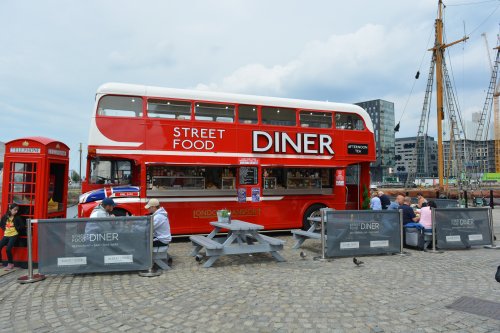
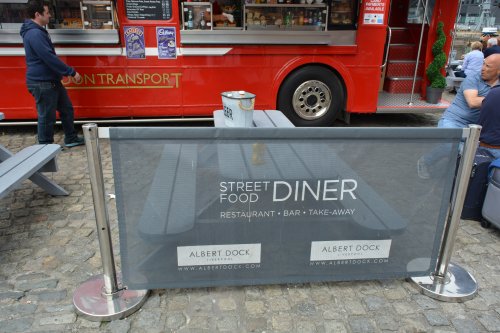
One of many 'refreshment places' in Albert Dock museum complex. The Quayside Cafe near the entrance to the Maritime Museum and there is a lovely picnic area outside under the colonnades that looks out on the fine buildings and boats of the Albert Dock.
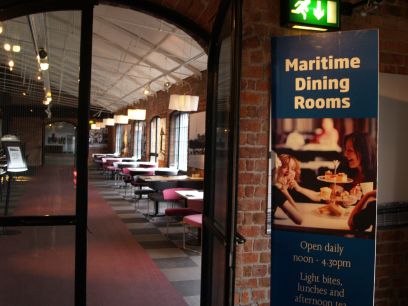
The Maritime Dining Rooms in the Maritime Museum of Albert Dock.
The massive warehouses of the Albert Dock.
The Albert Dock and the 'Three Graces' in the distance.
Albert Dock - the block on the left houses several museums
The fine rows, pillars and arches of the Albert Dock
The Royal Albert Dock near the entrance to the Tate Modern art gallery
'The Three Graces' from the Albert Dock.
The might pillars of the colonnades of the quayside of Albert Dock.
The Albert Dock with the entrance to the Tate Modern on the right.
The old tug boat called BROCKLEBANK, I remember this tugboat working on the River Mersey in the 1960s
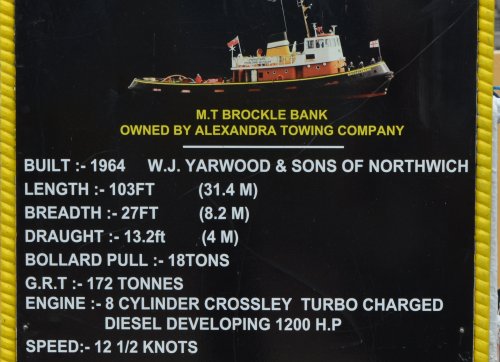
The old tugboat M.T BROCKLE BANK moored up in Liverpool's Canning Dock, built in 1964, owned by the Alexandra Towing Company
The entrance to the Tate Modern Art Gallery
Some older boats in Albert Dock.
The sailing ship Kathleen & May tied up in Canning Dock, with the old pumphouse chimney in the background
Canning Quaysides
The Canning Graving Docks
The GREAT WESTERN RAILWAY warehouse by Canning Graving Docks
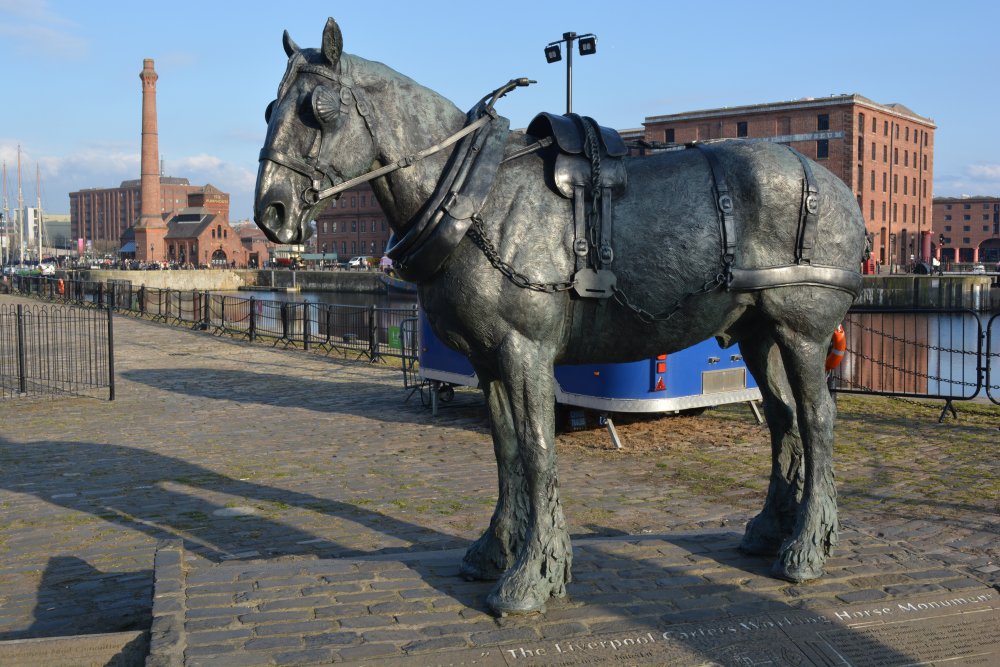
The carter horse sculpture, 'WAITING' by the sculptor Judy Boyt. These horses hauled all the merchandise between the docks and warehouses throughout the city streets of.
The De Wadden in Canning graving dry dock, she was built in 1917 as a trading ship carrying coal, timber, stone and grain between the Port of Liverpool and ports in Ireland from 1922 and 1961. She was Dutch built, with both sails and engine in 1917 by Gebr van Diepen of Waterhuizen in the Netherlands and was the last ship working on the Mersey using sails and a fine piece of Liverpool's marine heritage.
A broad view of Canning Half Tide Dock with modern residential and office developments in the distance.
The Mann Island Development of Liverpool's 'premier' apartments rising above Canning Docks
Canning Dock and the buildings of the Mann Island development properties.
Above & below: The 'retired' BAR Mersey Bar Lightship Planet and Channel Light Vessel No 23 in Canning Dock. She was built in 1960 at Dartmouth. Beyond stands some very 'modern' apartments-flats and a gym!
Canning Dock, on the right the retired BAR lightship and beyond the pumphouse and chimney.. On the left is the Dock Traffic Office, with its Greek temple-like frontage, was built in 1848 by Philip Hardwick. The portico is actually made of cast iron, the pillars being in two sections each and the architrave above a single casting.
Some modern flats housing a gym on the apex of the lower floors by Canning Dock
Barges moored in Salthouse Dock, with the Pier Head and man Island buildings beyond. The Salthouse Dock gets its name from a nearby salt refinery that processed rock salt from Cheshire. It was Liverpool's second dock, completed in 1753, and is the oldest still in existence.
Salthouse Dock
Salthouse Dock and the pillars of the grand entrance portico of Albert Dock.
Warehouses at Wapping Dock A history of the Albert Docks, Salthouse Dock, Canning Dock and Wapping Dock Area in Liverpool Below is a fully integrated, dock‑by‑dock account of Albert Dock, Salthouse Dock, Canning Dock, and Wapping Dock — their history, architecture, trade, imports/exports, and historic vessels — synthesised from the most authoritative sources available. This gives you a coherent picture of how this cluster functioned as the beating heart of Liverpool’s maritime world. 1. Origins and Development of the Dock SystemLiverpool’s dock system evolved because the River Mersey’s extreme tidal range (up to 11 metres) made traditional anchorage unsafe and inefficient for large ships. Enclosed wet docks were required to keep vessels afloat and speed up cargo handling. The first commercial wet dock opened in 1715, and over the next 200 years more than 50 docks were built along seven miles of waterfront. The four docks you asked about sit at the historic centre of this system and developed in a tightly interlinked way. 2. Salthouse Dock (1753)History
Architecture
Trade & Cargo
Historic Vessels & Activity
Decline
3. Canning Dock & Canning Half‑Tide Dock (1765)History
Role in the Dock System
Architecture
Historic Vessels
4. Albert Dock (1846)History
Architecture
Trade & Cargo
Historic Vessels
Decline & Regeneration
5. Wapping Dock (1855)History
Architecture
Trade & Cargo
Historic Vessels
6. How the Four Docks Worked TogetherIntegrated System
Typical Cargo Flow
This cluster formed one of the most efficient maritime complexes in the world during the 19th century. 7. Imports and Exports (Representative Overview)Imports
Exports
8. Historic Boats and Maritime Heritage TodayAlthough the docks no longer function commercially, the area preserves maritime heritage through:
The area remains one of the most atmospheric and best‑preserved dock landscapes in the world. Here is a rich, atmospheric, step‑by‑step walking route linking Albert Dock, Salthouse Dock, Canning Dock, and Wapping Dock — designed exactly in the style you enjoy: layered history, architecture, trade context, and heritage interpretation as you move. Circular Walking Route: The Historic South Docks of LiverpoolDistance: 1.5
miles (easy, fully accessible) 1. Start: Royal Albert Dock – Britannia Pavilion (1846)Stand facing the water with the huge brick warehouses around you. What to notice
Historical contextThis was the world’s first fireproof dock warehouse system, handling high‑value cargoes:
Ships unloaded directly into the warehouses — a revolution in security and efficiency. Move onWalk clockwise around the dock, keeping the water on your right, until you reach the bridge leading to Salthouse Dock. 2. Cross to Salthouse Dock (1753)You step from Victorian engineering into an 18th‑century dock — one of Liverpool’s earliest. What to notice
Historical contextSalthouse Dock handled:
It was a busy, noisy, aromatic place — barrels, crates, hemp ropes, and the smell of salt and tar. Move onWalk along the north edge of Salthouse Dock towards the narrow channel leading into Canning Dock. 3. Canning Dock & Canning Half‑Tide Dock (1765)You now enter the engineering heart of the South Docks. What to notice
Historical contextEvery ship entering the South Docks passed through
here.
The graving docks are among the oldest surviving in Britain. Move onWalk across the footbridge at the head of Canning Dock, towards the red‑brick warehouses of Wapping Dock. 4. Wapping Dock & Wapping Warehouse (1855)You now stand beside one of the most imposing dock warehouses in Liverpool. What to notice
Historical contextWapping Dock handled:
By 1920 it was directly connected to the Lancashire & Yorkshire Railway, making it one of the most efficient multimodal hubs in Britain. Move onWalk north along the quayside, keeping the water on your left, until you re‑enter the Albert Dock complex. 5. Return to Albert Dock – Salthouse Quay SideYou complete the loop by re‑entering the Albert Dock from the south‑east corner. What to notice
Optional ExtensionsIf you want to expand the walk: A. Pier Head & Three GracesContinue north to see the Liver Building, Cunard Building, and Port of Liverpool Building — the monumental face of Liverpool’s maritime empire. B. Mann Island & Museum of LiverpoolA modern architectural contrast with superb views back to the docks. C. Dockside Heritage TrailInterpretive panels explaining the slave trade, emigration, and dock engineering. Summary Map (text‑based)Below is a heritage‑themed walking route
through the Albert Dock, Salthouse Dock, Canning Dock and Wapping Dock
area — designed to foreground Liverpool’s layered maritime
history, including trade, migration, slavery, dock
labour, engineering, and social memory. HERITAGE WALK: Liverpool’s South Docks – Trade, Empire, Migration & MemoryDistance: 1.5
miles 1. Start: Royal Albert Dock – The Warehouse Front (1846)Stand facing the water, surrounded by the monumental brick warehouses. Heritage Themes
Pause & ReflectLook at the water and imagine the forest of masts, the smell of hemp, tar, spices, and the constant movement of cargo. 2. Walk to Salthouse Dock (1753)Cross the bridge into one of Liverpool’s earliest docks. Heritage Themes
Pause & ReflectThis was once a place of both commerce and crisis — where food arrived for the city, and where famine refugees disembarked in their thousands. 3. Canning Dock & Canning Half‑Tide Dock (1765)Walk north to the open water and the graving docks. Heritage Themes
Pause & ReflectStand by the water and consider the human cost behind the wealth that passed through these docks. 4. Wapping Dock & Wapping Warehouse (1855)Walk south along the quayside to the long brick warehouse. Heritage Themes
Pause & ReflectThis was the industrial engine room of Liverpool — a place of labour, hardship, and global exchange. 5. Return to Albert Dock – Salthouse Quay SideComplete the loop by walking back into the Albert Dock complex. Heritage Themes
Optional Heritage ExtensionsA. International Slavery Museum (inside Maritime Museum)A powerful, essential interpretation of Liverpool’s role in the transatlantic slave trade. B. Pier Head – Emigration StoryThe point from which millions left for North America. C. Mann Island – Modern MemoryA striking contrast between old and new, symbolising Liverpool’s ongoing reinvention. Summary Route (heritage‑focused)previous page <-> next page * North West Index North West of England Liverpool scenes docspics images pictures © Phil Brown top tourist attractions in Liverpool, tourist information on Liverpool, student accommodation in Liverpool, luxury hotels, hostels to suit all budgets, B&B, self-catering flats, dining out in Liverpool, pubs, cafes, restaurants, museums, art galleries, guided tours of Liverpool docks, colleges, universities, churches, cathedrals, music concerts, theatres, cinemas, River Mersey, mini-breaks in North-West England
Liverpool Index
Email:
chem55555@hotmail.com
LIVERPOOL PICTURE INDEX: Liverpool (1)
The Albert Dock, Salthouse Dock,
Canning Dock and Wapping Dock Area Liverpool (2)
The
Pierhead and 'Three Graces' Buildings Area Liverpool (3)
The
'NEW' Museum of Liverpool (4)
The
Maritime Museum and The International Museum of Slavery Liverpool (5)
Lime
Street Station, Mount Pleasant and University Area Liverpool (6)
Bold
Street Area, Bluecoat School Chambers and St Luke's Church Liverpool (7)
The
Roman Catholic Metropolitan Cathedral of Christ the King & Crypt Liverpool (8)
The
Anglican Cathedral Liverpool (9)
A
Miscellany of Buildings Liverpool (10)
St
George's Hall Area & William Brown Street Liverpool (11)
The Walker Art Gallery Liverpool (12)
The World Museum Liverpool (13)
YHA Youth Hostel and some places to eat and
drink
Liverpool (14)
A Ferry Trip on the River Mersey Ferryboat
the ROYAL IRIS Liverpool (15)
The Tate Modern Art Gallery,
Liverpool (16)
The Central Library and a wild flower garden! docspics images photos of Liverpool's historic docks © Phil Brown Tourist information on Liverpool's historic docks, Walks near, Holidays near Liverpool's historic docks, England, Top tourist attractions of Liverpool's historic docks, luxury hotels in Liverpool's historic docks, self-catering holiday cottages near Liverpool's historic docks, B&B near Liverpool's historic docks, friendly pubs near Liverpool's historic docks, cafes near Liverpool's historic docks, eating out in fine restaurants near Liverpool's historic docks, weekend breaks near Liverpool's historic docks, wining & dining weekends near Liverpool's historic docks, walking holidays around the Liverpool's historic docks, touring coach tours including Liverpool's historic docks, pretty villages near Liverpool's historic docks, historic town/village of Liverpool's historic docks, museums near Liverpool's historic docks, local art galleries near Liverpool's historic docks, guided walks from Liverpool's historic docks, excellent fell hill walking around Liverpool's historic docks, rambling, exploring the landscape near Liverpool's historic docks. good places to eat near Liverpool's historic docks tourist attractions near Liverpool's historic docks tourist information for places near Liverpool's historic docks good places for wining and dining near Liverpool's historic docks good walks near Liverpool's historic docks properties for sale near Liverpool's historic docks, renting a flat of house near Liverpool's historic docks, property for rent near Liverpool's historic docks, houses for sale near Liverpool's historic docks, lettings near Liverpool's historic docks places to rent near Liverpool's historic docks holiday cottage accommodation near Liverpool's historic docks docspics images photos of Liverpool's historic docks northwest England © Phil Brown Tourist information on Liverpool's historic docks, Things to do in Liverpool's historic docks, What to see in Liverpool's historic docks, Walks in Liverpool's historic docks, weekend breaks in Liverpool's historic docks holidays in Liverpool's historic docks, Top tourist attractions of Liverpool's historic docks, luxury hotels in Liverpool's historic docks, self-catering holiday cottages in Liverpool's historic docks, B&B in Liverpool's historic docks, friendly pubs in Liverpool's historic docks, cafes in Liverpool's historic docks, eating out in fine restaurants in Liverpool's historic docks, bargain holiday breaks in Liverpool's historic docks, wining & dining weekends in Liverpool's historic docks, touring coach tours including Liverpool's historic docks, pretty villages in Liverpool's historic docks, historic towns in Liverpool's historic docks, visiting museums in Liverpool's historic docks, local art galleries in Liverpool's historic docks, guided walks from Liverpool's historic docks, history of Liverpool's historic docks, architecture of Liverpool's historic docks trains to Liverpool's historic docks historic houses in Liverpool's historic docks historic churches in Liverpool's historic docks historic buildings good places to eat in Liverpool's historic docks tourist attractions in Liverpool's historic docks tourist information for things to do and see in Liverpool's historic docks good places to eat out in Liverpool's historic docks good walks from Liverpool's historic docks tourist attractions properties for sale in Liverpool's historic docks, renting a flat of house in Liverpool's historic docks, property for rent in Liverpool's historic docks, houses for sale in Liverpool's historic docks, lettings in Liverpool's historic docks places to rent in Liverpool's historic docks holiday cottages accommodation in Liverpool's historic docks |










 Enter place, street, building, feature, or anything else about LIVERPOOL!