Advanced level inorganic chemistry: UV and visible light absorption spectroscopy of manganese complexes

Homepage * SEARCH * UK GCSE level Chemistry for age ~14-16 * Advanced pre-university Chemistry ~16-18

Doc Brown's Advanced Chemistry: PART 15.5 uv and visible absorption spectra of manganese complex ions - transition metal absorption spectroscopy - manganese compounds

[Author ©  Dr Phil Brown PhD: Doc Brown's advanced level organic chemistry exam revision notes suitable for students of UK A level chemistry courses & US K12 grade 11-12 & AP honors chemistry courses: The uv-visible absorption spectroscopy of selected manganese ions [uv-visible spectra page updated Mar 9th 2026 *]

The chemistry of manganese

Other Associated links  *  [WEBSITE SEARCH BOX]

email doc brown - query? comment?  [privacy policy, cookies and disclaimer]


The uv and visible absorption spectrum of manganese complex ions

(a) Absorption spectrum of the manganate(VI) ion

uv-visible absorption spectrum of the manganate(VII) complex ion Ni2+(aq)

structure of the manganate(VII) complex ion tetrahedral purple colourThe manganate(VII) ion gives a deep violet/blue-red (purple) colour in aqueous solution.

The manganate(VII) ion is an example of a charge transfer complex - where absorption of light photon causes the transfer of an electron from the ground state of one atom to an excited state of another adjacent atom.

This electronic effect creates a very bright solution or pigment colours e.g. chrome yellow or Prussian blue.


(b) The colours of the hexaaquamanganese(II) ion and the hexaaquamanganese(II) ion

structure of the hexaaquanmanganese(II) complex ion octahedral very pale pink colourOn the internet I couldn't find any suitable absorption spectra for these two ions.
The very pale pink hexaaquamanganese(II) complex ion, [Mn(H2O)6]2+(aq).

The ion shows a series of absorbance peaks from 300 nm to 600 nm.

The red-brown hexaaquamanganese(III) complex ion, [Mn(H2O)6]3+(aq), is unstable in aqueous solution.


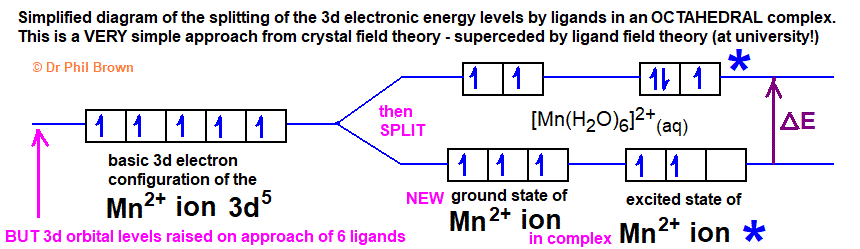
(c) The electronic explanation of why these two hexaaqua ions are coloured and have different colours.

Diagram show the ligand field splitting of the Mn2+ ion from the effect of six ligands in an octahedral complex ion of manganese hexaaquamanganese(II) ion

Diagrams to show the ligand field splitting of the Mn2+ or  Mn3+ ions from the effect of six water ligands in an octahedral complex ion of manganese.

Some ∆Eelec values correspond with the energy of visible light photons, so absorption of visible light takes place and solution is coloured rather than colourless.

∆Eelec will differ for each different oxidation state for the same ligand combination, hence each manganese complex ion will have a different colour.

Diagram show the ligand field splitting of the Mn3+ ion from the effect of six ligands in an octahedral complex ion of manganese hexaaquamanganese(III) ion


Key words & phrases: interpreting the uv-visible absorption spectra of manganese complex ions, identifying the maximum absorption peaks in the uv-visible absorption spectra of manganese complex ions, explaining the uv-visible absorption spectra of manganese complex ions, how to use the visible absorption spectra of manganese complex ions to explain the different colours of manganese complex ions, applications of the uv-visible absorption spectra of manganese complex ions electronic diagrams to explain the 3d ligand field splitting effects of ligands to explain the colours of manganese complex ions complex ions excitation of 3d orbital electrons to produce colour in manganese complex ions complex ions interpreting the uv-visible absorption spectrum of hexaaquamanganese(II) ion, identifying the maximum absorption peaks in the uv-visible absorption spectrum of hexaaquamanganese(II) ion, explaining the uv-visible absorption spectrum of hexaaquamanganese(II) ion, how to use the visible absorption spectra of hexaaquamanganese(II) ion to explain the colour of hexaaquamanganese(II) ion, applications of the uv-visible absorption spectrum of hexaaquamanganese(II) ion interpreting the uv-visible absorption spectrum of hexaaqamanganese(III) ion, identifying the maximum absorption peaks in the uv-visible absorption spectrum of hexaaqamanganese(III) ion, explaining the uv-visible absorption spectrum of hexaaqamanganese(III) ion, how to use the visible absorption spectra of hexaaqamanganese(III) ion to explain the colour of hexaaqamanganese(III) ion, applications of the uv-visible absorption spectrum of hexaaqamanganese(III) ion


Associated links

UV and visible spectroscopy index

General introduction to electron configuration of transition metal ions and colour theory

SPECTROSCOPY INDEXES

The chemistry of manganese

Index of Advanced A level Notes on the 3d block and Transition Metals

All Advanced Inorganic Chemistry Notes

Use My Google search site box

15.5.1 The origin of colour, the wavelengths of visible light, our perception!

15.5.2 uv-visible spectroscopy theory, spectrometer, examples of absorption & reflectance spectra explained

15.5.3 uv-visible absorption spectra - index of examples: uses, applications, more on the chemistry of colour

Website content © Dr Phil Brown 2000+. All copyrights reserved on revision notes, images, quizzes, worksheets etc. Copying of Doc Brown's pre-university/college advanced level inorganic chemistry website material is NOT permitted. Exam revision summaries & references to science course specifications are unofficial. These chemistry revision notes on spectroscopy on the uv and visible absorption spectra of selected manganese ions are suitable for use of pre-university students studying AQA advanced level chemistry, Edexcel advanced level chemistry, OCR advanced level chemistry, IB advanced level chemistry, WJEC (Eduqas) advanced level chemistry, CIE advanced level chemistry, US grade 11-12 AP honors chemistry courses and they will also prove useful to 1st year undergraduate students of chemistry. Examples of uv and visible light absorption spectra described and explained at Doc Brown's Chemistry

TOP OF PAGE