|
GCSE level chemistry exam revision notes on
acids, alkalis, salts etc.
1. Everyday examples of uses
of Acids, Alkalis
& Hazard Signs in the home,
school/college laboratory, industry, and in your body!
[Author
©
Dr Phil Brown GRIC, PhD:
Doc Brown's chemistry exam revision notes on
pH-reactions-acids-bases-neutralisation-salt preps,
suitable for students of UK GCSE
level and international
IGCSE/O level chemistry courses, ~US grades 9-10 chemistry notes [page updated
RE-EDIT]
email doc
brown - comments - query?
*
[privacy policy, cookies
and disclaimer]
GCSE level easier m/c QUIZ on pH, Indicators, Acids,
Bases, Neutralisation and Salts
GCSE level harder m/c QUIZ on pH, Indicators, Acids,
Bases, Neutralisation and Salts
Index of ALL GCSE level (~US grades 8-10) notes on acids, bases
and salts
What next?
Associated Pages
Sub-index for this page on acids, alkalis and
salts in everyday life
1a. Summary of this
introduction to acid and alkali chemistry
1b.
Reminders about the pH scale of acidity and alkalinity and use of pH paper
and universal indicator solution
1c. EXAMPLES of the 'everyday life' of acids, alkalis, neutralisation
and salts in the home
1d. Examples of acids, alkalis and
salts In
various industries
1e. HAZARD WARNING SYMBOLS you should know
and examples of harmful chemicals
1f. Introduction
to the pH scale of acidity and alkalinity (much
more in part 2.)
1g. Table
of selected pH
examples of common acidic, alkaline and neutral substances in aqueous
solution
1h. How to measure pH
accurately with pH meter - usefulness in monitoring aquatic
environment
1i. Some general learning objectives
1j Exam practise questions on
acids, alkalis and salts in everyday life
1a.
Summary of this introduction to acid and alkali chemistry
Examples of everyday acids
and alkali chemistry
in the home or industry, hazard warning symbols (safety signs!), examples of the pH of common materials in aqueous solution
e.g. acids, alkalis, salts you may encounter from domestic products to the
school or college laboratory acids,
alkalis and salts are different types of chemicals with a huge
variety of uses.
The chemistry of acids and bases–alkalis is
introduced by looking at common domestic examples in the home and not just in
industry or the chemical laboratory e.g. use of lime and antacids, chemistry of bee/wasp stings,
and the functions and domestic use of sodium bicarbonate, ammonia, sodium hydroxide, hydrochloric acid all get a
mention!
These revision notes on the use of acids, alkalis, pH
meters, pH paper and examples of the pH of many solutions and hazard signs
(hazard warning symbols) for acids and alkalis should prove useful for the new
AQA chemistry, Edexcel chemistry & OCR chemistry GCSE (9–1, 9-5 & 5-1) science
courses. Doc Brown's
chemistry revision notes: basic school chemistry science GCSE chemistry, IGCSE chemistry, O level
& ~US grades 8, 9, 10 school science courses for ~14-16 year old science
students for national examinations in chemistry topics including acids
bases alkalis salts preparations reactions

1b.
Reminders about the pH scale of acidity and alkalinity and use of pH paper
and universal indicator
In this introductory page of 'everyday' acid, alkali and salt chemistry,
I have assumed that in your earlier school studies you have gained some
idea of what the terms pH, acid, alkali, salt and neutralisation mean.
You should know that acids and bases/alkalis react together in a
neutralisation reaction to form salts which occur in many domestic
products for the home and garden.
If you are not sure any term used in section 1. revise the basics from
section 2., which eventually
goes on a bit further theoretically in section 2c.
BUT some REMINDERS:
The pH scale is a measure of how acidic or alkaline a solution is.
A low pH is very acid, pH 7 is
neutral, a very high pH means very alkaline

An indicator
is a dye molecule that changes colour depending on the
pH of the solution.
Universal indicator solution is a mix of indicators to produce a wide range of
colours to match a pH, you just add a few drops to the test solution and
match the colour. You can
also use universal indicator paper that you just
dip into the test solution.
The diagram above illustrate the colours you can see with a typical
universal indicator.
However its not as accurate as a specially calibrated instrument
called a pH meter -
see picture at the end of the page.
~
means approximately.
but the terms used on this page like acid, alkali and pH
are explained in more theoretical detail in Part 2 ...
pH scale, indicators, ionic theory of acids, alkalis
(bases) & neutralisation
GCSE level easier m/c QUIZ on pH, Indicators, Acids,
Bases, Neutralisation and Salts
GCSE level harder m/c QUIZ on pH, Indicators, Acids,
Bases, Neutralisation and Salts
1c. EXAMPLES of the 'everyday life' of acids, alkalis and
neutralisation to form salts

Theoretically the pH scale extends to <1 and >14 and there are solutions that
are so acid or so alkaline! The pH scale is a measure of the relative acidity or alkalinity of an aqueous
(water) solution. Each pH unit is a factor of 10, but the lower the value, the more acidic the
solution!
GCSE level easier m/c QUIZ on pH, Indicators, Acids,
Bases, Neutralisation and Salts
GCSE level harder m/c QUIZ on pH, Indicators, Acids,
Bases, Neutralisation and Salts
1c. Acids,
alkalis, salts and neutralisation encountered In
the home
Alkaline
lime/quicklime (CaO, calcium oxide) or slaked lime (Ca(OH)2,
calcium hydroxide) powders are put on soil that is too acid for healthy plant growth,
they raise the pH by neutralising the acidity in the soil.
You can use universal indicator
paper to test the pH of a soil-water mixture to decide if alkaline
lime needs to applied to soil that is too acidic for the healthy
growth of plants. Powdered
limestone (CaCO3, calcium carbonate) is slower and less
effective.
All three chemicals react with acids to neutralise them
- a neutral salt is formed.
For more see the
Chemistry of Limestone
The pH scale is fully explained on the next page
pH scale, indicator
colours, ionic theory of acids, alkalis
(bases) & neutralisation You can pre–test the
soil with pH paper and match the colour the paper turns with the pH
number it indicates.
These chemicals can be used on a larger scale in farming
and treating acidic rivers and lakes.
Some of these substances can be safely tested in the school
laboratory with pH paper
 The
alkali ammonia NH3 is a component in some oven cleaners and will react with
fatty acids to dissolve them away
(~pH 11). The
alkali ammonia NH3 is a component in some oven cleaners and will react with
fatty acids to dissolve them away
(~pH 11). Citric acid is found in citrus fruits and is used as a food and
drink flavouring, as is tartaric acid (~pH 3).
Table salt, used in preserving food and sprinkling over your fish
and chips as a flavouring etc. is the neutral chemical sodium chloride NaCl
(~pH 7)..
Concentrated hydrochloric acid
HCl and phosphoric acid H3PO4 are components of
limescale removers (take care - very corrosive on metal surfaces and skin too!
- look out for hazard warning symbols on the container
(~pH 1). Salts are used to produce the
colours in
fireworks e.g. sodium chloride a yellow flame, calcium chloride
makes a red flame and copper chloride can produce green and blue
effects. Antacid indigestion tablets are
mild
alkalis that react by neutralising excess stomach acid
which is the
'strong' hydrochloric acid which your delicate stomach lining and
upper gut can only take so much of.
The antacids must be weak bases i.e.
mild alkalis or harmless insoluble bases like calcium carbonate or
magnesium hydroxide which readily react with hydrochloric acid in the
stomach.
However, strong alkalis
are not to be recommended as a suitable medication for 'heartburn'
afflictions, since they can be just as irritating as strong
acids! See hazard warning signs further down the page and also "Investigation
of Indigestion Tablets".
Bicarbonate or (sodium hydrogencarbonate NaHCO3
(~pH 8).(sodium bicarbonate, baking powder)
can be used with sour milk (acidic) for raising action in baking. The acidic
milk reacts with 'Bicarb' to form carbon dioxide gas giving the rising action.
You can easily demonstrate this by adding any common laboratory acid to baking
powder or any other carbonate!
 Acidic bee stings
(pH 5.0–5.5)
can be soothed,
i.e. neutralised by calamine lotion, which is a mildly alkaline
antiseptic and anti–itching agent based
 on
zinc oxide. You can also use baking soda ('bicarb of soda' or
sodium hydrogen carbonate), another mild alkali. Hydrocortisone, an
anti-inflammatory agent helps too, but this is due to far more
sophisticated biochemistry. on
zinc oxide. You can also use baking soda ('bicarb of soda' or
sodium hydrogen carbonate), another mild alkali. Hydrocortisone, an
anti-inflammatory agent helps too, but this is due to far more
sophisticated biochemistry.
Wasp stings are supposed to be alkaline, but apparently not so! they are almost
neutral at pH 6.8–6.9 but are 'traditionally' treated with vinegar which is a weak
acid (and then perhaps you need the calamine too!).
I've come across references on the web to say that wasp stings are
not alkaline so 'English folklore' and mild–weak acid treatment has no real
scientific basis.
It should be pointed out that sting venom is a complex mixture, including many
protein–enzymes, which, with other 'foreign' substances, might well trigger a response from the bodies
immune system.
So, in all honesty, I'm not quite sure what the truth
is! However, what is known is that (i) bees and wasps have
glands that can secrete either acids or alkalis with other substances and (ii) ants sting
venom often contains methanoic acid ('formic acid') which can
have a pH
of 3 and is presumably 'soothed' by mild alkalis and just to confuse matters
more, (iii) many people claim the 'folklore' remedies
work! and maybe they do!
Ammonium salts, phosphate salts and
magnesium/potassium sulfate salts are used in fertilisers for the garden.
See ....
Manufacture and uses of ammonia-nitric acid-fertilisers
(and preparation of ammonium salts)
and
Use of NPK fertilisers and environmental problems
Soluble aspirin is made by neutralising the
acidic form of the medication with sodium hydroxide to make a soluble salt, or
its made in situ with a bicarbonate 'fizzing' mixture. The salt form of aspirin
is absorbed more readily than the relatively insoluble acid
(salicylic acid)
Acids and alkalis are useful in your body!
Your stomach produces hydrochloric acid to help in digestion of proteins.
Certain digestive enzymes only function properly in very acid conditions i.e.
a
low pH <2. Pancreatic fluids are alkaline to suit the conditions required by
enzymes breaking down starches, fats and proteins.
The hydrochloric acid in your
stomach kills a large % of potentially harmful bacteria, minimising the risk of
food poisoning and irritation of the gut system.
However, as mentioned above, if
you produce too much acid you get indigestion and need to take an antacid
indigestion tablet to neutralise the excess. More body chemistry, preferably to
be avoided!
The small
intestine is alkaline to help break down food.
Digestion and enzymes - section on
human digestion, metabolism and synthesis
The strong alkali sodium hydroxide NaOH is
used bleaches and other cleaning
products, very corrosive, especially on the skin - look out for hazard warning
symbols on the container. The equally
strong alkali potassium hydroxide KOH
is used in alkaline batteries.
TOP OF PAGE
GCSE level easier m/c QUIZ on pH, Indicators, Acids,
Bases, Neutralisation and Salts
GCSE level harder m/c QUIZ on pH, Indicators, Acids,
Bases, Neutralisation and Salts
1d. Examples of acids, alkalis
and salts In
various industries
Alkalis like lime (calcium oxide, CaO) and limestone (calcium
carbonate, CaCO3) are used to reduce the acidity in soil,
the neutralisation reaction produces the optimum pH for crops to grow.
For more see the
Chemistry of Limestone
Sodium hydroxide NaOH, one of the most
commonly used alkalis, is used to neutralise aspirin making 'soluble
aspirin' in the pharmaceutical industry (very strong alkali
pH 13-14).
Aspirin is an organic acid and not very soluble in water,
but,
its sodium salt is much more soluble and is absorbed faster by the
body for more effective treatment.
 Ammonia
NH3 gas is
a weak alkali and neutralised by
sulfuric acid or nitric acid to form ammonium sulfate or ammonium
nitrate salts. Ammonia
NH3 gas is
a weak alkali and neutralised by
sulfuric acid or nitric acid to form ammonium sulfate or ammonium
nitrate salts.
These are important agri–chemical fertilisers
supplying nitrogen
to the soil for better plant growth.
Of course
some people prefer organic growing using good old muck and compost,
but it doesn't involve neutralisation, but it does involve my wife,
who is a member of the Soil Association! NPK fertilisers for
agriculture contain potassium, ammonium and phosphate salts.
Neutralising
harmful sulfur dioxide gas
(acidic, irritating and toxic SO2) in power station smoke
from burning fossil fuels, by absorbing it in alkaline calcium
hydroxide solution (limewater) to absorb it. Eventually harmless
calcium sulfate solution is formed.
 Acids can be used to clean corroded
metal surfaces because of their reactivity to metals and metal
oxides to form soluble salts which can be washed away to leave a
cleaner metal surface. Acids can be used to clean corroded
metal surfaces because of their reactivity to metals and metal
oxides to form soluble salts which can be washed away to leave a
cleaner metal surface.
Concentrated acid solutions are used to
remove limescale from the ceramic (unreactive) sides of toilets.
Limescale is
the build–up of a limestone like deposit in areas of hard water.
Alkalis are important chemicals in many industrial processes e.g.
Heating natural oils and fats with strong alkalis like sodium
hydroxide produce 'old-fashioned' soaps which consist of salts of
long chain fatty acids. Alkalis are used either directly, or to
make other chemicals that bind natural dyes to cloth and other
fabrics. The alkali sodium carbonate is used in making glass.
In
the past alkalis have been obtained from burnt wood, burnt seaweed
and stale urine, but they are now may made on a huge bulk scale from
industrial processes e.g. sodium chloride is manufactured from the
electrolysis of brine (sodium chloride solution) and is then used to
make many other products.
Sodium carbonate is made from calcium
carbonate (limestone) and common salt (sodium chloride) by the
Solvay Process.
So
all of this is still pretty important chemistry even for the 21st century, with
strong links to agriculture, the environment and leading a stressful
life! Of course there
are 'downsides' to some of this 'acidic' chemistry:
Acid rain increases the rate of
corrosion of stonework (particularly limestone) and metal
structures.
Acid rain makes water too acid for
some aquatic organisms to live and this in turn affects food chains
e.g. salmon do not like water with a pH below 4.5!
Living on Venus could be hard going,
its atmosphere is mainly sulfuric acid,
mind you, you should be ok in
a plastic suit because plastics don't usually react with acids,
which is why, as well as being cheaper, plastics are replacing water
pipes, drain pipes and gutters etc.
GCSE level easier m/c QUIZ on pH, Indicators, Acids,
Bases, Neutralisation and Salts
GCSE level harder m/c QUIZ on pH, Indicators, Acids,
Bases, Neutralisation and Salts
1e. HAZARD WARNING SYMBOLS you should know
and examples of harmful chemicals
The
hazard signs for irritant, harmful and corrosive are those most
appropriate when dealing with acids and alkalis
|
HAZARD WARNING SIGN |
For all experiments, appropriate risk assessments
should be done and hazcards studied etc. This table illustrates the use
of hazard warning signs with common examples, and may NOT provide
sufficient detail for specific laboratory experiments and detailed safe
procedures, concentration factors (e.g. dilute or concentrated, 'doing
labs', coursework write up from school/college investigations etc. |
|
Symbol |
Examples of what might be
labelled/classified with this hazard warning sign (definitions above) |
 |
Irritant: Most acidic and alkaline
solutions unless very dilute, VERY small quantities of acidic gases like
chlorine, sulfur dioxide, nitrogen dioxide, very dilute bleaches. These may
not be that corrosive BUT they are irritating e.g. will cause irritation of
the skin and reddening and blistering. |
 |
Harmful: Some acids e.g. nitric
acid; acidic gases like chlorine, sulfur dioxide, nitrogen dioxide;
bleaches; heavy metal ions e.g. of lead, barium; some salts e.g. silver
nitrate, copper sulfate. They are not quite as harmful as toxic chemicals
but they can certainly make you ill. |
 |
Corrosive: Any substance like
concentrated acidic or alkaline solutions which will attack many materials
and destroy living tissue too! Also includes substances like bromine. |
|
 |
Highly flammable: Most organic
solvents like hexane, propanone (acetone), petrol and other
hydrocarbon fuels are easily ignited, easily catch fire. |
 |
Toxic: Chlorine, sulfur dioxide,
hydrogen cyanide can cause death if breathed in with sufficient quantity,
absorbed through the skin or ingested by swallowing. Salts of hydrogen
cyanide e.g. potassium cyanide are highly toxic – you only have a short time
to take an antidote mixture! |
 |
Oxidising: Chemicals that can act
as oxidising agents e.g. chlorine gas/solution and oxygen gas/liquid,
potassium manganate(VII), potassium chlorate (in some weed killers). Many
oxidising agents donate oxygen to materials that burn and can be dangerously
reactive. Many can cause combustion if mixed with an oxidisable combustible
material. They may cause materials to burn more fiercely. |
 |
Explosive: TNT,
hydrogen, fireworks, peroxides |
 |
Radioactive: Radioisotopes giving
off dangerous ionising radiation |
 |
Harmful to the environment.
e.g. chemicals toxic to aquatic wildlife an in general
harmful to organisms and the environment e.g. toxic metals like mercury, old
pesticides like DDT. |
|
Households often contain a surprising number
of acidic and alkaline chemicals—many of which are useful but potentially
hazardous if mishandled or mixed.
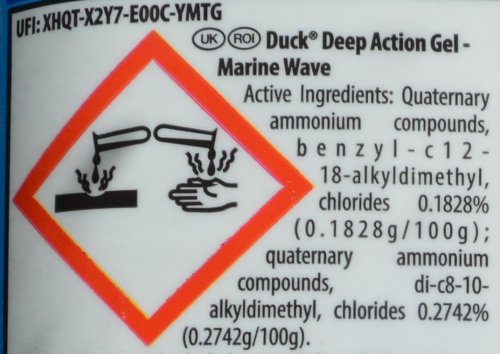
The hazard warning symbol on the label
of a bottle of toilet cleaner.
Here's a breakdown of common ones and the
risks they pose:
Acidic
Household Chemicals which should carry hazard warning symbols on the label
These typically have a low pH and can cause
burns, corrosion, or toxic reactions.
| Chemical |
Common Use |
Hazards |
| Hydrochloric acid |
Toilet bowl cleaners |
Corrosive to skin and eyes; toxic
fumes |
| Sulfuric acid |
Drain cleaners |
Severe burns; reacts violently
with water |
| Acetic acid |
Vinegar |
Mild irritant; dangerous when
mixed with bleach |
| Citric acid |
Descaling agents, cleaners |
Mild irritant; can damage surfaces
in high doses |
| Oxalic acid |
Rust removers |
Toxic if ingested; skin and eye
irritant |
| Phosphoric acid |
Rust removers, cleaners |
Corrosive; can damage enamel and
skin |
Vinegar solution (acetic acid, ethanoic acid) is weakly acidic substance
used in food preparation and cooking
Alkaline Household Chemicals which should carry hazard warning symbols on
the label
These have a high pH and can be just as
dangerous as acids.
| Chemical |
Common Use |
Hazards |
| Sodium hydroxide |
Oven and drain cleaners |
Severe chemical burns; reacts with
acids |
| Ammonia |
Glass and surface cleaners |
Toxic fumes; dangerous when mixed
with bleach |
| Calcium hydroxide |
Lime-based products |
Skin and eye irritant; corrosive |
| Sodium carbonate |
Laundry detergents |
Mild irritant; harmful in large
quantities |
| Potassium hydroxide |
Soap making, drain cleaners |
Highly corrosive; causes deep
tissue damage |
Some neutral substances in the
home
Common salt, chemical name sodium chloride, is used in cooking and
de-icing frozen paths and roads.
Sugar is used as a sweetener in
cooking.
Dangerous Combinations to Avoid
- Bleach + Ammonia
→ Toxic chloramine gas
- Bleach + Vinegar
→ Chlorine gas
- Hydrogen peroxide + Vinegar
→ Peracetic acid (corrosive)
- Bleach + Alcohol
→ Chloroform (can cause
unconsciousness or death)
Safety Tips
- Always read labels and follow
instructions.
- Store acids and alkalis separately.
- Use gloves and eye protection when
handling strong cleaners.
- Never mix products unless explicitly
instructed.
|
|
1f.
More on the pH scale of acidity and alkalinity
 
The pH scale and indicators are
explained in more detail in section 2.,
The diagram illustrates what you might see when a
universal indicator (mixture of several different colour changing
indicators) is added to a variety of solutions with a wide variation of pH
i.e. a wide range of acidity and alkalinity.
Basically a low pH 0-1 is very acid, pH 7 is neutral
(e.g. pure water), and a high pH 13-14 means very alkaline (~ means
approximately in the table below).
An acid solution is defined as one with a pH of less than
7, neutral solutions have a pH of 7 (or as near as make no difference if the
solutions has acidic or alkaline properties) and alkaline solutions have a
pH of over 7. The 'opposite' of an acid is a base, and a soluble base is
called an alkali.
The lower the pH the more acid the
solution.
The higher the pH the
more alkaline the solution.
It is important to understand two things about pH
and pH scale:
(i) pH is a measure of the hydrogen ion (H+)
concentration (see section 2.
ionic theory)
Acidic solutions are formed when a
substance dissolves in water and forms hydrogen ions.
The lower the pH, the higher the hydrogen ion
concentration, that is more acid.
I know this seems confusing, but that's the way pH
scale has been defined.
(ii) Each pH unit change is equivalent to a 10x change in
concentration of the hydrogen ion.
For example changing the pH of a
solution from pH 3 to pH 4 makes it 10x less acidic.
Changing a solution's pH from 7 to 5 makes it 100x
more acidic (10 x 10).
GCSE level easier m/c QUIZ on pH, Indicators, Acids,
Bases, Neutralisation and Salts
GCSE level harder m/c QUIZ on pH, Indicators, Acids,
Bases, Neutralisation and Salts
1g. Table
of selected pH
examples of common acidic, alkaline and neutral substances in aqueous
solution

|
|
|
|
STRONG
ACID pH <2 |
WEAK
ACID pH 2–6 |
~NEUTRAL
~pH 7 |
WEAK
ALKALI (weak soluble base)
pH 8–12 |
STRONG
ALKALI (strong soluble base)
pH >12 |
|
H2SO4
sulfuric acid (car battery acid) pH 1 |
vitamin C
(ascorbic acid) pH ~3 |
very pure deionised H2O
water pH7 |
toothpaste
pH 8 |
NaOH
sodium hydroxide pH 13–14 |
|
HCl
hydrochloric acid (in the lab is same as your stomach!) pH 0–1 |
CH3COOH acetic/ethanoic acid (vinegar)
pH ~3 |
NaCl
sodium chloride (salt water) ~pH 7 |
Ca(OH)2
calcium hydroxide (limewater, slaked lime) pH 12 |
KOH
potassium hydroxide pH 13–14 |
|
HNO3
nitric acid pH 1 |
fruit juices e.g. orange juice and lemon juice contain
citric acid pH 2–3 |
MgSO4
magnesium sulfate (Epsom salts) pH ~6.5 – 7.0 |
Na2CO3
sodium carbonate (washing soda) pH 11 |
oven cleaner if it contains NaOH, pH can be >12, so take care! |
|
Limescale remover, pH <1, so take care! |
milk pH 6 |
C6H12O6
(glucose and other sugars) pH 7 |
NH3
ammonia pH 11, in some domestic cleaning fluids |
bleach solution
might also be over pH 12 |
|
* |
wine/beer
pH 3 – 6 |
C2H5OH
ethanol ('alcohol') pH 7 |
soap powder
pH 11 |
Caustic soda drain cleaner can be pH 13–14, based
on sodium hydroxide |
|
* |
rain water naturally has a pH of pH ~5.6 due to the
dissolved weakly acidic gas carbon dioxide from the atmosphere ('carbonic
acid'), but it can fall to pH ~3.5 due to even more acidic sulfur
dioxide gas from fossil fuel burning.
See my local acid rain
project |
some 'natural fluids' e.g.
blood ~7.2 – 7.4
saliva
~6.4 – 6.9
cows milk ~6.6
human milk 6.6 – 7.6 |
Sea water has a pH of ~7.5 – 8.5 and has many different salts
dissolved in it and bicarbonates causing the very slight alkalinity. |
* |
|
* |
cider 2.9 – 3.3 |
Was sting, pH 6.8 – 6.9 |
NaHCO3
sodium hydrogen carbonate ('bicarb', baking soda, bread soda) pH 8 |
* |
|
* |
Bee sting, pH 5.0 – 5.5 |
* |
Mg(OH)2
magnesium hydroxide ('milk of magnesia') pH 10 – 10.5 |
* |
|
* |
* |
* |
Pancreatic juice for your digestive system can be
as alkaline as pH 10 |
|
|
* |
* |
* |
Washing–up liquid ~pH 8–9 |
|
1h. How
to measure pH accurately with a pH meter
 |
 |
|
You can measure the pH of a solution very
accurately using a pH meter and a glass membrane pH probe.
The pH meter is calibrated against standard buffer solutions of
accurately known pH.
These instruments are not
cheap, this probe alone cost £350 in 2023 ($471 US dollars).
It is a much more accurate method than
universal indicator solution or paper.
It is an important indicator
measurement for water pollution from industrial process waste and
climate change e.g. the acidification of oceans and its effects of coral
reefs from the increase in the weakly acidic gas carbon dioxide.
The acidification of lakes and rivers e.g.
from acid rain or industrial pollution, can disrupt ecosystems and kill
certain 'sensitive' plants or animals and affect the food chains of
other species. |
|
GCSE level easier m/c QUIZ on pH, Indicators, Acids,
Bases, Neutralisation and Salts
GCSE level harder m/c QUIZ on pH, Indicators, Acids,
Bases, Neutralisation and Salts
1i. Some general learning objectives for Part 1 on
Acids, bases, alkalis, pH, neutralisation and salts
Know that solutions with a pH <7 are acidic, pH = 7 solutions of are
neutral and if a solution has a pH of >7 it is alkaline.
Know that the pH is a measure of the concentration of the hydrogen
ion (H+) in a solution.
BUT, know the lower the pH, the more acidic the solution AND each pH
unit is a factor of 10 (up or down) in the concentration of the hydrogen
ion.
Appreciate the use of the pH scale colours and numbers as observed
using universal indicator paper.
Be able to quote some useful chemicals in the home that are acidic,
neutral and alkaline and what they are used for.
Be able to quote typical approximate pH values in aqueous solution
for common acidic, neutral or alkaline solutions in the home or the
school laboratory.
Be able to recognise and know the meaning of the eight hazard warning
symbols tabled in section (1d).
Know that the pH of a solution can be accurately measured with an
instrument called a pH meter, which is calibrated with buffer solutions
of known pH.
Knowing the pH of water systems e.g. lakes and rivers, is one
important indication of the health of them, e.g. acid rain can disrupt
aquatic ecosystems and kill important animal and plant species.
(1j) QUESTIONS
GCSE-level
chemistry - practise exam questions on
acids, bases, salts and neutralisation in everyday life
Jot
down your responses and check out the answers:
ANSWERS
If you think there are
any errors, please email me asap at
chem55555@hotmail.com
I don't mind if students/teachers do a selected printout
of these questions and answers.
Q1
How would you classify solutions with pH 1, pH 5, pH 7,
pH 10 and pH 13?
Q2 Explain why lime is spread on
soil to make it more fertile
Q3 After squeezing out some lemon
juice or orange juice and testing
it with universal indicator, what might you observe and
deduce about lemon juice?
Q4 Why is it ok to treat a bee sting
with 'bicarbonate of soda' mixed with a little water.?
GCSE level easier m/c QUIZ on pH, Indicators, Acids,
Bases, Neutralisation and Salts
GCSE level harder m/c QUIZ on pH, Indicators, Acids,
Bases, Neutralisation and Salts
|
|
What next?
Associated Pages
GCSE/IGCSE level revision notes on acids, bases,
neutralisation and salts
INDEX of ALL pH, Acids, Alkalis, Neutralisation and Salts Notes
1.
Examples of everyday acids, alkalis, salts, pH of
solution, hazard warning signs
2.
pH scale, indicators, ionic theory of acids–alkali neutralisation
4.
Reactions of acids with
metals/oxides/hydroxides/carbonates, neutralisation reactions
5.
Reactions of bases–alkalis
like ammonia & sodium hydroxide (overlaps with Part 4.)
6.
Methods
of making salts index and chemical tests for ions in salts
& tests for common gases
7. Changes in pH in a
neutralisation, choice and use of indicators
8. Important formulae
of compounds, salt solubility and water of crystallisation
10.
More on
advanced Acid–Base Theory and Weak and Strong Acids
See also
 Advanced Level Chemistry Students Acid–Base Revision
Notes – use index
Advanced Level Chemistry Students Acid–Base Revision
Notes – use index
Multiple choice revision quizzes and other worksheets
Quiz on identifying ions, salts and other compounds
 GCSE level easier multiple choice quiz on pH, Indicators, Acids,
Bases, Neutralisation and Salts
GCSE level easier multiple choice quiz on pH, Indicators, Acids,
Bases, Neutralisation and Salts
 GCSE level harder multiple choice quiz on pH, Indicators, Acids,
Bases, Neutralisation and Salts
GCSE level harder multiple choice quiz on pH, Indicators, Acids,
Bases, Neutralisation and Salts
 GCSE level worksheet on Acid
Reaction word equations and
symbol
equation questions
GCSE level worksheet on Acid
Reaction word equations and
symbol
equation questions
Word
equation answers and
symbol
equation answers)
 GCSE/IGCSE word–fill worksheet on Acids,
Bases, Neutralisation and Salts
GCSE/IGCSE word–fill worksheet on Acids,
Bases, Neutralisation and Salts
 GCSE/IGCSE
matching pair quiz on Acids, Bases, Salts and pH
GCSE/IGCSE
matching pair quiz on Acids, Bases, Salts and pH
Other useful links?
Email doc
brown comment? query?
HOME PAGE of Doc Brown's Science
UK KS3 Science Quizzes for
students aged ~11-14, ~US grades 6 to 8
Biology * Chemistry
* Physics notes for GCSE
level
students aged ~14-16, ~US grades 9 to 10
Advanced Level pre-university Chemistry
notes for students aged ~16-18 ~US grades 11 to 12
This is a BIG
website, you need to take time to explore it [ SEARCH
BOX]
useful acids,
alkalis & salts in the home - domestic products for syllabus-specifications
for students taking the IGCSE/GCSE level chemistry examinations, summary
revision notes key points on useful acids, alkalis & salts in the
home - domestic products for students studying AQA
igcse/gcse chemistry notes on useful acids, alkalis & salts in the home -
domestic products, Edexcel gcse
chemistry notes on useful acids, alkalis & salts in the home -
domestic products, OCR 21st century GCSE
chemistry notes on useful acids, alkalis & salts in the home -
domestic products, OCR gateway
GCSE chemistry notes on useful acids, alkalis & salts in the home -
domestic products, WJEC gcse chemistry notes on useful acids,
alkalis & salts in the home - domestic products, CCEA
gcse chemistry notes on useful acids, alkalis & salts in the home -
domestic products, CIE Cambridge igcse
chemistry, notes on
useful acids, alkalis & salts in the home - domestic products useful for US grade 9-10 chemistry student courses,
Explaining importance of pH values of various acids, alkalis & salts
in GCSE level chemistry, What you need to know about pH values of
various acids, alkalis & salts for
GCSE level
chemistry,
Explaining use of pH values of various acids, alkalis & salts knowledge in GCSE level chemistry, Examples of
pH values of various acids, alkalis & salts
explained when studying GCSE level chemistry, What is the significance
of pH values of various acids, alkalis & salts in GCSE level chemistry, describing
explaining theory of pH values of various acids, alkalis & salts when studying GCSE level chemistry, exam revision
notes for pH values of various acids, alkalis & salts, online help for understanding
pH values of various acids, alkalis & salts in GCSE
chemistry, what do I need to learn about pH values of various acids,
alkalis & salts? what do I need to know
about pH values of various acids, alkalis & salts for GCSE chemistry exams, how to prepare for questions on
pH values of various acids, alkalis & salts in GCSE
chemistry examination?
hazard warning
sign symbols for chemicals for
syllabus-specifications
for students taking the IGCSE/GCSE level chemistry examinations, summary
revision notes key points on hazard warning sign symbols for
chemicals for students studying AQA
igcse/gcse chemistry notes on hazard warning sign symbols for chemicals, Edexcel gcse
chemistry notes on hazard warning sign symbols for chemicals, OCR 21st century GCSE
chemistry notes on hazard warning sign symbols for chemicals, OCR gateway
GCSE chemistry notes on hazard warning sign symbols for chemicals, WJEC gcse chemistry notes on
hazard warning sign symbols for chemicals, CCEA
gcse chemistry notes on hazard warning sign symbols for chemicals, CIE Cambridge igcse
chemistry, notes on
hazard warning sign symbols for chemicals useful for US grade 9-10 chemistry student courses
|
|
Website content © Dr
Phil Brown 2000+. All copyrights reserved on Doc Brown's Chemistry revision notes, images,
quizzes, worksheets etc. on the chemical reactions of acids, bases
and salt formation, lots of equations, formulae and explanations
for IGCSE/GCSE level chemistry (US grades 8, 9, 10) Copying of website material is NOT
permitted. Exam revision summaries & references to science course specifications
are unofficial. These
notes are suitable for students studying the
syllabus-specifications of WJEC GCSE chemistry, CCEA GCSE
chemistry, CIE IGCSE chemistry, AQA GCSE chemistry, Edexcel GCSE
chemistry, OCR gateway GCSE chemistry, OCR 21st century
GCSE chemistry
What next?
Associated Pages
|
|
ANSWERS to the GCSE-level
chemistry - practise exam questions on
acids, bases, salts and neutralisation in everyday life
If you think there are
any errors, please email me asap at
chem55555@hotmail.com
Q1
How would you classify solutions with pH 1, pH 5, pH 7,
pH 10 and pH 13?ANSWERS pH 1
strongly acidic, pH 5 weakly acid, pH 7 neutral, pH 10
weakly alkaline, pH strongly alkaline
Q2 Explain why lime is spread on
soil to make it more fertile
ANSWER
Soil may be too acidic for good crop growth, so, by
adding an alkaline substance, you neutralise
the excess acidity of the soil, and this improves crop
growth.
Q3 After squeezing out some lemon
juice or orange juice and testing
it with universal indicator, what might you observe and
deduce about lemon juice?
ANSWER
The indicator will turn red-orange, indicating a pH of
~2-3, the juice is quite acid due to the presence of
citric acid - this is why 'citrus fruits' are quite
acidic.
Q4 Why is it ok to treat a bee sting
with 'bicarbonate of soda' mixed with a little water.?
ANSWER
A bee sting is weakly acidic causing pain in your
sensitive skin tissue. The 'bicarb' is a mild alkali and
neutralises the acid of the bee sting,
GCSE level easier m/c QUIZ on pH, Indicators, Acids,
Bases, Neutralisation and Salts
GCSE level harder m/c QUIZ on pH, Indicators, Acids,
Bases, Neutralisation and Salts
|
|