|
GCSE level biology:
The human circulatory system Part 7.
Describing and explaining treating cardiovascular disease (CVD, coronary heart
disease) with stents, bypass surgery and
angioplasty
procedures
[Author
©
Dr WP Brown PhD:
Doc Brown's biology exam revision notes suitable for students of UK
IGCSE & GCSE level biology courses & ~ US grades 9-10 biology,
page updated Feb 17th 2026 *]
[Key
points and learning objectives for this page, after the main body of
notes]
Index
of notes on human circulatory system: heart, lungs & blood vessels
[email doc
b: comment? query?]
*
[privacy-policies-disclaimer] *
]SEARCH doc b's
website]
(7) Treating cardiovascular diseases
- coronary heart disease
 Reminder: Cardiovascular disease (CVD)
is the scientific medical term for all types of disease that affect
the heart or blood vessels. CVD includes coronary heart
disease (clogged up arteries with fatty deposits), which can
cause heart attacks, stroke, heart failure, and peripheral artery
disease. Reminder: Cardiovascular disease (CVD)
is the scientific medical term for all types of disease that affect
the heart or blood vessels. CVD includes coronary heart
disease (clogged up arteries with fatty deposits), which can
cause heart attacks, stroke, heart failure, and peripheral artery
disease.
If the heart or blood vessels are severely
damaged major surgery might be required.
More on surgical techniques and other procedures
are described in a later section.
Use of Stents
Coronary heart disease can be treated with stents - see diagram below.
Stents are very thin-walled wire mesh tubes inserted
into arteries to widen them and keep them open to ensure a good supply of
blood to the heart muscles.
A good blood flow keeps the heart beating
regularly and so keeps you alive, particularly for people suffering
from cardiovascular disease!

1. A normal artery,
no hardened fat deposits (plaque) on the inner surface of the artery
wall, so there is no
restriction of blood flow away from the heart.
2. Fatty deposits
(plaque) can build up on the
inside wall of the artery restricting blood flow.
The cross-section
of the lumen is reduced e.g. the equivalent of narrowing a 'pipe'
and reducing blood flow - reducing the rate of oxygen transfer to
heart muscles.
Cholesterol is a fatty substance the body
needs to build cell membranes.
However, too much of fatty substances,
including 'bad' LDL cholesterol, in your blood stream can lead
to an excessive and dangerous build up of fatty deposits on the
walls of the arteries.
The fatty deposits harden over time to
form lots of atheromas which restricts blood flow.
These bits of atheromas damage the blood
vessel and if one breaks off it can cause a blood clot.
This damage to the arteries causes high
blood pressure with increased risk of heart attacks, angina and
strokes.
Thick fat deposits can block a blood
vessel or cause blood clots to form which can block the flow of
blood completely.
If this involves an artery supply blood to the
heart muscle, the heart muscle is deprived of oxygen and
glucose and can
cause a heart attack.
There is less energy available for the
heart muscles to contract.
Such blockages can also deprive the brain
of oxygen causing a stroke.
3. With
the help of a catheter, whose position is monitored by X-rays, a very thin-walled tubular
bare metal mesh stent is
inserted that pushes against the inside artery wall.
Via
the catheter, the
stent is inflated to expand it against the artery wall.
The stent squashes the
fat deposits and so widening the artery to allow normal blood flow -
increases the cross-section area of the artery, so increasing flow
rate - hopefully bringing the oxygen supply to the heart back to normal!
By allowing normal blood flow rate, stents are a very effective way of
lowering the risk of a heart attack or a stroke for people suffering from
coronary heart disease.
After the operation, recovery time is
short and the stents have a long working life of many years.
Repeat surgery might be necessary if the
artery narrows again.
However, such procedures are not without
risk -
(i) there may be complications during
the operation (including, ironically, a heart attack),
(ii) there is always a risk of
infection with any surgical procedure, and,
(iii) a risk of a blood clot
developing in the patient near the stent - known as a thrombosis.
This restricts blood flow and possibly
stopping the flow - not good!
NOTE An alternative stent
A
drug-eluting stent (DES) is a peripheral or coronary stent (a
scaffold) placed into narrowed, diseased peripheral or coronary
arteries that slowly releases a drug to block cell
proliferation.
This prevents the
artery from getting narrowed by the growth of tissue cells.
Bypass surgery
There
is little risk in having stents implanted, but the fatty deposits
can build up again.
However, if the coronary artery is too
badly damaged, bypass surgery must be used.
The blood vessels may be so badly blocked
that stents won't work.
In this situation, the blood flow to the
heart can be improved with coronary bypass surgery.
A healthy blood vessel (e.g. a vein in the
leg) is transplanted and surgically inserted and connected to
bypass the blocked damage artery.
Bypass surgery has the advantage of no
rejection, but still carries risks of any major surgery.
It is a more invasive procedure than
having stents fitted, requires a longer hospital stay and
requires a longer recovery time.
There is a lower chance that repeat bypass
surgery would be necessary, whereas with stents, this may be
needed if the artery narrows again.
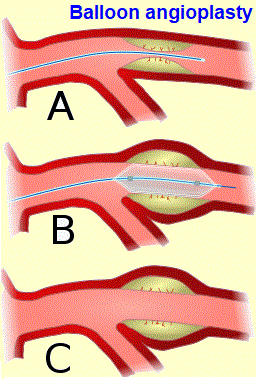 An
example of angioplasty An
example of angioplasty
(image adapted from
https://en.wikipedia.org/wiki/Angioplasty )
Angioplasty, is a minimally invasive endovascular procedure used
to widen narrowed or obstructed arteries or veins in the treatment
of arterial atherosclerosis.
A:
A deflated balloon attached to a catheter (a balloon
catheter) is passed via a guide-wire into the narrowed vessel.
B:
The balloon inflated to a fixed size (balloon angioplasty).
C:
The balloon forces expansion the blood vessel and the surrounding
muscular wall, allowing an improved blood flow.
Note: (i) A stent may be inserted at the time of
ballooning to ensure the expanded blood vessel remains open, and the
balloon is then deflated and withdrawn.
(II) Angioplasty has come to include all manner of vascular
interventions that are typically performed by needle-puncture of the
skin rather than by using an 'open' approach where inner organs or
tissue are exposed.
Key points -
Summary of ideas
treating CVD with stents, bypass surgery, angioplasty procedures on
the syllabus-specifications for students taking the AQA, Edexcel and OCR
GCSE level biology examinations (~US grades 9-10).
Treating Cardiovascular
Disease (CVD)
What is Cardiovascular
Disease (CVD)?
Cardiovascular disease refers
to conditions affecting the heart and blood vessels.
One common type is
coronary heart disease (CHD), which occurs when the coronary
arteries supplying oxygen-rich blood to the heart become narrowed or
blocked due to fatty deposits (atherosclerosis).
This reduces blood flow and
can lead to chest pain (angina), heart attacks, or even
heart failure.
Treatments for Coronary
Heart Disease
There are several medical
procedures to restore blood flow in the coronary arteries:
Stents
Description:
Procedure:
-
A catheter (a
thin tube) is guided into the blocked artery.
-
A balloon
inside the catheter inflates, pushing the fatty deposits against the artery
walls.
-
The stent
remains in place to keep the artery open.
Advantages:
-
Improves blood flow to the
heart.
-
Minimally invasive
compared to surgery.
-
Immediate relief
from symptoms like angina.
Disadvantages:
-
Risk of restenosis
(the artery narrowing again over time).
-
Blood clot formation
is possible, requiring blood-thinning medication.
Angioplasty (Balloon
Procedure)
Description:
Procedure:
-
A catheter is
inserted into the artery.
-
A balloon at
the tip inflates, pushing fatty deposits against the artery walls.
-
Sometimes, a stent
is added to keep the artery open.
Advantages:
-
Less invasive than heart
surgery.
-
Quick recovery time
compared to major surgery.
-
Effective in reducing symptoms
of CHD.
Disadvantages:
-
The artery may narrow
again in some cases.
-
Possible complications,
including damage to the artery wall.
Coronary Bypass
Surgery
Description:
Procedure:
-
The patient is placed under
general anaesthetic.
-
The surgeon takes a blood
vessel from the leg, arm, or chest.
-
The new blood vessel is
connected to the heart, allowing blood to flow past the blockage.
Advantages:
-
Long-term solution
for severe CHD.
-
Improves blood flow
significantly, reducing chest
pain and risk of heart attacks.
-
Can treat multiple blocked
arteries.
Disadvantages:
-
Major surgery,
requiring a longer recovery period.
-
Risk of complications,
including infections or blood clots.
-
Can be expensive
compared to other treatments.
Comparison of Treatment
Options
| Treatment |
Procedure Type |
Effectiveness |
Risks & Limitations |
| Stents |
Minimally invasive |
Improves blood flow instantly |
Risk of re-blockage, blood clots |
| Angioplasty |
Non-surgical |
Quick recovery |
Risk of artery re-narrowing |
| Bypass Surgery |
Major surgery |
Long-term solution |
Longer recovery, risk of complications |
-
Understand key terms
like CHD, atherosclerosis, restenosis, angioplasty, and bypass surgery.
-
Explain advantages and
disadvantages of each
procedure clearly.
-
Use diagrams
to illustrate how stents and bypass surgery work.
-
Practice exam-style
questions, such as explaining
why a doctor might recommend stents instead of bypass surgery.
-
Revise case studies
on heart disease treatments, if available in your syllabus.
Summary of learning objectives and key words or phrases
Be able to describe ways of treating coronary heart disease, cardiovascular disease CVD
using stents, bypass surgery and angioplasty surgical procedures.
-
Know and understand that if arteries begin to narrow and restrict blood flow
stents are used to keep them open.
-
You should understand the importance of stents,
particularly with reference to the coronary arteries.
-
Stents are narrow tubes capable
of supplying a blood flow equivalent to an artery.
-
Fatty deposits building up on
the inner surface of the arteries that supply blood to the heart muscles can
cause coronary heart disease.
-
These fatty deposits restrict
the blood flow increasing blood pressure and causing heart attacks.
-
To combat this potential fatal
condition you can insert stents into the arteries to increase blood flow to
the heart muscles.
-
However, there are some
drawbacks eg the stents can irritate the artery lining and cause the growth
of scar tissue and drugs must be taken to avoid blood clots forming in the
stent itself.
WHAT NEXT?
TOP OF PAGE
Index of biology notes on
the human circulatory system - the heart, lungs and blood vessels
INDEX of all my BIOLOGY NOTES
HOME PAGE of Doc Brown's Science
website Links to all indexes
UK KS3 Science Quizzes for
KS3 science students aged ~11-14, ~US grades 6, 7 and 8
Biology * Chemistry
* Physics UK
GCSE level students aged ~14-16, ~US grades 9-10
Advanced Level Chemistry
for pre-university age ~16-18 ~US grades 11-12, K12 Honors
Find your GCSE/IGCSE
science course for more help links to all science revision notes
email doc
brown - comments - query?
Doc Brown's school biology revision notes: GCSE biology, IGCSE
biology, O level biology, ~US biology science grade 8, grade 9 and
grade 10 school science courses or equivalent for ~14-16 year old students of
biology IGCSE AQA GCSE Biology Edexcel GCSE Biology IGCSE OCR Gateway Science
Biology OCR 21st Century Science Biology Some of these biology revision notes
might be suitable for UK KS3 Science-Biology courses for ages 12-14 (~US biology
science grades 6, grade 7 and
grade 8)
Explaining the importance of
treatments for cardiovascular disease
in GCSE level biology, What you need to know about treatments for
cardiovascular disease for
GCSE level
biology,
Explaining the use of treatments for cardiovascular disease knowledge in GCSE level biology, Examples of
treatments for cardiovascular disease explained
when studying GCSE level biology, What is
the significance of treatments for cardiovascular disease in GCSE level biology, describing and
explaining the theory of treatments for cardiovascular disease when studying GCSE level biology, revision
notes for treatments for cardiovascular disease in exams, online help for understanding
treatments for cardiovascular disease, exam revision
notes for treatments for cardiovascular disease, what do I need to learn about
treatments for cardiovascular disease? revision summary for treatments for
cardiovascular disease, learning notes for treatments for cardiovascular disease, help to pass the
treatments for cardiovascular disease
topic in an exam question, how to prepare for questions on treatments
for cardiovascular disease in a GCSE
biology examination?
treatment CVD with stents, bypass
surgery, angioplasty procedures on the syllabus-specifications
for students taking the IGCSE/GCSE level biology examinations summary
revision notes and key points on xyz for students taking the AQA
igcse/gcse biology notes on xyz, Edexcel gcse
biology notes on xyz, OCR 21st century GCSE
biology notes on xyz, OCR gateway
GCSE biology notes on xyz, WJEC gcse biology notes on xyz, CCEA
gcse biology notes on xyz for students taking CIE Cambridge igcse
biology, or any other GCSE or IGCSE level biology exams notes on
xyz, useful for US grade 9-10 biology courses
SITEMAP Website content © Dr
Phil Brown 2000+. All copyrights reserved on biology revision notes, images,
quizzes, worksheets etc. Copying of website material is NOT
permitted. Exam revision summaries and references to science course specifications
are unofficial.
|
