SEARCH Doc's Pic's picture pages
|
We Dig Archaeology in Ireland Ireland 7. Caherconnell and Poulawack Cairn, The Burren, County Clare, Ireland
We Dig
Archaeology Index
[Author
and photographer
Email: chem55555@hotmail.com *
Ireland 7. Caherconnell and Poulawack Cairn, The Burren, County Clare, Ireland
.... Another mile or so up the road brings you to the splendid stone ring fort of Caherconnell which has visitor centre and craft and coffee shops. It is typical of 'Cashel' in the Burren. These 'Celtic' stone ring forts were typically occupied between 400 and 1200 AD. Caherconnell has a diameter of 140-150 ft (~42m) with walls 12 feet thick and 6-14 feet high. Recent excavations in 2007 have found animal bones, iron fragments of unknown artefacts, an arrow head and pin mould. There is evidence that the entrance was rebuilt in the 14th-15th century suggesting occupation of these sites extended to later dates than hitherto thought.
Excavation demonstrated that the cairn was used repeatedly rather than in a single episode. 3500-1000 BCE, three phases of burial, relatively simple grave goods e.g. flints, shells, bronze age pottery Internally there are several cists and burial deposits placed at different heights and positions within the cairn, reflecting at least three broad phases of use from the Neolithic into the Bronze Age; later reworking and re‑interment of bones also occurred during the monument's long use. 1st phase: Initially 16 burials in the base of the cairn, 3614-3373 BCE 2nd phase ~2000 BCE 3rd phase ~1750-1420 BCE The prehistoric Poulawack Cairn or Cain Pholl an Bhaic !
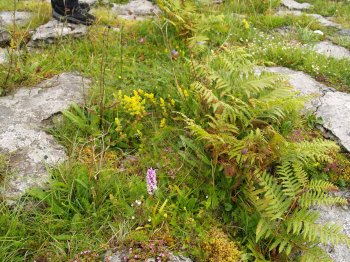
Poulawack Cairn is a large multiple cist (burial) cairn set up on the limestone pavement of the Burren and a haven of wild flowers. It probably dates from the early bronze age and this archaeological site might be over 3000 years old. The cairn, covering several cist graves, stands on a hill top on the limestone outcrops of the Burren.
Poulawack Cairn is a late Neolithic-early Bronze Age cairn dating from 3400 BC, four burials of this date and nine others from a thousand years later ~ 2400 BC. The multiple cist (stone line grave) cairn is 70 feet in diameter and 8 feet high. It is 70 feet in diameter and on excavation an inner dry stone walled area was found to contain several stone lined or cavity burials (cists). Some had been created and artefacts found included a scraper, a boar's tusk, a shell and bronze age pottery.
Near Poulawack cairn some fine zig-zag dry stone walling of small limestone slabs and some mini-portal dolmen tombs by 20th-21st century admirers of the local archaeology! Poulawack Cairn overview and setting Poulawack Cairn is a prehistoric round cairn on a limestone rise in the Burren, County Clare, first scientifically excavated by the Third Harvard Archaeological Mission under Hugh O’Neill Hencken in 1934. Structure and architectural detailsThe monument is a quarried limestone cairn about 21 m in diameter and roughly 2.4–2.5 m high at present; the cairn originally contained internal dry‑stone architecture including a surrounding kerb and an internal ring wall that defined burial deposits and cists. Excavation history and radiocarbon chronologyHencken's 1934 excavation revealed multiple internal cists and interments; later radiocarbon dating of samples from the cemetery indicates three main phases of activity: a mid‑fourth millennium BC phase (early Neolithic), a secondary phase in the earlier part of the second millennium BC (Bronze Age), and a further episode about a century after that Bronze Age phase. Phases of burial and burial practiceExcavation demonstrated that the cairn was used repeatedly rather than in a single episode. Internally there are several cists and burial deposits placed at different heights and positions within the cairn, reflecting at least three broad phases of use from the Neolithic into the Bronze Age; later reworking and re‑interment of bones also occurred during the monument's long use. Human remains, cremation, and grave goodsThe excavators recorded multiple individuals (the 1934 report describes around a dozen to a few dozen in the cemetery context, with specific counts varying by cist), with evidence for inhumations within cists and later Bronze Age burials; cremated material and infant burials were identified in later phases, and ancient DNA work has since been undertaken on some of the human bone from the site. Associated finds were modest and typical of Irish cairn cemeteries: worked stone and flint fragments, pottery sherds, and occasional small personal items placed with burials rather than rich assemblages. Interpretation and significancePoulawack is interpreted as a long‑lived community cemetery where emplacement of discrete cists and repeated burial episodes reflect changing funerary practices from early Neolithic communal use through episodic Bronze Age re‑use; its well‑recorded stratigraphy and subsequent radiocarbon programme have made it an important sequence for understanding prehistoric burial continuity and change in the Burren. previous Irish site <=> next Irish site history archaeology pictures of historical and prehistoric Irish archaeological sites from the megalithic Neolithic, bronze age or iron age historic sites from antiquity we find on holiday in Ireland images pictures photos © Phil Brown docspics famous archaeological sites history holiday tours of historic and archaeological sites of Europe archaeology holiday trips to Eastern Europe Greece Mediterranean Middle East Egypt Italy history famous ruins docspics images photos of Caherconnell Poulawack Cairn, Burren, Co. Clare, Ireland in Ireland © Phil Brown Tourist information on Caherconnell Poulawack Cairn, Burren, Co. Clare, Ireland, top tourist attractions near Caherconnell Poulawack Cairn, Burren, Co. Clare, Ireland Things to do near Caherconnell Poulawack Cairn, Burren, Co. Clare, Ireland, What to see near Caherconnell Poulawack Cairn, Burren, Co. Clare, Ireland, Walks near Caherconnell Poulawack Cairn, Burren, Co. Clare, Ireland, weekend breaks near Caherconnell Poulawack Cairn, Burren, Co. Clare, Ireland family holidays near Caherconnell Poulawack Cairn, Burren, Co. Clare, Ireland, Top tourist attractions near Caherconnell Poulawack Cairn, Burren, Co. Clare, Ireland, luxury hotels near Caherconnell Poulawack Cairn, Burren, Co. Clare, Ireland, self-catering holiday cottages near Caherconnell Poulawack Cairn, Burren, Co. Clare, Ireland, B&B near Caherconnell Poulawack Cairn, Burren, Co. Clare, Ireland, friendly pubs near Caherconnell Poulawack Cairn, Burren, Co. Clare, Ireland, cafes near Caherconnell Poulawack Cairn, Burren, Co. Clare, Ireland, eating out in fine restaurants near Caherconnell Poulawack Cairn, Burren, Co. Clare, Ireland, bargain holiday breaks near Caherconnell Poulawack Cairn, Burren, Co. Clare, Ireland, wining & dining weekends near Caherconnell Poulawack Cairn, Burren, Co. Clare, Ireland, touring coach tours including Caherconnell Poulawack Cairn, Burren, Co. Clare, Ireland, pretty villages near Caherconnell Poulawack Cairn, Burren, Co. Clare, Ireland, historic towns near Caherconnell Poulawack Cairn, Burren, Co. Clare, Ireland, visiting museums near Caherconnell Poulawack Cairn, Burren, Co. Clare, Ireland, local art galleries near Caherconnell Poulawack Cairn, Burren, Co. Clare, Ireland, guided walks from Caherconnell Poulawack Cairn, Burren, Co. Clare, Ireland, history of Caherconnell Poulawack Cairn, Burren, Co. Clare, Ireland, architecture of Caherconnell Poulawack Cairn, Burren, Co. Clare, Ireland trains to Caherconnell Poulawack Cairn, Burren, Co. Clare, Ireland buses to Caherconnell Poulawack Cairn, Burren, Co. Clare, Ireland coach tours to Caherconnell Poulawack Cairn, Burren, Co. Clare, Ireland historic houses near Caherconnell Poulawack Cairn, Burren, Co. Clare, Ireland historic churches near Caherconnell Poulawack Cairn, Burren, Co. Clare, Ireland historic buildings near Caherconnell Poulawack Cairn, Burren, Co. Clare, Ireland |




|
 Enter
anything of interest!
Enter
anything of interest!
|


