|
We Dig Archaeology
Ireland 8. Newgrange, Co.
Meath
We Dig
Archaeology Index
[Author
and photographer
©
Dr Phil Brown PhD
plus help from AI these days, page updated
May 15th 2026]
Email:
chem55555@hotmail.com
*
 *
*

Ireland 8. Newgrange, Co.
Meath
See also Knowth
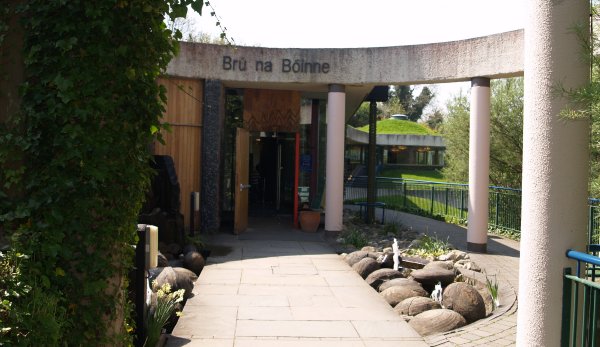
Newgrange archaeological site: The Brú na Bóinne visitor centre for the
prehistoric monuments at Newgrange, Knowth and Dowth in the valley of
the River Boyne, north of Dublin and 8km west of Drogheda, County Meath, Ireland.
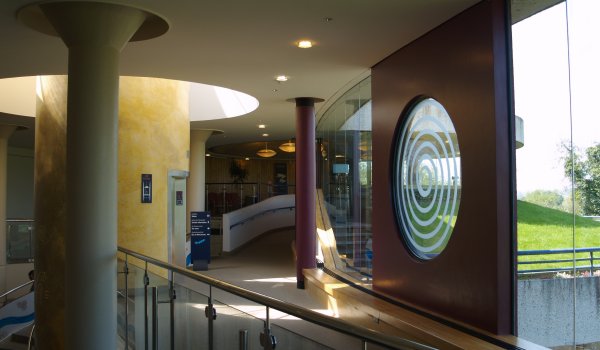
Newgrange archaeological site: Access to the various display areas is easy.

Newgrange archaeological site: The cafe!

Newgrange archaeological site: The Newgrange monument can be seen on the
distant hill above the River Boyne from the visitor centre.

From the Newgrange visitor centre you cross
the River Boyne on a footbridge to get the bus to this famous
archaeological site.

Newgrange archaeological site: The archaeological site of Newgrange is one
of the finest tombs in Europe known as a passage grave and was
constructed ~3000 BC (so it is now ~5000 years old and predates the
pyramids!). Your first impression of the white-stoned
facade of the Newgrange mound and some of the standing stones that seem
to guard the entrance to the passage tomb complex.
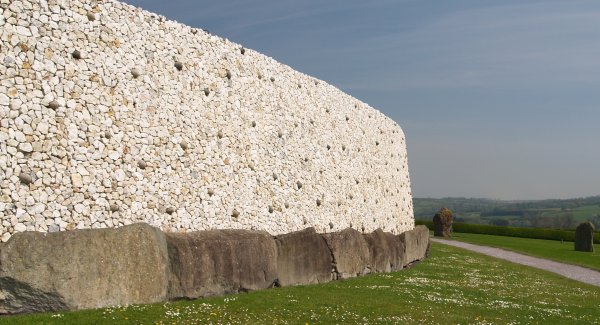
Newgrange archaeological site: The white quartz stones of the facade and
some of the 97 massive surrounding dark
kerb stones of Newgrange.

Newgrange archaeological site: The white quartz stones are mixed in
with rounded darker stones from the River Boyne.

Newgrange archaeological site: On the far left side of the white-stoned
facade is a large 'conglomerate'? standing stone. Many of these massive
standing stones and the kerb stones do not occur locally and have been
transported, by considerable effort, over quite long distances. There
are 12 giant standing stones left surrounding the tomb complex. There
are no 'satellite' smaller passage tombs associated with the mound at
Newgrange like
you get at Knowth.

Newgrange archaeological site: The 'walk-in' entrance to Newgrange and the lintel stone
'guarding'
the passage and above it the false lintel through which the Sun's rays
shine at the rising of the Winter Solstice Sun. This roof box was only
discovered in 1963. At the end of the passage is a cruciform arrangement
of chambers and the winter solstice sunlight shines onto the very back
wall in line with the entrance passage to the tombs. In the chambers
were found great carved stone bowls containing the cremated remains of
several individuals.

Newgrange archaeological site: The magnificently carved stone in front of the
entrance to Newgrange - it must be one of the most photographed
decoratively carved stones
in the Ireland, and no wonder!

Newgrange archaeological site: The higher false lintel stone is also quite
richly carved with a symmetrical pattern.

Newgrange archaeological site: The full symmetrical view of the Newgrange
entrance, the white-stoned facade and the standing stones arranged in
front of this magnificently restored tumulus.

Newgrange archaeological site: Some of the kerb stones are carved with
spirals and simple geometrical patterns of squares.
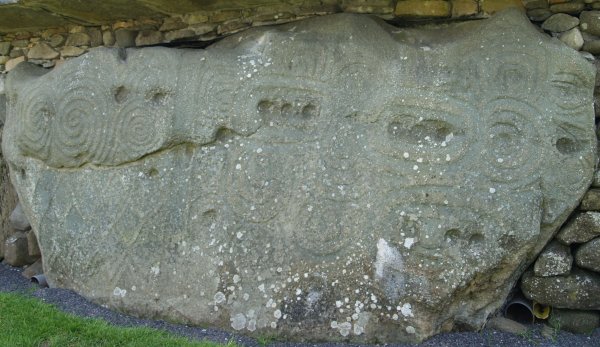
Newgrange archaeological site: The meaning of the carvings remains a
mystery!


Newgrange archaeological site: The largest standing stone associated with
the monument is on the far side of the mound from the white quartz stone
facade where the entrance is.

Newgrange archaeological site:


Goodbye Newgrange megalithic tomb complex and back to the bus to head
for the tombs of Knowth!
A detailed overview of Newgrange
- Location: Brú na Bóinne complex, valley of the
River Boyne, County Meath, Ireland.
- Site type: Large Neolithic passage tomb within
a broader ritual landscape that includes Knowth and Dowth.
- Date: Built in the early Neolithic;
conventionally dated to c. 3200 BCE (one of the earliest large-scale
monumental tombs in Atlantic Europe).
- Function (archaeological summary): A
multifunctional monument combining funerary deposition,
ancestral/lineage commemoration, ceremonial gathering, and
cosmically aligned performance (seasonal/solar ritual).
Chronology and Phasing
- Primary construction phase: Single major mound
and passage-chamber constructed in the early Neolithic; core
timber/earth/stone work represents an intentionally planned, large
communal project.
- Secondary modifications: Recutting and
reworking of kerbstones and facade; insertion of the distinctive
entrance roof-box may represent an early planned feature or a
slightly later elaboration connected to solar alignment.
- Use-life: Recurrent access and ritual use
across centuries; evidence for episodic re-deposition of human
remains and curated grave assemblages rather than continuous
inhumation use.
- Later activity: Bronze Age and historic-period
disturbance limited but present (small-scale reuse, ploughing,
antiquarian intervention).
Architecture, Materials and Building Techniques
- Mound and core: An earthen mound built over a
constructed stone cairn and passage; large volume of dumped earth
and sub-surface packing.
- Kerb and structural containment: Ring of large
kerbstones (many decorated) forming a structural retaining ring;
kerb function both practical (stabilise mound) and symbolic
(circumscribe sacred space).
- Passage and chamber: A long, axial passage
(approx. 15–20 m) leading to a cruciform chamber with side recesses;
corbelled dry-stone roofing produces a high, sealed chamber
interior.
- Entrance arrangement: Orthostatic portal stones
with a precisely cut entrance and a narrow roof-box or light-box
above the lintel that directs seasonal sunlight into the chamber.
- Stone sourcing & material palette: Local and
regional stone choices (large sarsens/orthostats; white quartz/silicified
stones used at the base/facade for visual impact); packing stones
and cairn rubble constructed from locally available material.
- Engineering highlights: Sophisticated
corbelling to create a long-lasting roof; drainage considerations
within the passage; deliberate selection and placement of orthostats
for load distribution.
Finds, Human Remains, and Bioarchaeology
- Human remains: Predominantly cremated bone
fragments and secondary deposits indicating selective deposition of
human remains rather than primary full-body inhumation; several
individuals represented in curated assemblages.
- Grave goods & portable finds: Fragments of
decorated bone, polished stone tools, flint blades, and a small
range of personal/ceremonial objects consistent with Neolithic
mortuary contexts.
- Burial practice interpretation: Ritualised
excarnation, cremation, curation and selective internment; tomb
functions as an ancestral repository for particular lineages or
elites rather than a community cemetery.
- Isotopes and aDNA (summary of implications):
Biogeochemical and genetic studies (where available) indicate
complex kinship patterns and mobility; evidence from related Brú na
Bóinne contexts suggests both local continuity and limited
exogamy—interpretation points to structured social groups with
ritualized descent claims.
- Mortuary demographics: Small number of
high-status internments contrasted with repeated symbolic deposits;
demographic inferences limited by cremation fragmentation and
recovery biases.
Megalithic Art, Symbolism and Astronomical Alignment
- Rock art repertoire: Deeply incised motifs on
kerbstones and portal stones—spirals, concentric circles, chevrons,
lozenges, and curvilinear decoration.
- Articulation and placement: Art concentrated on
kerbstones and portal orthostats where they would be visible at the
point of approach and entry; designs vary in density and complexity
across stones.
- Interpretive frameworks: Likely mnemonic,
cosmological, or ritual symbols: possible representations of
solar/lunar cycles, water/river-motif metaphors, life-death-rebirth
schemata, or markers of identity/lineage.
- Astronomical alignment: Entrance roof-box
admits direct sunlight to the chamber around midwinter (winter
solstice), producing a short, controlled illumination of the inner
recesses; alignment implies planned solar/seasonal ritual, likely
tied to concepts of rebirth and renewal and timed ceremonial access.
- Performance context: Passage illumination and
stone art together create a choreographed sensory experience for
participants and initiates.
Excavation, Conservation, and Interpretation History
- Key excavations: Major investigations in the
20th century established structural plans, recovered material
culture, and documented the solstitial alignment; antiquarian
activity pre-dates systematic excavation and caused some
disturbance.
- Restoration and controversies: Mid-20th-century
restoration reconstructed the facade and replaced a substantial
visible kerb and facade using quarried white quartz and
reconstructed roofing; some debate persists about the degree to
which the present visible appearance reflects the original Neolithic
exterior.
- Conservation practice: Active site management
balances public access (guided solstice events, tours) with
preservation (controlled lighting, environmental monitoring,
visitor-number controls).
- Public archaeology & interpretation: The site
is central to Irish national heritage narratives and presents
challenges in mediating spectacular solstice events with long-term
conservation.
Research Gaps and Current Questions
- Construction sequence detail: More fine-grained
stratigraphic, micromorphological and dating work could refine the
sequencing of mound build, facade installation, and use-phase
events.
- Social organization: How labour, organization
and resource mobilization were structured for monument building;
relationship between monument builders and contemporary settlement
patterns.
- Ritual practice specifics: The precise nature
of recurring rituals—who had access, how often, and what rites were
performed—remains interpretive rather than demonstrably
reconstructed.
- Art meanings: Decoding motif semantics remains
speculative; comparative motif analysis across the Boyne complex
could clarify regional symbolic dialects.
- Full bioarchaeological profile: Comprehensive
aDNA, isotopic and proteomic sampling of cremated remains could
yield better resolution on kinship, diet, and mobility;
methodological development for cremation sampling is a priority.
- Landscape integration: Further
geoarchaeological and palaeoenvironmental work to understand the
monument’s visual and hydrological relationship to the Boyne and
adjacent ritual sites.
Practical notes for researchers and teachers
- Primary data caution: Cremation and restoration
bias recovery—treat demographic and use-life claims cautiously.
- Teaching focus: Use Newgrange to illustrate
early monumentality, integrated ritual-astronomical planning, and
the interpretive interplay between material evidence and myth.
- Comparative potential: Compare construction
technology and art with contemporary passage-tomb traditions in
western Britain and Atlantic Europe for regional interaction
perspectives.
See also Knowth
previous Irish site
<==>
next Irish site - KNOWTH
We Dig
Archaeology Index
history archaeology pictures
of historical and
prehistoric Irish archaeological sites from the megalithic Neolithic, bronze
age or iron age historic sites from antiquity we find on holiday in
Ireland images pictures photos © Phil Brown docspics famous
archaeological sites history holiday tours of historic and
archaeological sites of Europe archaeology holiday trips to Eastern
Europe Greece Mediterranean Middle East Egypt Italy history famous ruins
Aspects of archaeology and history on the North York Moors
How does radio-carbon
dating work? |