SEARCH Doc's Pic's picture pages
|
Ireland 6. The Poulnabrone Dolmen, County, Clare, Ireland We Dig Archaeology in Ireland
We Dig
Archaeology Index
[Author
and photographer
Email: chem55555@hotmail.com *
This prehistoric archaeological Neolithic site is on the R480 road running north to Ballyvaughan.
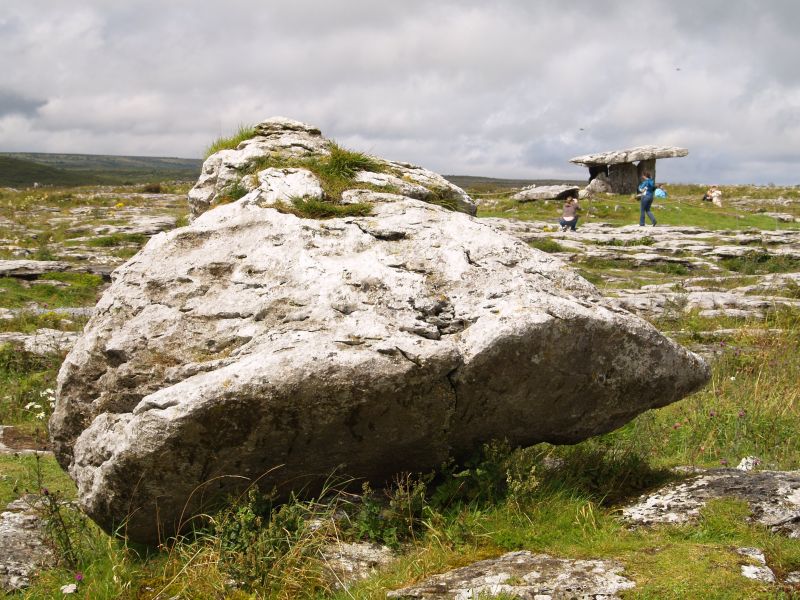
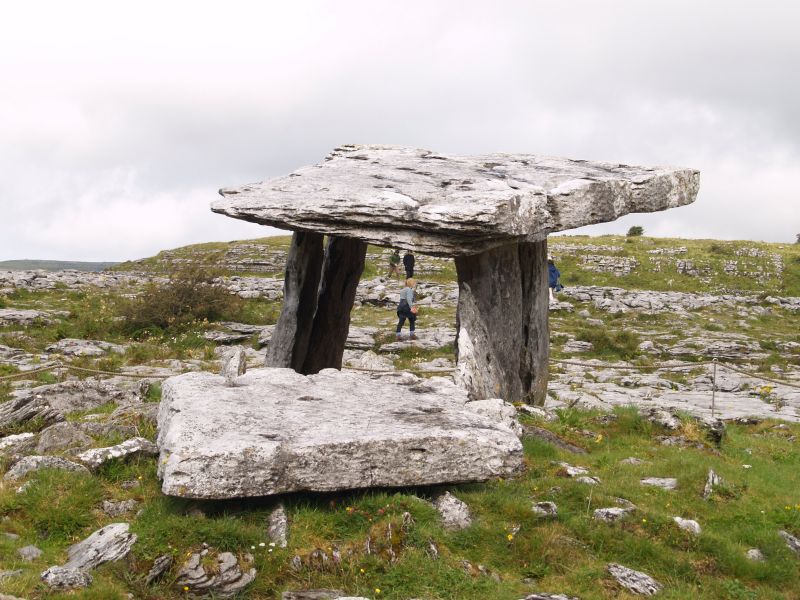
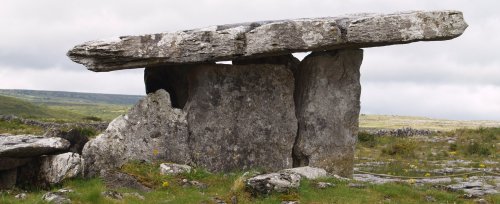
The Poulnabrone Portal Dolmen (distant top right) lies on the limestone pavement of The Burren, County Clare. The huge stone in the foreground is a glacial erratic, 'dropped' when the glacier's retreated at the end of the last ice age. Poulnabrone Dolmen, archaeological site in the Burren: Poulnabrone dolmen stands on a limestone pavement of the Burren hills and must be the most photographed archaeological site in Ireland! In the foreground is a large limestone rock left behind by the last glacier to cover the Burren! Poulnabrone Dolmen, archaeological site in the Burren: It is a Neolithic ritual-burial site dating from about 2500 BC, i.e. over 4500 years old.
The striking starkness of the Poulnabrone Dolmen, a prehistoric burial tomb. From excavations in the 1980's artefacts such as a polished stone axe, carved quartz crystals, perforated bone pendant, stone disc beads, sherds/fragments of course pottery and flint arrowheads and scrapers were found. The bones of 33 individuals were found of male and female, old and young and were probably put in the tomb around 3000 BC. Burials were radiocarbon dated to 4200 to 2900 BC (Neolithic or New Stone Age) and 1767 to 1423 BC (early Bronze Age).
Poulnabrone Dolmen, archaeological site in the Burren: The remains of about 22-28 people were found in the chamber including six children and the adults were all less than thirty in age.
Poulnabrone Dolmen, archaeological site in the Burren: A number of artefacts were also found in the graves e.g. a polished stone axe, stone disc beads, bone pendant - perforated to hang on 'string', quartz crystals and a fine bone pin.
Poulnabrone Dolmen, archaeological site in the Burren: The dolmen stands on a low circular cairn about 30 feet in diameter.
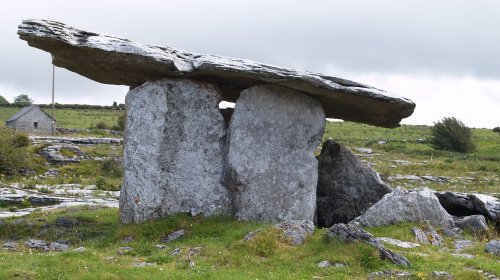
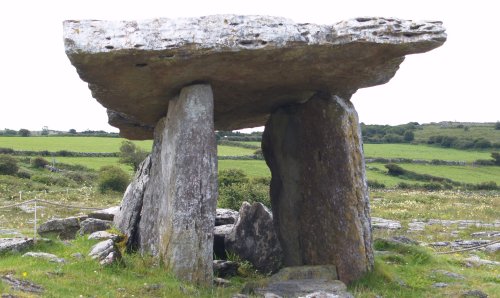
Poulnabrone Dolmen, archaeological site in the Burren: The great horizontal slab rests on four upright stones. The top capstone of this famous archaeological site weighs 1.5 tonne.
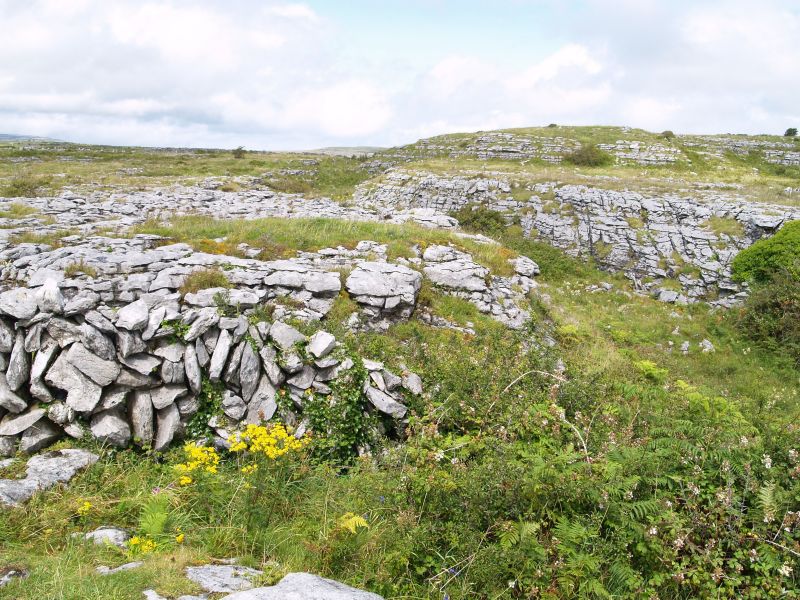
The typical seemingly barren landscape of the limestone pavements of the Burren. When the Poulnabrone tomb was constructed the landscape was very different. Open pine forests with elm and hazel were common and some areas of open grassland. Today's relatively barren terrain is mainly due to loss of top soil in prehistoric times. These early farmers would have lived in simple wooden houses living off crop cultivation like wheat and barley, domestic cattle together with fishing and hunting of fowl and wild animals. Their simple homesteads and subsistence poverty farming sharply contrasts with their elaborate and 'expensive' tomb building in terms of the physical effort and 'engineering' involved. There is much to be admired from the distant culture of our prehistoric ancestors. Unearthing prehistoric sites For example, excavations from 1986–88 found 33 human remains, both adults and children, and even a Bronze Age infant with radiocarbon dates suggesting a range from 3800–3200 BC (citation 1-3). I recall polished stone axes and pottery fragments as grave goods (citing Irish Archaeology for these). It's key I don’t misrepresent details, especially regarding cremated and unburnt remains—both have been documented. Poulnabrone Portal Tomb — overview and settingPoulnabrone is a classic Neolithic portal tomb (dolmen) set on the exposed limestone pavement of the Burren, County Clare. The visible monument today consists of two tall portal stones and a rear-stone that support a large, flat capstone; originally the stone chamber was covered by a cairn or mound of stone and soil, of which only a low spread of cairn material now survives. Structure and architectural details
Excavations and radiocarbon dating
Phases of use and burial sequence
Human remains recovered
Grave goods and associated artefacts
Interpretation and significancePoulnabrone is interpreted as a communal, ritual burial monument that functioned as a focus for Neolithic communities in the Burren landscape. Its repeated use, mixture of primary and secondary deposits, presence of both cremated and uncremated remains, and the occasional inclusion of grave goods all point to long‑lived social and ritual practices centred on collective ancestor deposition and memory in the Neolithic and with episodic re‑use into the Bronze Age. previous Irish site <=> next Irish site history archaeology pictures of historical and prehistoric Irish archaeological sites from the megalithic Neolithic, bronze age or iron age historic sites from antiquity we find on holiday in Ireland images pictures photos © Phil Brown docspics famous archaeological sites history holiday tours of historic and archaeological sites of Europe archaeology holiday trips to Eastern Europe Greece Mediterranean Middle East Egypt Italy history famous ruins docspics images photos of Poulnabrone Dolmen, Co. Clare, Ireland in Ireland © Phil Brown Tourist information on Poulnabrone Dolmen, Co. Clare, Ireland, top tourist attractions near Poulnabrone Dolmen, Co. Clare, Ireland Things to do near Poulnabrone Dolmen, Co. Clare, Ireland, What to see near Poulnabrone Dolmen, Co. Clare, Ireland, Walks near Poulnabrone Dolmen, Co. Clare, Ireland, weekend breaks near Poulnabrone Dolmen, Co. Clare, Ireland family holidays near Poulnabrone Dolmen, Co. Clare, Ireland, Top tourist attractions near Poulnabrone Dolmen, Co. Clare, Ireland, luxury hotels near Poulnabrone Dolmen, Co. Clare, Ireland, self-catering holiday cottages near Poulnabrone Dolmen, Co. Clare, Ireland, B&B near Poulnabrone Dolmen, Co. Clare, Ireland, friendly pubs near Poulnabrone Dolmen, Co. Clare, Ireland, cafes near Poulnabrone Dolmen, Co. Clare, Ireland, eating out in fine restaurants near Poulnabrone Dolmen, Co. Clare, Ireland, bargain holiday breaks near Poulnabrone Dolmen, Co. Clare, Ireland, wining & dining weekends near Poulnabrone Dolmen, Co. Clare, Ireland, touring coach tours including Poulnabrone Dolmen, Co. Clare, Ireland, pretty villages near Poulnabrone Dolmen, Co. Clare, Ireland, historic towns near Poulnabrone Dolmen, Co. Clare, Ireland, visiting museums near Poulnabrone Dolmen, Co. Clare, Ireland, local art galleries near Poulnabrone Dolmen, Co. Clare, Ireland, guided walks from Poulnabrone Dolmen, Co. Clare, Ireland, history of Poulnabrone Dolmen, Co. Clare, Ireland, architecture of Poulnabrone Dolmen, Co. Clare, Ireland trains to Poulnabrone Dolmen, Co. Clare, Ireland buses to Poulnabrone Dolmen, Co. Clare, Ireland coach tours to Poulnabrone Dolmen, Co. Clare, Ireland historic houses near Poulnabrone Dolmen, Co. Clare, Ireland historic churches near Poulnabrone Dolmen, Co. Clare, Ireland historic buildings near Poulnabrone Dolmen, Co. Clare, Ireland |





|
 Enter
anything!
Enter
anything!
|


