aromatic isomers of C8H10 

Advanced level organic chemistry PART 14.7: Selected benzene ring isomers of molecular formula C8H10

HOME PAGE * SEARCH * GCSE Level Chemistry students aged ~14-16 * Advanced Level Chemistry age ~16-19

Doc Brown's Advanced Chemistry: Part 14.7 Isomers of a given molecular formula

Selected constitutional-structural carbon chain isomers of molecular formula C8H10 (with a benzene ring)

[Author ©  Dr Phil Brown PhD: Doc Brown's advanced level organic chemistry exam revision notes suitable for students of UK advanced level chemistry courses, IB advanced chemistry & US K12 grades 11-12 and AP honors chemistry courses: Molecular spectroscopy and analysing the isomers of C8H10 [page updated Mar 1st 2026 *]

 email doc brown - comments - query? * [privacy policy, cookies and disclaimer]

 Associated organic chemistry page links

 Index of sets of isomers for a given molecular formula

 This is a big chemistry website, please allow time to explore it


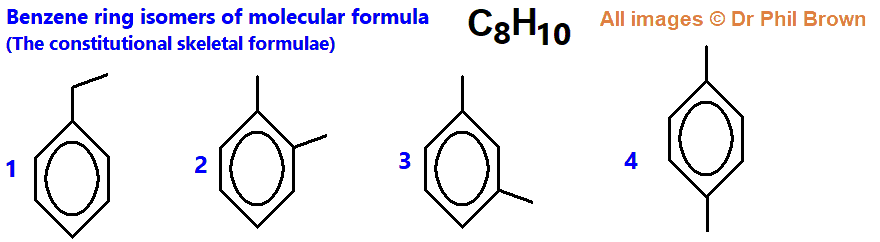
The aromatic constitutional-structural isomers of molecular formula C8H10 (Mr = 106)

Introduction to isomerism for aromatic compounds of molecular formula C8H10  (see also summary diagram)

4 structural skeletal formula of C8H10 isomers with benzene ring aromatic compound derivatives of molecular formula C8H10 arenes with benzene ring aromatic hydrocarbons of C8H10 carbon chain alkyl isomers of C8H10 Doc Brown's Chemistry

Percent composition of C8H10 based on atomic masses C= 12.01  H = 1.01  and  Mr(C8H10) = 106.18

Element composition of C8H10 aromatic molecules: carbon = 90.49%     hydrogen = 9.51%

Empirical formula  = C4H5 for molecular formula C8H10 of these aromatic molecules

Structural isomerism includes carbon chain variation (usually need a minimum of 4 C atoms), change in position of a substituent or functional group and functional group isomerism where the atoms have a different configuration, usually with significant differences in chemical and physical properties.

The aromatic isomerism of C8H10 described here is based on different carbon chain arrangements, which, overlaps with the different positions of the alkyl groups when there is more than one alkyl substituent in the C8H10 molecule.

Stereoisomerism is where molecules have the same basic constitutional structural formula, but isomers differ in the 2D/3D arrangement of the atoms.

E/Z stereoisomerism was called 'geometrical isomerism' e.g. cis and trans isomers of alkenes or disubstituted cyclic alkanes where there are 3D spatial variations that are not mirror images and not super imposable.

Not applicable to the aromatic isomers of C8H10 described here.

R/S stereoisomerism was called 'optical isomerism', the pairs of isomers are called enantiomers which are 3D non-superimposable mirror image forms of the molecule. The molecule must have a chiral centre (a stereocentre), that is an asymmetric carbon atom with four different atoms/groups attached to it.

Not applicable to the aromatic isomers of C8H10 described here.


Details of the 4 selected structural-constitutional isomers of the benzene ring C8H10 aromatic molecules

These 4 C8H10 isomers are primarily considered as aromatic molecules - aromatic hydrocarbons called arenes.

(1) ethylbenzene, ethylbenzene aromatic condensed structural formula isomer of formula C8H10 , ethylbenzene aromatic skeletal formula isomer of formula C8H10

and then three further carbon chain isomers of dimethybenzene.

Number of low resolution NMR chemical shift δ signal peaks: 5 1H and 6 13C (email if disagree?)

1H NMR ratio of peaks: 1 : 2 : 2 : 2 : 3 (for equivalent protons)


(2) 1,2-dimethylbenzene,  1,2-dimethylbenzene aromatic condensed structural formula isomer of formula C8H10 , 1,2-dimethylbenzene aromatic skeletal formula isomer of formula C8H10 , o-xylene

Number of low resolution NMR chemical shift δ signal peaks: 3 1H and 4 13C (email if disagree?)

1H NMR ratio of peaks: 4 : 4 : 6 (for equivalent protons)


(3) 1,3-dimethylbenzene, 1,3-dimethylbenzene aromatic condensed structural formula isomer of formula C8H10 , 1,3-dimethylbenzene aromatic skeletal formula isomer of formula C8H10 , m-xylene

Number of low resolution NMR chemical shift δ signal peaks: 4 1H and 5 13C (email if disagree?)

1H NMR ratio of peaks: 1 : 2 : 6 : 1 (for equivalent protons)


(4) 1,4-dimethylbenzene, 1,4-dimethylbenzene aromatic condensed structural formula isomer of formula C8H10 , aromatic skeletal formula isomer of formula C8H10 , p-xylene, a very symmetrical molecule, reduced chemical shifts

Number of low resolution NMR chemical shift δ signal peaks: 2 1H and 3 13C (email if disagree?)

1H NMR ratio of peaks: 4 : 6 (for equivalent protons)


Spectra can be used to distinguish between the aromatic isomers of C8H10

The infrared spectrum of ethylbenzene

The infrared spectrum of 1,2-dimethylbenzene

The infrared spectrum of 1,3-dimethylbenzene

The infrared spectrum of 1,4-dimethylbenzene

The mass spectrum of ethylbenzene

The mass spectrum of 1,2-dimethylbenzene

The mass spectrum of 1,3-dimethylbenzene

The mass spectrum of 1,4-dimethylbenzene

The H-1 NMR spectrum of ethylbenzene

The H-1 NMR spectrum of 1,2-dimethylbenzene

The H-1 NMR spectrum of 1,3-dimethylbenzene

The H-1 NMR spectrum of 1,4-dimethylbenzene

The C-13 NMR spectrum of ethylbenzene

The C-13 NMR spectrum of 1,2-dimethylbenzene

The C-13 NMR spectrum of 1,3-dimethylbenzene

The C-13 NMR spectrum of 1,4-dimethylbenzene


Other non-aromatic isomers of C8H10 (i.e. C8H10 isomers with no benzene ring)

There are potentially hundreds of other 'non-aromatic' isomers of formula C8H10, though many of these isomers are highly reactive and very unstable and some may not exist at all (except theoretically!).

Gopalpur Nagendrappa of Bangalore University, India has come up with 217 theoretical isomers of C6H6 at  https://www.ias.ac.in/article/fulltext/reso/006/05/0074-0078 wow !!!!, so goodness knows how many theoretical isomers there are of formula C8H10.

See also at the commercial molport website for isomers of C8H10

https://www.molport.com/shop/molecular-formula/C8H10

BUT, beware, the website uses Kekule formulae for benzene ring compounds and mixes condensed structural formulae with skeletal formulae, so take care when interpreting these C8H10 isomer formulae.


EXTRA NOTES on the uses and applications of these four isomers of C8H10

Structural Overview

Isomer

Common Name

Structure Description

1,2-Dimethylbenzene

o-Xylene

Methyl groups adjacent (ortho position)

1,3-Dimethylbenzene

m-Xylene

Methyl groups separated by one carbon

1,4-Dimethylbenzene

p-Xylene

Methyl groups opposite each other (para)

Ethylbenzene

Ethylbenzene

One ethyl group attached to benzene


Physical & Chemical Properties

  • Boiling Points: All are close (~138–145°C), but ethylbenzene is slightly higher due to the ethyl group.

  • Solubility: All are sparingly soluble in water but highly soluble in organic solvents.

  • Reactivity: Methyl groups activate the ring toward electrophilic substitution; ethylbenzene is slightly less reactive.


Industrial Applications

1. p-Xylene (1,4-dimethylbenzene)

  • Primary use: Precursor to terephthalic acid, essential for PET plastics and polyester fibers.

  • Dominates global xylene demand due to its role in polymer production.

  • Highly purified p-xylene is critical for high-performance polymers.

2. Ethylbenzene

  • Main use: Production of styrene, which is polymerized into polystyrene.

  • Accounts for ~50% of benzene consumption globally.

  • Also used in solvent blends and fuel additives.

3. o-Xylene (1,2-dimethylbenzene)

  • Used to make: Phthalic anhydride, a precursor for plasticizers, resins, and dyes.

  • Also used in solvent formulations and fuel blending.

  • Its boiling point and polarity make it suitable for specialty solvent systems.

4. m-Xylene (1,3-dimethylbenzene)

  • Less industrially prominent than p- and o-xylene.

  • Used in solvent mixtures, adhesives, and chemical intermediates.

  • Sometimes used in isomer separation studies due to its unique symmetry.


Comparative Summary

Isomer

Key Use

Industrial Importance

Notes

p-Xylene

PET & polyester production

Very high

Most economically valuable xylene

Ethylbenzene

Styrene → Polystyrene

Very high

Major benzene derivative

o-Xylene

Phthalic anhydride

Moderate

Used in plasticizers and dyes

m-Xylene

Solvents, adhesives

Low to moderate

Least used industrially


Educational & Analytical Relevance

  • These isomers are excellent case studies in spectroscopy:

    • ¹H NMR: Distinct splitting patterns due to symmetry differences.

    • IR: Similar aromatic C–H stretches, but methyl/ethyl shifts vary.

    • Mass spectrometry: All show M⁺ at m/z 106, but fragmentation differs.

  • Useful in exam questions on isomerism, electrophilic substitution, and industrial chemistry.


Learning objectives - questions to be answered?

What are the structural-constitutional isomers of C8H10?

What arene isomers with a benzene ring have the formula C8H10?

Draw and name the alkylbenzene isomers of C8H10

What aromatic hydrocarbons have the formula C8H10?

What benzene ring molecules have the formula C8H10?

Can you write out the names of the aromatic isomers of formula C8H10?

What are the possible isomers of C8H10 aromatic molecules?

How do you work out the structure of the isomers of molecular formula C8H10 aromatic molecules?

How do you draw the structural formula and skeletal formula of the isomers of molecular formula C8H10 aromatic molecules?

How do you name the isomers of molecular formula C8H10 aromatic molecules?

How many structural isomers are there of molecular formula C8H10 aromatic molecules?

How many carbon chain isomers are there of molecular formula C8H10 aromatic molecules?

How many positional isomers are there of molecular formula C8H10 aromatic molecules?

Are there any functional group isomers with a molecular formula C8H10 aromatic molecules?

Do C8H10 aromatic molecules have any stereoisomers?

Are there any E/Z (geometrical) aromatic isomers with a molecular formula C8H10?

Are there any R/S (optical) aromatic isomers (enantiomers) with a molecular formula C8H10?

This page will answer these questions for molecular formula C8H10 aromatic molecules


Associated organic chemistry links

 Advanced Level pre-university organic chemistry notes

 IR, mass and H-1 & C-13 NMR spectra of organic compounds

See also Examples of the effects of isomerism on the similarity or difference in the physical and chemical properties of structural isomers

Index of sets of isomers for a given molecular formula

The molecular structure & Naming of AROMATIC Compounds, including isomers

INDEX of ALL revision notes on the chemistry of AROMATIC COMPOUNDS

Isomerism: introduction, structural isomerism - chain, positional, functional group, tautomerism

Stereoisomerism: introduction, definition, priority rules, E/Z isomerism (cis/trans isomerism)

Stereoisomerism - R/S isomerism (optical isomerism) - definition - examples explained

 This is a big chemistry website, please allow time to explore it


Summary diagram of types of isomerism (pre-university)

index for all isomerism pages

Website content © Dr Phil Brown 2000+. All copyrights reserved on revision notes, images, quizzes, worksheets etc. Copying of Doc Brown's pre-university advanced level chemistry website material is NOT permitted. Exam revision summaries & references to science course specifications are unofficial. These organic chemistry revision notes on isomerism are suitable for use of pre-university students studying AQA advanced level chemistry constitutional isomers of C8H10, Edexcel advanced level chemistry constitutional isomers of C8H10, OCR advanced level chemistry constitutional isomers of C8H10, IB advanced level chemistry constitutional isomers of C8H10, WJEC (Eduqas) advanced level chemistry constitutional isomers of C8H10, CIE Cambridge advanced level chemistry constitutional isomers of C8H10, US grade 11-12 AP honors chemistry courses  constitutional isomers of C8H10 and they will also prove useful to 1st year undergraduate students of chemistry including  constitutional isomers of C8H10.

Keywords or phrases: how many isomers are there of molecular formula C8H10 aromatic molecules? how do you name the isomers of molecular formula C8H10 aromatic molecules? what is the molecular structure of the isomers of C8H10 aromatic molecules, what type of isomerism is exhibited by molecules of formula C8H10 aromatic molecules, the carbon chain isomers of C8H10 aromatic molecules, comparing the spectra of isomers of molecular formula C8H10 aromatic molecules how many structural isomers of C8H10 aromatic molecules can you draw? how many structural isomers does C8H10 aromatic molecules have? what are the possible isomers of C8H10 aromatic molecules? revision notes on isomerism of C8H10 aromatic molecules the molecular structure of the isomers of C8H10 aromatic molecules how to draw the structural formula of isomers of C8H10 aromatic molecules, how to draw the displayed formula of isomers of C8H10 aromatic molecules, how to draw the skeletal formula of isomers of C8H10 aromatic molecules, how to name the isomers of molecular formula C8H10 aromatic molecules, R/S optical isomers enantiomers of C8H10 aromatic molecules cycloalkenes and alkynes R/S optical isomers cis trans stereoisomers of C8H10 aromatic molecules E/Z geometrical isomers of molecular formula C8H10 aromatic molecules (geometric cis/trans isomers), molecules isomeric with molecular formula C8H10 aromatic molecules, structural isomers of molecular formula C8H10 aromatic molecules, which types of isomerism are exhibited by molecules isomeric with molecular formula C8H10 aromatic molecules alkyl positional isomers of C8H10 aromatic molecules branched carbon chain alkene isomers of C8H10 aromatic molecules, positional isomers isomeric with molecular formula C8H10 aromatic molecules, which types of isomerism are exhibited by molecules isomeric with molecular formula C8H10 aromatic molecules alkyl positional isomers of C8H10 aromatic molecules cycloalkenes and alkynes branched carbon chain cycloalkene isomers of molecular formula C8H10 aromatic molecules arenes of formula C8H10 aromatic hydrocarbons of formula C8H10 alkylbenzenes of formula C8H10

TOP OF PAGE