|
Doc Brown's
Advanced Chemistry: Part 14.7
Isomers of a given molecular formula
Carboxylic
acid and ester constitutional structural chain isomers of molecular formula
C7H14O2 (plus some other examples !!!)
[Author
©
Dr
Phil Brown GRIC, PhD:
Doc Brown's advanced level organic chemistry exam revision notes
suitable for students of UK advanced level chemistry courses, IB advanced
chemistry & US K12 grades
11-12 and AP honors chemistry courses: Molecular
spectroscopy and analysing the isomers of C7H14O2
[page updated
RE-EDIT]
email doc
brown - comments - query?
*
[privacy policy, cookies
and disclaimer]
Associated organic chemistry page links
Index of sets of isomers for a given
molecular formula
This is a big chemistry website, please allow time
to explore it
Sub-index
for this page on the isomerism of molecular formula C7H14O2
(a)
Introduction to the isomerism of C7H14O2
(b)
Examples of carboxylic
acids of
C7H14O2
(c)
Examples of esters of
C7H14O2
(d)
Examples of
aldehydes, ketones and 'ene-diols' of formula
C7H14O2
(e)
Examples of alicyclic of formula
C7H14O2
(f)
Examples of heterocyclic compounds of formula
C7H14O2
(g)
A comparison of the diagnostic wavenumbers for the infrared
spectra of selected isomers of
C7H14O2
(h)
A comparison of the uses and applications of selected isomers of
C7H14O2
los
qs
Selected aliphatic
carboxylic acid, esters and other structural isomers of molecular formula
C7H14O2
(Mr = 130)
(a) Introduction to the
isomerism and selected isomers of molecular formula C7H14O2
Composition of
C7H14O2
Percent mass composition of
C7H14O2 based on
the relative atomic masses
C= 12.01 H =
1.01 O = 16.00 and Mr(C7H14O2) =
130.21
Element composition of
C7H14O2 by mass:
64.56% carbon * 10.86%
hydrogen * 24.58% oxygen
Empirical formula = molecular formula =
C7H14O2
Please
note there are a very large number of isomers of molecular formula C7H14O2
and this page presents a selection of them, and, where appropriate,
indicates the type of isomerism involved.
I have chosen examples of isomers
that pre-university students are most likely to come across, and that is usually
carboxylic acids and esters.
Structural isomerism
- isomers based on different connectivity's of the constituent atoms, so
cannot be spatially identical (but can be defined as having the same shape).
This includes (a)
carbon chain variation (usually need a minimum of 4 atoms),
(b) change in position of a substituent or functional group and
(c) functional group
isomerism where the atoms have a different connectivity configuration, usually with
significant differences in chemical and physical properties e.g.
(a) The chain variation is between e.g.
C-C-C-C-C-C-C and C-C-C-C-O-C-C-C as well as carbon chain
branching.
(b) There is positional variation e.g. the
hydroxy substituent in the aldehydes.
(c) There are lots of examples of functional
group isomerism e.g. carboxylic acids, esters,
hydroxy-aldehydes, hydroxy-ketones, alkene-alcohols
(unsaturated 'enols')
Stereoisomerism - isomers
based on the same connectivity of the atoms (same constitutional formula), but
in some way, they are 2D or 3D spatially different non-superimposable images (e.g. E/Z
'geometrical' isomers or mirror image R/S 'optical' isomers)
This is
where molecules have the same basic constitutional structural formula, but
isomers differ in the 2D/3D arrangement of the atoms.
For stereoisomers, the (CIP) abbreviation means the
IUPAC Cahn-Ingold-Prelog priority
order rule for assigning E/Z (geometrical) and R/S (optical) stereoisomers.
E/Z
stereoisomerism was called 'geometrical isomerism' e.g. cis
and trans isomers of alkenes or disubstituted cyclic alkanes
where, due to restricted bond rotation, there are 2D/3D spatial variations that are not mirror images and not
super imposable.
Some isomers exhibit E/Z geometrical isomerism.
R/S
stereoisomerism was called 'optical isomerism', the pairs of
isomers are called enantiomers which are 3D non-superimposable
mirror image forms of the molecule (enantiomers). The molecule must have a chiral centre
(a stereocentre), that is an asymmetric carbon atom with four
different atoms/groups attached to it.
Some isomers exhibit R/S optical isomerism.
NOTE
According to
https://www.molport.com/shop/molecular-formula/C7H14O2
there are 619 isomers commercially available!
Details of selected isomers of
C7H14O2
(b) Examples of carboxylic acids of
C7H14O2
(1)
heptanoic acid,
CH3(CH2)5COOH
Linear carboxylic acid.
Number of low resolution
NMR
chemical shift
δ
signal peaks:
7 1H and
7
13C
(email
if disagree?)
1H NMR ratio of peaks: 3 : 2 : 2 : 2 : 2 : 2
: 1 (for equivalent protons)
(2)
2-methylhexanoic acid ,
 , ,

Branched carboxylic acid.
This molecule will exhibit R/S
stereoisomerism, optical isomers - enantiomers, C2 is
chiral.
Number of low resolution
NMR
chemical shift
δ
signal peaks:
7
1H and
7
13C
(email
if disagree?)
1H NMR ratio of peaks: 3 : 2 : 2
: 2 : 1 : 3 : 1 (for equivalent protons)
(3)
3-methylhexanoic acid ,
 , ,

Branched carboxylic acid.
This molecule will exhibit R/S
stereoisomerism, optical isomers - enantiomers,
C3 is chiral.
Number of low resolution
NMR
chemical shift
δ
signal peaks:
7
1H and
7
13C
(email
if disagree?)
1H NMR ratio of peaks: 3 : 2 : 2
: 1 : 3 : 2 : 1 (for equivalent protons)
(4)
4-methylhexanoic acid ,
 , ,

Branched carboxylic acid.
This molecule will exhibit R/S
stereoisomerism, optical isomers - enantiomers,
C4 is chiral.
Number of low resolution
NMR
chemical shift
δ
signal peaks:
7
1H and
7
13C
(email
if disagree?)
1H NMR ratio of peaks: 3 : 2 : 1
: 3 : 2 : 2 : 1 (for equivalent protons)
(5)
5-methylhexanoic acid ,
 , ,

Branched carboxylic acid.
Number of low resolution
NMR
chemical shift
δ
signal peaks:
6 1H and
6
13C
(email
if disagree?)
1H NMR ratio of peaks: 6
(3+3) : 1 : 2 : 2 : 2 : 1 (for equivalent protons)
(6)
2-ethylpentanoic acid ,
 , ,

Branched carboxylic acid.
This molecule will exhibit R/S
stereoisomerism, optical isomers - enantiomers,
C2 is chiral.
Number of low resolution
NMR
chemical shift
δ
signal peaks:
7
1H and
7
13C
(email
if disagree?)
1H NMR ratio of peaks: 3 : 2 : 2
: 1 : 2 : 3 : 1 (for equivalent protons)
(7)
3-ethylpentanoic acid ,
 , ,

Branched carboxylic acid.
Number of low resolution
NMR
chemical shift
δ
signal peaks:
5 1H and
5
13C
(email
if disagree?)
1H NMR ratio of peaks: 6
(3+3): 4 (2+2) : 1 : 2 : 1 (for equivalent protons)
(c) Examples of esters of
C7H14O2
(8)
methyl hexanoate,
CH3CH2CH2CH2CH2COOCH3
Ester made from hexanoic acid and methanol.
Number of low resolution
NMR
chemical shift
δ
signal peaks:
6 1H and
7
13C
(email
if disagree?)
1H NMR ratio of peaks: 3 : 2 : 2 : 2 : 2 : 3 (for equivalent protons)
(9)
ethyl pentanoate ,
 , ,
 , ,

Ester made from pentanoic acid and ethanol.
Number of low resolution
NMR
chemical shift
δ
signal peaks:
6 1H and
7
13C
(email
if disagree?)
1H NMR ratio of peaks: 3 : 2 : 2 : 2 : 2 : 3 (for equivalent protons)
(10)
propyl butanoate ,
 , ,

 , an ester made from butanoic acid and propan-1-ol.
Number of low resolution
NMR
chemical shift
δ
signal peaks:
6 1H and
7
13C
(email
if disagree?)
1H NMR ratio of peaks: 3 : 2 : 2 : 2 : 2 : 3 (for equivalent protons)
(11)
butyl propanoate,
CH3CH2COOCH2CH2CH2CH3
Ester made from propanoic acid and butan-1-ol.
Number of low resolution
NMR
chemical shift
δ
signal peaks:
6 1H and
7
13C
(email
if disagree?)
1H NMR ratio of peaks: 3 : 2 : 2 : 2 : 2 : 3 (for equivalent protons)
(12)
pentyl ethanoate,
CH3COOCH2CH2CH2CH2CH3
Ester made from ethanoic acid and pentan-1-ol..
Number of low resolution
NMR
chemical shift
δ
signal peaks:
6 1H and
7
13C
(email
if disagree?)
1H NMR ratio of peaks: 3 : 2 : 2 : 2 : 2 : 3 (for equivalent protons)
(13)
hexyl methanoate,
HCOOCH2CH2CH2CH2CH2CH3
Ester made from methanoic acid and hexan-1-ol..
Number of low resolution
NMR
chemical shift
δ
signal peaks:
7 1H and
7
13C
(email
if disagree?)
1H NMR ratio of peaks: 1 : 2 : 2 : 2 : 2 : 2
: 3 (for equivalent protons)
(14) 1-methylethyl butanoate, CH3CH2CH2COOCH(CH3)2
derived from butanoic acid and
propan-2-ol
Ester made from butanoic acid and propan-2-ol..
Number of low resolution
NMR
chemical shift
δ
signal peaks:
5 1H and
6
13C
(email
if disagree?)
1H NMR ratio of peaks: 3 : 2 : 2 : 1 : 6
(3+3) (for equivalent protons)
There many other
carboxylic acids and esters via branching with the formula C7H14O2
(d)
Examples of aldehydes, ketones and 'ene-diols' of formula
C7H14O2
For the functional groups
in abbreviated structural formulae, note ...
CO
is the >C=O carbonyl group of ketones (named ...one),
and CHO is the
H-C=O aldehyde group (named ...al),
plus some have an ether
C-O-C group linkages (instead of an OH hydroxy group) e.g.
via the methoxy group OCH3
There are also
many other constituent isomers
of
molecular formula C7H14O2
alcohol (hydroxy)-aldehydes e.g.
CH3CH2CH(OH)CH2CH2CH2CHO
, 5-hydroxyheptanal, R/S isomers C5
chiral
alcohol (hydroxy)-ketones e.g.
CH3CH2CH(OH)CH2COCH2CH3,
5-hydroxypentan-3-one,
R/S isomers C5 chiral
ether-aldehydes
(alkoxyaldehydes) e.g.
CH3CH2OCH2CH2CH2CH2CHO
, 2-ethoxyheptanal
ether-ketones (alkoxyketones)
e.g.
CH3CH2OCH2CH2COCH2CH3,
5-methoxypentan-3-one
enols (enol-diols) e.g.
CH3CH2CH2CH(OH)CH(OH)CH=CH2
,
hept-1-ene-3,4-diol,
R/S isomers C3/C4 chiral
and dozens more for each of
these!
For saturated cyclodiols e.g. see section (e)
(e)
Examples of alicyclic of formula
C7H14O2
e.g.
The are several cycloheptane
diols (not illustrated) e.g. cyclopentane-1,3-diol (also 1,1 and 1,3 etc.)
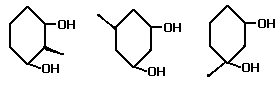 based on methylcyclohexane diols
2-methylcyclohexane-1,3-diol,
5-methylcyclohexane-1,3-diol,
1-methylcyclohexane-1,3-diol, and there are also cycloheptane diols and isomers
based on cyclohexane-1,1-diol,
cyclohexane-1,2-diol and
cyclohexane-1,4-diol.
There are all sorts of possible
E/Z and R/S isomers possible, overlapping and complicated.
Below are 6 examples based on
cyclopentane, cyclobutane and cyclopropane in which the substituent groups can
be hydroxy (alcohol), alkyl or carbon-alkoxy (ether linkage).

(1) is a
cyclopentane-1,1-diol, exhibits
R/S isomerism, bottom right ring C is chiral.
(2) has a secondary
and tertiary alcohol
group, can exhibit complex
'overlapping' E/Z and R/S isomerism, 3 chiral centres, C1, C2
and C3.
(3)
has a tertiary alcohol and ether functional groups, can exhibit complex 'overlapping' E/Z and R/S isomerism,
two chiral centres (C1 and C2 of the ring).
(4)
is a
cyclopropane-1,2-diol,
with
two secondary
alcohol groups, can exhibit complex 'overlapping' E/Z and R/S
isomerism, two
chiral centres, C1 and C2 of the ring.
(5)
has a secondary alcohol and ether functional groups, can exhibit complex 'overlapping' E/Z and R/S isomerism,
3
chiral centres, C1, C2 and C3 of cyclopropane ring.
They can be cyclic diols, ether
alcohols, di-ether compounds.
(f)
Examples of heterocyclic compounds of formula
C7H14O2
e.g.

(1) Based on a 1,4-epoxybutane ring and secondary
alcohol group
complex
'overlap' of E/Z and R/S isomerism, three
chiral centres.
(2) Based on a 1,2-dioxolane ring,
complex
'overlap' of E/Z and R/S isomerism, two
chiral centres.
(3)
Based on a 1,3-dioxolane ring,
complex 'overlap' of E/Z and R/S
isomerism, two
chiral centres.
(4) Based on an oxetane ring and secondary alcohol
group, complex
'overlap' of E/Z and R/S isomerism, two
chiral centres.
(5) Based on a 1,3-dioxetane ring,
complex
'overlap' of E/Z and R/S isomerism, two
chiral centres.
(6) Based on a 1,2-epoxy ring and a secondary alcohol
group,
complex
'overlap' of E/Z and R/S isomerism, two
chiral centres in the ring and the C of the C-OH
alcohol side chain).
(g-h) EXTRA NOTES on selected isomers of
C7H14O2
(g)
A comparison of the diagnostic wavenumbers for the infrared spectra of selected
isomers of
C7H14O2
Carboxylic acid (RCOOH) | 2500–3300 (broad
O–H); 1705–1725 (C=O) | Very broad, often sloping O–H; strong C=O | Very
broad, hydrogen-bonded O–H combined with C=O near 1710 cm⁻¹ | Broad O–H
always means alcohol | |
Ester (RCOOR') | 1735–1750 (C=O); 1200–1300
(C–O stretch) | Strong sharp C=O; strong C–O single bands | C=O shifted
higher than ketone; strong C–O fingerprint peaks | Esters show the same
broad O–H as acids | |
Aldehyde with OH (hydroxy‑aldehyde) |
2720–2820 and 2820–2850 (aldehyde C–H, weak); 1700–1725 (C=O); 3200–3600
(O–H) | Weak aldehyde C–H peaks; medium–strong C=O; O–H can be broad or
sharp | Presence of weak twin aldehyde C–H bands plus O–H distinguishes from
ketone/acid | Aldehyde C–H always very strong and obvious | |
Ketone with OH (hydroxy‑ketone) | 1710–1725
(C=O); 3200–3600 (O–H) | Strong C=O; O–H variable, often narrower than acid
| Absence of aldehyde C–H; C–O stretches weaker than ester | Any OH plus C=O
is a carboxylic acid | |
Ene‑diol (conjugated diol or enediol tautomer)
| 3200–3600 (O–H(s)); 1600–1680 (C=C region shifts) | O–H(s) usually
medium–broad; C=C absorption may be weak | Multiple O–H bands without strong
C=O; C=C shifts and broadened O–H pattern | Enediols always show a carbonyl
band | Sources: .
Group-by-group notes, diagnostic details, and exam tips
Carboxylic acids
-
Diagnostic bands: broad O–H from ~2500 to 3300 cm⁻¹
and C=O around 1705–1725 cm⁻¹.
-
Identification rule: look for a very broad, often
envelope-like O–H that swamps the alcohol region and a strong carbonyl near
1710 cm⁻¹.
-
Misconception: a broad O–H always means an alcohol; in acids
the O–H is broader and lower-frequency due to strong hydrogen bonding.
-
Exam tip: if you see both the broad low O–H band and a
strong C=O near 1710 cm⁻¹, call it a carboxylic acid rather than an
alcohol+ketone mixture.
Esters
-
Diagnostic bands: C=O at ~1735–1750 cm⁻¹
and strong C–O stretches in the 1200–1300 cm⁻¹ region.
-
Identification rule: esters have a higher-frequency C=O than
non-conjugated ketones and distinctive strong C–O single-bond peaks in the
fingerprint region.
-
Misconception: confusing esters with carboxylic acids
because both have C=O; check for the absence of the broad acidic O–H and the
presence of sharp C–O bands.
-
Exam tip: state two supporting peaks: the ester C=O plus at
least one strong C–O peak near 1250 cm⁻¹ to confirm an ester.
Hydroxy‑aldehydes (aldehyde + OH)
-
Diagnostic bands: aldehyde C–H stretches near 2720
and 2820 cm⁻¹ (weak), C=O ~1700–1725 cm⁻¹, and
O–H 3200–3600 cm⁻¹ if free or broadened if H‑bonded.
-
Identification rule: find the pair of weak aldehyde C–H
bands together with a carbonyl band; absence of these weak bands argues
against an aldehyde.
-
Misconception: students often miss weak aldehyde C–H peaks
and misidentify an aldehyde as a ketone; actively look for the 2700–2800
cm⁻¹ features.
-
Exam tip: mention the aldehyde C–H pair explicitly in answer
keys; if they are absent, justify calling the carbonyl a ketone.
Hydroxy‑ketones
-
Diagnostic bands: C=O at ~1710–1725 cm⁻¹
and O–H in 3200–3600 cm⁻¹; no aldehyde C–H in the 2700–2800
cm⁻¹ region.
-
Identification rule: confirm absence of aldehyde bands and
presence of O–H plus a standard ketone carbonyl.
-
Misconception: assuming every carbonyl+OH is a carboxylic
acid; the O–H in hydroxy‑ketones is usually less broad and does not extend
down into the 2500–3000 cm⁻¹ envelope characteristic of acids.
-
Exam tip: comment on hydrogen bonding: intramolecular
H‑bonding (vicinal hydroxy‑ketones) narrows and shifts the O–H band; report
expected shifts when the OH is adjacent to the C=O.
Ene‑diols and enediol tautomers
-
Diagnostic bands: one or more O–H absorptions around
3200–3600 cm⁻¹, no strong C=O bands, and possible
C=C/C–O patterns in the 1500–1680 cm⁻¹ region depending on
conjugation.
-
Identification rule: absence of a carbonyl plus multiple O–H
bands and C=C features suggests an enediol rather than a carbonyl-containing
isomer.
-
Misconception: expecting a strong carbonyl band from any
oxygenated isomer; tautomeric enediols lack C=O and must be identified by
O–H and C=C region features.
-
Exam tip: explain tautomerism briefly if proposing enediol;
point out absence of C=O and presence of characteristic O–H pattern as
evidence.
Practical advice for isomer
identification in exams
-
Always scan first for the presence or absence of C=O
(1700–1750 cm⁻¹ region) as the primary discriminator.
-
If C=O is present, check for broad acidic O–H
(2500–3300 cm⁻¹) to assign carboxylic acid, for aldehyde
C–H at 2700–2800 cm⁻¹ to assign aldehyde, and for strong
C–O peaks (1200–1300 cm⁻¹) to assign ester.
-
Report at least two corroborating bands
when naming a functional group (example: “ester C=O at 1740 cm⁻¹ and C–O at
1250 cm⁻¹”).
-
Mention hydrogen bonding effects when relevant:
H‑bonding broadens and lowers O–H frequency and can shift C=O
slightly.
-
Avoid the one‑band fallacy: do not identify a group based on
a single band without considering complementary peaks and the fingerprint
region.
Quick common pitfalls to avoid
-
Confusing a broad O–H (alcohol) with the acid O–H envelope;
acids extend down to 2500 cm⁻¹.
-
Missing weak aldehyde C–H signals and miscalling an aldehyde
a ketone; always inspect 2700–2800 cm⁻¹.
-
Assuming esters lack strong fingerprint-region features; the
1200–1300 cm⁻¹ C–O bands are decisive for esters.
-
Overlooking intramolecular hydrogen bonding which can make
OH bands unusually sharp or shifted for hydroxy‑carbonyl isomers.
Final exam-style checklist
(short)
-
Is there a strong C=O? yes → note exact wavenumber and check
for aldehyde C–H or broad acidic O–H.
-
Is there a very broad O–H from 2500–3300 cm⁻¹? yes →
carboxylic acid likely.
-
Are there weak bands at 2700–2800 cm⁻¹? yes → aldehyde C–H
present.
-
Are strong C–O stretches present at 1200–1300 cm⁻¹ with no
broad O–H? yes → ester likely.
(h) A comparison of the uses and applications of selected
isomers of C7H14O2
Overview
Compare practical uses and applications of constitutional
isomers with formula C7H14O2 across five functional classes: carboxylic
acids, esters, hydroxy‑aldehydes, hydroxy‑ketones, and
ene‑diols. For each class I list typical molecular examples (structural
motif), real-world roles, common synthetic uses, physical/handling notes that
affect application, and where relevant, niche or speciality uses.
Carboxylic acids
Typical motifs / examples
Uses and applications
-
Chemical intermediates for synthesis of esters, amides and
acid chlorides used in fine chemicals and agrochemicals.
-
Building blocks in pharmaceutical syntheses (introducing
carboxyl functionality for coupling, salt formation, or prodrugs).
-
Corrosion inhibitors and metal chelators in specialized
formulations when the acid coordinates metals.
-
Odorants/odour precursors in fragrance chemistry when small
branched acids contribute to fatty, waxy notes.
Practical/handling considerations
-
Relatively polar, higher boiling; form salts for water
solubility; strong H‑bonding affects volatility and odour.
-
Reactive toward dehydration, esterification and
decarboxylation under strong conditions.
Esters
Typical motifs / examples
Uses and applications
-
Fragrances and flavourings: many C7 esters have fruity,
floral or solvent‑like odours used in perfumery and flavour industries.
-
Solvents for coatings, inks and adhesives where moderate
polarity and volatility are required.
-
Plasticizers or co‑solvents in small‑scale specialty polymer
formulations.
-
Intermediates in organic synthesis: protective groups
(esters), transesterification partners and activated substrates for further
functionalisation.
-
Green chemistry replacements: some esters serve as
biodegradable solvent alternatives to harsher organics.
Practical/handling considerations
Hydroxy‑aldehydes
Typical motifs / examples
Uses and applications
-
Synthetic intermediates in carbohydrate, fragrance and
fine‑chemical syntheses where the aldehyde enables reductive coupling or
condensation chemistry.
-
Building blocks for heterocycle formation (e.g., via
intramolecular hemiacetal/hemiacetal-derived reactions).
-
Precursor to α‑hydroxy acids by mild oxidation, useful for
specialty cosmetic or polymer chemistry.
-
In situ reagents for reductive aminations or
Wittig/Horner–Wadsworth–Emmons reactions in lab synthesis.
Practical/handling considerations
-
Aldehydes are relatively reactive (oxidation,
polymerisation, condensation) and sometimes malodorous; hydroxy substitution
can stabilise via hemiacetal formation if vicinal.
-
Often handled under inert atmosphere or as protected
derivatives for stability.
Hydroxy‑ketones
Typical motifs / examples
Uses and applications
-
Important synthetic intermediates for stereoselective aldol
reactions, Robinson annulations, and as precursors to diols, α‑hydroxy acids
or reduced alcohols—widely used in total synthesis and medicinal chemistry.
-
Precursors to flavour and fragrance molecules after
selective reduction or dehydration.
-
Ligands or chelators in coordination chemistry when
bidentate (carbonyl + hydroxyl) binding is useful.
-
Building blocks for polymer modification where a carbonyl
plus OH allow crosslinking or grafting chemistry.
Practical/handling considerations
-
Intramolecular H‑bonding can alter reactivity and physical
properties (e.g., reduced volatility).
-
Stable relative to aldehydes but can undergo dehydration to
enones under acid catalysis.
Ene‑diols (enediols)
Typical motifs / examples
Uses and applications
-
Rare as isolable bulk chemicals at C7; typically encountered
as transient tautomers or stabilized by conjugation or hydrogen bonding.
-
Synthetic significance as reactive intermediates in
redox/tautomerisation chemistry and in specialized organic transformations
(e.g., pinacol rearrangements, oxidative coupling).
-
In medicinal and biochemical contexts, enediol moieties can
act as chelators or redox‑active centers in small‑molecule enzyme
inhibitors.
-
Research use: model compounds in mechanistic studies of
tautomerism, proton transfer and conjugation effects.
Practical/handling considerations
-
Often unstable; exist in equilibrium with carbonyl tautomers
(aldehyde/ketone forms); isolation requires stabilizing substituents or low
temperatures.
-
Application is usually indirect—used or exploited in situ
rather than as commercial products.
Cross‑class applications and
selection criteria
-
Fragrance/flavour industry: esters are primary choices for
pleasant volatility and aroma; some carboxylic acids used as precursors or
to tune scent profiles.
-
Pharmaceutical synthesis: carboxylic acids and
hydroxy‑ketones/hydroxy‑aldehydes are valued as versatile intermediates for
coupling, stereocontrol and functional group interconversion.
-
Materials and coatings: esters serve as solvents and
plasticizers; hydroxy‑ketones enable crosslinking chemistry through both OH
and carbonyl reactivity.
-
Research/analytical chemistry: ene‑diols and
hydroxy‑aldehydes/hydroxy‑ketones are used to probe mechanisms,
stereochemistry and tautomeric equilibria.
Practical exam‑style pointers
(applied use)
-
When asked to propose an isomer for a given application,
justify choice by physical properties and reactivity: volatility and odour →
ester; acidity/metal binding → carboxylic acid; synthetic versatility for
carbon–carbon bond formation → hydroxy‑carbonyls.
-
Mention stability: esters and carboxylic acids are usually
isolable and stable for formulation, while enediols are typically transient
and exploited in situ.
-
If asked to design a synthesis, use esterification from the
corresponding acid for esters, oxidation of alcohols for acids, selective
oxidation of alcohols for aldehydes, and aldol/Claisen‑type routes to
hydroxy‑carbonyls.
Short comparative summary
-
Esters: flavours, fragrances, solvents, biodegradable
alternatives, formulation components.
-
Carboxylic acids: coupling/salt formation, intermediates for
esters/amides, chelators and specialty additives.
-
Hydroxy‑aldehydes: reactive intermediates for heterocycles
and oxidation to hydroxy‑acids; limited direct commercial use.
-
Hydroxy‑ketones: versatile synthetic intermediates,
precursors to functionalised products and crosslinkable units.
-
Ene‑diols: mechanistic/research interest and in‑situ
intermediates rather than common commercial products.
If you want, I can convert this into a one‑page comparison table
with two or three specific C7 structural examples per class and brief synthetic
routes for each.
Learning objectives - questions to be answered?
How do you work out the structure
of the isomers of molecular formula C7H14O2?
How do you draw the structural
formula and skeletal formula of the isomers of molecular formula
C7H14O2?
How do you name the isomers of molecular formula
C7H14O2?
How many aliphatic structural
isomers are there of molecular formula C7H14O2?
How many aliphatic carbon chain
isomers are there of molecular formula C7H14O2?
How many positional isomers are
there of molecular formula C7H14O2?
Are there any
aliphatic open chain alkene isomers of molecular formula C7H14O2?
Are there any carboxylic acid isomers of
molecular formula C7H14O2?
Are there any ester
isomers of molecular formula C7H14O2?
Are there any
alkene-alcohol enol isomers of molecular formula C7H14O2?
Are there any alkene isomers of molecular formula
C7H14O2?
Are there any alcohol isomers of molecular formula
C7H14O2?
Are there any aldehyde isomers of molecular formula
C7H14O2?
Are there any ketone isomers of molecular formula
C7H14O2?
Are there any functional group
isomers with a molecular formula C7H14O2?
Does C7H14O2 have any stereoisomers?
Are there any E/Z (geometrical)
isomers with a molecular formula C7H14O2?
Are there any R/S (optical) isomers
(enantiomers) with a molecular formula C7H14O2?
How many E/Z (geometrical) isomers
are there of molecular formula C7H14O2?
How many R/S (optical) isomers
(enantiomers) of molecular formula C7H14O2?
This page will answer these questions
for molecular formula C7H14O2
Associated organic chemistry links
Advanced Level pre-university
organic chemistry notes
IR, mass and H-1 & C-13 NMR
spectra of organic compounds
See also
Examples of the effects of isomerism on the similarity or difference
in the physical and chemical properties of structural isomers
Index of sets of isomers for a given
molecular formula
The molecular structure and naming of CARBOXYLIC ACIDS and DERIVATIVES,
including isomers
INDEX of ALL revision notes on the
chemistry of CARBOXYLIC ACIDS and DERIVATIVES
Isomerism: introduction, structural isomerism - chain,
positional, functional group, tautomerism
Stereoisomerism:
introduction, definition,
priority rules, E/Z isomerism (cis/trans isomerism)
Stereoisomerism - R/S isomerism (optical
isomerism) -
definition - examples explained
This is a big chemistry website, please allow time
to explore it

|
Website content © Dr
Phil Brown 2000+. All copyrights reserved on revision notes, images,
quizzes, worksheets etc. Copying of Doc Brown's pre-university
advanced level chemistry website material is NOT
permitted. Exam revision summaries & references to science course specifications
are unofficial. These organic chemistry revision notes on
isomerism are
suitable for use of pre-university students studying AQA advanced level
chemistry constitutional isomers of C7H14O2, Edexcel advanced level
chemistry constitutional isomers of C7H14O2, OCR advanced level
chemistry constitutional isomers of C7H14O2, IB advanced level
chemistry constitutional isomers of C7H14O2, WJEC (Eduqas) advanced
level chemistry constitutional isomers of C7H14O2, CIE Cambridge advanced level chemistry
constitutional isomers of C7H14O2, US grade 11-12 AP honors
chemistry courses constitutional isomers of C7H14O2 and they will also prove useful to
1st year undergraduate students of chemistry including
constitutional isomers of C7H14O2. |
Keywords or phrases: how many isomers are
there of molecular formula C7H14O2? how do you name the isomers of
molecular formula C7H14O2? what is the molecular structure of the
isomers of C7H14O2, what type of isomerism is exhibited by molecules
of formula C7H14O2, how do you work out the isomers of molecular
formula C7H14O2, what are the structural isomers of C7H14O2, the carbon chain
isomers of C7H14O2 in the homologous series of alkanes, comparing
the spectra of isomers of molecular formula C7H14O2 how many structural isomers of
C7H14O2 can you draw? how many structural isomers does C7H14O2 have?
what are the possible isomers of C7H14O2? revision notes on
isomerism of C7H14O2 molecules, isomerism in
aliphatic carboxylic acids, isomerism in aliphatic esters,
carboxylic acid
isomers of C7H14O2, ester isomers of C7H14O2, the molecular structure of
the isomers of C7H14O2
how to draw the structural formula of isomers of C7H14O2, how to
draw the displayed formula of isomers of C7H14O2, how to draw
the skeletal formula of isomers of C7H14O2, how to name the
isomers of molecular formula C7H14O2
R/S optical isomers enantiomers of C7H14O2,
isomers of C7H14O2 of molecular mass 130
Diagrams of
the structure
of the isomers of C7H14O2,
Drawings the structural
formula and skeletal formula of the isomers of C7H14O2, names of the isomers of
C7H14O2, structural isomers are of C7H14O2, the number of carboxylic acid isomers of
C7H14O2, number of ester
isomers of C7H14O2, the alkene-alcohol enol isomers of C7H14O2, the alkene isomers of
C7H14O2, alcohol isomers of C7H14O2? the aldehyde isomers of
C7H14O2, the ketone isomers of C7H14O2, the any functional group
isomers with a C7H14O2 the stereoisomers of C7H14O2,
the E/Z geometrical
isomers of C7H14O2, the
R/S optical isomers (enantiomers) of C7H14O2
|
