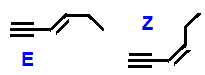
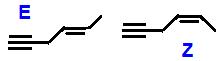
Abbreviated structural formula and skeletal formula.
This
molecule has two different functional groups, an alkene and
an alkyne
It has E/Z
isomers based on carbon atom 4.
From the CIP assignment priority rule for
E/Z isomers:
6C > 1H
CIP rule for the four atoms/groups around the >C=C< double bond
Other
names applicable: 1-hexen-4-yne, (E)-hex-4-en-1yne,
(4E)-hex-4-en-1yne, (Z)-hex-4-en-1yne, (4Z)-hex-4-en-1yne,
(E)-1-hexen-4-yne, (4E)-1-hexen-4-yne, (Z)-1-hexen-4-yne,
(4Z)-1-hexen-4-yne
Number of low resolution
NMR chemical shift
δ
signal peaks: 5 1H
and 6 13C
(email
if disagree?)
1H NMR ratio of peaks: 1
: 2 : 1 : 1 : 3 (for equivalent protons)
(3) hex-5-en-1-yne, HC≡CCH2CH2CH=CH2,
HC≡C-CH2-CH2-CH=CH2
,

Abbreviated structural formula and skeletal formula, both an
alkene and alkyne.
Other
names applicable: 1-hexen-5-yne
Number of low resolution
NMR chemical shift
δ
signal peaks: 5 1H
and 6 13C
(email
if disagree?)
1H NMR ratio of peaks: 1
: 2 : 2 : 1 : 2 (for equivalent protons)
BUT, for the 'end' =CH2 alkene protons,
you can get two chemical shifts close together, if there are two
different groups attached to the other carbon of the C=C bond i.e. R"R'C=CH2 where
R" and R' are different. This causes the
two =CH2 protons to experience slightly different fields.
(4) hex-2-en-4-yne, H3CC≡CCH=CHCH3,
H3C-C≡C-CH=CH-CH3,

Abbreviated structural formula and skeletal formula, both an
alkene and alkyne.
IUPAC
rule is that en takes the lowest number above yne, but, the suffix yne
is still higher
ranking than ene in IUPAC nomenclature.
E/Z
isomers based on carbon atom 4
CIP assignment priority rule for
E/Z isomers:
6C >
1H
CIP rule for the four atoms/groups around the >C=C< double bond
Other
names applicable: 2-hexen-5-yne, (E)-hex-2-en-4-yne,
(4E)-hex-2-en-4-yne,
(Z)-hex-2-en-4-yne, (4Z)-hex-2-en-4-yne,
(E)-2-hexen-5-yne, (4E)-2-hexen-5-yne,
(Z)-2-hexen-5-yne, (4Z)-2-hexen-5-yne
Number of low resolution
NMR chemical shift
δ
signal peaks: 4 1H
and 6 13C
(email
if disagree?)
1H NMR ratio of peaks: 3
: 1 : 1 : 3 (for equivalent protons)
(5) hex-1-en-4-yne, H3CC≡CCH2CH=CH2,
H3C-C≡C-CH2-CH=CH2,

Abbreviated structural formula and skeletal formula, both an
alkene and alkyne.
Other
names applicable: 1-hexen-4-yne
Number of low resolution
NMR chemical shift
δ
signal peaks: 4 1H
and 6 13C
(email
if disagree?)
1H NMR ratio of peaks: 3
: 2 : 1 : 2 (for equivalent protons)
BUT, for the 'end' =CH2 alkene protons,
you can get two chemical shifts close together, if there are two
different groups attached to the other carbon of the C=C bond i.e. R"R'C=CH2 where
R" and R' are different. This causes the
two =CH2 protons to experience slightly different fields.
(6) hex-1-en-3-yne, H3CCH2C≡CCH=CH2,
H3C-CH2-C≡C-CH=CH2,
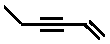
Abbreviated structural formula and skeletal formula, both an
alkene and alkyne.
Other
names applicable: 1-hexen-3-yne
Number of low resolution
NMR chemical shift
δ
signal peaks: 4 1H
and 6 13C
(email
if disagree?)
1H NMR ratio of peaks: 3
: 2 : 1 : 2 (for equivalent protons)
BUT, for the 'end' =CH2 alkene protons,
you can get two chemical shifts close together, if there are two
different groups attached to the other carbon of the C=C bond i.e. R"R'C=CH2 where
R" and R' are different. This causes the
two =CH2 protons to experience slightly different fields.
(7) 2-methylpent-2-en-4-yne, HC≡CCH=C(CH3)2,
HC≡C-CH=C(CH3)2,

Abbreviated structural formula and skeletal formula, both an
alkene and alkyne, but carbon chain now branched.
Other
names applicable: 2-methyl-2-penten-4-yne
Number of low resolution
NMR chemical shift
δ
signal peaks: 3 1H
and 5 13C
(email
if disagree?)
1H NMR ratio of peaks: 1
: 1 : 6 (for equivalent protons)
(8) 2-methylpent-1-en-4-yne, HC≡CCH2C(CH3)=CH2,
HC≡C-CH2-C(CH3)=CH2,

Abbreviated structural formula and skeletal formula, both an
alkene and alkyne, but carbon chain now branched.
Other
names applicable: 2-methyl-1-penten-4-yne
Number of low resolution
NMR chemical shift
δ
signal peaks: 4 1H
and 6 13C
(email
if disagree?)
1H NMR ratio of peaks: 1
: 2 : 3 : 2 (for equivalent protons)
BUT, for the 'end' =CH2 alkene protons,
you can get two chemical shifts close together, if there are two
different groups attached to the other carbon of the C=C bond i.e. R"R'C=CH2 where
R" and R' are different. This causes the
two =CH2 protons to experience slightly different fields.
(9) 3-methylenepent-1-yne, HC≡CC(=CH2)CH2CH3,
HC≡C-C(=CH2)-CH2-CH3,

Abbreviated structural formula and skeletal formula, both an
alkene and alkyne, but carbon chain now branched.
Other
names applicable: 3-methylene-1-pentyne
Number of low resolution
NMR chemical shift
δ
signal peaks: 4 1H
and 6 13C
(email
if disagree?)
1H NMR ratio of peaks: 1
: 2 : 2 : 3 (for equivalent protons)
BUT, for the 'end' =CH2 alkene protons,
you can get two chemical shifts close together, if there are two
different groups attached to the other carbon of the C=C bond i.e. R"R'C=CH2 where
R" and R' are different. This causes the
two =CH2 protons to experience slightly different fields.
(10) 2-methylpent-1-en-3-yne, H3CC≡CC(CH3)=CH2,
H3C-C≡C-C(CH3)=CH2,

Abbreviated structural formula and skeletal formula, both an
alkene and alkyne, but carbon chain now branched.
Other
names applicable: 2-methyl-1-penten-3-yne
Number of low resolution
NMR chemical shift
δ
signal peaks: 3 1H
and 6 13C
(email
if disagree?)
1H NMR ratio of peaks: 3
: 3 : 2 (for equivalent protons)
BUT, for the 'end' =CH2 alkene protons,
you can get two chemical shifts close together, if there are two
different groups attached to the other carbon of the C=C bond i.e. R"R'C=CH2 where
R" and R' are different. This causes the
two =CH2 protons to experience slightly different fields.
(11) hexa-1,2,3-triene, H2C=C=C=CHCH2CH3,
H2C=C=C=CH-CH2-CH3,

Abbreviated structural formula and skeletal formula, three
alkene groups connected in series.
Other
names applicable: 1,2,3-hexatriene
Number of low resolution
NMR chemical shift
δ
signal peaks: 4 1H
and 6 13C
(email
if disagree?)
1H NMR ratio of peaks: 2
: 1 : 2 : 3 (for equivalent protons)
BUT, for the 'end' =CH2 alkene protons,
you can get two chemical shifts close together, if there are two
different groups attached to the other carbon of the C=C bond i.e. R"R'C=CH2 where
R" and R' are different. This causes the
two =CH2 protons to experience slightly different fields.
(12) hexa-1,2,4-triene, H2C=C=CHCH=CHCH3,
H2C=C=CH-CH=CH-CH3,
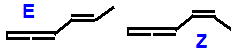
Abbreviated structural formula and skeletal formula, an
alkene - a triene (triple C=C bond) grouping.
E/Z
isomers based on carbon atom 4.
CIP assignment priority rule for
E/Z isomers:
6C >
1H
CIP rule for the four atoms/groups around the >C=C< double bond
Other
names applicable: 1,2,4-hexatriene, (E)-hexa-1,2,4-triene,
(4E)-hexa-1,2,3-triene, (Z)-hexa-1,2,4-triene,
(4Z)-hexa-1,2,3-triene, (E)-1,2,4-hexatriene,
(4E)-1,2,4-hexatriene, (Z)-1,2,4-hexatriene,
(4Z)-1,2,4-hexatriene
Number of low resolution
NMR chemical shift
δ
signal peaks: 5 1H
and 6 13C
(email
if disagree?)
1H NMR ratio of peaks: 2
: 1 : 1 : 1 : 3 (for equivalent protons)
BUT, for the 'end' =CH2 alkene protons,
you can get two chemical shifts close together, if there are two
different groups attached to the other carbon of the C=C bond i.e. R"R'C=CH2 where
R" and R' are different. This causes the
two =CH2 protons to experience slightly different fields.
(13) hexa-1,2,5-triene, H2C=C=CHCH2CH=CH2,
H2C=C=CH-CH2-CH=CH2,

Abbreviated structural formula and skeletal formula, an
alkene - a triene (triple C=C bond) grouping.
Other
names applicable: 1,2,5-hexatriene
Number of low resolution
NMR chemical shift
δ
signal peaks: 5 1H
and 6 13C
(email
if disagree?)
1H NMR ratio of peaks: 2
: 1 : 2 : 1 : 2 (for equivalent protons)
BUT, for the 'end' =CH2 alkene protons,
you can get two chemical shifts close together, if there are two
different groups attached to the other carbon of the C=C bond i.e. R"R'C=CH2 where
R" and R' are different. This causes the
two =CH2 protons to experience slightly different fields.
(14) hexa-1,3,5-triene,
H2C=CH-CH=CH-CH=CH2,
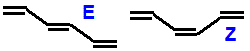
Abbreviated structural formula and skeletal formula,
note the symmetry of the molecule, which significantly reduces the number of
NMR chemical shifts.
The molecule has three
alkene groups all separated from each other - a triene (triple C=C bond) grouping.
CIP assignment priority rule for
E/Z isomers:
6C >
1H
CIP rule for the four atoms/groups around the >C=C< double bond
Other
names applicable: 1,3,5-hexatriene, (E)-hexa-1,3,5-triene,
(3E)-hexa-1,3,5-triene, (Z)-hexa-1,3,5-triene, (3Z)-hexa-1,3,5-triene,
(E)-1,3,5-hexatriene, (3E)-1,3,5-hexatriene, (Z)-1,3,5-hexatriene,
(3Z)-1,3,5-hexatriene
CIP assignment priority rule for
E/Z isomers:
6C >
1H
Number of low resolution
NMR chemical shift
δ
signal peaks: 3 1H
and 3 13C
(email
if disagree?)
1H NMR ratio of peaks: 4
(2x2) : 2 (2x1) : 2
(2x1) = 2
: 1 : 1 (for equivalent protons)
BUT, for the 'end' =CH2 alkene protons,
you can get two chemical shifts close together, if there are two
different groups attached to the other carbon of the C=C bond i.e. R"R'C=CH2 where
R" and R' are different. This causes the
two =CH2 protons to experience slightly different fields.
(15) hexa-2,3,4-triene, H3CCH=C=C=CHCH3,
H3C-CH=C=C=CH-CH3,

Abbreviated structural formula and skeletal formula, three
alkene groups connected in series (triene).
Other
names applicable: 2,3,4-hexatriene and no E/Z
or R/S isomers
Number of low resolution
NMR chemical shift
δ
signal peaks: 2 1H
and 3 13C
(email
if disagree?)
1H NMR ratio of peaks: 6
(2x3) : 2 (2x1) = 3 : 1 (for equivalent protons)
(16) 4-methylpenta-1,2,3-triene,
H2C=C=C=C(CH3)2,

Abbreviated structural formula and skeletal formula, three
alkene groups connected in series (triene) with chain branching.
Other
names applicable: 4-methyl-1,2,3-pentatriene
Number of low resolution
NMR chemical shift
δ
signal peaks: 2 1H
and 5 13C
(email
if disagree?)
1H NMR ratio of peaks: 2
: 6 (2x3) = 1 : 3 (for equivalent protons)
BUT, for the 'end' =CH2 alkene protons,
you can get two chemical shifts close together, if there are two
different groups attached to the other carbon of the C=C bond i.e. R"R'C=CH2 where
R" and R' are different. This causes the
two =CH2 protons to experience slightly different fields.
(17) 3-methylpenta-1,2,4-triene, H2C=C=C(CH3)CH=CH2,
H2C=C=C(CH3)-CH=CH2,

Abbreviated structural formula and skeletal formula, a diene
formation and alkene groupings, with chain branching, but a
triene overall.
Other
names applicable: 3-methyl-1,2,4-pentatriene
Number of low resolution
NMR chemical shift
δ
signal peaks: 4 1H
and 6 13C
(email
if disagree?)
1H NMR ratio of peaks: 2
: 3 : 1 : 2 (for equivalent protons)
BUT, for the 'end' =CH2 alkene protons,
you can get two chemical shifts close together, if there are two
different groups attached to the other carbon of the C=C bond i.e. R"R'C=CH2 where
R" and R' are different. This causes the
two =CH2 protons to experience slightly different fields.
(18) 4-methylpenta-1,2,4-triene, H2C=C=CHC(CH3)=CH2,
H2C=C=CH-C(CH3)=CH2,

Abbreviated structural formula and skeletal formula, three
alkene groups, two connected in series, triene overall.
Other
names applicable: 4-methyl-1,2,4-pentatriene
Number of low resolution
NMR chemical shift
δ
signal peaks: 4 1H
and 6 13C
(email
if disagree?)
1H NMR ratio of peaks: 2
: 1 : 3 : 2 (for equivalent protons)
BUT, for the 'end' =CH2 alkene protons,
you can get two chemical shifts close together, if there are two
different groups attached to the other carbon of the C=C bond i.e. R"R'C=CH2 where
R" and R' are different. This causes the
two =CH2 protons to experience slightly different fields.
(19) 3-methylenepenta-1,4-diene, H2C=CHC(=CH2)CH=CH2,
H2C=CH-C(=CH2)-CH=CH2,

Abbreviated structural formula and skeletal formula, three
separated alkene groups in this triene.
Other
names applicable: 3-methylene-1,4-pentadiene
Described as a
conjugated compound
Number of low resolution
NMR chemical shift
δ
signal peaks: 3 1H
and 4 13C
(email
if disagree?)
1H NMR ratio of peaks: 4
(2x2)
: 2 (2x1) : 2 = 2 : 1 : 1 (for equivalent protons)
BUT, for the 'end' =CH2 alkene protons,
you can get two chemical shifts close together, if there are two
different groups attached to the other carbon of the C=C bond i.e. R"R'C=CH2 where
R" and R' are different. This causes the
two =CH2 protons to experience slightly different fields.
(20) cyclohexa-1,2-diene,
 , skeletal formula, highly strained diene.
Other
names applicable: 1,2-cyclohexadene, double alkene molecule
(cyclo-diene).
(20-22)
are positional isomers of the alkene functional groups.
Number of low resolution
NMR chemical shift
δ
signal peaks: 3 1H
and 4 13C
(email
if disagree?)
1H NMR ratio of peaks: 2
(2x1)
: 4 (2x2) : 2 = 1 : 2 :1 (for equivalent protons)
(21) cyclohexa-1,3-diene,
 , skeletal formula, less strained than (20)
Other
names applicable: 1,2-cyclohexadene, double alkene molecule
(cyclo-diene).
Number of low resolution
NMR chemical shift
δ
signal peaks: 3 1H
and 3 13C
(email
if disagree?)
1H NMR ratio of peaks: 2
(2x1)
: 2 (2x1) : 4
(2x2) (for equivalent protons)
(22) cyclohexa-1,4-diene,
 , skeletal formula, less strained than (20)
Other
names applicable: 1,4-cyclohexadene, double alkene molecule
(cyclo-diene).
Number of low resolution
NMR chemical shift
δ
signal peaks: 2 1H
and 2 13C
(email
if disagree?)
1H NMR ratio of peaks: 4
(2x2)
: 4 (4x1) = 1 : 1 (for equivalent protons)
(23) 1-methylcyclopenta-1,2-diene,
 , skeletal formula
Other
names applicable: 1-methyl-1,2-cyclopentadiene.
(23-27)
are positional isomers based on the two alkene groups with a
diene structure based on a pentadiene ring.
Number of low resolution
NMR chemical shift
δ
signal peaks: 4 1H
and 6 13C
(email
if disagree?)
1H NMR ratio of peaks: 1 : 2
: 2 : 3 (for equivalent protons)
(24) 4-methylcyclopenta-1,2-diene,
 , skeletal formula
Other
names applicable: 4-methyl-1,2-cyclopentadiene.
(R)-4-methylcyclpenta-1,2-diene,
(R)-4-methyl-1,2-cyclopentadiene,
(S)-4-methylcyclpenta-1,2-diene,
(S)-4-methyl-1,2-cyclopentadiene.
Exhibits R/S stereoisomerism, the top atom of the
'pentangle' is a chiral centre.
Number of low resolution
NMR chemical shift
δ
signal peaks: 5 1H
and 5 13C
(email
if disagree?)
1H NMR ratio of peaks: 1
: 1 : 3 : 2 : 1 (for equivalent protons)
(25) 1-methylcyclopenta-1,3-diene,
 , skeletal formula, two separated alkene groups.
Other
names applicable: 1-methyl-1,3-cyclopentadiene
Number of low resolution
NMR chemical shift
δ
signal peaks: 5 1H
and 6 13C
(email
if disagree?)
1H NMR ratio of peaks: 1
: 1 : 1 : 2 : 3 (for equivalent protons)
(26) 2-methylcyclopenta-1,3-diene,
 ,
skeletal formula, two separated alkene groups.
,
skeletal formula, two separated alkene groups.
Other
names applicable: 2-methyl-1,3-cyclopentadiene
Number of low resolution
NMR chemical shift
δ
signal peaks: 5 1H
and 6 13C
(email
if disagree?)
1H NMR ratio of peaks: 3
: 1 : 1 : 2 : 1 (for equivalent protons)
(27) 5-methylcyclopenta-1,3-diene,
 , skeletal formula, two separated alkene groups.
Other
names applicable: 5-methyl-1,3-cyclopentadiene
Number of low resolution
NMR chemical shift
δ
signal peaks: 4 1H
and 4 13C
(email
if disagree?)
1H NMR ratio of peaks: 2
(2x1)
: 2 (2x1) : 1 : 3 (for equivalent protons)
(28) 3-methylenecyclopentene,
 , skeletal formula
One alkene group in the
ring, the other is connected by one of its carbon atoms to the ring.
Number of low resolution
NMR chemical shift
δ
signal peaks: 5 1H
and 6 13C
(email
if disagree?)
1H NMR ratio of peaks: 1 : 1
: 2 : 2 : 2 (for equivalent protons)
BUT, for the 'end' =CH2 alkene protons,
you can get two chemical shifts close together, if there are two
different groups attached to the other carbon of the C=C bond i.e. R"R'C=CH2 where
R" and R' are different. This causes the
two =CH2 protons to experience slightly different fields.
(29) 4-methylenecyclopentene,
 , skeletal formula
One
alkene group in the ring, the other is connected by one of
its carbon atoms to the ring.
Number of low resolution
NMR chemical shift
δ
signal peaks: 3 1H
and 4 13C
(email
if disagree?)
1H NMR ratio of peaks: 2
(2x1)
: 4 (2x2) : 2 = 1 : 2 : 1 (for equivalent protons)
(30) 1-ethylcyclobuta-1,3-diene,
 , skeletal formula, two separated alkene groups in the ring.
Other
names applicable: 1-ethyl-1,3-cyclobutadiene, diene
structure based on a butadiene ring.
Number of low resolution
NMR chemical shift
δ
signal peaks: 5 1H
and 6 13C
(email
if disagree?)
1H NMR ratio of peaks: 1
: 1 : 1 : 2 : 3 (for equivalent protons)
(31) 1,2-dimethylcyclobuta-1,3-diene,
 , skeletal formula, two separated alkene groups in the ring.
Other
names applicable: 1,2-dimethyl-1,3-cyclobutadiene
Number of low resolution
NMR chemical shift
δ
signal peaks: 2 1H
and 3 13C
(email
if disagree?)
1H NMR ratio of peaks: 2
(2x1) : 6 (2x3) = 1 : 3 (for equivalent protons)
(32) 1,3-dimethylcyclobuta-1,3-diene,
 , skeletal formula, two separated alkene groups in the ring.
Other
names applicable: 1,3-dimethyl-1,3-cyclbutadiene
Number of low resolution
NMR chemical shift
δ
signal peaks: 2 1H
and 3 13C
(email
if disagree?)
1H NMR ratio of peaks: 2
(2x1) : 6 (2x3) : = 1 :
3 (for equivalent protons)
(33) 1,4-dimethylcyclobuta-1,3-diene,
 , skeletal formula, two separated alkene groups in the ring.
Other
names applicable: 1,4-dimethyl-1,3-cyclbutadiene
Number of low resolution
NMR chemical shift
δ
signal peaks: 2 1H
and 3 13C
(email
if disagree?)
1H NMR ratio of peaks: 2
(2x1) : 6 (2x3) = 1 : 3 (for equivalent protons)
(34) 1-methyl-3-methylenecyclobutene,
 , skeletal formula
One
alkene group in the ring, the other is connected by one of
its carbon atoms to the ring.
Number of low resolution
NMR chemical shift
δ
signal peaks: 4 1H
and 6 13C
(email
if disagree?)
1H NMR ratio of peaks: 3 : 2
: 2 : 1 (for equivalent protons)
BUT, for the 'end' =CH2 alkene protons,
you can get two chemical shifts close together, if there are two
different groups attached to the other carbon of the C=C bond i.e. R"R'C=CH2 where
R" and R' are different. This causes the
two =CH2 protons to experience slightly different fields.
(35) 2-methyl-3-methylenecyclobutene,
 , skeletal formula
One
alkene group in the ring, the other is connected by one of
its carbon atoms to the ring.
Number of low resolution
NMR chemical shift
δ
signal peaks: 4 1H
and 6 13C
(email
if disagree?)
1H NMR ratio of peaks: 1
: 2 : 2 : 3 (for equivalent protons)
BUT, for the 'end' =CH2 alkene protons,
you can get two chemical shifts close together, if there are two
different groups attached to the other carbon of the C=C bond i.e. R"R'C=CH2 where
R" and R' are different. This causes the
two =CH2 protons to experience slightly different fields.
(36) 4-methyl-3-methylenecyclobutene,
 , skeletal formula
One
alkene group in the ring, the other is connected by one of
its carbon atoms to the ring.
Exhibits R/S stereoisomerism, the top left carbon atom of
the
□ is a
chiral centre.
Number of low resolution
NMR chemical shift
δ
signal peaks: 5 1H
and 6 13C
(email
if disagree?)
1H NMR ratio of peaks: 1
: 1 : 3 : 2 : 1 (for equivalent protons)
BUT, for the 'end' =CH2 alkene protons,
you can get two chemical shifts close together, if there are two
different groups attached to the other carbon of the C=C bond i.e. R"R'C=CH2 where
R" and R' are different. This causes the
two =CH2 protons to experience slightly different fields.
(37) 3-ethylidenecyclobutene,
 , skeletal formula, no E/Z or R/S isomers.
One
alkene group in the ring, the other is connected by one of
its carbon atoms to the ring.
Number of low resolution
NMR chemical shift
δ
signal peaks: 5 1H
and 6 13C
(email
if disagree?)
1H NMR ratio of peaks: 1
: 2 : 1 : 3 : 1 (for equivalent protons)
BUT, for the 'end' =CH2 alkene protons,
you can get two chemical shifts close together, if there are two
different groups attached to the other carbon of the C=C bond i.e. R"R'C=CH2 where
R" and R' are different. This causes the
two =CH2 protons to experience slightly different fields.
(38) 1-ethenylcyclobutene,
 , skeletal formula, no E/Z or R/S isomers.
One alkene group in the ring and the other
in a side-chain.
Number of low resolution
NMR chemical shift
δ
signal peaks: 5 1H
and 6 13C
(email
if disagree?)
1H NMR ratio of peaks: 1
: 2 : 2 : 1 : 2 (for equivalent protons)
BUT, for the 'end' =CH2 alkene protons,
you can get two chemical shifts close together, if there are two
different groups attached to the other carbon of the C=C bond i.e. R"R'C=CH2 where
R" and R' are different. This causes the
two =CH2 protons to experience slightly different fields.
(39) 3-ethenylcyclobutene,
 , skeletal formula
One alkene group in the ring and the other
in a side-chain.
Exhibits R/S stereoisomerism, the top right carbon atom of
the
□ is a
chiral centre.
(R)-3-ethenylcyclobutene,
(S)-3-ethenylcyclobutene
Number of low resolution
NMR chemical shift
δ
signal peaks: 6 1H
and 6 13C
(email
if disagree?)
1H NMR ratio of peaks: 1
: 2 : 1 : 1 : 2 : 1 (for equivalent protons)
BUT, for the 'end' =CH2 alkene protons,
you can get two chemical shifts close together, if there are two
different groups attached to the other carbon of the C=C bond i.e. R"R'C=CH2 where
R" and R' are different. This causes the
two =CH2 protons to experience slightly different fields.
(40) 1,2-dimethylenecyclobutane,
 ,
skeletal formula, no E/Z or R/S isomers.
,
skeletal formula, no E/Z or R/S isomers.
Number of low resolution
NMR chemical shift
δ
signal peaks: 2 1H
and 3 13C
(email
if disagree?)
1H NMR ratio of peaks: 4
(2x2) : 4 (2x2) = 1 : 1 (for equivalent protons)
BUT, for the 'end' =CH2 alkene protons,
you can get two chemical shifts close together, if there are two
different groups attached to the other carbon of the C=C bond i.e. R"R'C=CH2 where
R" and R' are different. This causes the
two =CH2 protons to experience slightly different fields.
(41) 1,3-dimethylenecyclobutane,
 , skeletal formula, no E/Z or R/S isomers.
Number of low resolution
NMR chemical shift
δ
signal peaks: 2 1H
and 3 13C
(email
if disagree?)
1H NMR ratio of peaks: 4
(2x2) : 4 (2x2) = 1 : 1 (for equivalent protons)
BUT, for the 'end' =CH2 alkene protons,
you can get two chemical shifts close together, if there are two
different groups attached to the other carbon of the C=C bond i.e. R"R'C=CH2 where
R" and R' are different. This causes the
two =CH2 protons to experience slightly different fields.
(42) name ?,
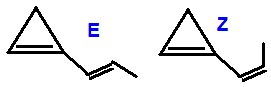 , skeletal formula
One alkene group in the ring and the other
in a propene side-chain.
E/Z
isomers based on the propene side chain.
CIP assignment priority rule for
E/Z isomers:
6C >
1H
Number of low resolution
NMR chemical shift
δ
signal peaks: 5 1H
and 6 13C
(email
if disagree?)
1H NMR ratio of peaks: 1
: 2 : 1 : 1 : 3 (for equivalent protons)
(43) name ?,
 , skeletal formula, no E/Z or R/S isomers.
One alkene group in the ring and the other
in a propene side-chain.
Number of low resolution
NMR chemical shift
δ
signal peaks: 6 1H
and 6 13C
(email
if disagree?)
1H NMR ratio of peaks: 1
: 2 : 2 : 1 : 2 (for equivalent protons)
BUT, for the 'end' =CH2 alkene protons,
you can get two chemical shifts close together, if there are two
different groups attached to the other carbon of the C=C bond i.e. R"R'C=CH2 where
R" and R' are different. This causes the
two =CH2 protons to experience slightly different fields.
(44) name ?,
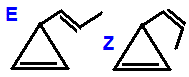 , skeletal formula
One alkene group in the ring and the other
in a propene side-chain.
E/Z
isomers based on the propene side-chain off the ring, NOT R/S isomerism
CIP assignment priority rule for
E/Z isomers:
6C >
1H
Number of low resolution
NMR chemical shift
δ
signal peaks: 5 1H
and 5 13C
(email
if disagree?)
1H NMR ratio of peaks: 2
(2x1)
: 1 : 1 : 3 : 1 (for equivalent protons)
(45) name ?,
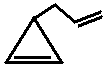 , skeletal formula, no E/Z
or R/S isomers.
, skeletal formula, no E/Z
or R/S isomers.
Number of low resolution
NMR chemical shift
δ
signal peaks: 5 1H
and 5 13C
(email
if disagree?)
1H NMR ratio of peaks: 2
(2x1)
: 1 : 2 : 1 : 2 (for equivalent protons)
BUT, for the 'end' =CH2 alkene protons,
you can get two chemical shifts close together, if there are two
different groups attached to the other carbon of the C=C bond i.e. R"R'C=CH2 where
R" and R' are different. This causes the
two =CH2 protons to experience slightly different fields.
(46) name ?,
 , skeletal formula, no E/Z
or R/S isomers.
, skeletal formula, no E/Z
or R/S isomers.
Number of low resolution
NMR chemical shift
δ
signal peaks: 4 1H
and 6 13C
(email
if disagree?)
1H NMR ratio of peaks: 1
: 2 : 2 : 3 (for equivalent protons)
BUT, for the 'end' =CH2 alkene protons,
you can get two chemical shifts close together, if there are two
different groups attached to the other carbon of the C=C bond i.e. R"R'C=CH2 where
R" and R' are different. This causes the
two =CH2 protons to experience slightly different fields.
(47) name ?,
 , skeletal formula, no E/Z
or R/S isomers.
, skeletal formula, no E/Z
or R/S isomers.
Number of low resolution
NMR chemical shift
δ
signal peaks: 4 1H
and 5 13C
(email
if disagree?)
1H NMR ratio of peaks: 2
(2x1)
: 1 : 3 : 2 (for equivalent protons)
BUT, for the 'end' =CH2 alkene protons,
you can get two chemical shifts close together, if there are two
different groups attached to the other carbon of the C=C bond i.e. R"R'C=CH2 where
R" and R' are different. This causes the
two =CH2 protons to experience slightly different fields.
(48) name ?,
 , skeletal formula,
no E/Z or R/S isomers.
, skeletal formula,
no E/Z or R/S isomers.
Number of low resolution
NMR chemical shift
δ
signal peaks: 4 1H
and 5 13C
(email
if disagree?)
1H NMR ratio of peaks: 2
(2x1)
: 1 : 2 : 3 (for equivalent protons)
(49) 1,2-dimethyl-3-methylenecyclopropene,
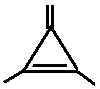 , skeletal formula, no E/Z
or R/S isomers.
, skeletal formula, no E/Z
or R/S isomers.
Number of low resolution
NMR chemical shift
δ
signal peaks: 2 1H
and 4 13C
(email
if disagree?)
1H NMR ratio of peaks: 6
(2x3) : 2 = 3 : 1 (for equivalent protons)
BUT, for the 'end' =CH2 alkene protons,
you can get two chemical shifts close together, if there are two
different groups attached to the other carbon of the C=C bond i.e. R"R'C=CH2 where
R" and R' are different. This causes the
two =CH2 protons to experience slightly different fields.
(50) 3-ethylidene-1-methylcycloprop-1-ene,
 , skeletal formula, no E/Z
or R/S isomers.
, skeletal formula, no E/Z
or R/S isomers.
Other
names applicable: 3-ethylidene-1-methylcyclopropene
Number of low resolution
NMR chemical shift
δ
signal peaks: 4 1H
and 6 13C
(email
if disagree?)
1H NMR ratio of peaks: 1 : 1 : 3
: 3 (for equivalent protons)
(51) 1-methyl-3-methylenecycloprop-1-ene,
 , skeletal formula, no E/Z
or R/S isomers.
, skeletal formula, no E/Z
or R/S isomers.
Other
names applicable: 1-methyl-3-methylenecyclopropene
Number of low resolution
NMR chemical shift
δ
signal peaks: 4 1H
and 6 13C
(email
if disagree?)
1H NMR ratio of peaks: 1
: 2 : 2 : 3 (for equivalent protons)
BUT, for the 'end' =CH2 alkene protons,
you can get two chemical shifts close together, if there are two
different groups attached to the other carbon of the C=C bond i.e. R"R'C=CH2 where
R" and R' are different. This causes the
two =CH2 protons to experience slightly different fields.
(52) 1-ethenyl-2-methylcycloprop-1-ene,
 , skeletal formula, no E/Z
or R/S isomers.
, skeletal formula, no E/Z
or R/S isomers.
Other
names applicable: 1-ethenyl-2-methylcyclopropene
Number of low resolution
NMR chemical shift
δ
signal peaks: 4 1H
and 6 13C
(email
if disagree?)
1H NMR ratio of peaks: 3 : 2 : 1
: 2 (for equivalent protons)
BUT, for the 'end' =CH2 alkene protons,
you can get two chemical shifts close together, if there are two
different groups attached to the other carbon of the C=C bond i.e. R"R'C=CH2 where
R" and R' are different. This causes the
two =CH2 protons to experience slightly different fields.
(53) 1-ethenyl-3-methylcycloprop-1-ene,
 , skeletal formula, no E/Z
or R/S isomers.
, skeletal formula, no E/Z
or R/S isomers.
Other
names applicable: 1-ethenyl-3-methylcyclopropene
Exhibits R/S stereoisomerism, the top carbon atom of the
∆ is a
chiral centre.
Number of low resolution
NMR chemical shift
δ
signal peaks: 5 1H
and 6 13C
(email
if disagree?)
1H NMR ratio of peaks: 1 : 1 : 3
: 1 : 2 (for equivalent protons)
BUT, for the 'end' =CH2 alkene protons,
you can get two chemical shifts close together, if there are two
different groups attached to the other carbon of the C=C bond i.e. R"R'C=CH2 where
R" and R' are different. This causes the
two =CH2 protons to experience slightly different fields.
(54) 3-ethenyl-1-methylcycloprop-1-ene,
 , ?, skeletal formula
Other
names applicable: 3-ethenyl-1-methylcyclopropene
Exhibits R/S stereoisomerism, the top carbon atom of the
∆ is a
chiral centre.
Number of low resolution
NMR chemical shift
δ
signal peaks: 5 1H
and 6 13C
(email
if disagree?)
1H NMR ratio of peaks: 1 : 1 : 1
: 2 : 3 (for equivalent protons)
BUT, for the 'end' =CH2 alkene protons,
you can get two chemical shifts close together, if there are two
different groups attached to the other carbon of the C=C bond i.e. R"R'C=CH2 where
R" and R' are different. This causes the
two =CH2 protons to experience slightly different fields.
(55) 3-ethenyl-3-methylcycloprop-1-ene,
 , skeletal formula
Other
names applicable: 3-ethenyl-3-methylcyclopropene
Number of low resolution
NMR chemical shift
δ
signal peaks: 4 1H
and 5 13C
(email
if disagree?)
1H NMR ratio of peaks: 2
(2x1) : 3 : 1 : 2 (for equivalent protons)
BUT, for the 'end' =CH2 alkene protons,
you can get two chemical shifts close together, if there are two
different groups attached to the other carbon of the C=C bond i.e. R"R'C=CH2 where
R" and R' are different. This causes the
two =CH2 protons to experience slightly different fields.
(56) 1-cyclopropylprop-2-yne,
 , skeletal formula
Other
names applicable: 1-cyclopropyl-2-propyne.
This
molecule has a saturated cycloalkane ring (cyclopropyl), but
attached to an unsaturated propyne chain containing an
alkyne group (triple bond
C≡C).
Number of low resolution
NMR chemical shift
δ
signal peaks: 3 1H
and 5 13C
(email
if disagree?)
1H NMR ratio of peaks: 4
(2x2) : 1 : 3 (for equivalent protons)
(57) 3-cyclopropylprop-1-yne,
 , skeletal formula
Other
names applicable: 3-cyclopropyl-1-propyne.
cyclopropyl group attached to a propyne chain - with an
alkyne group.
Number of low resolution
NMR chemical shift
δ
signal peaks: 3 1H
and 5 13C
(email
if disagree?)
1H NMR ratio of peaks: 4
(2x2) : 1 : 2 : 1 (for equivalent protons)
(58) name ?,
 , skeletal formula
A cyclopropyl group attached to a diene
chain.
Number of low resolution
NMR chemical shift
δ
signal peaks: 3 1H
and 5 13C
(email
if disagree?)
1H NMR ratio of peaks: 4
(2x2) : 1 : 3 (for equivalent protons)
(59) name ?,
 , skeletal formula
A
bicyclo compound, one ring saturated and the other
unsaturated with an alkene group.
Number of low resolution
NMR chemical shift
δ
signal peaks: 3 1H
and 3 13C
(email
if disagree?)
1H NMR ratio of peaks: 2
(2x1) : 2 (2x1) :
4 (2x2) = 1 : 2 : 1 (for equivalent protons)
(60) Bicyclo[2.2.0]hex-1(4)-ene,
![constitutional structural skeletal formula of Bicyclo[2.2.0]hex-1(4)-ene isomer of molecular formula C6H8](../addhoc06/0isomc6h8-60.gif) , skeletal formula
, skeletal formula
A
bicyclo compound, two rings connected by an alkene
C=C bond which is shared by both rings..
Number of low resolution
NMR chemical shift
δ
signal peaks: 1 1H
and 2 13C
(email
if disagree?)
(61) 1,1'-bi(cyclopropylidene),
 , skeletal formula
Other
names applicable: bicyclopropylidene, cyclopropylidene-cyclopropane
A
bicyclo compound, two rings connected by an alkene
C=C bond.
Number of low resolution
NMR chemical shift
δ
signal peaks: 1 1H
and 2 13C
(email
if disagree?)
(62) name ?,
 , skeletal formula
A
bicyclo compound, one ring saturated and the other
unsaturated with an alkene group.
Number of low resolution
NMR chemical shift
δ
signal peaks: 6 1H
and 6 13C
(email
if disagree?)
1H NMR ratio of peaks: 1 : 1 : 1
: 2 : 1 : 2 (for equivalent protons)
(63) 1-ethynyl-2-methylcyclopropane ,
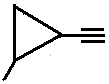 ,
skeletal formula
,
skeletal formula
A
cycloalkane ring (cyclopropyl) and an alkyne group in a
side-chain
Both
E/Z isomers and R/S isomers, the bottom
left and right carbon atoms of the
∆
are chiral centres (asymmetric).
(Z)-1-ethynyl-2-methylcyclopropane (cis)
 a
is CH3 and
b is C≡CH
a
is CH3 and
b is C≡CH
and (E)-1-ethynyl-2-methylcyclopropane
(trans)
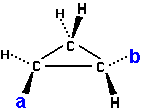 a
is CH3 and
b is C≡CH
a
is CH3 and
b is C≡CH
This is
a complicated overlap of two types of stereoisomerism -
university level analysis!
Number of low resolution
NMR chemical shift
δ
signal peaks: 5 1H
and 6 13C
(email
if disagree?)
1H NMR ratio of peaks: 3 : 1 : 2
: 1 : 1 (for equivalent protons)
(64)
ethynylcyclobutane,
 ,
skeletal formula
,
skeletal formula
A
cycloalkane ring (cyclobutyl) and an alkyne group in a
side-chain
Number of low resolution
NMR chemical shift
δ
signal peaks: 4 1H
and 5 13C
(email
if disagree?)
1H NMR ratio of peaks: 2
: 4 (2x2) : 1 : 1 (for equivalent protons)