|
Doc Brown's
Advanced Chemistry: Part 14.7:
Isomers and extra notes on their properties and uses
The structural
isomers and stereoisomers of molecular formula C2H2X2
(X = halogen)
[Author
©
Dr WP Brown PhD:
Doc Brown's advanced level organic chemistry exam revision notes
suitable for students of UK A level chemistry courses, IB advanced
chemistry and US K12 grade
11, grade 12 and AP honors chemistry courses: Molecular
spectroscopy and analysing the isomers of C2H2X2
[isomerism page updated Feb 9th 2026 *]
*
Associated organic chemistry page links
*
Index of sets of isomers for a given
molecular formula
*
This is a big chemistry website, please allow time
to explore it
*
email doc brown - comments - query?
* [privacy policy,
cookies and disclaimer]
The two
constitutional-structural isomers of molecular formula
C2H2X2
(X = halogen)
Relative molecular mass and
percent composition by mass of
C2H2F2 , C2H2Cl2
, C2H2Br2
and C2H2I2
based on atomic masses:
C 12.01,
H 1.01, F 19.00, Cl 35.45,
Br 79.90, I 126.90
|
Formula of
compound |
Relative molecular mass |
% carbon |
% hydrogen |
% halogen |
|
C2H2F2 |
64.04 |
37.51 |
3.15 |
59.34 |
|
C2H2Cl2 |
96.94 |
24.78 |
2.08 |
73.14 |
|
C2H2Br2 |
185.84 |
12.93 |
1.08 |
85.99 |
|
C2H2I2 |
279.84 |
8.58 |
0.72 |
90.70 |
Empirical formulae
CHX for
molecular formulae
C2H2X2
(where X = halogen atom F, Cl, Br or I)
Introduction to isomerism in molecules of formulae
C2H2X2
(where X = F, Cl, Br or I)
If applicable
(see isomerism
summary at the end of the page)
Structural isomerism
- isomers based on different connectivity's of the constituent atoms, so cannot
be spatially identical (but can be defined as having the same shape).
This includes (a) carbon chain variation (usually need a minimum of 4 C atoms),
(b)
change in position of a substituent or functional group and (c) functional group
isomerism where the atoms have a different connectivity configuration, usually with
significant differences in chemical and physical properties.
Of these, only substituent
(halogen) structural positional isomerism occurs for the isomers of
the formulae
C2H2F2 C2H2Cl2
C2H2Br2 or C2H2I2
Stereoisomerism - isomers
based on the same connectivity of the atoms, but 2D or 3D spatially different,
non-superimposable images (e.g. E/Z isomers or mirror image R/S optical isomers)
This is where
molecules have the same basic constitutional structural formula, but isomers
differ in the 2D/3D arrangement of the atoms.
There is no R/S optical isomerism
possible for the formulae C2H2F2 C2H2Cl2
C2H2Br2
or C2H2I2, but one of the constitutional
structural isomers exhibits E/Z geometrical isomerism.
E/Z
(geometrical) stereoisomerism
This was
called 'geometrical isomerism' e.g. cis and trans isomers of alkenes or
disubstituted cyclic alkanes where there are 2D/3D spatial variations that are not
mirror images and not super imposable due to restricted rotation e.g. about a
>C=C< bond (E = trans, Z = cis).
One isomer for each of the
four halogen formulae exhibits E/Z (geometrical) isomerism.
R/S
(optical) stereoisomerism
This was
called 'optical isomerism', the pairs of isomers are called enantiomers which
are 3D non-superimposable mirror image forms of the molecule.
The molecule must
have a chiral centre
(a stereocentre), e.g. an asymmetric carbon atom with four different
atoms/groups attached to it.
Not applicable here.
Note for isomers of
formulae C2H2F2 C2H2Cl2
C2H2Br2 or C2H2I2
Some of the isomers of formulae C2H2F2 C2H2Cl2
C2H2Br2 or C2H2I2 be highly reactive and very unstable and some may not even exist at
all (except theoretically of course!), so some
isomers presented are theoretical, in the sense that
some may be so unstable
as not to exist, but you will find most, and sometimes all of them, on the
internet.
The are only 2
constitutional-structural isomers possible of molecular formula
C2H2X2
(X = F, Cl, Br and I),
irrespective of any E/Z or R/S isomerism that may be possible.
If you include the stereoisomeric E/Z geometrical isomers (cis
and
trans), there are 3 distinct isomers in total. for the four C2H2X2
formulae.
All three of these isomers are derived from the dihalo-substitution of the
unsaturated alkene
hydrocarbon of formula C2H4 (ethene) with fluorine,
chlorine, bromine or iodine.
Details of the
constitutional structural isomers of
C2H2F2
C2H2Cl2 C2H2Br2
and C2H2I2

(1) H2C=CX2
where X = F, Cl, Br or I,
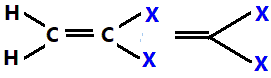
The abbreviated structural formula, displayed structural
formula and skeletal formula for ...
1,1-difluoroethene, 1,1-dichloroethene, 1,1-dibromethene,
1,1-diiodoethene
You might encounter their old names e.g.
1,1-dichloroethylene.
These molecules cannot exhibit E/Z 'geometrical'
isomerism, just positional isomers.
For the same halogen atom, the 1,1-dihalgenated ethene
molecules are constitutional structural (positional) isomers along with the
1,2-dihalogenated ethene molecules.
Number of low resolution
NMR chemical shift
δ
signal peaks: 1 1H
and 2 13C
(email
if disagree?)
The protons have identical chemical environments, but not
the two carbon atoms.
(2)
XHC=CHX where
X = F, Cl, Br or I

The abbreviated structural formula, displayed structural
formula and skeletal formula for ...
1,2-difluoroethene, 1,2-dichloroethene, 1,2-dibromethene,
1,2-diiodoethene
Apart from positional isomerism, these molecules exhibit E/Z
'geometrical' isomerism, the C=C bond being the stereocentre, the E/Z
assignment is quite easy in this case.
From the CIP priority rule: ZX > 1H (where
X = halogen, and Z = 9, 17, 35 or 53)
Reminder, that for the same halogen atom, the E/Z (cis/trans)
geometrical isomers of 1,2-dihalgenated ethene molecules are constitutional
structural (positional) isomers along with the 1,1-dihalogenated ethene
molecules.
To indicate the E/Z (trans/cis) geometrical isomers, you
would be name them as follows:
(E)-1,2-difluoroethene, (E)-1,2-dichloroethene,
(E)-1,2-dibromethene, (E)-1,2-diiodoethene
(Z)-1,2-difluoroethene, (Z)-1,2-dichloroethene,
(Z)-1,2-dibromethene, (Z)-1,2-diiodoethene
In old notation (E) is trans and (Z) is cis, so all the names
can be written as:
trans-1,2-difluoroethene, trans-1,2-dichloroethene,
trans-1,2-dibromethene, trans-1,2-diiodoethene
cis-1,2-difluoroethene, cis-1,2-dichloroethene,
cis-1,2-dibromethene, cis-1,2-diiodoethene
You might encounter their old names e.g.
1,2-dichloroethylene or trans-1,2-dichloroethylene.
Number of low resolution
NMR chemical shift
δ
signal peaks: 1 1H
and 1 13C
because of the symmetry of both E/Z isomer molecules.
(email
if disagree?)
Both pairs of protons and carbon atoms have their own identical
chemical environments, though there might be small difference between the
chemical shifts of the E (trans) and Z (cis) isomers.
There are three
distinct isomers in total, counting the two E/Z
isomers.
There are only 2
possible constitutional structural isomers.
Summary of key points and extra notes on the isomers of molecular
formulae
C2H2F2 ,C2H2Cl2
, C2H2Br2
and C2H2I2
These dihalogenated ethene molecules pack a surprising
variety of isomerism types into a deceptively simple formula.
General Molecular Structure
Each formula corresponds to
C2H2X2, where X is a
halogen (F, Cl, Br, I).
These are derivatives of
ethene (C=C) with
two hydrogen atoms and
two identical halogen atoms
substituted on the double bond.
Types
of Isomerism Exhibited
|
Isomerism Type |
Description |
Applicable to |
Examples / Notes |
| E/Z
geometrical Isomerism (cis-trans) |
Due to
restricted rotation around the double bond; halogens on same side =
Z/cis, opposite side =
E/trans |
All:
C2H2X2 |
e.g.
cis-1,2-dihaloethene
versus
trans-1,2-dihaloethene |
|
Position Isomerism |
Halogens can
be on same carbon (geminal) or on adjacent carbons (vicinal) |
All:
C2H2X2 |
1,1-dihaloethene versus
1,2-dihaloethene |
|
Optical Isomerism |
Rare in
these cases - but could theoretically occur if substituted groups
made a chiral center |
Not
applicable for
C2H2X2 |
No chiral
center possible with identical halogens and simple ethene backbone |
|
Structural (constitutional) Isomerism |
Different
connectivity of atoms.
This is a case of positional isomerism |
All:
C2H2X2 |
CHX=CHX
versus CH2=CX2 - alters
electronic and steric properties |
|
Stereoisomerism |
Encompasses
both E/Z geometrical and R/S optical isomerism |
Applies as
subset |
BUT, only
cis-trans
geometrical isomerism cases here |
Example Breakdown e.g.
for the dichloroethenes: C2H2Cl2
There are three distinct isomers:
-
1,1-dichloroethene - both Cl
atoms on same carbon (geminal)
-
cis-1,2-dichloroethene - Cl
atoms on same side of double bond
-
trans-1,2-dichloroethene - Cl
atoms on opposite sides
These differ in:
-
Dipole moment and polarity (1,1 and 1,2-cis
has net dipole moments, 1,2-trans cancels out)
-
Boiling points and reactivity due to
different spatial arrangements
These statements will equally apply to the
difluoroethenes, dibromoethenes and diiodoethenes.
Common
Misconceptions
-
People often confuse cis-trans (E/Z) isomerism with
positional isomerism, But cis/trans requires
vicinal arrangement on a double bond
1,2-isomers) - it doesn’t apply to the geminal case
(1,1-isomers).
-
Optical isomerism (R/S) doesn’t occur unless there's a
chiral carbon (not possible in these symmetrical molecules with just H and X
substituents).
Extra note on
comparison of boiling points
Boiling points among the C2H2X2
isomers (where X = F, Cl, Br, I) vary due to differences in
intermolecular forces,
molecular polarity, and molecular mass.
Boiling Point Trends of
the isomers by Halogen Type
|
Molecular Formula |
Isomer
Type |
Boiling Point (°C) |
Notes |
|
C2H2F2 |
cis-1,2-difluoroethene |
−36.0 |
Polar; stronger
dipole - dipole interactions |
| |
trans-1,2-difluoroethene |
Lower than cis |
Non-polar; weaker
intermolecular forces |
| |
1,1-difluoroethene |
Varies |
Geminal; less
symmetry, moderate polarity |
|
C2H2Cl2 |
cis-1,2-dichloroethene |
60.2 |
Polar; higher
boiling point |
| |
trans-1,2-dichloroethene |
48.5 |
Non-polar; lower
boiling point |
| |
1,1-dichloroethene |
~37.3 |
Geminal;
intermediate polarity |
|
C2H2Br2 |
cis-1,2-dibromoethene |
~112.5 |
Polar; highest
boiling point among Br isomers |
| |
trans-1,2-dibromoethene |
~108 |
Non-polar;
slightly lower than cis |
| |
1,1-dibromoethene |
~90 - 100 |
Geminal; less
polar than cis |
|
C2H2I2 |
cis-1,2-diiodoethene |
~197 |
Polar; highest
boiling point overall |
| |
trans-1,2-diiodoethene |
Slightly lower
than cis |
Non-polar; less
dipole - dipole interaction |
| |
1,1-diiodoethene |
~180 - 190 |
Geminal;
intermediate boiling point |
Key Factors Influencing Boiling Points
-
Polarity: Z/cis isomers are
generally more polar than E/trans, leading to stronger dipole -
dipole interactions and higher boiling points.
-
Symmetry: E/trans isomers are more
symmetrical, often resulting in lower boiling points due to reduced
polarity.
-
Molecular Mass: Heavier halogens (I > Br >
Cl > F) with more electrons (more polarizable) increase London dispersion
forces, increasing intermolecular bonding force, hence raising boiling
points across the series.
-
Isomer Type: 1,1-isomers (geminal)
tend to have intermediate boiling points due to their unique dipole
arrangements.
Uses of these
halogenated ethenes and their isomers.
Here’s a detailed overview of the isomers and their
uses for the molecular formulas, all of which are
halogenated ethenes with geometric (cis/trans) and positional
isomerism.
General Overview of Isomers
Each of these compounds has:
-
1,1-isomer: both halogen atoms on the same
carbon
-
cis-1,2-isomer: halogens on adjacent
carbons, same side
-
trans-1,2-isomer: halogens on adjacent
carbons, opposite sides
These isomers differ in polarity,
boiling points, reactivity, and industrial
utility.
C2H2F2
(Difluoroethene)
Isomers:
-
1,1-Difluoroethene
-
cis-1,2-Difluoroethene
-
trans-1,2-Difluoroethene
Applications:
-
Refrigerants: Used in hydrofluoroolefins
(HFOs), especially in low-global-warming refrigerants.
-
Polymer precursors: Building blocks for
fluoropolymers like Teflon.
-
Electronic materials: Used in plasma
etching and semiconductor processing.
-
Research: Studied for unique dipole
interactions and cis-trans stability inversion.
C2H2Cl2
(Dichloroethene)
Isomers:
-
1,1-Dichloroethene
-
cis-1,2-Dichloroethene
-
trans-1,2-Dichloroethene
Applications:
-
Solvents: Used in degreasing and cleaning
agents, especially trans-isomer.
-
Intermediate in vinyl chloride production:
A precursor for PVC plastics.
-
Chemical synthesis: Participates in
coupling and cycloaddition reactions.
-
Environmental studies: Found as a breakdown
product of trichloroethene in polluted sites.
C2H2Br2
(Dibromoethene)
Isomers:
-
1,1-Dibromoethene
-
cis-1,2-Dibromoethene
-
trans-1,2-Dibromoethene
Applications:
-
Flame retardants: Used in fire-resistant
materials.
-
Organic synthesis: Intermediate for
pharmaceuticals and agrochemicals.
-
Material science: Studied for molecular
geometry and dipole behavior.
-
Nonpolar solvents: Trans-isomer is nonpolar
and used in specialized solvent systems.
C2H2I2
(Diiodoethene)
Isomers:
-
1,1-Diiodoethene
-
cis-1,2-Diiodoethene
-
trans-1,2-Diiodoethene
Applications:
-
Radiopaque agents: Iodine-rich compounds
are used in medical imaging.
-
Synthetic intermediates: Useful in coupling
reactions due to iodine’s leaving group ability.
-
Research: Valuable in studying halogen
effects on molecular stability and reactivity.
Comparative Table of Isomer Uses
|
Compound |
Key Uses |
Notable Traits |
|
C2H2F2 |
Refrigerants,
polymers, electronics |
Cis more stable
than trans |
|
C2H2Cl2 |
Solvents, PVC
precursor, environmental studies |
Trans used in
cleaning |
|
C2H2Br2 |
Flame retardants,
synthesis, solvents |
Trans is nonpolar |
|
C2H2I2 |
Radiopaque agents,
synthesis, research |
High molar mass,
less stable cis |
Learning objectives - questions to be answered?
How do you draw the structural
formula and skeletal formula of the isomers of molecular formula C2H2Cl2 C2H2Br2
C2H2F2 C2H2I2?
How many aliphatic
structural isomers are there of halogen compounds with molecular formula
C2H2Cl2 C2H2Br2 C2H2F2 C2H2I2?
How many aliphatic carbon
chain isomers are there of halogen compounds with molecular formula
C2H2Cl2 C2H2Br2 C2H2F2 C2H2I2?
How many positional
isomers are there of organic halogen molecules with molecular formula
C2H2Cl2 C2H2Br2 C2H2F2 C2H2I2?
How many E/Z (geometrical)
isomers are there of molecular formula C2H2Cl2 C2H2Br2 C2H2F2 C2H2I2?
How many R/S (optical)
isomers (enantiomers) of molecular formula C2H2Cl2 C2H2Br2 C2H2F2
C2H2I2?
Are there any cyclic
haloalkene isomers of formula C2H2Cl2 C2H2Br2 C2H2F2 C2H2I2?
Are there any cyclo
haloalkane isomers of formula C2H2Cl2 C2H2Br2 C2H2F2 C2H2I2?
Are there any halodiene
isomers of molecular formula C2H2Cl2 C2H2Br2 C2H2F2 C2H2I2?
Are there any haloalkyne
isomers of molecular formula C2H2Cl2 C2H2Br2 C2H2F2 C2H2I2?
Are there any functional
group isomers with a molecular formula C2H2Cl2 C2H2Br2 C2H2F2 C2H2I2?
Do C2H2Cl2 C2H2Br2
C2H2F2 C2H2I2 organic halogen molecules have any stereoisomers?
Are there any E/Z
(geometrical) isomers with a molecular formula C2H2Cl2 C2H2Br2 C2H2F2
C2H2I2?
Are there any R/S
(optical) isomers (enantiomers) with a molecular formula C2H2Cl2 C2H2Br2
C2H2F2 C2H2I2?
This page will answer these questions for molecular formulae
C2H2F2,
C2H2Cl2, C2H2Br2
and
C2H2I2
Associated organic chemistry links
Index of sets of isomers for a given
molecular formula
The molecular structure and naming of
HALOALKANES
(how to name and draw alkane structures)
The molecular structure and naming of ALKANES
(how to name and draw alkane structures)
The molecular structure and naming of ALKENES
(how to name and draw alkene structures)
Index of revision notes on the chemistry
HALOALKANES
including reactions
Advanced
Level pre-university organic chemistry notes
IR,
mass and H-1 and C-13 NMR spectra of organic compounds
For isomerism in organic chemistry, see also the
notes
Isomerism: introduction, structural
isomerism - chain, positional, functional group, tautomerism
Stereoisomerism: introduction, definition, priority rules, E/Z
isomerism (cis/trans isomerism)
Stereoisomerism - R/S isomerism (optical
isomerism) - definition - examples explained
This is a
big chemistry website, please allow time to explore it
A summary chart of isomerism

|
Website content © Dr Phil Brown 2000+. All copyrights reserved on
revision notes, images, quizzes, worksheets etc. Copying of website
material is NOT permitted. Exam revision summaries & references to
science course specifications are unofficial. |
Keywords or phrases:
isomers of halogenoalkanes, how many isomers are there of
halogen compounds of molecular formula C2H2Cl2 C2H2Br2 C2H2F2
C2H2I2? what is the structure of the halogen compound isomers of
molecular formula how do you name the isomers of molecular
formula C2H2Cl2 C2H2Br2 C2H2F2 C2H2I2? what is the molecular
structure of the isomers of C2H2Cl2 C2H2Br2 C2H2F2 C2H2I2, what
type of isomerism is exhibited by molecules of formula C2H2Cl2
C2H2Br2 C2H2F2 C2H2I2, how do you work out the isomers
of haloalkanes formula C2H2Cl2 C2H2Br2 C2H2F2 C2H2I2, what are
the structural isomers of C2H2Cl2 C2H2Br2 C2H2F2 C2H2I2, the
carbon chain isomers of C2H2Cl2 C2H2Br2 C2H2F2 C2H2I2 in the
homologous series of alkanes, comparing the many structural
isomers does C2H2Cl2 C2H2Br2 C2H2F2 C2H2I2 have? what are the
possible isomers of C2H2Cl2 C2H2Br2 C2H2F2 C2H2I2? revision
notes on isomerism of C2H2Cl2 C2H2Br2 C2H2F2 C2H2I2 molecules,
the molecular structure of the isomers of C2H2Cl2 C2H2Br2 C2H2F2
C2H2I2 how to draw the structural formula of isomers of C2H2Cl2
C2H2Br2 C2H2F2 C2H2I2, how to draw the displayed formula of
isomers of C2H2Cl2 C2H2Br2 C2H2F2 C2H2I2, how to draw the
skeletal formula of halogenoalkane compound isomers of formula
C2H2Cl2 C2H2Br2 C2H2F2 C2H2I2, how to name the isomers of
molecular formula C2H2Cl2 C2H2Br2 C2H2F2 C2H2I2,
R/S optical isomers enantiomers of C2H2Cl2 C2H2Br2 C2H2F2 C2H2I2
isomeric with molecular formula C2H2Cl2 C2H2Br2 C2H2F2 C2H2I2,
structural isomers of molecular formula C2H2Cl2 C2H2Br2 C2H2F2
C2H2I2, optical isomers R/S enantiomers isomeric with molecular
formula C2H2Cl2 C2H2Br2 C2H2F2 C2H2I2, positional isomers
isomeric with halocycloalkenes, haloalkanes, haloalkynes,
haloalkenes of molecular formula C2H2Cl2 C2H2Br2 C2H2F2 C2H2I2,
which types of isomerism are exhibited by molecules of formula
C2H2Cl2 C2H2Br2 C2H2F2 C2H2I2 alkyl positional isomers of
C2H2Cl2 C2H2Br2 C2H2F2 C2H2I2 branched carbon chain isomers of
C2H2Cl2 C2H2Br2 C2H2F2 C2H2I2, stereoisomers of molecular
formula C2H2Cl2 C2H2Br2 C2H2F2 C2H2I2,
optical isomers R/S enantiomers isomeric with molecular formula
C2H2Cl2 C2H2Br2 C2H2F2 C2H2I2, positional isomers isomeric with
molecular formula C2H2Cl2 C2H2Br2 C2H2F2 C2H2I2, which types of
isomerism are exhibited by C2H2Cl2 C2H2Br2 C2H2F2 C2H2I2 halogen
atom positional isomers of C2H2Cl2 C2H2Br2 C2H2F2 C2H2I2, how to
work out the halogen compound names of isomers of C2H2Cl2
C2H2Br2 C2H2F2 C2H2I2, haloalkene C2H2Cl2 C2H2Br2 C2H2F2 C2H2I2
isomers, cycloalkane isomers of C2H2Cl2 C2H2Br2 C2H2F2 C2H2I2,
cycloalkene isomers of C2H2Cl2 C2H2Br2 C2H2F2 C2H2I2
|
