|
GCSE level exam revision notes on Evolution:
8.
Evidence
of human evolution - fossil skeletons, stone tools and modern
genetic analysis
[Author
©
Dr Phil Brown PhD:
Doc Brown's biology exam revision notes suitable for students of UK
IGCSE & GCSE level biology courses & ~ US grades 9-10 biology
[evolution page updated
Mar 11th 2026 *]
[email doc
b: comment? query?]
*
[privacy-policies-disclaimer] * ]SEARCH doc b's
website]
[Key
points and learning objectives for this page, after the main body of
notes]
Sub-index of biology notes on all aspects of EVOLUTION
(8)
The evidence of human evolution - from stone tools to modern genetic
analysis
What does the fossil record and artefacts tell
us about ourselves!
Since we are the species which has elucidated a
theory of evolution, it seems appropriate to look at how we our selves
(homo sapiens) have evolved!

As a child, I was fascinated by this picture of
skeletons in a book my mother had, called "Apes and Men" published by
Oxford: The Clarendon Press (Oxford University Press) in 1927.
The skeletons alone suggest they all have a common
ancestor! but note the changes in the relative length of arms and
legs, and the structure of the feet and skull (including the size of
the brain
containing cranium).
Actually humans and chimpanzees are descended
from a common ancestor - things have moved on since 1927, but the
idea is correct, if not in true evolutionary detail.

Skeletons of a human, chimpanzee, orang-utan
and male gorilla
in the Natural History Museum, Dublin
We (humans and like species, genus Homo) split
from chimpanzees (genus Pan) from a common ancestor about 4-7 million years ago - its not that
long ago in terms of geological time!
(The Earth is 4500 million years old, 4.5 x 10⁹ years)
The split is difficult to pin-point in time
because only fragments of fossil bones are found and they, and the
surrounding rock layers, are difficult to date precisely.
Rocks are dated from the ratios of elements in
them including lead Pb, samarium Sm, neodymium Nd and argon Ar - the
calculations are very complex and not without error, but improving
with more research and cross-checking of data between different
research groups. This branch of science is called radiometric
dating.
Human beings and their ancestors are called
hominids, but despite the scarcity of good quality fossils, from the
fossil record, it is possible to show how we have evolved over
the past ~5 million years.
The human fossil record and timeline
-
tabular style for a clear comparison
The early hominid fossils have characteristics
somewhere between true apes and true modern humans.
The structure of feet, legs, arms and
skull are of particular importance, and of course, a measurement
of brain size.
You can also see evidence of evolution through
the development of tools using stone and wood.
Gradually, stone tools became more
sophisticated, along with brain development.
Generally speaking, the lower the layer of
rock the fossils and tools are found in, the older the materials
at that level.
The structural features of the tools tells
you about their age - the more sophisticated, the more recent.
If a stone tool is found with a wooden
handle, or non-mineralised skeleton (still bone), they will
contain the element carbon and can be dated by carbon-14 dating
(14C is a radioactive isotope of carbon with a half-life of
~5700 years).
For more on dating organic materials see
Uses of decay data and half-life values
-
archaeological radiocarbon dating, dating ancient rocks GCSE
chemistry/physics revision notes
Metals were first extracted and used
around 11000 years ago, well after the first appearance of
modern humans - copper was extracted from crushed rock and
beaten into shape - but smelting came a bit later!
|
Fossil name
and species |
~Age in millions of years |
Skull and
brain size (cranial capacity - brain area in skull) |
Structure of feet |
Arms and legs |
Comments |
| 'Ardi' Ardipithecus
ramidus female from Ethiopia |
4.4 |
Brain size similar to chimpanzee ~35 kg, 350
cm3 |
Suggests she climbed trees - had a big toe to
grasp branches. |
She had long arms and short legs - more like
an ape than human, but leg structure suggests she walked upright
(bipedal) and didn't use hands to walk like apes do. |
A mixture of ape and human features. |
|
'Lucy'
Australopithecus afarensis from Ethiopia |
3.2 |
Brain slightly
bigger than Ardi's ~37kg, 430 cm3 but still similar to
chimps. |
Arched feet, more adapted
to walking than climbing and no ape-like big toe. |
The arm and leg sizes are
between that of apes and humans, and suggest she walked upright more
efficiently than Ardi |
A mixture of ape and human
features, but a bit more 'human' than Ardi. |
| 'Turkana Boy' species of
Homo erectus |
1.6 |
Brain much larger than
Lucy's,~1000 cm3, but still less than modern humans |
Feet and leg structure suggest that he was
even better adapted to walking upright than Lucy. |
He had short arms and long legs, much more
human than an ape - better to upright walking than 'Lucy'. |
Still a mixture of ape and human features,
but significantly more 'human-like' than Lucy. |
|
Modern humans
Homo sapiens |
0.1 - 0.2 |
significant
increase in brain size ~57 kg, 1450 cm3 |
|
|
|
Further comments
on the table of hominids
The table only quotes a few of the many
hominid fossils that have been found, but they are, I hope,
sufficient, to illustrate the evolutionary path by which a species
emerges that can investigate its own complex path of development!
From the table the general evolutionary
trends from early hominids to modern humans are:
(i) A general increase in brain size -
survival of the best 'thinkers'.
(ii) Arms are no longer required to help
in walking - free to develop to do other skilful things!
(iii) Feet and legs evolve to give true
bipedal upright walking.
(iv) The craftsmanship and sophistication
of stone tool gradually improves.
In the 1980s a scientist called Richard Leakey
led an expedition to Kenya in Africa to look for hominid fossils. He
and his teams, discovered many important fossils of different
species of the genus Australopithecus and genus
Homo
Apparently for most of the past 2 million
years, there was only a small increase in brain size, but from
100000 to 200000 years ago, evolutionary selection pressures
produced a smaller body mass and larger brain.
Examples of stone tool development
Homohabilis (2.5 to 1.5 million
years ago)
Made simple crude stone tools by bashing
rocks together to make sharp flakes that could be used to scrape
meat off bone and extract marrow from cracked bones.
Homo erectus (includes Turkana
Boy', 2.0 to 0.3 million years ago)
More sophisticated 'sculpturing' of rocks
to make simple hand axes - these could be used for chopping
meat/wood, scraping meat from bone and a hunting weapon.
Homo Neanderthals (300 000 to 2
million years ago)
A species that
went extinct around 30,000 to 40,000 years ago, emerged ~0.4 million
years ago.
Able to make good quality flint tools e.g.
sharper axes, pointed tools that could bore into wood and wooden
spears for hunting.
Flint is a hard sedimentary rock material
that can be split into thin layers that can act as blades.
Larger flint tools can be made by striking
a large lump to break of flakes and gradually work it into a
useful shape like an axe blade - which can be mounted in a
wooden shaft.
Homo sapiens (200,000 years ago
to the present)
Further improvements in working stone -
precisely carved arrow heads from flint.
From 50,000 years ago (at least) a
wider range of natural materials is being exploited e.g. spear
heads fish hooks from carving antlers, buttons and needles
appear in the archaeological record.
Some examples of stone tools and dating
them
For dating organic materials see
archaeological radiocarbon dating, dating ancient rocks
GCSE chemistry/physics revision notes
Radiocarbon dating is based on carbon
atoms that were once part of a living organism and so cannot be
used to date rock layers or stone tools.
There are several methods used to date rocks in
which stone tools are found.
(i) Tools can be put into a crude timeline based
on their sophistication.
e.g. as the tools become more recent, their
structural features become elaborate.
(ii) Stratigraphy is the study of rock layers.
The deeper the layer of rock where the hominid
fossil or stone tool is found in, the older it is more likely to be.
Over time, over thousands of years, any
surface layer becomes gradually covered with deposits of e.g.
weathered rock or volcanic ash.
This covers fossils and stone tools, entombing
them in a particular and successively older geological layer
Therefore you can produce a timeline of
hominid fossils and stone tools from what archaeologists and
palaeontologists
find in success rock layers by (i) digging down carefully through
rock layers relatively near the surface or (ii) deeper layers
exposed by erosion or tectonic plate activity.
(A
palaeontologist is a scientist who studies the fossilized remains of
all kinds of organisms (plants, animals, fungi, bacteria and other
single-celled living things), and is interested in knowing the
history of organic life on earth.)

Derby Museum - Stone
tools, mainly flint, used by people 300,000 to 180,000 years ago.
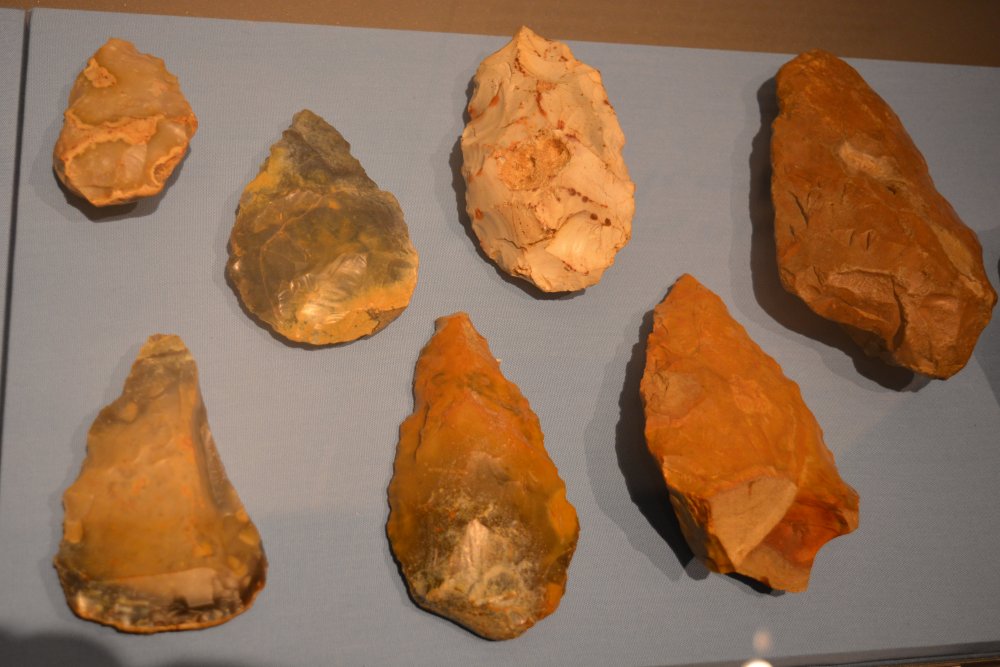
Flint hand axe heads of palaeolithic man from 180,000
t0 450,000 years ago, mostly from Lincolnshire (The Collection Museum,
Lincoln)
Some are a bit more sophisticated than
the ones in Derby Museum.

Polished stone from
the Neolithic Age found on Shetland, much more recent, 4500-6000 years
old, much more recent, often produced with great skill, perhaps as
ceremonial objects of status?

An elk antler fashioned
into a digging tool
|

An inscribed pendant,
11,000 years old
|

An efficient barbed
hunting too made from antler bone
|

Flint nodule from
smaller flake scraper tools can be made
|
Examples of Mesolithic
('middle stone age) artefacts in the Yorkshire Museum, York,
some from the famous Mesolithic site of Starr Carr near
Scarborough. The Mesolithic period in Britain dates from around
11000 to 6000 years ago.
You can see from the series of
photographs of stone and wooden tools that they have become more elaborate
with decreasing age.
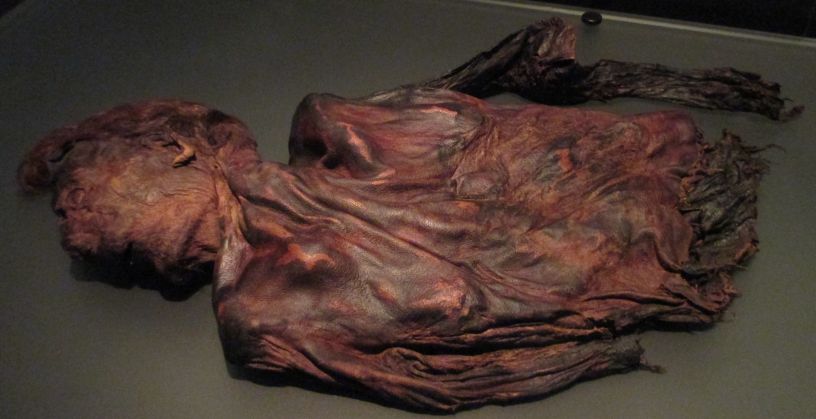
National Archaeology Museum, Dublin,
Ireland - well worth a visit - a wonderful museum
Clonycavan Man, an iron age bogman dated, by
radiocarbon dating to 392-201 BCE (~25 years old)
Changes in the DNA of prehistoric man can be measured with modern
genetic analysis, particularly from well preserved bodies found in bogs,
usually from some ceremonial-religious ritual activity.
Lactose tolerance and intolerance
For example a mutation occurred, maybe 9000 years ago (the
lactose mutation), that allowed neolithic and their modern
successors to digest animal milk (cows, goats etc.) beyond breast
feeding. Genetic researchers compared archaeological evidence for
9,000 years of European milk and found an unusually rapid, evolution
of lactose tolerance among Europeans well after they first started
consuming the animal milk other than human breast milk.
However,
some people do not have that particular 'lactose tolerant' mutation
and suffer from lactose intolerance, which is quite a common
digestive problem where the body is unable to digest lactose, a type
of sugar mainly found in milk and dairy products. Symptoms of
lactose intolerance usually develop within a few hours of consuming
food or drink that contains lactose.
Key points
Based on
the syllabus-specifications for students taking the AQA, Edexcel and OCR
GCSE level biology examinations (~US grades 9-10).
Key
points of human evolution
Evidence of Human
Evolution
Human evolution is supported
by multiple sources of evidence, including fossil skeletons, stone
tools, genetic analysis, and other findings.
These clues allow scientists
to trace our ancestry, understand adaptations, and determine how humans
evolved over millions of years.
1. Fossil Skeletons as
Evidence of Human Evolution
Fossils provide physical proof of
anatomical changes in hominins over time.
Key Fossil Discoveries
-
Ardipithecus ramidus
(4.4 million years ago)
-
Australopithecus
afarensis ("Lucy") (3.2 million years ago)
-
Walked upright (bipedal)
but had a small brain size (~400cc).
-
Foot structure suggests
human-like movement, proving early adaptation to walking.
-
Homo habilis (2.4–1.4
million years ago)
-
Known as "Handy Man"
because of simple stone tool use.
-
Larger brain (~600cc)
compared to earlier hominins, indicating cognitive development.
-
Homo erectus (1.8
million – 300,000 years ago)
-
Fully upright posture and
larger brain (~1000cc).
-
Used advanced stone tools
and fire, showing problem-solving skills.
-
Homo neanderthalensis
(400,000 – 40,000 years ago)
-
Stocky build adapted for
cold climates.
-
Evidence of social
structures, tool-making, and burial practices.
-
Homo sapiens (300,000
years ago – present)
-
Larger brain (~1300cc) and
complex reasoning skills.
-
Development of language,
culture, and advanced technology.
2.
Stone Tools as
Evidence of Cognitive Evolution
Stone tools illustrate the
increasing intelligence and problem-solving abilities of human ancestors.
Progression of Tool Use
-
Oldowan Tools (Homo
habilis, ~2.5 million years ago)
-
Acheulean Tools (Homo
erectus, ~1.6 million years ago)
-
Mousterian Tools
(Neanderthals, ~200,000 years ago)
-
Upper Paleolithic
Tools (Homo sapiens, ~40,000 years ago)
3.
Genetic Analysis as
Evidence of Evolution
Modern genetic research helps
confirm relationships between ancient hominins and present-day humans.
Key Genetic Evidence
-
Comparative DNA
studies show humans share
98–99% of DNA with chimpanzees, confirming common ancestry.
-
Neanderthal DNA:
Some modern humans (European and Asian populations) contain ~1-2%
Neanderthal genes, showing interbreeding occurred.
-
Mitochondrial DNA
(mtDNA) supports the "Out of
Africa" theory, tracing all modern human ancestry to a single African
population.
4. Other Evidence
Supporting Human Evolution
-
Fossilized Footprints:
Evidence from Laetoli, Tanzania (~3.6 million years ago) shows
early bipedalism in Australopithecus.
-
Brain Size Increase:
Skull fossils show how brain size expanded over time, allowing advanced
thought.
-
Cultural Evolution:
Cave paintings, symbolic objects, and burial rituals highlight growing
intelligence and abstract thinking.
Importance of These
Findings on human evolution
-
Confirms Common
Ancestry – Fossil and genetic
evidence proves humans evolved from ape-like ancestors.
-
Explains Adaptations
– Shows how walking, tool use, and brain development allowed survival.
-
Supports Evolutionary
Theory – Provides clear proof
that natural selection shaped human traits over time.
The combined study of
fossils, tools, genetics, and cultural artifacts creates a
comprehensive picture of human evolution, helping us understand our origins
and how we became the species we are today.
Summary of learning objectives and key words or phrases
Know and be able to describe or interpret, evidence of human evolution from
the fossil record of skeletons.
Know how
stone tools, bone tools and modern genetic analysis all contribute to
understand the evolution of human beings.
Know about the lactose tolerance
mutation that occurred in prehistoric man.
Be able to discuss and interpret archaeological findings of palaeolithic
man, neolithic man and bronze age man.
WHAT NEXT?
TOP OF PAGE
INDEX
of biology notes on all aspects of EVOLUTION
Big website and use [SEARCH
BOX] below, maybe quicker than the indexes
INDEX of all my BIOLOGY NOTES
HOME PAGE of Doc Brown's Science
website
UK KS3 Science Quizzes for
KS3 science students aged ~11-14, ~US grades 6, 7 and 8
Biology * Chemistry
* Physics UK
GCSE level students aged ~14-16, ~US grades 9-10
Advanced Level Chemistry
for pre-university age ~16-18 ~US grades 11-12, K12 Honors
Find your GCSE/IGCSE
science course for more help links to all science revision notes
email doc
brown - comments - query?
Explaining importance of Evidence of
human evolution from fossil skeletons, stone tools & DNA genetic
analysis
in GCSE level biology, What you need to know about Evidence of human
evolution from fossil skeletons, stone tools & DNA genetic analysis for
GCSE level
biology,
Explaining use of Evidence of human evolution from fossil skeletons,
stone tools & DNA genetic analysis knowledge in GCSE level biology, Examples of
Evidence of human evolution from fossil skeletons, stone tools & DNA
genetic analysis
explained when studying GCSE level biology, What is the significance of
Evidence of human evolution from fossil skeletons, stone tools & DNA
genetic analysis in GCSE level biology, describing
explaining theory of Evidence of human evolution from fossil skeletons,
stone tools & DNA genetic analysis when studying GCSE level biology, exam revision
notes for Evidence of human evolution from fossil skeletons, stone tools
& DNA genetic analysis, online help for understanding Evidence of human
evolution from fossil skeletons, stone tools & DNA genetic analysis in GCSE
biology, what do I need to learn about Evidence of human evolution from
fossil skeletons, stone tools & DNA genetic analysis? what do I need to know about
Evidence of human evolution from fossil skeletons, stone tools & DNA
genetic analysis for GCSE biology exams, how to prepare for questions on
Evidence of human evolution from fossil skeletons, stone tools & DNA
genetic analysis in GCSE
biology examination? Evidence of human evolution from fossil skeletons,
stone tools & DNA genetic analysis for
syllabus-specifications
for students taking the IGCSE/GCSE level biology examinations, summary
revision notes key points on Evidence of human evolution from fossil
skeletons, stone tools & DNA genetic analysis for students studying AQA
igcse/gcse biology notes on Evidence of human evolution from fossil skeletons,
stone tools & DNA genetic analysis, Edexcel gcse
biology notes on Evidence of human evolution from fossil skeletons,
stone tools & DNA genetic analysis, OCR 21st century GCSE
biology notes on Evidence of human evolution from fossil skeletons,
stone tools & DNA genetic analysis, OCR gateway
GCSE biology notes on Evidence of human evolution from fossil
skeletons, stone tools & DNA genetic analysis, WJEC gcse biology notes on
Evidence of human evolution from fossil skeletons, stone tools & DNA
genetic analysis, CCEA
gcse biology notes on Evidence of human evolution from fossil skeletons,
stone tools & DNA genetic analysis, CIE Cambridge igcse
biology, notes on
Evidence of human evolution from fossil skeletons, stone tools & DNA
genetic analysis useful for US grade 9-10 biology student courses
SITEMAP Website content © Dr
Phil Brown 2000+. All copyrights reserved on Doc Brown's biology revision notes, images,
quizzes, worksheets etc. Copying of website material is NOT
permitted. Exam revision summaries and references to science course specifications
are unofficial.
|
