1. Why is the
enzyme catalase important? Why study its biochemistry?
Catalase is a vital enzyme
in the human body because it converts toxic hydrogen peroxide H2O2,
a natural by-product of cellular metabolism, into harmless water H2O
and oxygen O2.
2H2O2(aq) ===> 2H2O(l)
+ O2(g)
This is a rapid
detoxification process that prevents cellular and DNA damage to help
safeguard critical structures in the body and also protecting against
chronic diseases
In terms of hydrogen peroxide, three important functions of catalase in
the human body are:
(a) It is one of
the most efficient antioxidant enzymes because it neutralizes highly
reactive oxygen species. This reduces oxidative stress, which is a major
factor in cell aging, premature greying of hair, and organ tissue
degeneration.
(b) To minimise
cell damage because hydrogen peroxide is highly destructive to proteins,
lipids, and DNA - three essential groups of molecules in cell structure
and function. Catalase rapidly breaks down hydrogen peroxide and,
amazingly, one catalase molecule can decompose millions of molecules of
hydrogen peroxide per second. In doing so it protects critical organs,
particularly the liver and kidneys, where the enzyme catalase is most
concentrated.
(c) The enzyme
catalase is important in maintaining the health, and therefore function
of cells by reducing oxidative damage, so catalase plays a vital role in
preventing or reducing the severity of various conditions e.g. shows it
has protective effects against cardiovascular and inflammatory issues.
As you
can see, catalase, like many other enzymes, is extremely important in
the biochemistry that keeps us alive and hopefully in good health.
For these investigation experiments the
catalase source can be liver tissue, potato cubes or yeast solution
2.
Chemistry reminders - activation energy and the key & lock mechanism of
enzymes
 Here the enzyme is catalase
Hydrogen peroxide is quite a stable
molecule and only decomposes slowly in aqueous solution at room
temperature to form water and oxygen gas.
2H2O2(aq)
===> 2H2O(l) + O2(g)
For any reaction, there is an energy
barrier called the activation energy ('black hump' on the
reaction profile diagram above).
This prevents the majority of, (in
this case), hydrogen peroxide molecules from reacting on collision i.e.
they do not have sufficient kinetic energy to react on collision
to break open bonds and form new bonds in the product molecules.
The enzyme catalase considerably reduces
the activation energy for the catalase - hydrogen peroxide reaction (the
'green hump' on the diagram above).
This means a much
greater proportion of hydrogen peroxide molecules can be decomposed on
collision with the enzyme catalase.
The reaction proceeds via a key and
lock mechanism illustrated below.
The hydrogen peroxide molecule collides
with the active site on the catalase enzyme which very efficiently
'manipulates' the molecule to break it down into the water and oxygen
reaction products - enzymes are very good at breaking bonds open!
2H2O2(aq)
== catalase ==> 2H2O(l) + O2(g)

Guide to the key and lock
mechanism for the enzyme catalytic decomposition of hydrogen peroxide by
catalase. Hydrogen peroxide is the substrate molecule.
Ignoring the real shapes
of the enzyme protein, H2O2, O2
and H2O molecules!
Red = enzyme catalase, blue =
hydrogen peroxide, purple = oxygen, brown = water
3. Decomposition of hydrogen peroxide by catalase
- introducing the investigations and explaining the experimental variables
involved
In this experiment you are measuring the rate at which oxygen is formed
from the enzyme catalase decomposing hydrogen peroxide.
Here, the product
oxygen gas, provides the means of following the rate of the reaction.
Enzyme reaction equation: hydrogen peroxide ===
catalase ===> water + oxygen (gas)
2H2O2(aq)
====> 2H2O(l) + O2(g)
All the experiment investigations described depend on
measuring the rate of oxygen gas formed by measuring its volume versus
time e.g. rate of decomposition = VO2/minute.
Therefore the measured volume of oxygen is the
dependent variable from which the reaction rate is measured.
For an enzyme-substrate molecule reaction there are
four independent variables:
(a) The concentration of the substrate molecule
(hydrogen peroxide)
(b) The concentration of the enzyme
(catalase)
(d) The temperature of the reaction mixture.
(c) The pH of the reaction mixture.
Therefore, to investigate any one independent variable,
you must keep the other three constant and then measure the dependent
variable.
For this reaction there three experimental
situations are fully described
4.
Changing concentration of substrate molecule or
enzyme
5.
Changing the temperature of the reaction mixture -
looking for the optimum
6.
Changing the pH of the reaction mixture - looking for
the optimum
For each factor a little 'rate of reaction' theory of the results is
added at the end of the full description of the method and results of
the catalase - hydrogen peroxide reaction.
Two ways
are described for measuring the volume of oxygen evolved in the reaction
Method 1. Upward
delivery into an inverted measuring cylinder (less accurate)
Method 2. Using a gas
syringe system (more accurate)
4. Investigating the effect of changing concentration -
hydrogen peroxide or catalase
There is a short
theory section at the end of 4. explaining the results.
 .
.
(4a) The basic
procedures for method 1.
Method 1. A
method of measuring the rate of product formation from an enzyme reaction
(a)
Investigating the effect
of changing the concentration for an enzyme reaction
(decomposition of hydrogen
peroxide to water and oxygen using the enzyme catalase)
(vary either the hydrogen peroxide or
the enzyme catalase).
Enzyme reaction equation: hydrogen peroxide ===
catalase ===> water + oxygen (gas)
2H2O2(aq)
====> 2H2O(l) + O2(g)
Mashed up potato made into a fine slurry
diluted with acts as a
source of the enzyme catalase. It needs to be well shaken before use so
that each portion measured out has the same amount of catalase in it.
A slurry is a pulverized solid
of fine particles mixed in
a liquid.
You need a series of hydrogen peroxide solutions
of known different concentrations and a fixed concentration of the potato
mix to investigate the effect of changing the hydrogen peroxide
concentration.
You may have to do some 'trial and error'
experiments to find out which amounts give 'reasonable' results.
You can also keep the hydrogen peroxide
concentration constant and do the investigation with a set of
different concentrations of the potato-catalase mixture.
The water bath is set to a constant temperature
e.g. 25oC. The apparatus is setup as illustrated above.
The optimum conditions for human
catalase are pH 7 (so no need for buffer) and 37oC
If no thermostated water bath is available you can
get reasonable results if the laboratory temperature stays reasonably
constant - but record and monitor the room temperature.
You can use a beaker of heated water but its
difficult to keep it at a constant temperature.
The 'stock' solutions of potato-catalase or hydrogen
peroxide should be initially in separate boiling tubes and placed in the
water bath so that everything starts at the right temperature. Or, if no
water bath available, they can be just put together in test tube racks on
the laboratory bench, but you should monitor and record the room
temperature.
Depending on what accuracy you require, you can
measure out a fixed amount of the potato slurry and a varied amount of
the same hydrogen peroxide solution into the boiling tube using a
pipette, or 10 cm3 measuring cylinder or plastic syringe.
You should keep the total volume of the reaction mixture the same.
There shouldn't be a need for a buffer, but
the mixture should have a constant pH of ~7.
If in doubt build a fixed volume of a pH 7
buffer into your method.
You should make up the reaction mixture of
hydrogen peroxide and potato slurry as quickly as possible and shake
well.
Your reaction mixture to vary the hydrogen
peroxide concentration may be as follows
w cm3 of buffer (if used)
x cm3 of potato slurry - kept
constant
y cm3 of hydrogen peroxide solution
- variable
z cm3 of water - variable
w + x + y + z = total constant volume and
volume y + z must also be kept constant.
You can vary y and z to give different
concentrations if different stock solutions of
By varying volumes y and z you can produce
a range of hydrogen peroxide concentrations if a variety of
stock solutions are not available..
Procedure
The boiling tube and mixture is quickly connected
to the delivery tube rubber bung and placed in the water bath and the stop watch started.
Make sure the boiling tube is fully immersed in water so it and the
contents are at the right temperature.
Start the stopwatch. You can now measure how much oxygen is formed in a
set time e.g. 1 minute, and repeat the experiment several times with the
same volumes of reactants at the same temperature.
This will allow a
more accurate mean value of the rate of reaction to be used in the final analysis.
 (Or set of volume readings for one run over a longer time, and plot graph of volume versus time
and measure the initial gradient, but more work for repeats - see graph
on the right)
(Or set of volume readings for one run over a longer time, and plot graph of volume versus time
and measure the initial gradient, but more work for repeats - see graph
on the right)
However you get the results, the rate is
calculated as follows:
From the initial gradient of the graph, the rate of enzyme reaction is expressed as:
rate = volume
of O2 formed ÷ time taken (cm3/s)
 You then
draw a graph of the mean values of the rate of reaction (in cm3/s)
at each temperature versus concentration.
You then
draw a graph of the mean values of the rate of reaction (in cm3/s)
at each temperature versus concentration.
You should find that the rate increases with
increase in either hydrogen peroxide or enzyme concentration, if you
have been very accurate you may
get a nice linear graph like the one on the right or else!
You then repeat the whole exercise with different
concentrations of the enzyme using the kind of x + y + z 'recipe'
described above using a fixed concentration of hydrogen peroxide.
Method 2.
Gas syringe system
It is possible to get more accurate results using a
gas syringe system, as long as the flask can be set up in a water bath
(omitted from the diagram below!) or the laboratory temperature stays
constant.
The investigation is conducted in the same way as
already described above.

You can get more accurate data of the volume of oxygen
formed over time and from the graphs work out the initial rate of reaction
from the initial gradient (see right-hand side of above diagram).

Graph line A (steeper gradient) compared to graph line
B may represent an increase in concentration of either substrate or enzyme,
or an increase in temperature or a solution pH nearer the
optimum value for that particular enzyme.
See also GCSE chemistry notes:
Effect on rate of changing reactant
concentration in a solution
4. Theory of the effect of changing
the concentration of hydrogen peroxide or catalase
This is usually,
initially, a linear relationship between rate of reaction and
concentration of a reactant. This is based on a simple probability
argument.
e.g. doubling a
concentration often doubles the rate of reaction because it doubles the
probability of a fruitful decomposition collision between the catalase
and hydrogen peroxide.
However, at high
concentrations of the substrate molecule (hydrogen peroxide), all the
active sites on the enzymes are occupied and the rate of decomposition
becomes constant i.e. you see a plateau on the graph line.
5. Investigating the effect of changing the reaction
mixture temperature
There is a short
theory section at the end of 5. explaining the results.
(5b)
Investigating the effect
of changing temperature
for an enzyme reaction
(decomposition of hydrogen
peroxide to water and oxygen using the enzyme catalase)
Enzyme reaction equation: hydrogen peroxide ===
catalase ===> water + oxygen (gas)
2H2O2(aq)
====> 2H2O(l) + O2(g)
Mashed up potato made into a fine slurry diluted
with water acts as a
source of the enzyme catalase. It needs to be well shaken before use so
that each portion measured out has the same amount of catalase in it.
You need a hydrogen peroxide solution of known and
constant concentration.
You may have to do some 'trial and error'
experiments to find out which amounts give 'reasonable' results.
You should also use the same volume of the
well shaken potato slurry.
The water bath is set to the start temperature
e.g. 20oC. The apparatus setup is illustrated above.
You could start as low as 10oC
perhaps by cooling the water with ice, not sure how well it would
work?
The two 'stock' solutions should be initially in
separate boiling tubes and placed in the water bath so that everything
starts at the right temperature - solutions and boiling tube.
Depending on what accuracy you require, you can
measure out a fixed amount of the potato slurry and a fixed amount of
the same hydrogen peroxide solution into the boiling tube using a
pipette or a 10 cm3 measuring cylinder or plastic syringe.
You should keep the total volume of reaction mixture constant.
(There shouldn't be a need for a buffer, the mixture should have a constant pH of ~7)
(If in doubt use a buffer to match the optimum
pH of the enzyme catalase).
You make up the reaction mixtures as quickly as
possible in a boiling tube and shake well.
The boiling tube and mixture is quickly connected
to the delivery tube rubber bung and the stop watch started. Make
sure the boiling tube is fully immersed in water so it and the contents
are at the right temperature.
Start
the stopwatch. You can now measure how much oxygen is formed in a set time e.g. 1
minute, and repeat the experiment several times with the same volumes of
reactants at the same temperature.
Repeats will allow a more accurate average value
of the rate of reaction to be used in the final analysis.
(or set of volume readings for one run, plot graph of volume versus time
and measure the initial gradient, but more work for repeats - see the
graph on the right)
From the initial gradient of the graph, the rate of enzyme reaction is expressed as:
rate = volume
of O2 formed/time taken (cm3/s)
You then repeat the whole exercise at 30oC,
40oC, 50oC etc. adjusting the thermostat
temperature control.
You should find from 20oC to 40oC
an increase in the rate of oxygen production, but an increasingly slower
rate of reaction from 50oC to 70oC (see graph on
bottom
right).
 You then draw a graph of the mean values of the
rate of reaction (in cm3/s) at each temperature versus
temperature.
You then draw a graph of the mean values of the
rate of reaction (in cm3/s) at each temperature versus
temperature.
It should look like the
graph on the right.
See the end of method 1. (a) for a
gas syringe method
See also GCSE chemistry notes:
Effect on
rate of
changing the temperature of reactants
5. Theory of the effect of changing
the temperature of the reaction mixture
Here the rate graph shows
a rise in rate of reaction rising to a highest value (optimum
temperature of the enzyme) and then falling with further increase in
temperature (see graph above).
Initially with rise in
temperature, the average kinetic energy of the molecules is increasing,
and a greater proportion of the molecules have enough kinetic energy to
overcome the activation energy leading to a fruitful collision between
the catalase enzyme and the substrate hydrogen peroxide molecule.
Bonds are broken and the
hydrogen peroxide breaks down into water and oxygen.
However, at higher
temperatures, the higher kinetic energy situation causes some of the
weaker bonds in the catalase protein molecule to weaken and break.
This disrupts the
structure and function of catalase e.g. it disturbs the molecular
geometry of the active site so it cannot accept the hydrogen peroxide
molecules to decompose them.
The higher the
temperature, the greater the denaturing of the enzyme, so after the
optimum temperature, the rate of decomposition gets slower and slower
with increase in temperature.
The optimum temperature
for the catalase enzyme in the human body (e.g. the liver) is around 37oC
(normal body temperature, evolution optimisation!).
6. Investigating the
effect of changing the reaction mixture pH
There is a short
theory section at the end of 6. explaining the results.
(6c)
Investigating the effect of changing pH
for an enzyme reaction
(decomposition of hydrogen
peroxide to water and oxygen using the enzyme catalase)
Enzyme reaction equation: hydrogen peroxide ===
catalase ===> water + oxygen (gas)
2H2O2(aq)
====> 2H2O(l) + O2(g)
Mashed up potato made into a fine slurry diluted
with water acts as a
source of the enzyme catalase. It needs to be well shaken before use so
that each portion measured out has the same amount of catalase in it.
You need a hydrogen peroxide solution of known and
constant concentration AND stock solution of the potato slurry to
provide the enzyme catalase.
You may have to do some 'trial and error'
experiments to find out which amounts give 'reasonable' results.
You need a range of at least five stock solutions of buffers giving a
variety of pH values e.g. ideally from pH 2 to pH 11.
A buffer solution keeps the pH constant in a
reaction medium - it can neutralise small amounts of acid or alkali
formed.
The water bath is set to a constant temperature
e.g. 25oC-35oC.
The higher temperature is faster - do a trial
run, if too slow raise the temperature, but don't go above 35oC
and make sure the temperature stays constant.
The apparatus setup is illustrated above.
If no thermostated water bath is available you can
get reasonable results if the laboratory temperature stays reasonably
constant - measure and monitor.
The 'stock' solutions of catalase, hydrogen
peroxide and the buffer solutions should be initially in separate
boiling tubes and placed in the water bath so that everything starts at
the right temperature. Or, if no water bath available, they can be just
together in test tube racks on the laboratory bench, but you should
monitor and record the room temperature.
Depending on what accuracy you require, you can
measure out a fixed amounts of the potato slurry, hydrogen peroxide
solution and the buffer solutions into the boiling tube using a pipette
or more accurately with a 10 cm3 measuring cylinder.
Whatever your 'recipe', keep the total volume
of the three solutions constant for the final reaction mixture.
The three solutions are mixed in a boiling tube
and well mixed, the total volume should be constant and you use the same
concentrations of the hydrogen peroxide and potato-catalase. The pH of
the buffer should be the only variable.
The boiling tube and mixture is quickly connected
to the delivery tube rubber bung and the stop watch started. Make
sure the boiling tube is fully immersed in water so it and the contents
are at the right temperature.
Start
the stopwatch. You can now measure how much oxygen is formed in a
set time e.g. 1 minute, and repeat the experiment several times with the
same volumes of reactants at the same temperature.
This will allow a
more accurate mean value of the rate of reaction to be used in the final analysis.
(or set of volume readings for one run, plot graph of volume versus time
and measure the initial gradient, but more work doing repeats - see the
graph on the right)
 From the initial gradient of the graph, the rate of enzyme reaction is expressed as:
rate = volume of O2 formed/time
taken (cm3/s)
You then repeat the whole exercise with different pH
buffer solutions.
You then draw a graph of the mean values of the
rate of reaction (in cm3/s) versus the pH, and it should look
like the graph on the right.
See the end of method 1. (a) for a
gas syringe method
6. Theory of the effect of changing
the pH of the reaction mixture
Here the rate graph shows
a rise in rate of reaction rising to a highest value (optimum pH of the
enzyme) and then falling with further increase in pH of the reaction
mixture (see graph above).
Initially with rise in pH,
via chemical changes, the catalase enzyme increasingly adopts an optimum
molecular structure when the active site on the protein molecule can
break the bonds in the hydrogen peroxide molecule and it breaks down
into water and oxygen.
However, at higher pH,
further chemical changes take place that change the structure of the
catalase protein that disrupts the structure and function of the enzyme
e.g. it disturbs the molecular geometry of the active site so it cannot
accept the hydrogen peroxide molecules to decompose them.
The higher the pH, the
greater the denaturing of the enzyme, so after the optimum reaction
mixture pH, the rate of decomposition gets slower and slower with
increase in pH.
The optimum temperature
for the catalase enzyme in the human body (e.g. the liver) is around pH
7 (normal blood pH is around 7.4, more evolution optimisation!).
7.
Key revision points
for investigating the decomposition of hydrogen peroxide by the enzyme
catalase
Based on
the syllabus-specifications for students taking the AQA, Edexcel and OCR
GCSE level biology examinations (~US grades 9-10).
Key
ideas on apparatus, method and processing of results
Aim of experiment
To investigate how
different conditions affect the rate at which catalase breaks down
hydrogen peroxide into oxygen and water:
The enzyme-catalysed
decomposition of hydrogen peroxide by catalase, with a
focus on how changing temperature, pH,
and substrate concentration affects the rate of
reaction. This includes apparatus, chemicals, and a method using
oxygen gas volume as the measurable outcome.
Apparatus and Chemicals
-
Test tubes
or conical flasks
-
Measuring
cylinders or gas
syringes to collect oxygen
-
Delivery tube and
bung
-
Stopwatch
-
Water bath
(for temperature investigations)
-
Hydrogen peroxide
solution (commonly 10–20
vol or 2–6%)
-
Catalase source:
liver tissue, potato cubes, or yeast solution
-
Buffer solutions
(for pH investigations)
-
Thermometer
-
Ruler or balance
(to measure solid samples if needed)
Experimental Method (Using
Oxygen Volume)
-
Set up
the apparatus so that oxygen released is collected in an
inverted measuring cylinder or gas syringe
connected by a delivery tube.
-
Measure
a fixed volume of hydrogen peroxide (e.g. 10 cm³) and pour it into the
reaction vessel.
-
Prepare the
catalase source (e.g.
yeast solution or a fixed mass of potato/liver).
-
Add the catalase,
quickly seal the flask with the bung, and start the stopwatch.
-
Record the volume
of oxygen collected at
regular intervals (e.g. every 10–30 seconds for 2–3 minutes).
-
Repeat
the experiment under different conditions (temperature, pH,
concentration), keeping all other variables constant.
Effect of Temperature
-
Temperature
affects enzyme kinetic energy.
Too low: slower movement, fewer collisions. Too high: enzyme denatures.
-
Suggested range: 10°C,
20°C, 30°C, 40°C, 50°C, 60°C
-
Expected: Rate
increases to an optimum (~37°C), then decreases sharply
due to denaturation.
-
Use a water bath
to maintain precise temperature.
Effect of pH
-
Enzymes have an
optimal pH where they function best.
-
Use buffer
solutions to maintain specific pH levels (e.g. pH 4, 6, 7, 8,
10).
-
Expected: Highest rate at
neutral pH (~7) for many catalase sources. Extremes
denature enzyme.
Effect of Substrate
Concentration
-
More substrate =
more collisions between enzyme and substrate — up to saturation
point.
-
Use different
concentrations of hydrogen peroxide (e.g. 1%, 2%, 4%,
6%).
-
Expected: Rate increases
until active sites are saturated, then plateaus.
Notes on Fair Testing
-
Only change one
variable at a time.
-
Use the same
volume and concentration of catalase across tests.
-
Keep total
reaction volume and collection time constant.
-
Repeat for
reliability and calculate average rates.
Summary of learning objectives and key words or phrases
Know about the experimental methods for investigating the enzyme catalysed decomposition of hydrogen
peroxide by catalase and how to investigate the effects of changing temperature,
changing pH and changing the concentration.
Know what
apparatus is needed and the main points of the experimental procedure for
the enzyme decomposition of hydrogen peroxide, including the apparatus and chemicals required.
|
8. Practise exam questions based on the
catalase - hydrogen peroxide
reaction
From your experimental investigation knowledge jot your
answers down and check your answers
If you think there is an
error email
chem55555@hotmail.com asap (partly AI designed!)
I don't mind if students/teachers do a selected printout of these
questions and answers.
ANSWERS to the questions on the catalase -
hydrogen peroxide reaction
Q1
In
an investigation of catalase breaking down hydrogen peroxide, which
variable should be kept constant to make the test fair?
A Temperature of the reaction mixture
B Volume of oxygen produced
C Time taken for the reaction
D Type of measuring equipment used
Q2
Catalase breaks down hydrogen peroxide into water and oxygen. What type
of reaction is this?
A Neutralisation
B Decomposition
C Condensation
D Polymerisation
Q3
A student measures the rate of catalase activity by collecting oxygen
gas.
Which apparatus is most suitable?
A Measuring cylinder filled with water and
inverted in a water trough
B Thermometer
C Light microscope
D pH meter
Q4
Why does increasing temperature from 20 °C to 30 °C usually increase the
rate of catalase activity?
A More catalase molecules are made
B Substrate molecules move faster and
collide more often with catalase
C Hydrogen peroxide becomes more
concentrated
D Catalase changes shape and stops working
Q5
A student uses pieces of liver as a source of catalase. Why might
results vary between different liver pieces?
A Catalase concentration may differ
between pieces
B Hydrogen peroxide concentration changes
C Oxygen dissolves in water
D Liver cells do not contain catalase
Q6 Given the following sketches
of 'rates of reaction graphs' A to F
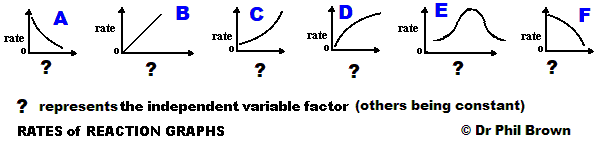
For the catalase - hydrogen peroxide
reaction which of the rate graphs corresponds to ... and give some
reasoning for your answer:
(a) Which corresponds to stepwise
increasing the concentration of hydrogen peroxide concentration?
(b) Which might correspond to the rate of reaction changing as the
temperature of the reaction mixture rises from 20oC to 80oC?
(c)
Which
corresponds to the usual rate of reaction changing with time?
(d) Which might correspond to the rate of reaction changing as the pH of
the reaction mixture rises from pH 3 to pH 11?
Q7
A student investigates the effect of pH on catalase. At which pH
is catalase most likely to work fastest?
A pH 2, B pH 7, C
pH 10, D pH 14
Q8
A student heats catalase to 80 °C and then adds hydrogen peroxide.
No bubbles are seen. What is the best explanation?
A Hydrogen peroxide is no longer a
substrate
B Oxygen cannot form at high temperatures
C Water cannot be produced at high
temperatures
D Catalase has been denatured and no
longer fits the substrate
Q9
In an experiment, the student increases the mass of potato used while
keeping hydrogen peroxide volume the same.
What effect does this have?
A Increases catalase concentration
B Decreases catalase concentration
C Stops catalase working
D Removes hydrogen peroxide
Q10
A graph of volume of oxygen (cm³) against time (s) is plotted. What does
the steepness (gradient) of the line show?
A Total amount of oxygen produced
B Rate of reaction at that time
C Final pH of the solution
D Temperature of the reaction
Q11
Why
is hydrogen peroxide often stored in dark bottles in the laboratory?
A Light speeds up its decomposition, so
dark bottles slow this down
B Catalase only works in the dark
C Light prevents oxygen forming
D Dark bottles increase its concentration
ANSWERS to the questions on the catalase -
hydrogen peroxide reaction
From your experimental investigation knowledge jot your
answers down and check your answers
If you think there is an
error email
chem55555@hotmail.com asap (partly AI designed!)
I don't mind if students/teachers do a selected printout of these
questions and answers.
|
WHAT NEXT?
TOP OF PAGE
INDEX
of biology notes on enzymes and digestion
(Enzymes are also dealt with in my GCSE chemistry notes
chemistry - biotechnology)
Big website and use [SEARCH
BOX] below, maybe quicker than the indexes
INDEX of all my BIOLOGY NOTES
HOME PAGE of Doc Brown's Science
website Links to all indexes
UK KS3 Science Quizzes for
KS3 science students aged ~11-14, ~US grades 6, 7 and 8
Biology * Chemistry
* Physics UK
GCSE level students aged ~14-16, ~US grades 9-10
Advanced Level Chemistry
for pre-university age ~16-18 ~US grades 11-12, K12 Honors
Find your GCSE/IGCSE
science course for more help links to all science revision notes
email doc
brown - comments - query?
Explaining importance of enzyme
catalysed decomposition of hydrogen peroxide with catalase enzyme
investigation
in GCSE level biology, What you need to know about enzyme catalysed
decomposition of hydrogen peroxide with catalase enzyme investigation for
GCSE level
biology,
Explaining use of enzyme catalysed decomposition of hydrogen peroxide
with catalase enzyme investigation knowledge in GCSE level biology, Examples of
enzyme catalysed decomposition of hydrogen peroxide with catalase enzyme
investigation
explained when studying GCSE level biology, What is the significance of
enzyme catalysed decomposition of hydrogen peroxide with catalase enzyme
investigation in GCSE level biology, describing
explaining theory of enzyme catalysed decomposition of hydrogen peroxide
with catalase enzyme investigation when studying GCSE level biology, exam revision
notes for enzyme catalysed decomposition of hydrogen peroxide with
catalase enzyme investigation, online help for understanding enzyme
catalysed decomposition of hydrogen peroxide with catalase enzyme
investigation in GCSE
biology, what do I need to learn about enzyme catalysed decomposition of
hydrogen peroxide with catalase enzyme investigation? what do I need to know about
enzyme catalysed decomposition of hydrogen peroxide with catalase enzyme
investigation for GCSE biology exams, how to prepare for questions on
enzyme catalysed decomposition of hydrogen peroxide with catalase enzyme
investigation in GCSE
biology examination? enzyme catalysed decomposition of hydrogen peroxide
with catalase enzyme investigation for
syllabus-specifications
for students taking the IGCSE/GCSE level biology examinations, summary
revision notes key points on enzyme catalysed decomposition of hydrogen
peroxide with catalase enzyme investigation for students studying AQA
igcse/gcse biology notes on enzyme catalysed decomposition of hydrogen peroxide
with catalase enzyme investigation, Edexcel gcse
biology notes on enzyme catalysed decomposition of hydrogen peroxide
with catalase enzyme investigation, OCR 21st century GCSE
biology notes on enzyme catalysed decomposition of hydrogen peroxide
with catalase enzyme investigation, OCR gateway
GCSE biology notes on enzyme catalysed decomposition of hydrogen
peroxide with catalase enzyme investigation, WJEC gcse biology notes on
enzyme catalysed decomposition of hydrogen peroxide with catalase enzyme
investigation, CCEA
gcse biology notes on enzyme catalysed decomposition of hydrogen
peroxide with catalase enzyme investigation, CIE Cambridge igcse
biology, notes on
enzyme catalysed decomposition of hydrogen peroxide with catalase enzyme
investigation useful for US grade 9-10 biology student courses
Website
content © Dr Phil Brown 2000+. All copyrights reserved on Doc
Brown's Biology revision notes, images, quizzes, worksheets etc.
Copying of website material is NOT permitted. Detailed
notes on how to enzyme catalysed decomposition of hydrogen peroxide.
Based on the syllabus-specifications for students taking the
IGCSE/GCSE level biology examinations summary revision notes and key
points for students studying enzyme decomposition of H2O2, taking the WJEC gcse
biology
experiment to investigate the enzyme catalysed decomposition of
hydrogen peroxide, defining molarity, CCEA gcse biology, for
students taking CIE igcse biology, AQA
igcse/gcse biology, problem solving using molarity calculations, Edexcel gcse
biology procedure to measuring the
enzyme catalysed decomposition of hydrogen peroxide, enzyme
decomposition of H2O2, OCR 21st century GCSE biology, OCR gateway
GCSE biology or any other GCSE or IGCSE level biology exams e.g.
enzyme investigations of rates of reaction of hydrogen peroxide
decomposition for US grade 9-10 biology courses
|
8. ANSWERS to the practise exam questions based on the
catalase - hydrogen peroxide
reaction
If you think there is an
error email
chem55555@hotmail.com asap (partly AI designed!)
I don't mind if students/teachers do a selected printout of these
questions and answers.
Q1
In
an investigation of catalase breaking down hydrogen peroxide, which
variable should be kept constant to make the test fair?
A Temperature of the reaction mixture
B Volume of oxygen produced
C Time taken for the reaction
D Type of measuring equipment used
Answer: A
Feedback: Students often confuse “things you measure” (like oxygen
volume, time) with “control variables”. Temperature must be kept
constant because it affects enzyme activity.
Q2
Catalase breaks down hydrogen peroxide into water and oxygen. What type
of reaction is this?
A Neutralisation
B Decomposition
C Condensation
D Polymerisation
Answer: B
Feedback: Some think “neutralisation” because hydrogen peroxide sounds
like an acid. It is actually broken down (decomposed) into simpler
substances.
Q3
A student measures the rate of catalase activity by collecting oxygen
gas.
Which apparatus is most suitable?
A Measuring cylinder filled with water and
inverted in a water trough
B Thermometer
C Light microscope
D pH meter
Answer: A
Feedback: Learners sometimes pick “thermometer” or “pH meter” because
they are familiar probes. The rate here is about gas volume, so a
gas‑collection setup is needed.
Q4
Why does increasing temperature from 20 °C to 30 °C usually increase the
rate of catalase activity?
A More catalase molecules are made
B Substrate molecules move faster and
collide more often with catalase
C Hydrogen peroxide becomes more
concentrated
D Catalase changes shape and stops working
Answer: B
Feedback: Students may jump straight to “denatured” (D). Denaturation
happens at high temperatures; at moderate increases, more frequent
successful collisions increase rate.
Q5
A student uses pieces of liver as a source of catalase. Why might
results vary between different liver pieces?
A Catalase concentration may differ
between pieces
B Hydrogen peroxide concentration changes
C Oxygen dissolves in water
D Liver cells do not contain catalase
Answer: A
Feedback: Some think all biological samples are identical. In reality,
tissue pieces can contain different amounts of enzyme, affecting rate.
Q6 Given the following sketches
of 'rates of reaction graphs' A to F
For the catalase - hydrogen peroxide
reaction which of the rate graphs corresponds to ... and give some
reasoning for your answer:
(a) Which corresponds to stepwise
increasing the concentration of hydrogen peroxide concentration?
ANSWER B: Usually a
linear relationship e.g. doubling a concentration often doubles the rate
of reaction because it doubles the probability of a fruitful
decomposition collision between the catalase and hydrogen peroxide.
(b) Which might correspond to the rate of reaction changing as the
temperature of the reaction mixture rises from 20oC to 80oC?
ANSWER E: Initially
the rate rises as the molecules have more kinetic energy to react and
overcome the activation energy, but eventually the higher temperatures
cause damage to the protein structure of the enzyme, denaturing it
resulting in a slowing down of the reaction.
(c)
Which
corresponds to the usual rate of reaction changing with time?
ANSWER A: All
reaction rates usually slow down with time as the reactants get used up
and less chance of a fruitful collision e.g. between hydrogen peroxide
and the catalase enzyme.
(d) Which might correspond to the rate of reaction changing as the pH of
the reaction mixture rises from pH 3 to pH 11?
ANSWER E: An enzyme has an optimum pH when the structure
of the enzyme is best suited to accept with the hydrogen peroxide
molecule into its active site to decompose it. At low or high pH values
the enzyme is denatured.
Q7
A student investigates the effect of pH on catalase. At which pH
is catalase most likely to work fastest?
A pH 2, B pH 7, C
pH 10, D pH 14
Answer: B
Feedback: Students sometimes pick extremes (2 or 14) thinking “more
reactive”. Most enzymes in human cells, including catalase, work best
around neutral pH.
Q8
A student heats catalase to 80 °C and then adds hydrogen peroxide.
No bubbles are seen. What is the best explanation?
A Hydrogen peroxide is no longer a
substrate
B Oxygen cannot form at high temperatures
C Water cannot be produced at high
temperatures
D Catalase has been denatured and no
longer fits the substrate
Answer: D
Feedback: A common error is to think the substrate changed (A). High
temperature alters the enzyme’s active site, so the substrate no longer
fits.
Q9
In an experiment, the student increases the mass of potato used while
keeping hydrogen peroxide volume the same.
What effect does this have?
A Increases catalase concentration
B Decreases catalase concentration
C Stops catalase working
D Removes hydrogen peroxide
Answer:
A Feedback: Some
think “more potato” just means “more mass”. It actually means more
enzyme molecules, so the effective enzyme concentration increases.
Q10
A graph of volume of oxygen (cm³) against time (s) is plotted. What does
the steepness (gradient) of the line show?
A Total amount of oxygen produced
B Rate of reaction at that time
C Final pH of the solution
D Temperature of the reaction
Answer: B
Feedback: Students often focus on the height of the curve (total
product). The gradient shows how quickly product is formed—this is the
rate.
Q11
Why
is hydrogen peroxide often stored in dark bottles in the laboratory?
A Light speeds up its decomposition, so
dark bottles slow this down
B Catalase only works in the dark
C Light prevents oxygen forming
D Dark bottles increase its concentration
Answer: A
Feedback: Some think storage is about enzyme activity (B). The main
reason is that hydrogen peroxide decomposes more quickly in light; dark
bottles help keep it stable.
If you think there is an
error email
chem55555@hotmail.com asap (partly AI designed!) |
