HOME PAGE * SEARCH * UK KS3 level Science Quizzes for students aged ~13-14

UK GCSE level BiologyChemistryPhysics ~14-16 * Advanced pre-university Chemistry ~16-18

School Biology revision notes: 7. Extracting DNA

GCSE level biology exam revision notes

DNA-proteins 7. How to extract DNA from plant cells - a simple experiment with strawberries

[Author © Dr Phil Brown PhD: Doc Brown's biology exam revision notes suitable for students of UK IGCSE & GCSE level biology courses & ~ US grades 9-10 biology [DNA page updated Mar 1st 2026 *]

[Key points and learning objectives for this page, after the main body of notes]

INDEX of notes: DNA, RNA, synthesis of proteins and functions of proteins

[email doc b: comment? query?] * [privacy-policies-disclaimer] * ]SEARCH doc b's website]


(7) How to extract DNA from plant cells - a simple experiment with strawberry fruit

This section is illustrated by the extraction of DNA from strawberries by a simple experiment.

Humans have 23 pairs of chromosomes (46 in total). The modern common strawberry has 8 pairs of each of the 7 chromosomes (56 in total) and is a rich 'school/college experiment' source of DNA.


1. You need an appropriate source e.g. split peas, strawberries, kiwi fruit, onions or bananas etc.

However, it is reported that the 'white strands' of DNA from fruit, may actually contain pectin too!

Any green leaves or stalk should be removed from the strawberry.

You can use a plastic bag or beaker in the first steps, you then need a test tube and filter funnel and filter paper.


2. The starting plant material is well mashed, but avoid creating air bubbles in the mash.

How to extract DNA from a strawberry Squishing!

You can crush the strawberries in a plastic bag for a few minutes.


3. The mash is scraped into a beaker containing a solution of detergent and salt (the DNA extraction liquid).

You can add this mixture to the plastic bag or beaker of crushed strawberry.

With a plastic bag, its easier to do further effective crushing if you add the detergent/salt solution to the bag.

The detergent further helps to break down the cell membranes to release the DNA from the cell nuclei.

The salt makes the DNA strands stick together.


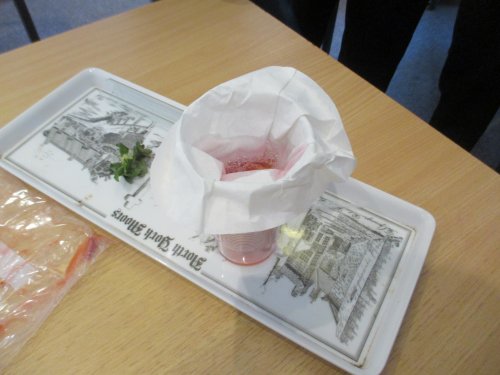
4. The resulting mixture is filtered into a test tube/2nd clean beaker. I used a hand held coffee filter paper!

How to extract DNA from a strawberry Filtering!

In school/college you can use a normal filter funnel and filter paper, as in your chemistry lessons!

This removes the froth and the bigger insoluble bits of the plant cells.

How to extract DNA from a strawberry Kitchen style!

The filtrate was transferred from the 2nd clean beaker into a test tube (if not already in a test tube).


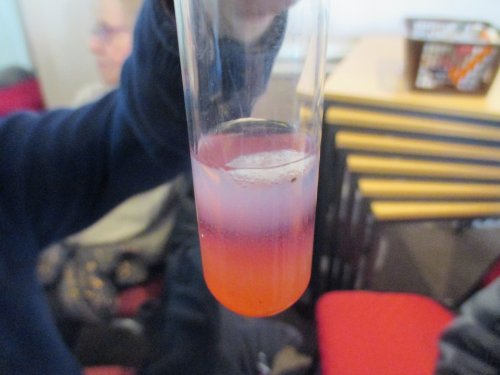
5. Some ice-cooled alcohol is carefully added to the filtered mixture down the side of the test tube.

How to extract DNA from a strawberry

Adding alcohol, mixture goes cloudy


6. A band of white precipitated DNA strands should form - DNA is not soluble in cold alcohol.

How to extract DNA from a strawberry

White coagulated mass of DNA


7. You can then extract the DNA from this band with a glass rod.


Key points for an experiment to extract DNA from plant material

Based on the syllabus-specifications for students taking the AQA, Edexcel and OCR GCSE level biology examinations (~US grades 9-10).

DNA Extraction from Plant Cells

1. Aim of the Experiment

The purpose of this experiment is to extract DNA from plant cells using a simple method that breaks down the cell structure, removes proteins, and allows the DNA to be observed.


2. Materials Needed

  • Plant material (e.g., fresh spinach, strawberries, or bananas)

  • Washing-up liquid (or mild detergent)

  • Salt (table salt)

  • Distilled water

  • Ice-cold ethanol (or surgical spirit)

  • Beaker

  • Pestle and mortar (or blender)

  • Fine sieve or coffee filter paper

  • Test tubes

  • Glass rod or wooden splint


3. Step-by-Step Method

Step 1: Prepare the Plant Cells

  • Chop the plant material into small pieces and place it into a pestle and mortar.

  • Add a pinch of salt and a few drops of washing-up liquid.

  • Grind the mixture while adding a small amount of distilled water until it forms a liquid extract.

  • The detergent helps break down cell membranes, releasing the DNA.

Step 2: Filter the Solution

  • Pour the mixture through filter paper (or a sieve) into a clean beaker.

  • This removes solid debris, leaving behind the cell extract containing DNA.

Step 3: Precipitate the DNA

  • Take 2-3 ml of the filtered extract into a test tube.

  • Carefully pour ice-cold ethanol down the side of the tube to form a separate layer above the extract.

  • Do not mix the layers—DNA will precipitate at the boundary between the ethanol and the cell extract.

Step 4: Observe and Collect the DNA

  • After a few minutes, white, stringy DNA will start to appear in the ethanol layer.

  • Use a glass rod or wooden splint to gently lift the DNA strands.


4. Explanation of the Process

  • Cell Breakdown: The washing-up liquid breaks open the cell membranes and nuclear envelope to release DNA.

  • Protein Removal: Salt helps to remove proteins that can tangle DNA molecules.

  • DNA Precipitation: Ethanol makes DNA insoluble, causing it to clump together and become visible.


5. Importance of DNA Extraction in Biology

  • Allows scientists to study DNA structure and function.

  • Used in genetic research, crime investigations (DNA fingerprinting), and medical diagnostics.

  • Essential for techniques like genetic engineering and cloning.


6. Other points

  • Always explain the role of each ingredient (detergent, salt, ethanol).

  • Use clear diagrams to illustrate DNA precipitation.

  • Link the process to real-world applications in genetics and biotechnology.


Summary of learning objectives and key words or phrases

Understand the details of an experiment to extract DNA from plant cells e.g. strawberries, describe the procedure, the chemicals needed e.g. alcohol, detergent, salt and crushed strawberries.


WHAT NEXT?

TOP OF PAGE

INDEX of biology notes on DNA, RNA, synthesis of proteins and functions of proteins

Big website and use [SEARCH BOX] below, maybe quicker than the indexes

INDEX of all my BIOLOGY NOTES

HOME PAGE of Doc Brown's Science website

UK KS3 Science Quizzes for KS3 science students aged ~11-14, ~US grades 6, 7 and 8

BiologyChemistryPhysics UK GCSE level students aged ~14-16, ~US grades 9-10

Advanced Level Chemistry for pre-university age ~16-18 ~US grades 11-12, K12 Honors

Find your GCSE/IGCSE science course for more help links to all science revision notes

email doc brown - comments - query?


Doc Brown's school biology revision notes: GCSE biology, IGCSE  biology, O level biology,  ~US biology science grade 8, grade 9 and grade 10 school science courses or equivalent for ~14-16 year old students of biology IGCSE AQA GCSE Biology Edexcel GCSE Biology IGCSE OCR Gateway Science Biology OCR 21st Century Science Biology  Some of these biology revision notes might be suitable for UK KS3 Science-Biology courses for ages 12-14 (~US biology science grades 6, grade 7 and grade 8), Explaining the importance of experiment to extract DNA from plant material in GCSE level biology, What you need to know about experiment to extract DNA from plant material for GCSE level biology, Explaining the use of experiment to extract DNA from plant material knowledge in GCSE level biology, Examples of experiment to extract DNA from plant material explained when studying GCSE level biology, What is the significance of experiment to extract DNA from plant material in GCSE level biology, describing and explaining the theory of experiment to extract DNA from plant material when studying GCSE level biology, revision notes for experiment to extract DNA from plant material in exams, online help for understanding experiment to extract DNA from plant material for GCSE biology, exam revision notes for experiment to extract DNA from plant material, what do I need to learn about experiment to extract DNA from plant material? revision summary for experiment to extract DNA from plant material in GCSE biology exams, learning notes for experiment to extract DNA from plant material, help to pass the experiment to extract DNA from plant material topic in an exam question, how to prepare for questions on experiment to extract DNA from plant material in a GCSE biology examination? Based on the syllabus-specifications for students taking the IGCSE/GCSE level biology examinations summary revision notes and key points on experiment to extract DNA from plant material for students studying the AQA igcse/gcse biology notes on experiment to extract DNA from plant material, Edexcel gcse biology notes on experiment to extract DNA from plant material,  OCR 21st century GCSE biology notes on experiment to extract DNA from plant material, OCR gateway GCSE biology notes on experiment to extract DNA from plant material, WJEC gcse biology notes on experiment to extract DNA from plant material, CCEA gcse biology notes on experiment to extract DNA from plant material for students taking & studying CIE Cambridge igcse biology, or any other GCSE or IGCSE level biology exams notes on experiment to extract DNA from plant material, useful for US grade 9-10 students taking biology courses


SITEMAP Website content © Dr Phil Brown 2000+. All copyrights reserved on Doc Brown's biology revision notes, images, quizzes, worksheets etc. Copying of website material is NOT permitted. Exam revision summaries and references to science course specifications are unofficial.

TOP OF PAGE