|
48. Castle Archdale Country Park, RAF Museum, the 9th century White Island Celtic carved figures and the ancient stones in Killadeas Churchyard County Fermanagh Scenes from Northern Ireland The CASTLE ARCHDALE Estate
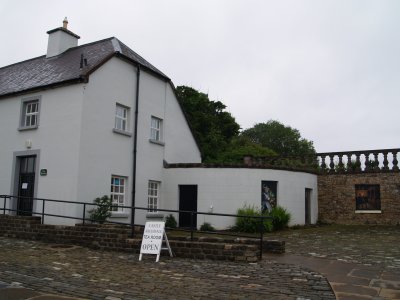
The entrance and courtyard of Castle Archdale
and Country Park with its exhibition and tearoom!
*
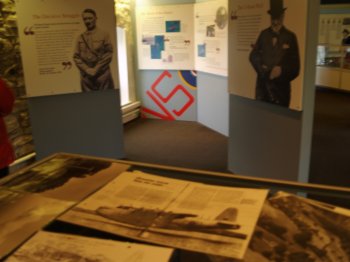
The exhibition featuring the flora and fauna of the area, its geology and the war-time role of Castle Archdale.
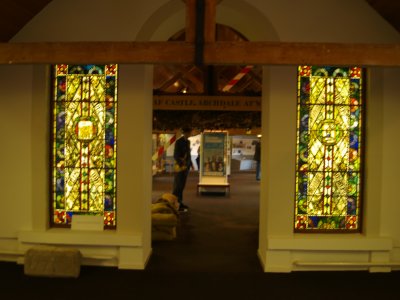
Two panels of the 19th century stained glass 'guard' the entrance to displays describing the war-time role of Castle Archdale. RAF Lough Erne became RAF Castle Archdale in 1940 and was the home to many squadrons of the RAF. The western approaches from the Atlantic Ocean were major hunting grounds for packs of German U-boats which a great deal of vital allied merchant shipping. The faster Catalina flyingboats could do long range reconnaissance patrols but the heavier and slower Sunderland had a shorter range, but its extra load of anti-submarine depth charges and guns gave it quite an attacking punch! The vital role of Castle Archdale in helping in the vital 'Battle of the Atlantic' cannot be understated and one of its aircraft, Catalina Z, first spotted the Bismarck after it had sunk HMS Hood with the loss of 1416 lives (only 3 seaman survived) and it itself suffered the same fate. One advantage of using Lough Erne was that the Irish Free State government (SECRETLY!) allowed the aircraft to fly directly across Donegal out into the Atlantic, thereby negating the long route around through Northern Ireland and consequent loss of this advantage.
Details of the stained glass.
Some colourful pictures of pastimes at Castle Archdale near the cafe entrance. Castle Archdale, like many historic estates has had a chequered history!
The old Castle Archdale was built of limestone by the English planter John Archdale in 1612. The castle was destroyed by fire and abandoned in the troubled times of 1689.
In the 18th century a Georgian house was built by Colonel Mervyn Archdale from 1773-1777. It is reputed that it was built with stone Kiltierney monastic site and gave rise to curse that no heir would be born within the walls - and this is true to the present time!
In 1889 Edward Archdale added a wing to the house and wired the house for electricity and two of the three armorial stained glass windows survive (see above) which are on either side of the entrance to the World War II Museum.
RAF history note
During World War II Castle Archdale was the station Headquarters and Officers billet of the wartime RAF base for Catalina and Sunderland flyingboat aircraft. The marina now occupies the site of RAF flyingboat base.
The marina where you can get the boat to White Island. It is surrounded by parkland which is mainly deciduous trees including native oak and ash in the Country Park.
WWII commemoration stone: Overlooking lower Lough Erne is a war grave memorial to the crew of a Catalina flying boat aircraft which crashed near here in May 1941. The inscription reads - Catalina AH536 of 240 Squadron RAF, Killadeas crashed near Gay Island 7th May 1941. Fl/Lt P.C Thomas, F/O H.H. Hirst, P/O K.B. Fuller, P/O D.W. Hockey, Sgt. W. Peebles, Sgt. J.L. Elwell, Sgt. J.S. Hesk, Sgt. H.E. Wilson, LAC H.A. Cottam, LAC L.R. Holmes.
Here you can board the Gipsy Lady to take a trip to White Island to the ruined church and historic carved stone figures. WHITE ISLAND in Lough Erne
The entrance to the ruined church and the carved figures beyond set into the opposite wall. The eight figures are carved out of hard quartzite rock somewhere between AD 800-1200 and subsequently 'rescued' from being used as building stones in the later medieval church from which we see the remains of the ruined monastery.
It is recorded in the Irish Annals that Vikings attacked and destroyed the monasteries in Lough Erne in A.D.837. For at least 400 years these carvings may have laid in the ruins before a stone Romanesque style church was built - the archway above has the characteristic top curve of the Romanesque architectural style of doorways or windows.
All eight of the carved stone figures. From left to right i.e. 1 to 8 the best descriptions I can up with from the plaque by them and from internet research are as follows ....
Left 1. is presumed to be a Sheela na Gig e.g. a statue of a grinning, cross-legged naked female figure with cape, grimacing face, its hands resting on its thighs. These 'Sheelas' are often grotesque and are common in Ireland, perhaps a 'creature' to represent lust and warn monks of the sins of the flesh. They can be found over church doorways and windows and sometimes hidden away by later 'good Catholic' generations! Right 2. is a seated figure, presumed to be Christ and not unlike a seated Christ in the Book of Kells. It is perhaps holding a rectangular object, perhaps a book shrine.
Left 3. A taller stone (found in 1958) and possibly a bishop or abbot, or similarly highly ranking clerical figure wearing a hemmed tunic and front seam. The figure is hooded and holding a crook/crozier and a bell. It may be Patrick, Christ Abbot of the world, or Constans founder of the Abbey? Opinion is divided - as in the case of several of these statues. Right 4. A slightly smaller figure with a distinctive face is possibly David with hand pointing to his mouth, a reference to David’s role as a psalmist and is shown holding a staff/scroll? with a pouch hanging from a belt.
Left 5. This figure is considered by some to be 'Christ with Griffins'? The figure has curly hair grasping the two necks of two-winged headed creatures of four legs with claws. The panel of broad ribbon loose interlace on the right of the stone resembles decoration of a high-backed chair. Right 6. Similar in size to 5., perhaps a pair? Generally considered as 'Christ the militant' or 'David the warrior' with sword & shield' and is shown to be wearing a penannular brooch of 9th or 10th century fashion.
Left 7. Only the crude outline of where the face and body and would be, otherwise it is uncarved, but it does suggest the figures were carved on White Island. Right 8. A frowning mask staring out from a slab of stone - or maybe just the face survives? and maybe a later date than the others?
Some of the walls remain, but little else of this ancient historic church.
Quite an atmospheric site, there should no rush to leave, but the boatman awaits us!
KILLADEAS CHURCH The ancient stones of Killadeas Church in the Church of Ireland Parish of Killadeas on the eastern side of Lough Erne. In the cemetery of Killadeas Church are several interesting 'ancient' stones covering a wide prehistoric-historic period. The most famous is the 'Bishops Stone'. To get there from Fermanagh Town you take the A32 North, then the B82 for Killadeas.
The contemporary 'priory' church itself was built in the late 19th century in 1864 on the site of a much earlier church.
The carved figure of the Bishop's Stone dates from the 9th-12th century and appears to be clad in a short garment, holding a crozier and a bell and wearing pointed slippers (I couldn't see the latter?).
The Cross Slab stone (sometimes referred to as the 'Ballaun Stone') has at least 10-12 cupped shaped hollows. (a multiple ballaun stone?) and on the reverse a (Greek?) cross within a circle i.e. the cross slab stone has both Christian and pre-Christian pagan symbols carved on it. It was found within the cemetery and apparently first described by Lady D. Lowry-Corry in 1935. The holes or cups seem to be in pairs? and the stone was probably sacred in prehistory and re-used (re-dedicated!) as a Christian cross slab stone.
The Pillar, a prehistoric standing stone, perhaps a phallic stone?
|








 |
 |
 |
 |
 |
 |
 |
 |
 |
 |
 |
 |
 |
 |
 |
 |
 |
 |
|
 Enter place, heritage site, feature, walk, town, village, city, museum, historic building,
mountain, island, anything of interest!
Enter place, heritage site, feature, walk, town, village, city, museum, historic building,
mountain, island, anything of interest! |
||||||||