|
 |
 |
 |
 |
 |
 |
 |
 |
 |
 |
 |
 |
 |
 |
 |
 |
 |
|
 Enter place, heritage site, feature, walk, town, village, city, museum, historic building,
mountain, island, anything of interest in Ireland!
Enter place, heritage site, feature, walk, town, village, city, museum, historic building,
mountain, island, anything of interest in Ireland! |
|
13. The town of Cashel and historic sites in or near the town centre SCENES from IRELAND in County Tipperary (1) The Town Centre of Cashel: Kearney's castle, folk museum, cafes etc. (2) The ruin of Saint Dominic's Friary, Cashel (3) The Rock of Cashel and its many features (4) Hore Abbey, set below the Rock of Cashel
(5) Some
miscellaneous images from trips to/from Dublin *
(1) The Town Centre of Cashel including Kearney's Castle and Cashel Folk Museum
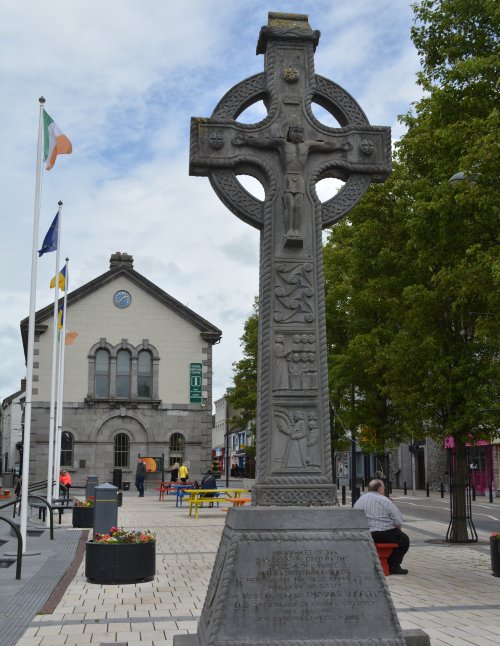
The free standing limestone High Cross or Croke Memorial Market Cross in the town centre of Cashel - erected in 1895 for the Jubilee of Archbishop Thomas Croke. The detail shows St Patrick baptising people converted to Christianity.
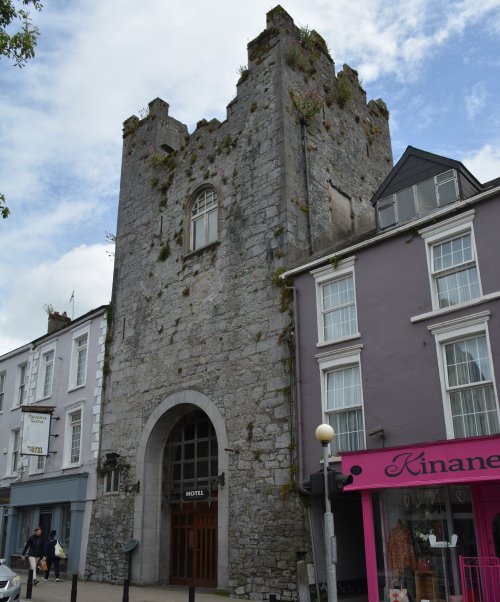
Kearney's Castle was built in the 15th century by the Kearneys, a prominent merchant family in medieval Cashel. Blessed John Kearney, a member of the family, was hanged in Clonmel in 1652 during the reign of Cromwell. It was used as a garrison by Lord Inchiquin during the Sack of Cashel in 1647. Kearney's Castle is now a hotel.
Cashel Folk Village includes the Irish War of Independence Museum, Irish Famine Museum/workhouse, Easter Rising Memorial Plaza, Garden of Remembrance and the Penal Chapel
The Bake House cafe
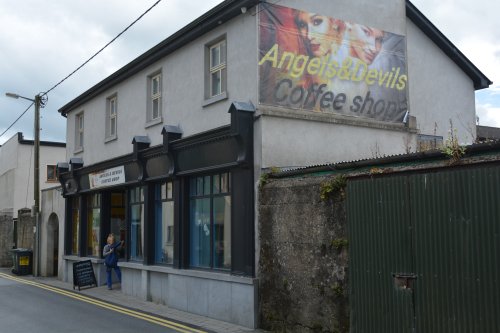
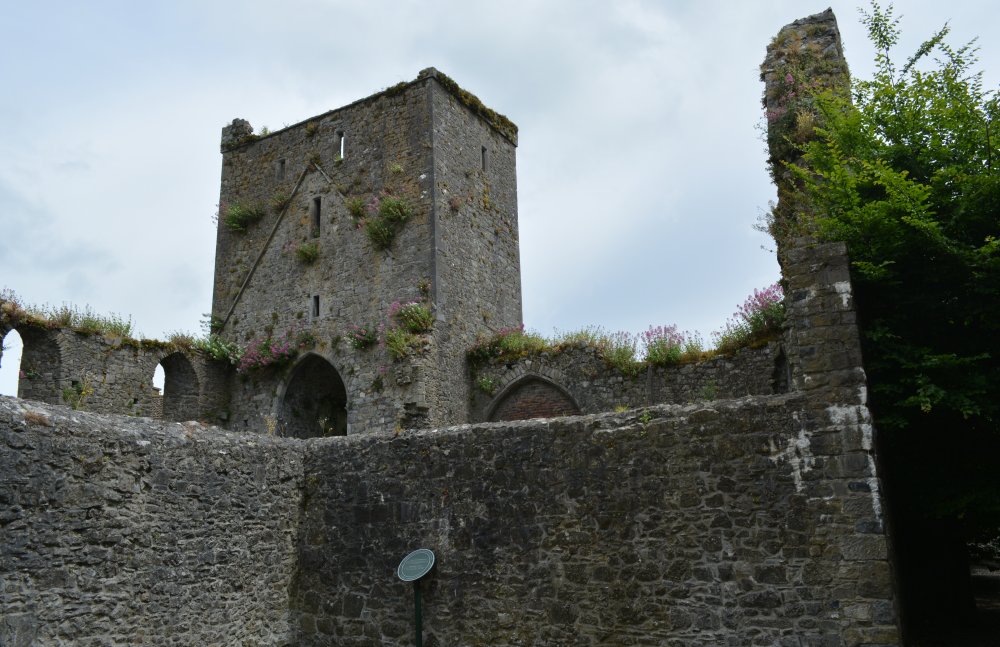
Angels and Devils Coffee Shop and the Bowes & Co. Restaurant (2) The ruins of Saint Dominic's Friary, Cashel St Dominic's Friary was founded for the Dominican Friars by Archbishop David MacKelly in 1243. It was destroyed by fire but was rebuilt by Archbishop John Cantwell around 1480 when new windows were inserted. The friary was dissolved in 1540 by the English King Henry VIII's dissolution of the monasteries.
After passing the ruined friary the xyx begins to show up on the skyline. (3) Historic features of the Rock of Cashel, high above the town of Cashel
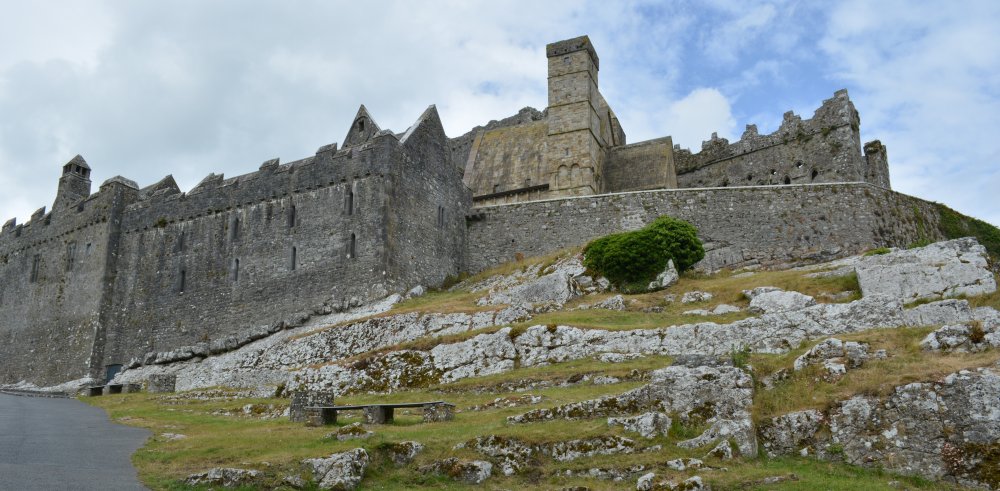
Approaching the Rock of Cashel in County Tipperary, original quick snaps on an earlier journey en route back to the boat in Dublin. The Rock of Cashel is a limestone outcrop on which is built a variety of medieval buildings. The Rock of Cashel is one of Ireland's most historic sites. It was the seat of the Kings of Munster from the 4th century to 1101 when it was presented to the Church. The most important monuments are: Cormac's Chapel, built by Cormac Mac Carthaigh, King of Munster from 1127 to 1134. A very remarkable Irish Romanesque Church. St Patrick's Cathedral was built in the 13th century and was in continual use until 1748. The Castle, used as the Bishop's residence, was where the Earl of Inchiquin massacred hundreds of people in 1647. The round tower was built in the 12th century. A replica of St Patrick's Cross, on a pedestal of granite, stands at the entrance to the Rock of Cashel. The Hall of the Vicars Choral, was built by Archbishop O'Hedian in the 15th century,
The approach to the Rock of Cashel
On the left the tower of Cormac's Chapel
The peak of the round tower can just be seen on the right.
St Cormac's Chapel was built around 1134 on the Rock of Cashel.
The Tower House (castle?) on the Rock of Cashel, built ~1440, with a curious octagonal topped tower as part of the defences.
View of the Rock of Cashel from the south-west, on the path down to Hore Abbey (4) The Cistercian Hore Abbey, built below the Rock of Cashel
A view of Hore Abbey from beneath the walls of the Rock of Cashel.
The 13th century Cistercian Hore Abbey, which lies below the Rock of Cashel, but well away from the busy roads. Sometimes known as St Mary's Abbey, the former Benedictine monastery was given to the Cistercians by Archbishop David Mac Cerbaill in 1270. Hore Abbey was dissolved in 1540.
The amazing original medieval stone vaulting in Hore Abbey.
A 1st World War grave left neglected in the nettles beside Hore Abbey. (5) A journey from Dublin to Ballyhooly Co. Cork via Tipperary to south-west Ireland
We stayed in Howth, in north of County Dublin, before driving down to Cork to stay in Ballyhooly. There is a great cliff walk from Howth Harbour to the Bailey Lighthouse.
Clonbeg Church (Church of Ireland) in Tipperary. On its left are the ruins of the original medieval church and this Christian site was founded by St Sedna.
St Sedna's Well in the graveyard of Clonbeg Church where you leave a token for your future wishes!
The picturesque Glen of Aherlow in County Tipperary is a lovely place to drive through en route to (in our case) Ballyhooly on the River Blackwater, near Fermoy, County Cork. We stayed at the Old Train House (below), one of many excellent B&B places to stay in Ireland and a splendid use of an old goods shed.
The River Blackwater between Fermoy and Lismore, a very good fishing river.
|
||||||