Brown rat
From Wikipedia, the free encyclopedia
Jump to navigationJump to search
"Rattus norvegicus" and "Sewer Rat" redirect here. For the album, see Rattus
Norvegicus (album). For the roller coaster, see Sewer Rat (roller coaster).
Brown rat
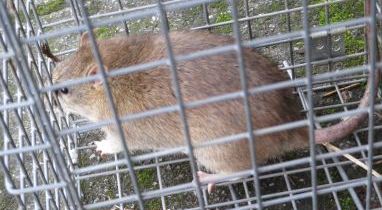
Rattus norvegicus -Fairlands Valley Park, Stevenage, England-8.jpg
Conservation status
Least Concern (IUCN 3.1) brown rat 1 Rattus norvegicus
Scientific classification edit
Kingdom: Animalia
Phylum: Chordata
Class: Mammalia
Order: Rodentia
Family: Muridae
Genus: Rattus
Species: R. norvegicus
Binomial name
Rattus norvegicus
(Berkenhout, 1769)
Brown rat distribution.png
Brown rat range brown rat dubious – discuss Rattus norvegicus
The brown rat (Rattus norvegicus), also known as the common rat, street rat,
sewer rat, Hanover rat, Norway rat, Norwegian rat, Parisian rat, water rat or
wharf rat, is one of the best known and most common rats.
One of the largest muroids, it is a brown or grey rodent with a head and body
length of up to 28 cm (11 in) long, and a slightly shorter tail. It weighs
between 140 and 500 g (4.9 and 17.6 oz). Thought to have originated in northern
China, this rodent has now spread to all continents except Antarctica, and is
the dominant rat in Europe and much of North America, making it by at least this
particular definition the most successful mammal on the planet alongside humans.
brown rat 2 Rattus norvegicus With rare exceptions, the brown rat lives wherever
humans live, particularly in urban areas.
Selective breeding of Rattus norvegicus has produced pet rats, as well as the
laboratory rat - the white rats used as model organisms in biological research.
Contents
1 Naming and etymology
2 Description
3 Biology and behavior
3.1 Communication
3.1.1 Chirping
3.1.2 Audible communication
3.2 Diet
3.3 Reproduction and life cycle
3.4 Mating behaviors
3.5 Social behavior
3.6 Burrowing
4 Distribution and habitat
4.1 Faroe Islands
4.2 Alaska
4.3 Alberta
4.4 New Zealand
5 Diseases
6 In captivity
6.1 Uses in science
6.2 As pets
6.3 Working rats
7 References
8 External links
Naming and etymology
Originally called the "Hanover rat" by people wishing to link problems in 18th
century England with the House of Hanover, brown rat 3 Rattus norvegicus it is
not known for certain why the brown rat is named Rattus norvegicus (Norwegian
rat), as it did not originate from Norway. However, the English naturalist John
Berkenhout, author of the 1769 book Outlines of the Natural History of Great
Britain, is most likely responsible for popularizing the misnomer. Berkenhout
gave the brown rat the binomial name Rattus norvegicus, believing it had
migrated to England from Norwegian ships in 1728.
By the early to middle part of the 19th century, British academics believed that
the brown rat was not native to Norway, hypothesizing (incorrectly) that it may
have come from Ireland, Gibraltar or across the English Channel with William the
Conqueror. brown rat 4 Rattus norvegicus As early as 1850, however, a new
hypothesis of the rat's origins was beginning to develop. brown rat 5 Rattus
norvegicus The British novelist Charles Dickens acknowledged this in his weekly
journal, All the Year Round, writing:
"Now there is a mystery about the native country of the best known species of
rat, the common brown rat. It is frequently called, in books and otherwise, the
'Norway rat', and it is said to have been imported into this country in a
ship-load of timber from Norway. Against this hypothesis stands the fact that
when the brown rat had become common in this country, it was unknown in Norway,
although there was a small animal like a rat, but really a lemming, which made
its home there." brown rat 6 Rattus norvegicus
Academics began to prefer this etymology of the brown rat towards the end of the
19th century, as seen in the 1895 text Natural History by American scholar
Alfred Henry Miles:
"The brown rat is the species common in England, and best known throughout the
world. It is said to have travelled from Persia to England less than two hundred
years ago and to have spread from thence to other countries visited by English
ships." brown rat 7 Rattus norvegicus
Though the assumptions surrounding this species' origins were not yet the same
as modern ones, by the 20th century, it was believed among naturalists that the
brown rat did not originate in Norway, rather the species came from central Asia
and (likely) China. brown rat 8 Rattus norvegicus
Description
Comparison of the physique of a black rat (Rattus rattus) with a brown rat (Rattus
norvegicus)
The fur is coarse and usually brown or dark grey, while the underparts are
lighter grey or brown. The brown rat is a rather large murid and can weigh twice
as much as a black rat (Rattus rattus) and many times more than a house mouse (Mus
musculus). The head and body length ranges from 15 to 28 cm (5.9 to 11.0 in)
while the tail ranges in length from 10.5 to 24 cm (4.1 to 9.4 in), therefore
being shorter than the head and body. Adult weight ranges from 140 to 500 g (4.9
to 17.6 oz). brown rat 9 Rattus norvegicus brown rat 10 Rattus norvegicus brown
rat 11 Rattus norvegicus brown rat 12 Rattus norvegicus Exceptionally large
individuals can reportedly reach 900 to 1,000 g (32 to 35 oz) but are not
expected outside of domestic specimens. Stories of rats attaining sizes as big
as cats are exaggerations, or misidentifications of larger rodents, such as the
coypu and muskrat. In fact, it is common for breeding wild brown rats to weigh
(sometimes considerably) less than 300 g (11 oz). brown rat 13 Rattus norvegicus
brown rat 14 Rattus norvegicus
Brown rats have acute hearing, are sensitive to ultrasound, and possess a very
highly developed olfactory sense. Their average heart rate is 300 to 400 beats
per minute, with a respiratory rate of around 100 per minute. The vision of a
pigmented rat is poor, around 20/600, while a non-pigmented (albino) with no
melanin in its eyes has both around 20/1200 vision and a terrible scattering of
light within its vision. Brown rats are dichromates which perceive colors rather
like a human with red-green colorblindness, and their colour saturation may be
quite faint. Their blue perception, however, also has UV receptors, allowing
them to see ultraviolet lights that some species cannot. brown rat 15 Rattus
norvegicus
Biology and behavior
Brown rat skull
The brown rat is nocturnal and is a good swimmer, both on the surface and
underwater, and has been observed climbing slim round metal poles several feet
in order to reach garden bird feeders. Brown rats dig well, and often excavate
extensive burrow systems. A 2007 study found brown rats to possess metacognition,
a mental ability previously only found in humans and some primates, brown rat 16
Rattus norvegicus but further analysis suggested they may have been following
simple operant conditioning principles. brown rat 17 Rattus norvegicus
Communication
Brown rats are capable of producing ultrasonic vocalizations. As pups, young
rats use different types of ultrasonic cries to elicit and direct maternal
search behavior, brown rat 18 Rattus norvegicus as well as to regulate their
mother's movements in the nest. brown rat 19 Rattus norvegicus Although pups
will produce ultrasounds around any other rats at 7 days old, by 14 days old
they significantly reduce ultrasound production around male rats as a defensive
response. brown rat 20 Rattus norvegicus Adult rats will emit ultrasonic
vocalizations in response to predators or perceived danger; brown rat 21 Rattus
norvegicus the frequency and duration of such cries depends on the sex and
reproductive status of the rat. brown rat 22 Rattus norvegicus brown rat 23
Rattus norvegicus The female rat will also emit ultrasonic vocalizations during
mating. brown rat 24 Rattus norvegicus
Chirping
Rats may also emit short, high frequency, ultrasonic, socially induced
vocalization during rough and tumble play, before receiving morphine, or mating,
and when tickled. The vocalization, described as a distinct "chirping", has been
likened to laughter, and is interpreted as an expectation of something
rewarding. brown rat 25 Rattus norvegicus Like most rat vocalizations, the
chirping is too high in pitch for humans to hear without special equipment. Bat
detectors are often used by pet owners for this purpose.
In research studies, the chirping is associated with positive emotional
feelings, and social bonding occurs with the tickler, resulting in the rats
becoming conditioned to seek the tickling. However, as the rats age, the
tendency to chirp appears to decline. brown rat 26 Rattus norvegicus
Audible communication
Brown rats also produce communicative noises capable of being heard by humans.
The most commonly heard in domestic rats is bruxing, or teeth-grinding, which is
most usually triggered by happiness, but can also be 'self-comforting' in
stressful situations, such as a visit to the vet. The noise is best described as
either a quick clicking or 'burring' sound, varying from animal to animal.
In addition, they commonly squeak along a range of tones from high, abrupt pain
squeaks to soft, persistent 'singing' sounds during confrontations.
Diet
The brown rat is a true omnivore and will consume almost anything, but cereals
form a substantial part of its diet.
Brown rat eating sunflower seeds
Martin Schein, founder of the Animal Behavior Society in 1964, studied the diet
of brown rats and came to the conclusion that the most-liked foods of brown rats
include scrambled eggs, macaroni and cheese, raw carrots, and cooked corn
kernels. According to Schein, the least-liked foods were raw beets, peaches, and
raw celery. brown rat 27 Rattus norvegicus
Foraging behavior is often population-specific, and varies by environment and
food source. brown rat 2 Rattus norvegicus Brown rats living near a hatchery in
West Virginia catch fingerling fish. brown rat 28 Rattus norvegicus Some
colonies along the banks of the Po River in Italy will dive for mollusks, brown
rat 29 Rattus norvegicus brown rat 30 Rattus norvegicus a practice demonstrating
social learning among members of this species. brown rat 31 Rattus norvegicus
Rats on the island of Norderoog in the North Sea stalk and kill sparrows and
ducks. brown rat 32 Rattus norvegicus
Reproduction and life cycle
The brown rat can breed throughout the year if conditions are suitable, with a
female producing up to five litters a year. The gestation period is only 21
days, and litters can number up to 14, although seven is common. They reach
sexual maturity in about five weeks. Under ideal conditions (for the rat), this
means that the population of females could increase by a factor of three and a
half (half a litter of 7) in 8 weeks (5 weeks for sexual maturity and 3 weeks of
gestation), corresponding to a population growing by a factor of 10 in just 15
weeks. As a result, the population can grow from 2 to 15 000 in a year. brown
rat 33 Rattus norvegicus The maximum life span is three years, although most
barely manage one. A yearly mortality rate of 95% is estimated, with predators
and interspecies conflict as major causes.
When lactating, female rats display a 24-hour rhythm of maternal behavior, and
will usually spend more time attending to smaller litters than large ones. brown
rat 34 Rattus norvegicus
Brown rats live in large, hierarchical groups, either in burrows or subsurface
places, such as sewers and cellars. When food is in short supply, the rats lower
in social order are the first to die. If a large fraction of a rat population is
exterminated, the remaining rats will increase their reproductive rate, and
quickly restore the old population level. brown rat citation needed Rattus
norvegicus
Females are capable of becoming pregnant immediately after giving birth, and can
nurse one litter while pregnant with another. brown rat 35 Rattus norvegicus
Females are able to produce and raise two healthy litters of normal size and
weight without significantly changing their own food intake. brown rat 35 Rattus
norvegicus However, when food is restricted, females can extend pregnancy by
over two weeks, and give birth to litters of normal number and weight. brown rat
35 Rattus norvegicus
Mating behaviors
Males can ejaculate multiple times in a row, and this increases the likelihood
of pregnancy as well as decreases the number of stillborns. brown rat 36 Rattus
norvegicus Multiple ejaculation also means that males can mate with multiple
females, and they exhibit more ejaculatory series when there are several
oestrous females present. brown rat 37 Rattus norvegicus Males also copulate at
shorter intervals than females. brown rat 37 Rattus norvegicus In group mating,
females often switch partners. brown rat 38 Rattus norvegicus
Dominant males have higher mating success and also provide females with more
ejaculate, and females are more likely to use the sperm of dominant males for
fertilization. brown rat 38 Rattus norvegicus
In mating, female rats show a clear mating preference for unknown males versus
males that they have already mated with (also known as the Coolidge effect), and
will often resume copulatory behavior when introduced to a novel sexual partner.
brown rat 39 Rattus norvegicus
Females also prefer to mate with males who have not experienced social stress
during adolescence, and can determine which males were stressed even without any
observed difference in sexual performance of males experiencing stress during
adolescence and not. brown rat 40 Rattus norvegicus
Social behavior
Rats commonly groom each other and sleep together. brown rat 41 Rattus
norvegicus Rats are said to establish an order of hierarchy, so one rat will be
dominant over another one. brown rat 42 Rattus norvegicus Groups of rats tend to
"play fight", which can involve any combination of jumping, chasing, tumbling,
and "boxing". Play fighting involves rats going for each other's necks, while
serious fighting involves strikes at the others' back ends. brown rat 43 Rattus
norvegicus If living space becomes limited, rats may turn to aggressive behavior,
which may result in the death of some animals, reducing the burden over the
living space.
Rats, like most mammals, also form family groups of a mother and her young.
brown rat 44 Rattus norvegicus This applies to both groups of males and females.
However, rats are territorial animals, meaning that they usually act
aggressively or scared of strange rats. Rats will fluff up their hair, hiss,
squeal, and move their tails around when defending their territory. brown rat 45
Rattus norvegicus Rats will chase each other, groom each other, sleep in group
nests, wrestle with each other, have dominance squabbles, communicate, and play
in various other ways with each other. brown rat 45 Rattus norvegicus Huddling
is an additional important part of rat socialization. Huddling is often supposed
to have a heat-conserving function. Nestling rats especially depend on heat from
their mother, since they cannot regulate their own temperature. Huddling is an
extreme form of herding. Other forms of interaction include: crawling under,
which is literally the act of crawling underneath one another; walking over,
also explained in the name; allo-grooming, so-called to distinguish it from
self-grooming; and nosing, where a rat gently pushes with its nose at another
rat near the neck. brown rat 44 Rattus norvegicus
Burrowing
Rats are known to burrow extensively, both in the wild and in captivity, if
given access to a suitable substrate. brown rat 46 Rattus norvegicus Rats
generally begin a new burrow adjacent to an object or structure, as this
provides a sturdy "roof" for the section of the burrow nearest to the ground's
surface. brown rat 47 Rattus norvegicus Burrows usually develop to eventually
include multiple levels of tunnels, as well as a secondary entrance. brown rat
46 Rattus norvegicus Older male rats will generally not burrow, while young
males and females will burrow vigorously. brown rat 46 Rattus norvegicus brown
rat 48 Rattus norvegicus
Burrows provide rats with shelter and food storage, as well as safe,
thermo-regulated nest sites. brown rat 46 Rattus norvegicus Rats use their
burrows to escape from perceived threats in the surrounding environment; for
example, rats will retreat to their burrows following a sudden, loud noise or
while fleeing an intruder. brown rat 49 Rattus norvegicus Burrowing can
therefore be described as a "pre-encounter defensive behavior", as opposed to a
"post-encounter defensive behavior", such as flight, freezing, or avoidance of a
threatening stimulus.
Distribution and habitat
Possibly originating from the plains of Asia, northern China and Mongolia, the
brown rat spread to other parts of the world sometime in the Middle Ages. brown
rat 50 Rattus norvegicus brown rat 51 Rattus norvegicus brown rat 52 Rattus
norvegicus The question of when brown rats became commensal with humans remains
unsettled, but as a species, they have spread and established themselves along
routes of human migration and now live almost everywhere humans are. brown rat
53 Rattus norvegicus
The brown rat may have been present in Europe as early as 1553, a conclusion
drawn from an illustration and description by Swiss naturalist Conrad Gesner in
his book Historiae animalium, published 1551–1558. brown rat 54 Rattus
norvegicus Though Gesner's description could apply to the black rat, his mention
of a large percentage of albino specimens—not uncommon among wild populations of
brown rats—adds credibility to this conclusion. brown rat 55 Rattus norvegicus
Reliable reports dating to the 18th century document the presence of the brown
rat in Ireland in 1722, England in 1730, France in 1735, Germany in 1750, and
Spain in 1800, brown rat 55 Rattus norvegicus becoming widespread during the
Industrial Revolution. brown rat 56 Rattus norvegicus It did not reach North
America until around 1750–1755. brown rat 54 Rattus norvegicus brown rat 57
Rattus norvegicus
As it spread from Asia, the brown rat generally displaced the black rat in areas
where humans lived. In addition to being larger and more aggressive, the change
from wooden structures and thatched roofs to bricked and tiled buildings favored
the burrowing brown rats over the arboreal black rats. In addition, brown rats
eat a wider variety of foods, and are more resistant to weather extremes. brown
rat 58 Rattus norvegicus
In the absence of humans, brown rats prefer damp environments, such as river
banks. brown rat 56 Rattus norvegicus However, the great majority are now linked
to man-made environments, such as sewage systems.
Brown rat in a flower box in the East Village of New York City
It is often said that there are as many rats in cities as people, but this
varies from area to area depending on climate, living conditions, etc. Brown
rats in cities tend not to wander extensively, often staying within 20 m (66 ft)
of their nest if a suitable concentrated food supply is available, but they will
range more widely where food availability is lower. There is great debate over
the size of the population of rats in New York City, with estimates from almost
100 million rats to as few as 250,000. brown rat 59 Rattus norvegicus Experts
suggest that New York is a particularly attractive place for rats because of its
aging infrastructure, high moisture, and high poverty rates. brown rat 59 Rattus
norvegicus In addition to sewers, rats are very comfortable living in alleyways
and residential buildings, as there is usually a large and continuous food
source in those areas. brown rat 60 Rattus norvegicus
In the United Kingdom, some figures show that the rat population has been
rising, with estimations that 81 million rats reside in the UK. brown rat 61
Rattus norvegicus Those figures would mean that there are 1.3 rats per person in
the country. High rat populations in the UK are often attributed to the mild
climate, which allow them higher survival rates during the winter.
The only brown rat-free areas in the world are the continent of Antarctica, the
Arctic, brown rat 62 Rattus norvegicus brown rat 11 Rattus norvegicus some
isolated islands, brown rat 63 Rattus norvegicus the Canadian province of
Alberta, brown rat 64 Rattus norvegicus and certain conservation areas in New
Zealand. brown rat 65 Rattus norvegicus brown rat 66 Rattus norvegicus
Antarctica is almost completely covered by ice, making it uninhabitable by rats.
The Arctic has extremely cold winters that rats cannot survive outdoors, and the
human population density is extremely low, making it difficult for rats to
travel from one habitation to another, although they have arrived in many
coastal areas by ship. When the occasional rat infestation is found and
eliminated, the rats are unable to reinfest it from an adjacent one. Isolated
islands are also able to eliminate rat populations because of low human
population density and the geographic distance from other rat populations.
Faroe Islands
The brown rat was first observed on the Faroe Islands in 1768. It is thought
that the first individuals arrived on the southernmost island, Suðuroy, via the
wreck of a Norwegian ship that had stranded on the Scottish Isle of Lewis on its
way from Trondheim to Dublin. The drifting wreck, carrying brown rats, drifted
northwards until it reached the village of Hvalba. Dispersion afterwards appears
to have been fast, including all of Suðuroy within a year. In 1769, they were
observed in Torshavn on the southern part of Streymoy, and a decade later, in
the villages in the northern part of this island. From here, they crossed the
strait and occupied Eysturoy during the years 1776 to 1779. In 1779, they
reached Vagar. Whether the rats dispersed from the already established
population in Suðuroy, or they were brought to the Faroe Islands with other
ships, is unknown. The Northern islands were invaded by the brown rat more than
100 years later, after Norwegians built and operated a whaling station in the
village of Hvannasund on Borðoy from 1898 to 1920. From there, the brown rat
spread to the neighbouring islands of Viðoy and Kunoy. brown rat 67 Rattus
norvegicus Today the brown rat is found on seven of the 18 Faroese islands, and
is common in and around human habitations as well as in the wild. Although the
brown rat is now common on all of the largest Faroese islands, only sparse
information on the population is available in the literature. An investigation
for infection with the spirochaete Leptospira interrogans did not find any
infected animals, suggesting that Leptospira prevalence rates on the Faroe
Islands may be among the lowest recorded worldwide. brown rat 68 Rattus
norvegicus
Alaska
Hawadax Island (formerly known as Rat Island) in Alaska was infested with brown
rats following a Japanese shipwreck in 1780. They had a devastating effect on
the native bird life. An eradication program was started in 2007 and the island
was declared rat-free in June 2009.
Alberta
Alberta, Canada, is the largest rat-free populated area in the world. Rat
invasions of Alberta were stopped and rats were eliminated by very aggressive
government rat control measures, starting during the 1950s. brown rat 69 Rattus
norvegicus brown rat 70 Rattus norvegicus brown rat 71 Rattus norvegicus
The only species of Rattus that is capable of surviving the climate of Alberta
is the brown rat, which can only survive in the prairie region of the province,
and even then must overwinter in buildings. Although it is a major agricultural
area, Alberta is far from any seaport and only a portion of its eastern boundary
with Saskatchewan provides a favorable entry route for rats. Brown rats cannot
survive in the wild boreal forest to the north, the Rocky Mountains to the west,
nor can they safely cross the semiarid High Plains of Montana to the south. The
first brown rat did not reach Alberta until 1950, and in 1951, the province
launched a rat-control program that included shooting, poisoning, and gassing
rats, and bulldozing or burning down some rat-infested buildings. The effort was
backed by legislation that required every person and every municipality to
destroy and prevent the establishment of designated pests. If they failed, the
provincial government could carry out the necessary measures and charge the
costs to the landowner or municipality. brown rat 72 Rattus norvegicus
In the first year of the rat control program, 64 tonnes (71 short tons) of
arsenic trioxide were spread throughout 8,000 buildings on farms along the
Saskatchewan border. However, in 1953 the much safer and more effective
rodenticide, warfarin was introduced to replace arsenic. Warfarin is an
anticoagulant that was approved as a drug for human use in 1954 and is much
safer to use near humans and other large animals than arsenic. brown rat 73
Rattus norvegicus By 1960, the number of rat infestations in Alberta had dropped
to below 200 per year. In 2002, the province finally recorded its first year
with zero rat infestations, and from 2002 to 2007 there were only two
infestations found. brown rat 74 Rattus norvegicus After an infestation of rats
in the Medicine Hat landfill was found in 2012, the province's rat-free status
was questioned, but provincial government rat control specialists brought in
excavating machinery, dug out, shot, and poisoned 147 rats in the landfill, and
no live rats were found thereafter. brown rat 75 Rattus norvegicus In 2013, the
number of rat infestations in Alberta dropped to zero again. Alberta defines an
infestation as two or more rats found at the same location, since a single rat
cannot reproduce. About a dozen single rats enter Alberta in an average year and
are killed by provincial rat control specialists before they can reproduce.
brown rat 76 Rattus norvegicus
Only zoos, universities, and research institutes are allowed to keep caged rats
in Alberta, and possession of unlicensed rats (including pet rats) by anyone
else is punishable by a penalty of up to $5,000 or up to 60 days in jail. brown
rat 77 Rattus norvegicus The adjacent and similarly landlocked province of
Saskatchewan initiated a rat control program in 1972, and has managed to reduce
the number of rats in the province substantially, although they have not been
eliminated. The Saskatchewan rat control program has considerably reduced the
number of rats trying to enter Alberta. brown rat 78 Rattus norvegicus
New Zealand
First arriving before 1800 (perhaps on James Cook's vessels), brown rat 79
Rattus norvegicus brown rats pose a serious threat to many of New Zealand's
native wildlife. Rat eradication programmes within New Zealand have led to
rat-free zones on offshore islands and even on fenced "ecological islands" on
the mainland. Before an eradication effort was launched in 2001, the
sub-Antarctic Campbell Island had the highest population density of brown rats
in the world. brown rat 80 Rattus norvegicus
Diseases
Similar to other rodents, brown rats may carry a number of pathogens, brown rat
81 Rattus norvegicus which can result in disease, including Weil's disease, rat
bite fever, cryptosporidiosis, viral hemorrhagic fever, Q fever and hantavirus
pulmonary syndrome. In the United Kingdom, brown rats are an important reservoir
for Coxiella burnetii, the bacterium that causes Q fever, with seroprevalence
for the bacteria found to be as high as 53% in some wild populations. brown rat
82 Rattus norvegicus
This species can also serve as a reservoir for Toxoplasma gondii, the parasite
that causes toxoplasmosis, though the disease usually spreads from rats to
humans when domestic cats feed on infected brown rats. brown rat 83 Rattus
norvegicus The parasite has a long history with the brown rat, and there are
indications that the parasite has evolved to alter an infected rat's perception
to cat predation, making it more susceptible to predation and increasing the
likelihood of transmission. brown rat 84 Rattus norvegicus
Surveys and specimens of brown rat populations throughout the world have shown
this species is often associated with outbreaks of trichinosis, brown rat 85
Rattus norvegicus brown rat 86 Rattus norvegicus but the extent to which the
brown rat is responsible in transmitting Trichinella larvae to humans and other
synanthropic animals is at least somewhat debatable. brown rat 87 Rattus
norvegicus Trichinella pseudospiralis, a parasite previously not considered to
be a potential pathogen in humans or domestic animals, has been found to be
pathogenic in humans and carried by brown rats. brown rat 88 Rattus norvegicus
Brown rats are sometimes mistakenly thought to be a major reservoir of bubonic
plague, a possible cause of the Black Death. However, the bacterium responsible,
Yersinia pestis, is commonly endemic in only a few rodent species and is usually
transmitted zoonotically by rat fleas—common carrier rodents today include
ground squirrels and wood rats. However, brown rats may suffer from plague, as
can many nonrodent species, including dogs, cats, and humans. brown rat 89
Rattus norvegicus The original carrier for the plague-infected fleas thought to
be responsible for the Black Death was the black rat, and it has been
hypothesized that the displacement of black rats by brown rats led to the
decline of bubonic plague. brown rat 90 Rattus norvegicus This theory has,
however, been deprecated, as the dates of these displacements do not match the
increases and decreases in plague outbreaks. brown rat 91 Rattus norvegicus
In captivity
Uses in science
Main article: Laboratory rat
Selective breeding of albino brown rats rescued from being killed in a
now-outlawed sport called rat baiting has produced the albino laboratory rat.
brown rat 92 Rattus norvegicus Like mice, these rats are frequently subjects of
medical, psychological and other biological experiments, and constitute an
important model organism. This is because they grow quickly to sexual maturity
and are easy to keep and to breed in captivity. When modern biologists refer to
"rats", they almost always mean Rattus norvegicus.
As pets
Main article: Fancy rat
The brown rat is kept as a pet in many parts of the world. Australia, the United
Kingdom, and the United States are just a few of the countries that have formed
fancy rat associations similar in nature to the American Kennel Club,
establishing standards, orchestrating events, and promoting responsible pet
ownership.
The many different types of domesticated brown rats include variations in coat
patterns, as well as the style of the coat, such as Hairless or Rex, and more
recently developed variations in body size and structure, including dwarf and
tailless fancy rats.
Working rats
Main article: Working rat
A working rat is a rat trained for specific tasks as a working animal. In many
cases, working rats are domesticated brown rats. However, other species, notably
the Gambian pouched rat, have been trained to assist humans.
For Doc Brown's
latest updates of pictures or science see https://twitter.com/docbrownchem
Doc Brown's
Science Website - GCSE Biology, GCSE & A Level Chemistry and GCSE Physics
TOP OF PAGE



 Enter
anything of interest
Enter
anything of interest *
*