|
||||||||||



 Enter
anything of interest
Enter
anything of interest |
*
 *
*
Bird of prey
From Wikipedia, the free encyclopedia
Jump to navigationJump to search
For other uses, see Bird of prey (disambiguation).
This article's use of external links may not follow Wikipedia's policies or
guidelines. Please improve this article by removing excessive or inappropriate
external links, and converting useful links where appropriate into footnote
references. (April 2017) (Learn how and when to remove this template message)
Birds of prey
Birds of prey are not a taxon; they are an informal grouping of predatory
members of Telluraves
Steinadler Aquila chrysaetos closeup2 Richard Bartz.jpg
Golden eagle (Aquila chrysaetos)
Information
Orders and families of birds of prey
Order Strigiformes
Family Tytonidae (barn-owls)
Family Strigidae (true owls)
Order Cathartiformes
Family Cathartidae (New World vultures)
Order Accipitriformes
Family Sagittariidae (secretarybird)
Family Pandionidae (osprey)
Family Accipitridae (accipitrid raptors)
Order Falconiformes
Family Falconidae (falcons and caracaras)
vte
Griffon vulture
Birds of prey, or raptors, include species of bird that primarily hunt and feed
on vertebrates that are large relative to the hunter. Additionally, they have
keen eyesight for detecting food at a distance or during flight, strong feet
equipped with talons for grasping or killing prey, and powerful, curved beaks
for tearing flesh. birds of prey 1 birds of prey birds of prey 2 birds of prey
birds of prey 3 birds of prey The term raptor is derived from the Latin word
rapere, meaning to seize or take by force. birds of prey 4 birds of prey In
addition to hunting live prey, most also eat carrion, at least occasionally, and
vultures and condors eat carrion as their main food source. birds of prey 1
birds of prey
Although the term bird of prey could theoretically be taken to include all birds
that primarily consume animals, birds of prey 3 birds of prey ornithologists
typically use the narrower definition followed in this page. Examples of
animal-eating birds not encompassed by the ornithological definition include
storks, herons, gulls, skuas, penguins, kookaburras, and shrikes, as well as the
many songbirds that are primarily insectivorous.
Contents
1 Common names
2 Systematics
2.1 Historical classifications
2.2 Modern systematics
2.3 Phylogeny
3 Migration
4 Sexual dimorphism
5 See also
6 Notes
7 References
8 Further reading
9 External links
Common names
The common names for various birds of prey are based on structure, but many of
the traditional names do not reflect the evolutionary relationships between the
groups.
Variations in shape and size
Eagles tend to be large birds with long, broad wings and massive feet. Booted
eagles have legs and feet feathered to the toes and build very large stick
nests.
Ospreys, a single species found worldwide that specializes in catching fish and
builds large stick nests.
Kites have long wings and relatively weak legs. They spend much of their time
soaring. They will take live vertebrate prey, but mostly feed on insects or even
carrion.
The true hawks are medium-sized birds of prey that usually belong to the genus
Accipiter (see below). They are mainly woodland birds that hunt by sudden dashes
from a concealed perch. They usually have long tails for tight steering.
Buzzards are medium-large raptors with robust bodies and broad wings, or,
alternatively, any bird of the genus Buteo (also commonly known as "hawks" in
North America, while "buzzard" is colloquially used for vultures).
Harriers are large, slender hawk-like birds with long tails and long thin legs.
Most use a combination of keen eyesight and hearing to hunt small vertebrates,
gliding on their long broad wings and circling low over grasslands and marshes.
Vultures are carrion-eating raptors of two distinct biological families: the
Accipitridae, which occurs only in the Eastern Hemisphere; and the Cathartidae,
which occurs only in the Western Hemisphere. Members of both groups have heads
either partly or fully devoid of feathers.
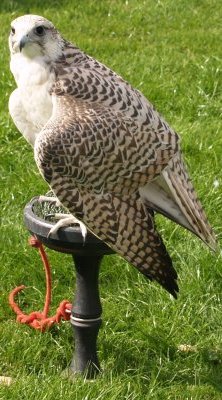
Falcons are medium-size birds of prey with long pointy wings. They belong to the
Falconidae family, rather than the Accipitridae (accipiters). Many are
particularly swift flyers.
Caracaras are a distinct subgroup of the Falconidae unique to the New World, and
most common in the Neotropics – their broad wings, naked faces and appetites of
a generalist suggest some level of convergence with either the Buteos or the
vulturine birds, or both.
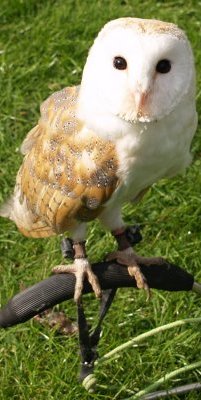
Owls are variable-sized, typically night-specialized hunting birds. They fly
almost silently due to their special feather structure that reduces turbulence.
They have particularly acute hearing.
Many of these English language group names originally referred to particular
species encountered in Britain. As English-speaking people travelled further,
the familiar names were applied to new birds with similar characteristics. Names
that have generalised this way include: kite (Milvus milvus), sparrow-hawk or
sparhawk (Accipiter nisus), goshawk (Accipiter gentilis), kestrel (Falco
tinninculus), hobby (Falco subbuteo), harrier (simplified from "hen-harrier",
Circus cyaneus), buzzard (Buteo buteo).
Some names have not generalised, and refer to single species (or groups of
closely related (sub)species): merlin (Falco columbarius), osprey (Pandion
haliaetus).
Systematics
Historical classifications
The taxonomy of Carl Linnaeus grouped birds (class Aves) into orders, genera,
and species, with no formal ranks between genus and order. He placed all birds
of prey into a single order, Accipitres, subdividing this into four genera:
Vultur (vultures), Falco (eagles, hawks, falcons, etc.), Strix (owls), and
Lanius (shrikes). This approach was followed by subsequent authors such as
Gmelin, Latham, and Turnton.
Louis Pierre Veillot used additional ranks: order, tribe, family, genus,
species. Birds of prey (order Accipitres) were divided into diurnal and
nocturnal tribes; the owls remained monogeneric (family Ægolii, genus Strix),
whilst the diurnal raptors were divided into three families: Vulturini, Gypaëti,
and Accipitrini. birds of prey 5 birds of prey
Thus Veillot's families were similar to the Linnaean genera, with the difference
that shrikes were no longer included amongst the birds of prey. In addition to
the original Vultur and Falco (now reduced in scope), Veillot adopted four
genera from Savigny: Phene, Haliæetus, Pandion, and Elanus. He also introduced
five new genera of vultures (Gypagus, Catharista, Daptrius, Ibycter, Polyborus)
birds of prey note 1 birds of prey and eleven new genera of accipitrines
(Aquila, Circaëtus, Circus, Buteo, Milvus, Ictinia, Physeta, Harpia, Spizaëtus,
Asturina, Sparvius).
Modern systematics
Bald eagle
The order Accipitriformes is believed to have originated 44 million years ago
when it split from the common ancestor of the secretarybird (Sagittarius
serpentarius) and the accipitrid species. birds of prey 6 birds of prey The
phylogeny of Accipitriformes is complex and difficult to unravel. Widespread
paraphylies were observed in many phylogenetic studies. birds of prey 7 birds of
prey birds of prey 8 birds of prey birds of prey 9 birds of prey birds of prey
10 birds of prey birds of prey 11 birds of prey More recent and detailed studies
show similar results. birds of prey 12 birds of prey However, according to the
findings of a 2014 study, the sister relationship between larger clades of
Accipitriformes was well supported (e.g. relationship of Harpagus kites to
buzzards and sea eagles and these latter two with Accipiter hawks are sister
taxa of the clade containing Aquilinae and Harpiinae). birds of prey 6 birds of
prey
The diurnal birds of prey are formally classified into five families of two
orders.
Accipitridae: hawks, eagles, buzzards, harriers, kites, and Old World vultures
Pandionidae: the osprey
Sagittariidae: the secretarybird
Falconidae: falcons, caracaras, and forest falcons
Cathartidae: New World vultures
These families were traditionally grouped together in a single order
Falconiformes but are now split into two orders, the Falconiformes and
Accipitriformes. The Cathartidae are sometimes placed separately in an enlarged
stork family, Ciconiiformes, and may be raised to an order of their own,
Cathartiiformes.
The secretary bird and/or osprey are sometimes listed as subfamilies of
Acciptridae: Sagittariinae and Pandioninae, respectively.
Australia's letter-winged kite is a member of the family Accipitridae, although
it is a nocturnal bird.
The nocturnal birds of prey – the owls – are classified separately as members of
two extant families of the order Strigiformes:
Strigidae: "typical owls"
Tytonidae: barn and bay owls
Phylogeny
Below is a simplified phylogeny of Telluraves which is the clade where the birds
of prey belong to along with passerines and several near-passerine lineages.
birds of prey 13 birds of prey birds of prey 14 birds of prey birds of prey 15
birds of prey The orders in bold text are birds of prey orders; this is to show
the polyphly of the group as well as their relationships to other birds.
Telluraves
Afroaves
Accipitrimorphae
Accipitriformes (hawks and relatives)Gyps fulvus -Basque Country-8 white
background.jpgMaakotka (Aquila chrysaetos) by Jarkko Järvinen white
background.jpg
Cathartiformes (New World vultures)Black Vulture RWD2013A white background.jpg
Strigiformes (owls)Tyto alba -British Wildlife Centre, Surrey, England-8a (1)
white background.jpg
Coraciimorphae (woodpeckers, rollers, hornbills, etc.)Halcyon smyrnensis in
India (8277355382) white background.jpg
Australaves
Cariamiformes (seriemas)Seriema (Cariama cristata) white background.jpg
Eufalconimorphae
Falconiformes (falcons)Male Peregrine Falcon (7172188034) white background.jpg
Psittacopasserae (parrots and songbirds)Carrion crow 20090612 white
background.jpg
Migration
Migratory behaviour evolved multiple times within accipitrid raptors.
An obliged point of transit of the migration of the birds of prey is the
bottleneck-shaped Strait of Messina, Sicily, here seen from Dinnammare mount,
Peloritani.
The earliest event occurred nearly 14 to 12 million years ago. This result seems
to be one of the oldest dates published so far in the case of birds of prey.
birds of prey 6 birds of prey For example, a previous reconstruction of
migratory behaviour in one Buteo clade birds of prey 11 birds of prey with a
result of the origin of migration around 5 million years ago was also supported
by that study.
Migratory species of raptors had a southern origin because it seems that all of
the major lineages within Accipitridae had an origin to one of the biogeographic
realms of the Southern Hemisphere. The appearance of migratory behaviour
occurred in the tropics parallel with the range expansion of migratory species
to temperate habitats. birds of prey 6 birds of prey Similar results of southern
origin in other taxonomic groups can be found in the literature. birds of prey
16 birds of prey birds of prey 17 birds of prey birds of prey 18 birds of prey
Distribution and biogeographic history highly determine the origin of migration
in birds of prey. Based on some comparative analyses, diet breadth also has an
effect on the evolution of migratory behaviour in this group, birds of prey 6
birds of prey but its relevance needs further investigation. The evolution of
migration in animals seems to be a complex and difficult topic with many
unanswered questions.
A recent study discovered new connections between migration and the ecology,
life history of raptors. A brief overview from abstract of the publish paper
shows that "clutch size and hunting strategies have been proved to be the most
important variables in shaping distribution areas, and also the geographic
dissimilarities may mask important relationships between life history traits and
migratory behaviours. The West Palearctic-Afrotropical and the North-South
American migratory systems are fundamentally different from the East
Palearctic-Indomalayan system, owing to the presence versus absence of
ecological barriers." birds of prey 19 birds of prey Maximum entropy modelling
can help in answering the question: why species winters at one location while
the others are elsewhere. Temperature and precipitation related factors differ
in the limitation of species distributions. "This suggests that the migratory
behaviours differ among the three main migratory routes for these species" birds
of prey 19 birds of prey which may have important consevational consequences in
the protection of migratory raptors.
Sexual dimorphism
Shikra females have yellow eyes
Raptors are known to display patterns of sexual dimorphism. It is commonly
believed that the dimorphisms found in raptors occur due to sexual selection or
environmental factors. In general, hypotheses in favor of ecological factors
being the cause for sexual dimorphism in raptors are rejected. This is because
the ecological model is less parsimonious, meaning that its explanation is more
complex than that of the sexual selection model. Additionally, ecological models
are much harder to test because a great deal of data is required. birds of prey
20 birds of prey
Dimorphisms can also be the product of intrasexual selection between males and
females. It appears that both sexes of the species play a role in the sexual
dimorphism within raptors; females tend to compete with other females to find
good places to nest and attract males, and males competing with other males for
adequate hunting ground so they appear as the most healthy mate. birds of prey
21 birds of prey It has also been proposed that sexual dimorphism is merely the
product of disruptive selection, and is merely a stepping stone in the process
of speciation, especially if the traits that define gender are independent
across a species. Sexual dimorphism can be viewed as something that can
accelerate the rate of speciation. birds of prey 22 birds of prey
In non-predatory birds, males are typically larger than females. However, in
birds of prey, the opposite is the case. For instance, the kestrel is a type of
falcon in which males are the primary providers, and the females are responsible
for nurturing the young. In this species, the smaller the kestrels are, the less
food is needed and thus, they can survive in environments that are harsher. This
is particularly true in the male kestrels. It has become more energetically
favorable for male kestrels to remain smaller than their female counterparts
because smaller males have an agility advantage when it comes to defending the
nest and hunting. Larger females are favored because they can incubate larger
numbers of offspring, while also being able to breed a larger clutch size. birds
of prey 23 birds of prey
For Doc Brown's latest updates of pictures or science see https://twitter.com/docbrownchem
Doc Brown's Science Website - GCSE Biology, GCSE & A Level Chemistry and GCSE Physics