|
|
|
|
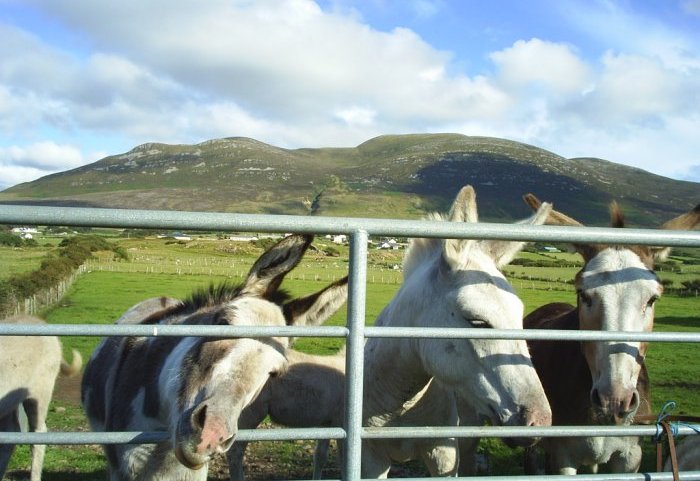
  1. The friendly donkeys below the Urris Hills near Clonmany, Inishowen,
Co. Donegal. Lovely animals and in a most beautiful
part of the north-west of Ireland *
photos pictures images © Phil Brown docspics
Domestic pets, dogs & cats, horses, wild animals, vet services
*
next picture *
more
Donegal Scenes *
Animal Picture Index
*
animal
photos pictures images © Phil Brown docspics
vets practices,
domestic pets, dogs & cats, horses, wild animals, veterinary services 1. The friendly donkeys below the Urris Hills near Clonmany, Inishowen,
Co. Donegal. Lovely animals and in a most beautiful
part of the north-west of Ireland *
photos pictures images © Phil Brown docspics
Domestic pets, dogs & cats, horses, wild animals, vet services
*
next picture *
more
Donegal Scenes *
Animal Picture Index
*
animal
photos pictures images © Phil Brown docspics
vets practices,
domestic pets, dogs & cats, horses, wild animals, veterinary services
|
|
 Enter
anything of interest
Enter
anything of interest
|
*
 *
*
Page semi-protected
Donkey
From Wikipedia, the free encyclopedia
Jump to navigationJump to search
For other uses, see Donkey (disambiguation).
Donkey
Donkey 1 arp 750px.jpg
Conservation status
Domesticated
Scientific classification e
Kingdom: Animalia
Phylum: Chordata
Class: Mammalia
Order: Perissodactyla
Family: Equidae
Genus: Equus
Species: E. africanus
Subspecies: E. a. asinus
Trinomial name
Equus africanus asinus
Linnaeus, 1758
The donkey or ass (Equus africanus asinus)donkey 1 donkey 2 donkey is a
domesticated member of the horse family, Equidae. The wild ancestor of the
donkey is the African wild ass, E. africanus. The donkey has been used as a
working animal for at least 5000 years. There are more than 40 million donkeys
in the world, mostly in underdeveloped countries, where they are used
principally as draught or pack animals. Working donkeys are often associated
with those living at or below subsistence levels. Small numbers of donkeys are
kept for breeding or as pets in developed countries.
A male donkey or ass is called a jack, a female a jenny or jennet; donkey 3
donkey 4 donkey 5 donkey a young donkey is a foal. donkey 5 donkey Jack donkeys
are often used to mate with female horses to produce mules; the biological
"reciprocal" of a mule, from a stallion and jenny as its parents instead, is
called a hinny.
Asses were first domesticated around 3000 BC, probably in Egypt or
Mesopotamia,donkey 6 donkey donkey 7 donkey and have spread around the world.
They continue to fill important roles in many places today. While domesticated
species are increasing in numbers, the African wild ass is an endangered
species. As beasts of burden and companions, asses and donkeys have worked
together with humans for millennia.
Scientific and common names
Traditionally, the scientific name for the donkey is Equus asinus asinus based
on the principle of priority used for scientific names of animals. However, the
International Commission on Zoological Nomenclature ruled in 2003 that if the
domestic species and the wild species are considered subspecies of one another,
the scientific name of the wild species has priority, even when that subspecies
was described after the domestic subspecies.donkey 2 donkey This means that the
proper scientific name for the donkey is Equus africanus asinus when it is
considered a subspecies, and Equus asinus when it is considered a species.
At one time, the synonym ass was the more common term for the donkey. The first
recorded use of donkey was in either 1784donkey 8 donkey or 1785.donkey 9 donkey
donkey 10 donkey donkey 11 donkey While the word ass has cognates in most other
Indo-European languages, donkey is an etymologically obscure word for which no
credible cognate has been identified. Hypotheses on its derivation include the
following:
Perhaps from Spanish, for its don-like gravity; the donkey was also known as
"the King of Spain's trumpeter"donkey 10 donkey
Perhaps a diminutive of dun (dull grayish-brown), a typical donkey colour.donkey
9 donkey donkey 12 donkey
Perhaps from the name Duncan.donkey 9 donkey donkey 13 donkey
Perhaps of imitative origin.donkey 13 donkey
From the 18th century, donkey gradually replaced ass, and jenny replaced
she-ass, which is now considered archaic.donkey 14 donkey The change may have
come about through a tendency to avoid pejorative terms in speech, and be
comparable to the substitution in North American English of rooster for cock, or
that of rabbit for coney, which was formerly homophonic with cunny. By the end
of the 17th century, changes in pronunciation of both ass and arse had caused
them to become homophones. Other words used for the ass in English from this
time include cuddy in Scotland, neddy in southwest England and dicky in the
southeast;donkey 11 donkey moke is documented in the 19th century, and may be of
Welsh or Gypsy origin.
Characteristics
See also: List of donkey breeds
Classic British seaside donkeys in Skegness
Donkeys vary considerably in size, depending on breed and management. The height
at the withers ranges from 7.3 to 15.3 hands (31 to 63 inches, 79 to 160 cm),
and the weight from 80 to 480 kg (180 to 1,060 lb). Working donkeys in the
poorest countries have a life expectancy of 12 to 15 years;donkey 15 donkey in
more prosperous countries, they may have a lifespan of 30 to 50 years.donkey 5
donkey
Donkeys are adapted to marginal desert lands. Unlike wild and feral horses, wild
donkeys in dry areas are solitary and do not form harems. Each adult donkey
establishes a home range; breeding over a large area may be dominated by one
jack.donkey 16 donkey The loud call or bray of the donkey, which typically lasts
for twenty secondsdonkey 17 donkey donkey 18 donkey and can be heard for over
three kilometres, may help keep in contact with other donkeys over the wide
spaces of the desert.donkey 19 donkey Donkeys have large ears, which may pick up
more distant sounds, and may help cool the donkey's blood.donkey 20 donkey
Donkeys can defend themselves by biting, striking with the front hooves or
kicking with the hind legs.
Breeding
A 3-week-old donkey
A jenny is normally pregnant for about 12 months, though the gestation period
varies from 11 to 14 months,donkey 5 donkey donkey 21 donkey and usually gives
birth to a single foal. Births of twins are rare, though less so than in
horses.donkey 5 donkey About 1.7 percent of donkey pregnancies result in twins;
both foals survive in about 14 percent of those.donkey 22 donkey In general
jennies have a conception rate that is lower than that of horses (i.e. less than
the 60–65% rate for mares).donkey 5 donkey
Although jennies come into heat within 9 or 10 days of giving birth, their
fertility remains low, and it is likely the reproductive tract has not returned
to normal.donkey 5 donkey Thus it is usual to wait one or two further oestrous
cycles before rebreeding, unlike the practice with mares. Jennies are usually
very protective of their foals, and some will not come into estrus while they
have a foal at side.donkey 23 donkey The time lapse involved in rebreeding, and
the length of a jenny's gestation, means that a jenny will have fewer than one
foal per year. Because of this and the longer gestation period, donkey breeders
do not expect to obtain a foal every year, as horse breeders often do, but may
plan for three foals in four years.donkey 5 donkey
Donkeys can interbreed with other members of the family Equidae, and are
commonly interbred with horses. The hybrid between a jack and a mare is a mule,
valued as a working and riding animal in many countries. Some large donkey
breeds such as the Asino di Martina Franca, the Baudet de Poitou and the Mammoth
Jack are raised only for mule production. The hybrid between a stallion and a
jenny is a hinny, and is less common. Like other inter-species hybrids, mules
and hinnies are usually sterile.donkey 5 donkey Donkeys can also breed with
zebras in which the offspring is called a zonkey (among other names).
Behaviour
Donkeys have a notorious reputation for stubbornness, but this has been
attributed to a much stronger sense of self-preservation than exhibited by
horses.donkey 24 donkey Likely based on a stronger prey instinct and a weaker
connection with humans, it is considerably more difficult to force or frighten a
donkey into doing something it perceives to be dangerous for whatever reason.
Once a person has earned their confidence they can be willing and companionable
partners and very dependable in work.donkey 25 donkey
Although formal studies of their behaviour and cognition are rather limited,
donkeys appear to be quite intelligent, cautious, friendly, playful, and eager
to learn.donkey 26 donkey
History
See also: Evolution of the horse
Skull of a giant extinct horse, Equus eisenmannae
The genus Equus, which includes all extant equines, is believed to have evolved
from Dinohippus, via the intermediate form Plesippus. One of the oldest species
is Equus simplicidens, described as zebra-like with a donkey-shaped head. The
oldest fossil to date is ~3.5 million years old from Idaho, USA. The genus
appears to have spread quickly into the Old World, with the similarly aged Equus
livenzovensis documented from western Europe and Russia.donkey 27 donkey
Molecular phylogenies indicate the most recent common ancestor of all modern
equids (members of the genus Equus) lived ~5.6 (3.9–7.8) mya. Direct
paleogenomic sequencing of a 700,000-year-old middle Pleistocene horse
metapodial bone from Canada implies a more recent 4.07 Myr before present date
for the most recent common ancestor (MRCA) within the range of 4.0 to 4.5 Myr
BP.donkey 28 donkey The oldest divergencies are the Asian hemiones (subgenus E.
(Asinus), including the kulan, onager, and kiang), followed by the African
zebras (subgenera E. (Dolichohippus), and E. (Hippotigris)). All other modern
forms including the domesticated horse (and many fossil Pliocene and Pleistocene
forms) belong to the subgenus E. (Equus) which diverged ~4.8 (3.2–6.5) million
years ago.donkey 29 donkey
The ancestors of the modern donkey are the Nubian and Somalian subspecies of
African wild ass.donkey 30 donkey
Donkey in an Egyptian painting c. 1298–1235 BC
Lt. Richard Alexander "Dick" Henderson using a donkey to carry a wounded soldier
at the Battle of Gallipoli.
donkey 31 donkey Remains of domestic donkeys dating to the fourth millennium BC
have been found in Ma'adi in Lower Egypt, and it is believed that the
domestication of the donkey was accomplished long after the domestication of
cattle, sheep and goats in the seventh and eighth millennia BC. Donkeys were
probably first domesticated by pastoral people in Nubia, and they supplanted the
ox as the chief pack animal of that culture. The domestication of donkeys served
to increase the mobility of pastoral cultures, having the advantage over
ruminants of not needing time to chew their cud, and were vital in the
development of long-distance trade across Egypt. In the Dynasty IV era of Egypt,
between 2675 and 2565 BC, wealthy members of society were known to own over
1,000 donkeys, employed in agriculture, as dairy and meat animals and as pack
animals.donkey 32 donkey In 2003, the tomb of either King Narmer or King Hor-Aha
(two of the first Egyptian pharaohs) was excavated and the skeletons of ten
donkeys were found buried in a manner usually used with high ranking humans.
These burials show the importance of donkeys to the early Egyptian state and its
ruler.donkey 33 donkey
Feral burros in Red Rock Canyon
By the end of the fourth millennium BC, the donkey had spread to Southwest Asia,
and the main breeding center had shifted to Mesopotamia by 1800 BC. The breeding
of large, white riding asses made Damascus famousdonkey citation needed donkey ,
while Syrian breeders developed at least three other breeds, including one
preferred by women for its easy gait. The Muscat or Yemen ass was developed in
Arabia. By the second millennium BC, the donkey was brought to Europe, possibly
at the same time as viticulture was introduced, as the donkey is associated with
the Syrian god of wine, Dionysus. Greeks spread both of these to many of their
colonies, including those in what are now Italy, France and Spain; Romans
dispersed them throughout their empire.donkey 32 donkey
The first donkeys came to the Americas on ships of the Second Voyage of
Christopher Columbus, and were landed at Hispaniola in 1495.donkey 34 donkey The
first to reach North America may have been two animals taken to Mexico by Juan
de Zumárraga, the first bishop of Mexico, who arrived there on 6 December 1528,
while the first donkeys to reach what is now the United States may have crossed
the Rio Grande with Juan de Oñate in April 1598.donkey 35 donkey From that time
on they spread northward, finding use in missions and mines. Donkeys were
documented as present in what today is Arizona in 1679. By the Gold Rush years
of the 19th century, the burro was the beast of burden of choice of early
prospectors in the western United States. With the end of the placer mining
boom, many of them escaped or were abandoned, and a feral population established
itself.
Present status
About 41 million donkeys were reported worldwide in 2006.donkey 36 donkey China
had the most with 11 million, followed by Pakistan, Ethiopia and Mexico. As of
2017, however, the Chinese population was reported to have dropped to 3 million,
with African populations under pressure as well, due to increasing trade and
demand for donkey products in China.donkey 37 donkey Some researchers believe
the actual number may be somewhat higher since many donkeys go uncounted.donkey
38 donkey The number of breeds and percentage of world population for each of
the FAO's world regions was in 2006:donkey 36 donkey
Region No. of breeds % of world pop.
Africa 26 26.9
Asia and Pacific 32 37.6
Europe and the Caucasus 51 3.7
Latin America and the Caribbean 24 19.9
Near and Middle East 47 11.8
United States and Canada 5 0.1
World 185 41 million head
In 1997 the number of donkeys in the world was reported to be continuing to
grow, as it had steadily done throughout most of history; factors cited as
contributing to this were increasing human population, progress in economic
development and social stability in some poorer nations, conversion of forests
to farm and range land, rising prices of motor vehicles and fuel, and the
popularity of donkeys as pets.donkey 38 donkey donkey 39 donkey Since then, the
world population of donkeys is reported to be rapidly shrinking, falling from
43.7 million to 43.5 million between 1995 and 2000, and to only 41 million in
2006.donkey 36 donkey The fall in population is pronounced in developed
countries; in Europe, the total number of donkeys fell from 3 million in 1944 to
just over 1 million in 1994.donkey 40 donkey
The Domestic Animal Diversity Information System (DAD-IS) of the FAO listed 189
breeds of ass in June 2011.donkey 41 donkey In 2000 the number of breeds of
donkey recorded worldwide was 97, and in 1995 it was 77. The rapid increase is
attributed to attention paid to identification and recognition of donkey breeds
by the FAO's Animal Genetic Resources project.donkey 36 donkey The rate of
recognition of new breeds has been particularly high in some developed
countries. In France, for example, only one breed, the Baudet de Poitou, was
recognised prior to the early 1990s; by 2005, a further six donkey breeds had
official recognition.donkey 42 donkey
In prosperous countries, the welfare of donkeys both at home and abroad has
become a concern, and a number of sanctuaries for retired and rescued donkeys
have been set up. The largest is The Donkey Sanctuary near Sidmouth, England,
which also supports donkey welfare projects in Egypt, Ethiopia, India, Kenya,
and Mexico.donkey 43 donkey
See also: List of donkey breeds
Uses
Economic use
Donkeys bring supplies through the jungle to a camp outpost in Tayrona National
Natural Park in northern Colombia
On the island of Hydra, because cars are outlawed, donkeys and mules form
virtually the sole method of heavy goods transport.
A donkey operating a water well at Carisbrooke Castle on the Isle of Wight.
The donkey has been used as a working animal for at least 5000 years. Of the
more than 40 million donkeys in the world, about 96% are in underdeveloped
countries, where they are used principally as pack animals or for draught work
in transport or agriculture. After human labour, the donkey is the cheapest form
of agricultural power.donkey 44 donkey They may also be ridden, or used for
threshing, raising water, milling and other work. Working donkeys are often
associated with those living at or below subsistence levels.donkey 45 donkey
Some cultures that prohibit women from working with oxen in agriculture do not
extend this taboo to donkeys, allowing them to be used by both sexes.donkey 46
donkey
In developed countries where their use as beasts of burden has disappeared,
donkeys are used to sire mules, to guard sheep,donkey 32 donkey donkey 47 donkey
for donkey rides for children or tourists, and as pets. Donkeys may be pastured
or stabled with horses and ponies, and are thought to have a calming effect on
nervous horses. If a donkey is introduced to a mare and foal, the foal may turn
to the donkey for support after it has been weaned from its mother.donkey 48
donkey
A few donkeys are milked or raised for meat;donkey 38 donkey in Italy, which has
the highest consumption of equine meat in Europe and where donkey meat is the
main ingredient of several regional dishes, about 1000 donkeys were slaughtered
in 2010, yielding approximately 100 tonnes of meat.donkey 49 donkey Asses' milk
may command good prices: the average price in Italy in 2009 was €15 per
litre,donkey 50 donkey and a price of €6 per 100 ml was reported from Croatia in
2008; it is used for soaps and cosmetics as well as dietary purposes. The niche
markets for both milk and meat are expanding.donkey 36 donkey In the past,
donkey skin was used in the production of parchment.donkey 36 donkey In 2017,
the UK based charity The Donkey Sanctuary estimated that 1.8 million skins were
traded every year, but the demand could be as high as 10 million.donkey 51
donkey
In China, donkey meat is considered a delicacy with some restaurants
specializing in such dishes, and Guo Li Zhuang restaurants offer the genitals of
donkeys in dishes. Donkey-hide gelatin is produced by soaking and stewing the
hide to make a traditional Chinese medicine product. Ejiao, the gelatine
produced by boiling donkey skins, can sell for up to $388 per kilo, at October
2017 prices.
In 2017, a drop in the number of Chinese donkeys, combined with the fact that
they are slow to reproduce, meant that Chinese suppliers began to look to
Africa. As a result of the increase in demand, and the price that could be
charged, Kenya opened three donkey abattoirs. Concerns for donkeys' well-being,
however, have resulted in a number of African countries (including Uganda,
Tanzania, Botswana, Niger, Burkina Faso, Mali, and Senegal) banning China from
buying their donkey products.donkey 51 donkey
In warfare
During World War I John Simpson Kirkpatrick, a British stretcher bearer serving
with the Australian and New Zealand Army Corps, and Richard Alexander "Dick"
Henderson of the New Zealand Medical Corps used donkeys to rescue wounded
soldiers from the battlefield at Gallipoli.donkey 52 donkey donkey 53 donkey
According to British food writer Matthew Fort, donkeys were used in the Italian
Army. The Mountain Fusiliers each had a donkey to carry their gear, and in
extreme circumstances the animal could be eaten.donkey 54 donkey
Donkeys have also been used to carry explosives in conflicts that include the
war in Afghanistan and others.donkey 55 donkey donkey 56 donkey
Care
Shoeing
Donkey hooves are more elastic than those of horses, and do not naturally wear
down as fast. Regular clipping may be required; neglect can lead to permanent
damage.donkey 5 donkey Working donkeys may need to be shod. Donkey shoes are
similar to horseshoes, but usually smaller and without toe-clips.
A donkey shoe with calkins
Farriers shoeing a donkey in Cyprus in 1900
Nutrition
In their native arid and semi-arid climates, donkeys spend more than half of
each day foraging and feeding, often on poor quality scrub.donkey 57 donkey The
donkey has a tough digestive system in which roughage is efficiently broken down
by hind gut fermentation, microbial action in the caecum and large
intestine.donkey 57 donkey While there is no marked structural difference
between the gastro-intestinal tract of a donkey and that of a horse, the
digestion of the donkey is more efficient. It needs less food than a horse or
pony of comparable height and weight,donkey 58 donkey approximately 1.5 percent
of body weight per day in dry matter,donkey 59 donkey compared to the 2–2.5
percent consumption rate possible for a horse.donkey 60 donkey Donkeys are also
less prone to colic.donkey 61 donkey The reasons for this difference are not
fully understood; the donkey may have different intestinal flora to the horse,
or a longer gut retention time.donkey 62 donkey
Poitou donkeys.
Donkeys obtain most of their energy from structural carbohydrates. Some suggest
that a donkey needs to be fed only straw (preferably barley straw), supplemented
with controlled grazing in the summer or hay in the winter,donkey 63 donkey to
get all the energy, protein, fat and vitamins it requires; others recommend some
grain to be fed, particularly to working animals,donkey 5 donkey and others
advise against feeding straw.donkey 64 donkey They do best when allowed to
consume small amounts of food over long periods. They can meet their nutritional
needs on 6 to 7 hours of grazing per day on average dryland pasture that is not
stressed by drought. If they are worked long hours or do not have access to
pasture, they require hay or a similar dried forage, with no more than a 1:4
ratio of legumes to grass. They also require salt and mineral supplements, and
access to clean, fresh water.donkey 65 donkey In temperate climates the forage
available is often too abundant and too rich; over-feeding may cause weight gain
and obesity, and lead to metabolic disorders such as founder (laminitisdonkey 66
donkey ) and hyperlipaemia,donkey 63 donkey or to gastric ulcers.donkey 67
donkey
Throughout the world, working donkeys are associated with the very poor, with
those living at or below subsistence level.donkey 45 donkey Few receive adequate
food, and in general donkeys throughout the Third World are under-nourished and
over-worked.donkey 68 donkey
Burro
A burro pulling a cart during the Carnival of Huejotzingo
In the Iberian Peninsula and the Americas, a burro is a small donkey. The
Domestic Animal Diversity Information System (DAD-IS) of the FAO lists the burro
as a specific breed of ass.donkey 69 donkey In Mexico, the donkey population is
estimated at three million.donkey 70 donkey There are also substantial burro
populations in El Salvador, Guatemala, and Nicaragua.
Burro is the Spanish and Portuguese word for donkey. In Spanish, burros may also
be called burro mexicano ('Mexican donkey'), burro criollo ('Criollo donkey'),
or burro criollo mexicano. In the United States, "burro" is used as a loan word
by English speakers to describe any small donkey used primarily as a pack
animal, as well as to describe the feral donkeys that live in Arizona,
California, Oregon, Utah, Texas and Nevada.donkey 64 donkey
Among donkeys, burros tend to be on the small side. A study of working burros in
central Mexico found a weight range of 50–186 kilograms (110–410 lb), with an
average weight of 122 kg (269 lb) for males and 112 kg (247 lb) for females.
Height at the withers varied from 87–120 cm (34–47 in), with an average of
approximately 108 cm (43 in), and girth measurements ranged from 88–152 cm
(35–60 in), with an average of about 120 cm (47 in). The average age of the
burros in the study was 6.4 years; evaluated by their teeth, they ranged from 1
to 17 years old.donkey 45 donkey They are gray in color. Mexican burros tend to
be smaller than their counterparts in the USA, which are both larger and more
robust. To strengthen their bloodstock, in May 2005, the state of Jalisco
imported 11 male and female donkeys from Kentucky.donkey 70 donkey
Feral donkeys and wild asses
In some areas domestic donkeys have returned to the wild and established feral
populations such as those of the Burro of North America and the Asinara donkey
of Sardinia, Italy, both of which have protected status. Feral donkeys can also
cause problems, notably in environments that have evolved free of any form of
equid, such as Hawaii.donkey 71 donkey In Australia, where there may be 5
million feral donkeys,donkey 34 donkey they are regarded as an invasive pest and
have a serious impact on the environment. They may compete with livestock and
native animals for resources, spread weeds and diseases, foul or damage watering
holes and cause erosion.donkey 72 donkey
Wild asses, onagers, and kiangs
Few species of ass exist in the wild. The African wild ass, Equus africanus, has
two subspecies, the Somali wild ass, Equus africanus somaliensis, and the Nubian
wild ass, Equus africanus africanus,donkey 73 donkey the principal ancestor of
the domestic donkey.donkey 36 donkey Both are critically endangered.donkey 74
donkey Extinct species include the European ass, Equus hydruntinus, which became
extinct during the Neolithic, and the North African wild ass, Equus africanus
atlanticus, which became extinct in Roman times.donkey 36 donkey
There are five subspecies of Asiatic wild ass or onager, Equus hemionus, and
three subspecies of the kiang, Equus kiang, of the Himalayan upland.
Donkey hybrids
A male donkey (jack) can be crossed with a female horse to produce a mule. A
male horse can be crossed with a female donkey to produce a hinny.
Horse-donkey hybrids are almost always sterile because horses have 64
chromosomes whereas donkeys have 62, producing offspring with 63 chromosomes.
Mules are much more common than hinnies. This is believed to be caused by two
factors, the first being proven in cat hybrids, that when the chromosome count
of the male is the higher, fertility rates drop (as in the case of stallion x
jenney).donkey citation needed donkey The lower progesterone production of the
jenny may also lead to early embryonic loss. In addition, there are reasons not
directly related to reproductive biology. Due to different mating behavior,
jacks are often more willing to cover mares than stallions are to breed jennys.
Further, mares are usually larger than jennys and thus have more room for the
ensuing foal to grow in the womb, resulting in a larger animal at birth. It is
commonly believed that mules are more easily handled and also physically
stronger than hinnies, making them more desirable for breeders to produce.donkey
citation needed donkey
The offspring of a zebra-donkey cross is called a zonkey, zebroid, zebrass, or
zedonk;donkey 75 donkey zebra mule is an older term, but still used in some
regions today. The foregoing terms generally refer to hybrids produced by
breeding a male zebra to a female donkey. Zebra hinny, zebret and zebrinny all
refer to the cross of a female zebra with a male donkey. Zebrinnies are rarer
than zedonkies because female zebras in captivity are most valuable when used to
produce full-blooded zebras.donkey 76 donkey There are not enough female zebras
breeding in captivity to spare them for hybridizing; there is no such limitation
on the number of female donkeys breeding.
Cultural references
The long history of human donkey use has created a rich store of cultural
references:
Religion, myth and folklore
Jesus rode on a donkey in his triumphal entry into Jerusalem
Due to its widespread domestication and use, the donkey is referred to in myth
and folklore around the world. In classical and ancient cultures, donkeys had a
part. The donkey was the symbol of the Egyptian sun god Ra .donkey 77 donkey In
Greek myth, Silenus is pictured in Classical Antiquity and during the
Renaissance (illustration, left) drunken and riding a donkey, and Midas was
given the ears of an ass after misjudging a musical competition.donkey 78 donkey
Donkeys (or asses) are mentioned many times in the Bible, beginning in the first
book and continuing through both Old and New Testaments, so they became part of
Judeo-Christian tradition. They are portrayed as work animals, used for
agricultural purposes, transport and as beasts of burden, and terminology is
used to differentiate age and gender. In contrast, horses were represented only
in the context of war, ridden by cavalry or pulling chariots. Owners were
protected by law from loss caused by the death or injury of a donkey, showing
their value in that time period. Narrative turning points in the Bible (and
other stories) are often marked through the use of donkeys — for instance,
leading, saddling, or mounting/dismounting a donkey are used to show a change in
focus or a decision having been made.donkey 79 donkey They are used as a measure
of wealth in Genesis 30:43,donkey 80 donkey and in Genesis chapter 34, the
prince of Shechem (the modern Nablus) is named Hamor ("donkey" in Hebrew).donkey
81 donkey
Silenus on a donkey, detail from The Discovery of Honey (c. 1500) by Piero di
Cosimo
According to Old Testament prophecy, the Messiah is said to arrive on a donkey:
"Behold, your King is coming to you; He is just and having salvation, Lowly and
riding on a donkey, A colt, the foal of a donkey!" (Zechariah 9:9). According to
the New Testament, this prophecy was fulfilled when Jesus entered Jerusalem
riding on the animal (Matthew 21:4-7, John 12:14-15). Jesus appeared to be aware
of this connection (Matthew 21:1-3, John 12:16).
In the Jewish religion, the donkey is not a kosher animal. In the Zohar, it is
considered avi avot hatuma or the ultimate impure animal, and doubly "impure",
as it is both non-ruminant and non-cloven hoofed. However, it is the only impure
animal that falls under the mitzvah (commandment) of firstborn ("bechor")
consecration that also applies to humans and pure animals (See Petter Chamor).
In Jewish Oral Tradition (Talmud Bavli), the son of David was prophesied as
riding on a donkey if the tribes of Israel are undeserving of redemption.donkey
82 donkey
In contemporary Israel, the term "Messiah's Donkey" (Chamoro Shel Mashiach חמורו
של משיח) stands at the center of a controversial religious-political doctrine,
under which it was the Heavenly-imposed "task" of secular Zionists to build up a
Jewish State, but once the state is established they are fated to give place to
the Religious who are ordained to lead the state. The secularists in this
analogy are "The Donkey" while the religious who are fated to supplant them are
a collective "Messiach". A book on the subject, published in 1998 by the
militant secularist Sefi Rechlevsky, aroused a major controversy in the Israeli
public opinion.donkey 83 donkey
With the rise of Christianity, some believers came to see the cross-shaped
marking present on donkeys' backs and shoulders as a symbol of the animal's
bearing Jesus into Jerusalem on Palm Sunday. During the Middle Ages, Europeans
used hairs from this cross (or contact with a donkey) as folk remedies to treat
illness, including measles and whooping cough.donkey 84 donkey Around 1400 AD,
one physician listed riding backwards on a donkey as a cure for scorpion
stings.donkey 85 donkey
Goddess Kalaratri rides a donkey.
Donkeys are also referred to repeatedly in the writings and imagery of the
Hinduism, where the goddess Kalaratri's vahana (vehicle) is a donkey.donkey 86
donkey Donkeys also appear multiple times in Indian folklore as the subject of
stories in both the Hitopadeshadonkey 87 donkey and the Panchatantra.donkey 88
donkey
In Islam, eating the meat of a domestic donkey is not allowed.donkey 89 donkey
Literature and film
Donkeys hold a significant place in literature, especially in Western cultures.
The original representations of donkeys in Western literature come mainly from
the Bible and Ancient Greece. Donkeys were represented in a fairly negative form
by the Greeks, but perceptions later changed, partially due to donkeys becoming
increasingly symbolically connected to Christianity. Donkeys were found in the
works of Homer, Aesop and Apuleius, where they were generally portrayed as
stupid and stubborn, or servile at best, and generally represented the lower
class. They were often contrasted with horses, which were seen as powerful and
beautiful. Aesop's The Ass in the Lion's Skin, representational of the almost 20
of his fables that portray donkeys, shows the donkey as a fool. Apuleius's The
Golden Ass (160 AD), where the narrator is turned into a donkey, is also notable
for its portrayal of donkeys as stubborn, foolish, wicked and lowly. This work
had a large influence on the portrayal of donkeys in later cultures, including
medieval and renaissance Europe. During this time, donkeys continued to be shown
as stupid, clumsy and slow. Shakespeare popularized the use of the word "ass" as
an insult meaning stupid or clownish in many of his plays, including Bottom's
appearance in A Midsummer Night's Dream (1600). In contrast, a few years later,
Cervantes' Don Quixote shows a more positive slant on the donkey, primarily as
Sancho Panza's mount, portraying them as steady and loyal companions. This
difference is possibly due to donkeys being an important aspect of many
Spaniards' lives at this point in time.donkey 90 donkey
In contrast to Grecian works, donkeys were portrayed in Biblical works as
symbols of service, suffering, peace and humility. They are also associated with
the theme of wisdom in the Old Testament story of Balaam's ass, and are seen in
a positive light through the story of Jesus riding into Jerusalem on a donkey.
By the 19th century, the donkey was portrayed with more positive attributes by
popular authors. William Wordsworth portrayed the donkey as loyal and patient in
his 1819 poem Peter Bell:A Tale, using the donkey as a Christian symbol. Robert
Louis Stevenson in Travels with a Donkey (1879), portrays the animal as a
stubborn beast of burden. Sympathetic portrayals return in Juan Ramon Jimenez's
Platero and I. The melancholy Eeyore in Winnie the Pooh (first published in
1926) is arguably the most famous donkey in Western literature.donkey 90 donkey
Donkeys were featured in literature during the 20th century, including in George
Orwell's 1951 Animal Farm, where Benjamin the donkey is portrayed as resilient
and loyal.donkey 90 donkey Puzzle is a well-meaning but easily manipulated
donkey in C. S. Lewis's 1956 The Last Battle.donkey 91 donkey Brighty is the
central character of the 1953 children's novel and 1967 film Brighty of the
Grand Canyon.donkey citation needed donkey Donkeys are portrayed in film
including the 1940 Disney film Fantasia, where the donkey is portrayed as a
slapstick character who participates in a social faux pas with Bacchus and is
punished by Zeus.donkey 92 donkey A donkey is featured as the main figure in the
1966 film Au hasard Balthazar by Robert Bresson, and, is given a life path of
Christian symbolism.donkey 90 donkey Donkey, voiced by Eddie Murphy, is featured
as a main character in the Shrek franchise of the 2000s.donkey 93 donkey
Colloquialisms, proverbs and insults
Many cultures have colloquialisms and proverbs that include donkeys or asses.
British phrases include "to talk the hind legs off a donkey", used to describe
someone talking excessively and generally persuasively.donkey 94 donkey Donkeys
are the animals featured most often in Greek proverbs, including such statements
of fatalistic resignation as "the donkey lets the rain soak him".donkey 95
donkey The French philosopher Jean Buridan constructed the paradox called
Buridan's ass, in which a donkey, placed exactly midway between water and food,
would die of hunger and thirst because he could not find a reason to choose one
of the options over the other, and so would never make a decision.donkey 96
donkey Italy has several phrases regarding donkeys, including "put your money in
the ass of a donkey and they'll call him sir" (meaning, if you're rich, you'll
get respect) and "women, donkeys and goats all have heads" (meaning, women are
as stubborn as donkeys and goats).donkey 97 donkey The United States developed
its own expressions, including "better a donkey that carries me than a horse
that throws me", "a donkey looks beautiful to a donkey", and "a donkey is but a
donkey though laden with gold", among others.donkey 98 donkey From Afghanistan,
we find the Pashto proverb, "Even if a donkey goes to Mecca, he is still a
donkey." In Ethiopia, there are many Amharic proverbs that demean donkeys, such
as, "The heifer that spends time with a donkey learns to fart" (Bad company
corrupts good morals).
The words "donkey" and "ass" (or translations thereof) have come to have
derogatory or insulting meaning in several languages, and are generally used to
mean someone who is obstinate, stupid or silly,donkey 99 donkey donkey 100
donkey donkey 101 donkey donkey 102 donkey In football, especially in the United
Kingdom, a player who is considered unskilful is often dubbed a "donkey",donkey
99 donkey and the term has a similar connotation in poker.donkey 103 donkey In
the US, the slang terms "dumbass" and "jackass" are used to refer to someone
considered stupid.donkey 104 donkey donkey 105 donkey
Politics
Satirical use of braying in a political cartoon
The Thomas Nast political cartoon that introduced the donkey as the mascot of
the Democratic Party
In keeping with their widespread cultural references, donkeys feature in
political systems, symbols and terminology in many areas of the world. A "donkey
vote" is a vote that simply writes down preferences in the order of the
candidates (1 at the top, then 2, and so on), and is most often seen in
countries with ranked voting systems and compulsory voting, such as
Australia.donkey 106 donkey The donkey is a common symbol of the Democratic
Party of the United States, originating in a cartoon by Thomas Nast of Harper's
Weekly in the nineteenth century.donkey 107 donkey
The bray of the donkey may be used as a simile for loud and foolish speech in
political mockery.donkey 108 donkey donkey 109 donkey For example,donkey 110
donkey
There are braying men in the world as well as braying asses; for what's loud and
senseless talking and swearing, any other than braying
— Sir Roger L'Estrange
In 1963, Party of Donkeys, a frivolous political party was founded in
Iran.donkey 111 donkey
The "ruc català" or "burro català" (Catalan donkey) has become a symbol of
Catalonia in Spain. In 2003 some friends in Catalonia made bumper stickers
featuring the burro català as a reaction against a national advertising campaign
for Toro d'Osborne, a brandy. The burro became popular as a nationalist symbol
in Catalonia, whose residents wanted to assert their identity to resist Spanish
centralism. Renewed attention to the regional burro helped start a breeding
campaign for its preservation, and its numbers have increased.donkey 112 donkey
Proshka, an ass owned by Russian populist nationalist liberal democratic
politician Vladimir Zhirinovsky, became prominent during the 2012 Russian
presidential election campaign, when he was filmed in an election advertisement
video. In that controversial ad, Zhirinovsky appeared sitting in a sleigh
harnessed with Proshka, then claiming that the "little wretched ass" is the
symbol of Russia and that if he would become President a "daring troika" would
return as a symbol of Russia instead of the ass; at the end, Zhirinovsky beat
Proshka with a whip, made the ass move and had a ride on him through the
snow-covered backyard of his dacha. International organisations People for the
Ethical Treatment of Animals (PETA) and World Animal Protection have accused
Zhirinovsky of cruelty to animals. Zhirinovsky replied to the assertions by
stating that similar treatment is commonplace in the Arab world and claimed that
his ass has been treated "better than many people".donkey 113 donkey
For Doc Brown's latest updates
of pictures or science see https://twitter.com/docbrownchem
Doc Brown's
Science Website - GCSE Biology, GCSE & A Level Chemistry and GCSE Physics
TOP OF PAGE