Homepage [Search] GCSE level chemistry age ~14–16 Advanced pre–university chemistry age ~16–19
|
Born-Haber Cycle for Group 1 alkali metal oxides and group 1 metal sulfides and calculation of lattice enthalpies Doc Brown's A-level Chemistry Exam Revision Notes for Revising Advanced A-Level Chemistry [Author © Dr Phil Brown PhD: Doc Brown's exam revision notes suitable for students of advanced pre–university A-level theoretical–physical chemistry courses: [updated RE-EDIT]email doc brown - comments - query? * [privacy policy, cookies and disclaimer] Born-Haber Cycle and Lattice Enthalpy INDEX Energetics–Thermochemistry–Thermodynamics Notes INDEX 2.2j Born–Haber cycle energy level diagrams for a group 1 metal 'normal' oxide M2O and Group 1 metal sulfide M2S
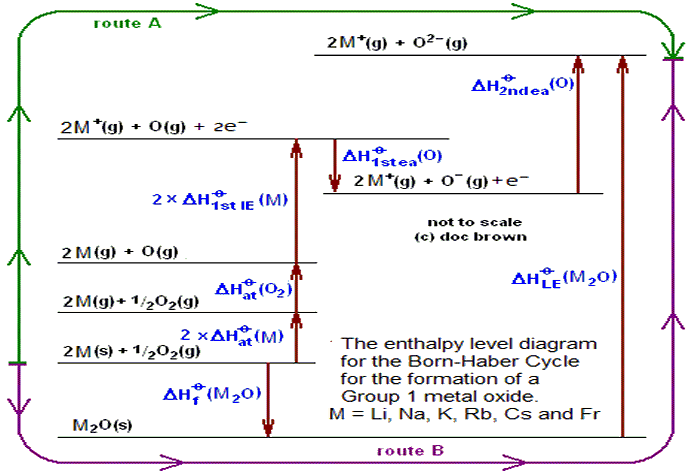
e.g. for sodium oxide M = Na from Hess's Law ΔHθf(M2O) = {2 x ΔHθatom(M)} + ΔHθatom(O2) + {2 x ΔHθ1st IE(M)} + ΔHθ1st elec. affin.(O) + ΔHθ2nd elec. affin.(O) + ΔHθLE(M2O) Watch out for the different enthalpy sign of the two electron affinities. Rearranging gives the lattice enthalpy of a group 1 oxide ('normal' not peroxides) - ΔHθLE(M2O) = {2 x ΔHθatom(M)} + ΔHθatom(O2) + {2 x ΔHθ1st IE(M)} + ΔHθ1st elec. affin.(O) + ΔHθ2nd elec. affin.(O) - ΔHθf(M2O) The Born-Haber cycle for sodium oxide shown as an enthalpy level diagram for sodium oxide.
From Hess's Law: route B = route A route A = route B = +2114 kJ mol–1 for sodium oxide and be very careful of the signs in the algebra as well as the enthalpy values! {2 x ΔHθatom(Na)} + ΔHθatom(O2) + {2 x ΔHθ1st IE(Na)} + ΔHθ1st elec. affin.(O) + ΔHθ2nd elec. affin.(O) = ΔHθf(Na2O) + ΔHθLE(Na2O) ΔHθLE(Na2O) = {2 x ΔHθatom(Na)} + ΔHθatom(O2) + {2 x ΔHθ1st IE(Na)} + ΔHθ1st elec. affin.(O) + ΔHθ2nd elec. affin.(O) - ΔHθf(Na2O) 2nd electron affinity of oxygen is the same as the 1st electron affinity of the O– ion, but you may think of these as the 1st and 2nd electron affinities of oxygen atoms themselves, in the same way that you refer to the 1st and 2nd ionisation energies of gaseous sodium atoms. This Born–Haber cycle can be adapted for any Group 1 Alkali Metal oxide M2O e.g. Li2O, K2O etc. A general Born-Haber Cycle for a group 1 metal oxide expressed as an enthalpy level diagram
ΔHfθ(M2O) = standard enthalpy of formation of group 1 oxide (↓ exothermic) ΔHθat(M) = standard enthalpy of atomisation of the group 1 metal (↑ endothermic) ΔHθatom(O2) = standard enthalpy of atomisation of oxygen (↑ endothermic) ΔHθ1stea.(O) = standard enthalpy of the 1st electron affinity of oxygen (↓ exothermic) ΔHθ2ndea.(O-) = standard enthalpy of the 2nd electron affinity of oxygen (↑ endothermic) ΔHθ1st IE(M) = standard enthalpy of the 1st ionisation of the group 1 metal (↑ endothermic) ΔHθLE(M2O) = lattice enthalpy of the group 1 metal oxide (↑ endothermic) From Hess's Law: route B = route A {2 x ΔHθatom(M)} + ΔHθatom(O2) + {2 x ΔHθ1st IE(M)} + ΔHθ1st elec. affin.(O) + ΔHθ2nd elec. affin.(O) = ΔHθf(M2O) + ΔHθLE(M2O) Rearrange to obtain the lattice enthalpy of a Group 1 metal oxide and be very careful of the signs in the algebra as well as the enthalpy values! ΔHθLE(M2O) = {2 x ΔHθatom(M)} + ΔHθatom(O2) + {2 x ΔHθ1st IE(M)} + ΔHθ1st elec. affin.(O) + ΔHθ2nd elec. affin.(O) - ΔHθf(M2O) Born-Haber Cycle for a Group 1 alkali metal sulfide to compute its lattice enthalpy
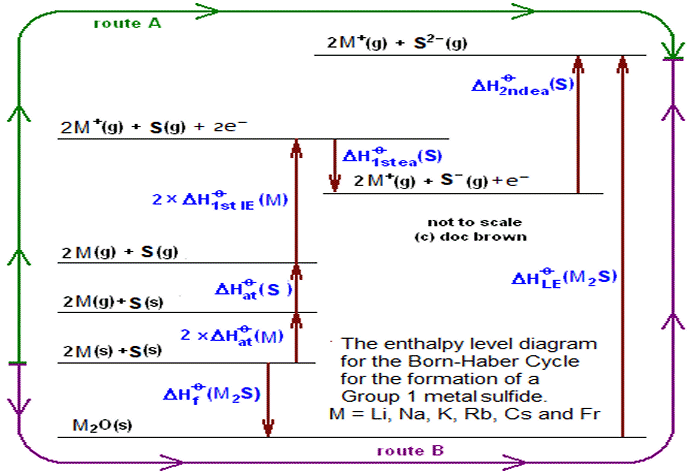
e.g. for M = Li, Na and K etc. From Hess's Law ΔHθf(M2S) = {2 x ΔHθatom(M)} + ΔHθatom(S) + {2 x ΔHθ1st IE(M)} + ΔHθ1st elec. affin.(S) + ΔHθ2nd elec. affin.(S) + ΔHθLE(M2S) Watch out for the different enthalpy sign of the two electron affinities of gaseous sulfur atoms. Rearrange to obtain the lattice enthalpy of any Group 1 metal sulfide and be very careful of the signs in the algebra as well as the enthalpy values! - ΔHθLE(M2S) = {2 x ΔHθatom(M)} + ΔHθatom(S) + {2 x ΔHθ1st IE(M)} + ΔHθ1st elec. affin.(S) + ΔHθ2nd elec. affin.(S) - ΔHθf(M2S) A general Born-Haber Cycle for a group 1 metal sulfide expressed as an enthalpy level diagram to calculate lattice enthalpy
ΔHfθ(M2S) = standard enthalpy of formation of group 1 sulfide (↓ exothermic) ΔHθat(M) = standard enthalpy of atomisation of the group 1 metal (↑ endothermic) ΔHθatom(S) = standard enthalpy of atomisation of sulfur (↑ endothermic) ΔHθ1stea.(S) = standard enthalpy of the 1st electron affinity of sulfur (↓ exothermic) ΔHθ2ndea.(S-) = standard enthalpy of the 2nd electron affinity of sulfur (↑ endothermic) ΔHθ1st IE(M) = standard enthalpy of the 1st ionisation of the group 1 metal (↑ endothermic) ΔHθLE(M2S) = lattice enthalpy of the group 2 metal oxide (↑ endothermic) From Hess's Law: route A = route B {2 x ΔHθatom(M)} + ΔHθatom(S) + {2 x ΔHθ1st IE(M)} + ΔHθ1st elec. affin.(S) + ΔHθ2nd elec. affin.(S) = ΔHθf(M2S) + ΔHθLE(M2S) Rearrange to obtain the lattice enthalpy of any Group 1 metal sulfide and be very careful of the signs in the algebra as well as the enthalpy values! ΔHθLE(M2S) = {2 x ΔHθatom(M)} + ΔHθatom(S) + {2 x ΔHθ1st IE(M)} + ΔHθ1st elec. affin.(S) + ΔHθ2nd elec. affin.(S) - ΔHθf(M2S) Born-Haber Cycle and Lattice Enthalpy INDEX Energetics–Thermochemistry–Thermodynamics Notes INDEX How to draw the Born-Haber Cycle for Group 1 metal oxides and group 1 metal sulfides, how to calculate the lattice enthalpy for Group 1 metal oxides and group 1 metal sulfides from a Born-Haber Cycle, a full explanation of the terms and enthalpy values of the Born-Haber Cycle for Group 1 metal oxides and group 1 metal sulfides, what do I need to know about the Born-Haber Cycle of Group 1 metal oxides and group 1 metal sulfides for AQA, Edexcel, OCR, Salters, CIE, WJEC Eduqas & CCEA A-level chemistry, US grades 11-12 K12 AP Honors chemistry courses, how to use enthalpies of formation, ionisation, atomisation, electron affinity and lattice enthalpy to problem solve the Born-Haber Cycle for Group 1 metal oxides and group 1 metal sulfides. |
||||||||||||||||||||||||||||||||||||||||||||||||||||||
 ΔH
ΔH

 ΔH
ΔH
 2
x
2
x