Homepage [Search] GCSE level chemistry age ~14–16 Advanced pre–university chemistry age ~16–19
|
The Born-Haber Cycle for group 2 alkaline earth metal halides and calculation of lattice enthalpy Doc Brown's A-level Chemistry Exam Revision Notes for Revising Advanced A-Level Chemistry [Author © Dr Phil Brown PhD: Doc Brown's exam revision notes suitable for students of advanced pre–university A-level theoretical–physical chemistry courses: [updated RE-EDIT]email doc brown - comments - query? * [privacy policy, cookies and disclaimer] Born-Haber Cycle and Lattice Enthalpy INDEX Energetics–Thermochemistry–Thermodynamics Notes INDEX 2.2f. Calculating the lattice enthalpy of a group 2 metal halide using the Born–Haber cycle diagram
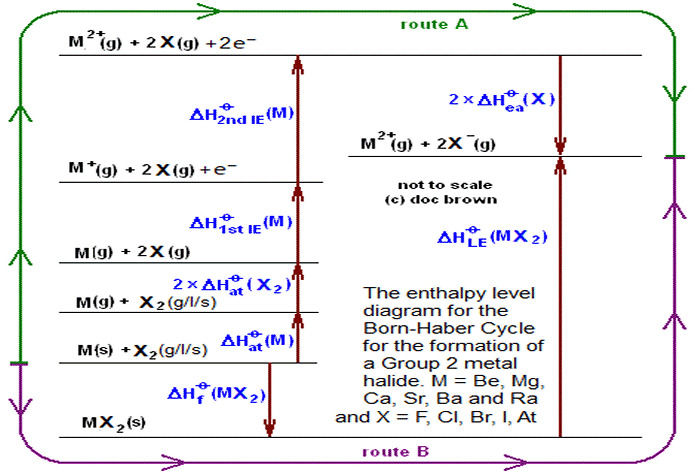
For X = halogen and M = group 2 metal From Hess's Law: ΔHθf(MX2) = ΔHθatom(M) + {2 x ΔHθatom(X2)} + ΔHθ1st IE(M) + ΔHθ2nd IE(M) + {2 x ΔHθelec. affin.(X)} + ΔHθLE(MX2) After substitution, rearrange to calculate the lattice enthalpy of the group 2 metal halide and watch out for the signs in the algebra as well as the enthalpy values! -ΔHθLE(MX2) = ΔHθatom(M) + {2 x ΔHθatom(X2)} + ΔHθ1st IE(M) + ΔHθ2nd IE(M) + {2 x ΔHθelec. affin.(X)} - ΔHθf(MX2) Watch out for the state of the halogen: F2(g), Cl2(g), Br2(l) and I2(s) and watch out for the signs in the algebra as well as the enthalpy values! Other lattice enthalpies that can be calculated with the magnesium chloride Born-Haber Cycle for any Group 2 metal oxide using an enthalpy level diagram A general scheme is set out below of a general Born-Haber Cycle for a group 2 metal halide salt using an enthalpy level diagram.
ΔHfθ(MX2) = standard enthalpy of formation of group 2 halide salt e.g. iodide (↓ exothermic) ΔHθat(M) = standard enthalpy of atomisation of the group 2 metal (↑ endothermic) ΔHθatom(X2) = standard enthalpy of atomisation of the halogen X2 (↑ endothermic) ΔHθea.(X) = standard enthalpy of the electron affinity of the halogen (↓ exothermic) ΔHθ1st IE(M) = standard enthalpy of the 1st ionisation of the group 2 metal (↑ endothermic) ΔHθ2ndt IE(M) = standard enthalpy of the 2nd ionisation of the group 2 metal (↑ endothermic) ΔHθLE(MX) = lattice enthalpy of the group 2 metal halide salt (↑ endothermic) From Hess's Law: route B = route A ΔHfθ(MX) + ΔHθLE(MX) = ΔHθat(M) + 2 x ΔHθatom(X) + ΔHθ1st IE(M) + ΔHθ2ndIE(M) + {2 x ΔHθea.(X)} rearranging to get the lattice enthalpy of a group 2 metal halide salt and watch out for the signs in the algebra as well as the enthalpy values! ΔHθLE(MX) = ΔHθat(M) + 2 x ΔHθatom(X) + ΔHθ1st IE(M) + ΔHθ2ndIE(M) + {2 x ΔHθea.(X)} - ΔHfθ(MX) Hence you can calculate the lattice enthalpy of any group 2 metal halide assuming it is a purely ionic compound e.g. magnesium bromide, calcium fluoride, strontium iodide, barium chloride etc. Born-Haber Cycle and Lattice Enthalpy INDEX Energetics–Thermochemistry–Thermodynamics Notes INDEX How to draw the Born-Haber Cycle for group 2 metal halides, how to calculate the lattice enthalpy for group 2 metal halides from a Born-Haber Cycle, a full explanation of the terms and enthalpy values of the Born-Haber Cycle for group 2 metal halides, what do I need to know about the Born-Haber Cycle of group 2 metal halides for AQA, Edexcel, OCR, Salters, CIE, WJEC Eduqas & CCEA A-level chemistry, US grades 11-12 K12 AP Honors chemistry courses, how to use enthalpies of formation, ionisation, atomisation, electron affinity and lattice enthalpy to problem solve the Born-Haber Cycle for group 2 metal halides. |
|||||||||||||||||||||||||||
 ΔH
ΔH

 2xΔH
2xΔH
 ΔH
ΔH