|
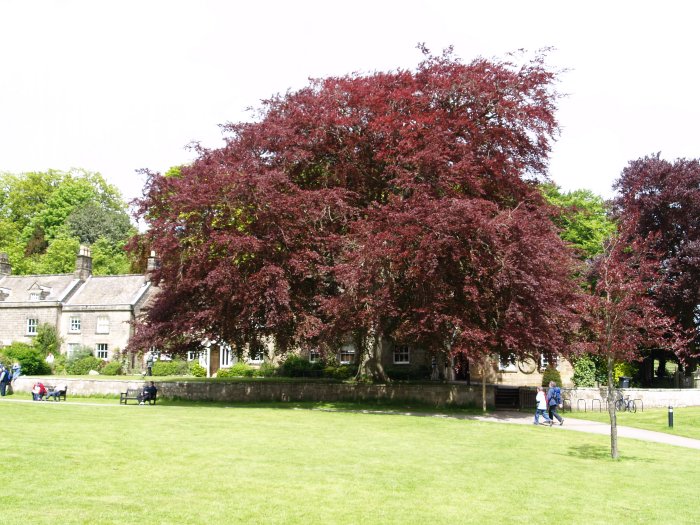
NATURE SCENES: 64. The
copper beech tree that once stood in Danby Lodge, North Yorkshire
 Enter
anything of interest
Enter
anything of interest
|
*
 *
*
 
*
previous page *
next picture *
NATURE SCENES photographs docspics
pictures photos images © Phil
Brown * The Natural World - Natural
History |
Fagus sylvatica
From Wikipedia, the free encyclopedia
Fagus sylvatica
European beech
Fagus-sylvatica-cansiglio-forest-italy.jpg
European beech in alpine forest (Italy)
Scientific classification edit
Kingdom: Plantae
Clade: Angiosperms
Clade: Eudicots
Clade: Rosids
Order: Fagales
Family: Fagaceae
Genus: Fagus
Species: F. sylvatica
Binomial name
Fagus sylvatica
L.
Fagus sylvatica range.svg
Distribution map
Synonyms copper beech 1 tree
Castanea fagus Scop.
Fagus aenea Dum.Cours.
Fagus asplenifolia Dum.Cours.
Fagus cochleata (Dippel) Domin
Fagus comptoniifolia Desf.
Fagus crispa Dippel
Fagus cristata Dum.Cours.
Fagus cucullata Dippel
Fagus cuprea Hurter ex A.DC.
Fagus echinata Gilib. nom. inval.
Fagus incisa Dippel
Fagus laciniata A.DC. nom. inval.
Fagus pendula (Lodd.) Dum.Cours.
Fagus purpurea Dum.Cours.
Fagus quercoides (Pers.) Dippel
Fagus salicifolia A.DC.
Fagus sylvestris Gaertn.
Fagus tortuosa (Dippel) Domin
Fagus variegata A.DC.
Fagus sylvatica, the European beech or common beech, is a deciduous tree
belonging to the beech family Fagaceae.
Contents
1 Description
2 Distribution and habitat
3 Ecology
4 Cultivation
5 Image gallery
6 Timber
7 Other uses
8 Pathogens
9 Notes
10 External links
Description
Copper beech in autumn
European beech shoot with nut cupules
Fagus sylvatica is a large tree, capable of reaching heights of up to 50 m (160
ft) tall copper beech 2 tree and 3 m (9.8 ft) trunk diameter, though more
typically 25–35 m (82–115 ft) tall and up to 1.5 m (4.9 ft) trunk diameter. A
10-year-old sapling will stand about 4 m (13 ft) tall. It has a typical lifespan
of 150–200 years, though sometimes up to 300 years. In cultivated forest stands
trees are normally harvested at 80–120 years of age. copper beech 3 tree 30
years are needed to attain full maturity (as compared to 40 for American beech).
Like most trees, its form depends on the location: in forest areas, F. sylvatica
grows to over 30 m (100 ft), with branches being high up on the trunk. In open
locations, it will become much shorter (typically 15–24 m (50–80 ft)) and more
massive.
The leaves are alternate, simple, and entire or with a slightly crenate margin,
5–10 cm long and 3–7 cm broad, with 6–7 veins on each side of the leaf (7–10
veins in Fagus orientalis). When crenate, there is one point at each vein tip,
never any points between the veins. The buds are long and slender, 15–30 mm
(0.59–1.18 in) long and 2–3 mm (0.079–0.118 in) thick, but thicker (to 4–5 mm
(0.16–0.20 in)) where the buds include flower buds.
The leaves of beech are often not abscissed in the autumn and instead remain on
the tree until the spring. This process is called marcescence. This particularly
occurs when trees are saplings or when plants are clipped as a hedge (making
beech hedges attractive screens, even in winter), but it also often continues to
occur on the lower branches when the tree is mature.
Small quantities of seeds may be produced around 10 years of age, but not a
heavy crop until the tree is at least 30 years old. F. sylvatica male flowers
are borne in the small catkins which are a hallmark of the Fagales order
(beeches, chestnuts, oaks, walnuts, hickories, birches, and hornbeams). The
female flowers produce beechnuts, small triangular nuts 15–20 millimetres
(0.59–0.79 in) long and 7–10 mm (0.28–0.39 in) wide at the base; there are two
nuts in each cupule, maturing in the autumn 5–6 months after pollination. Flower
and seed production is particularly abundant in years following a hot, sunny and
dry summer, though rarely for two years in a row.
Distribution and habitat
Fagus sylvatica pliocenica – Museum of Toulouse
The natural range extends from southern Sweden to northern Sicily, copper beech
4 tree west to France, southern England, northern Portugal, central Spain, and
east to northwest Turkey, where it intergrades with the oriental beech (Fagus
orientalis), which replaces it further east. In the Balkans, it shows some
hybridisation with oriental beech; these hybrid trees are named Fagus × taurica.
In the southern part of its range around the Mediterranean, it grows only in
mountain forests, at 600–1,800 m (1,969–5,906 ft) altitude.
Although often regarded as native in southern England, recent evidence suggests
that F. sylvatica did not arrive in England until about 4000 BC, or 2,000 years
after the English Channel formed after the ice ages; it could have been an early
introduction by Stone age humans, who used the nuts for food. copper beech 5
tree The beech is classified as a native in the south of England and as a
non-native in the north where it is often removed from 'native' woods. copper
beech 6 tree Localised pollen records have been recorded in the North of England
from the Iron Age by Sir Harry Godwin. Changing climatic conditions may put
beech populations in southern England under increased stress and while it may
not be possible to maintain the current levels of beech in some sites it is
thought that conditions for beech in north-west England will remain favourable
or even improve. It is often planted in Britain. Similarly, the nature of
Norwegian beech populations is subject to debate. If native, they would
represent the northern range of the species. However, molecular genetic analyses
support the hypothesis that these populations represent intentional introduction
from Denmark before and during the Viking Age. copper beech 7 tree However, the
beech in Vestfold and at Seim north of Bergen in Norway is now spreading
naturally and regarded as native. copper beech 8 tree
Though not demanding of its soil type, the European beech has several
significant requirements: a humid atmosphere (precipitation well distributed
throughout the year and frequent fogs) and well-drained soil (it cannot handle
excessive stagnant water). It prefers moderately fertile ground, calcified or
lightly acidic, therefore it is found more often on the side of a hill than at
the bottom of a clayey basin. It tolerates rigorous winter cold, but is
sensitive to spring frost. In Norway's oceanic climate planted trees grow well
as far north as Trondheim. In Sweden, beech trees do not grow as far north as in
Norway. copper beech 9 tree
A beech forest is very dark and few species of plant are able to survive there,
where the sun barely reaches the ground. Young beeches prefer some shade and may
grow poorly in full sunlight. In a clear-cut forest a European beech will
germinate and then die of excessive dryness. Under oaks with sparse leaf cover
it will quickly surpass them in height and, due to the beech's dense foliage,
the oaks will die from lack of sunlight.
Ecology
The root system is shallow, even superficial, with large roots spreading out in
all directions. European beech forms ectomycorrhizas with a range of fungi
including members of the genera Amanita, Boletus, Cantharellus, Hebeloma,
Lactarius, copper beech citation needed tree and with the species Ramaria
flavosaponaria; copper beech 10 tree these fungi are important in enhancing
uptake of water and nutrients from the soil.
In the woodlands of southern Britain, beech is dominant over oak and elm south
of a line from about north Suffolk across to Cardigan. Oak are the dominant
forest trees north of this line. One of the most beautiful European beech
forests called Sonian Forest (Forêt de Soignes/Zoniënwoud) is found in the
southeast of Brussels, Belgium. Beech is a dominant tree species in France and
constitutes about 10% of French forests. The largest virgin forests made of
beech trees are Uholka-Shyrokyi Luh (8,800 ha (22,000 acres)) in Ukraine copper
beech 11 tree and Izvoarele Nerei (5,012 ha (12,380 acres) in one forest body)
in Semenic-Cheile Carașului National Park, Romania. These habitats are home of
Europe's largest predators (the brown bear, the grey wolf and the lynx). copper
beech 12 tree copper beech 13 tree copper beech 14 tree Many trees are older
than 350 years in Izvoarele Nerei copper beech 15 tree and even 500 years in
Uholka-Shyrokyi Luh. copper beech 11 tree
Spring leaf budding by the European beech is triggered by a combination of day
length and temperature. Bud break each year is from the middle of April to the
beginning of May, often with remarkable precision (within a few days). It is
more precise in the north of its range than the south, and at 600 m (2,000 ft)
than at sea level. copper beech 16 tree
The European beech invests significantly in summer and autumn for the following
spring. Conditions in summer, particularly good rainfall, determine the number
of leaves included in the buds. In autumn, the tree builds the reserves that
will sustain it into spring. Given good conditions, a bud can produce a shoot
with up to ten or more leaves. The terminal bud emits a hormonal substance in
the spring that halts the development of additional buds. This tendency, though
very strong at the beginning of their existence, becomes weaker in older trees.
It is only after the budding that root growth of the year begins. The first
roots to appear are very thin (with a diameter of less than 0.5 mm). Later,
after a wave of above ground growth, thicker roots grow in a steady fashion.
Cultivation
European beech is a very popular ornamental tree in parks and large gardens in
temperate regions of the world. In North America, they are preferred for this
purpose over the native F. grandifolia, which despite its tolerance of warmer
climates, is slower growing, taking an average of 10 years longer to attain
maturity. The town of Brookline, Massachusetts has one of the largest, if not
the largest, grove of European beech trees in the United States. The 2.5 acre
public park, called 'The Longwood Mall', was planted sometime before 1850
qualifying it as the oldest stand of European beeches in the United States.
copper beech 17 tree
It is frequently kept clipped to make attractive hedges.
Since the early 19th century there have been numerous cultivars of European
beech made by horticultural selection, often repeatedly; they include:
copper beech or purple beech (Fagus sylvatica purpurea) copper beech 18 tree –
leaves purple, in many selections turning deep spinach green by mid-summer. In
the United States Charles Sprague Sargent noted the earliest appearance in a
nurseryman's catalogue in 1820, but in 1859 "the finest copper beech in
America... more than fifty feet high" was noted in the grounds of Thomas Ash,
Esq., Throggs Neck, New York; copper beech 19 tree it must have been more than
forty years old at the time.
fern-leaf beech (Fagus sylvatica Heterophylla Group) – leaves deeply serrated to
thread-like
dwarf beech (Fagus sylvatica Tortuosa Group) – distinctive twisted trunk and
branches
weeping beech (Fagus sylvatica Pendula Group) – branches pendulous
Dawyck beech (Fagus sylvatica 'Dawyck') – fastigiate (columnar) growth – occurs
in green, gold and purple forms; named after Dawyck Botanic Garden in the
Scottish Borders
golden beech (Fagus sylvatica 'Zlatia') – leaves golden in spring
The following cultivars have gained the Royal Horticultural Society's Award of
Garden Merit:- copper beech 20 tree
F. sylvatica copper beech 21 tree
'Dawyck' copper beech 22 tree
'Dawyck Gold' copper beech 23 tree
'Dawyck Purple' copper beech 24 tree
'Pendula' copper beech 25 tree
'Riversii' copper beech 26 tree
F. sylvatica var. heterophylla 'Aspleniifolia' copper beech 27 tree
Image gallery
'Pendula', Harlow Carr.
The famous Upside-down Tree, Hyde Park, London, an example of F. sylvatica 'pendula'.
Beech planted on a march dyke (boundary hedge) in Scotland.
Leaves of var. heterophylla 'Aspleniifolia', Belfast Botanic Garden
Old stand of beech prepared for regeneration (note the young undergrowth) in the
Sonian Forest.
Fagus sylvatica wood – MHNT
Fagus sylvatica – MHNT
Seedlings
Copper beech (spring)
Fagus sylvatica
Timber
The wood of the European beech is used in the manufacture of numerous objects
and implements. Its fine and short grain makes it an easy wood to work with,
easy to soak, dye, varnish and glue. Steaming makes the wood even easier to
machine. It has an excellent finish and is resistant to compression and
splitting and it is stiff when flexed. Milling is sometimes difficult due to
cracking. The density of the wood is 720 kg per cubic meter. copper beech 28
tree It is particularly well suited for minor carpentry, particularly furniture.
From chairs to parquetry (flooring) and staircases, the European beech can do
almost anything other than heavy structural support, so long as it is not left
outdoors. Its hardness make it ideal for making wooden mallets and workbench
tops. The wood rots easily if it is not protected by a tar based on a distillate
of its own bark (as used in railway sleepers). copper beech 29 tree copper beech
30 tree It is better for paper pulp than many other broadleaved trees though is
only sometimes used for this, the high cellulose content can also be spun into
modal, which is used as a textile akin to cotton. The code for its use in Europe
is fasy (from FAgus SYlvatica). Common beech is also considered one of the best
firewoods for fireplaces. copper beech 31 tree
Other uses
Detail of the tarcrust's structure.
Primary Product AM 01, a smoke flavouring, is produced from Fagus sylvatica L.
copper beech 32 tree
The nuts are an important food for birds, rodents and in the past also humans.
Slightly toxic to humans if eaten in large quantities due to the tannins and
alkaloids they contain, the nuts were nonetheless pressed to obtain an oil in
19th century England that was used for cooking and in lamps. They were also
ground to make flour, which could be eaten after the tannins were leached out by
soaking. copper beech 33 tree copper beech 34 tree copper beech 35 tree
Pathogens
Biscogniauxia nummularia (beech tarcrust) is an ascomycete primary pathogen of
beech trees, causing strip-canker and wood rot. It can be found at all times of
year and is not edible. copper beech 36 tree
For Doc Brown's
latest updates of pictures or science see https://twitter.com/docbrownchem
Doc Brown's
Science Website - GCSE Biology, GCSE & A Level Chemistry and GCSE Physics
TOP OF PAGE