

 Which of the following fuels would be used for a central heating system? [7i-1]
- oil
- charcoal
- petrol
- kerosene
- Which of the following fuels would be used for a barbecue? [7i-2]
- oil
- charcoal
- coal
- coke
- Which of the following fuels would be used for a vintage steamroller (traction engine)? [7i-3]
- oil
- charcoal
- coal
- natural gas
- Which of the following fuels would be used for a camping stove? [7i-4]
- oil
- charcoal
- coal
- butane gas
- Which is a fossil fuel source of energy? [7i-5]
- natural gas
- wood
- geothermal
- sunlight
- Which is a fossil fuel source of energy? [7i-6]
- wood
- oil
- geothermal
- sunlight
- Which is a fossil fuel source of energy? [7i-7]
- wood
- geothermal
- coal
- sunlight


Which is a renewable source of energy? [7i-8]- oil
- rechargeable battery
- coal
- wood
Which is a renewable source of energy? [7i-9]- hydroelectric
- battery
- coal
- natural gas
Which is a renewable source of energy? [7i-10]- peat
- geothermal
- natural gas
- oil
Which is a renewable source of energy? [7i-11]- peat
- battery
- wind generator
- oil

Which is a renewable source of energy? [7i-12]- peat
- battery
- natural gas
- sunlight
Which is a non-fossil and non-renewable source of energy? [7i-13]- battery
- natural gas
- geothermal
- sunlight
Which is a non-renewable source of energy? [7i-14]- wood
- natural gas
- geothermal
- sunlight
Which is a non-renewable source of energy? [7i-15]- wood
- geothermal
- oil
- sunlight
Which is a non-renewable source of energy? [7i-16]- wood
- geothermal
- sunlight
- coal


Which is TRUE about fossil fuels? [7i-17]- they are non-renewable sources of energy
- oil and gas are formed from the decay of remains of dead land plants
- coal is formed from the remains of dead sea organisms
- the main chemical element in them is hydrogen
Which is TRUE about fossil fuels? [7i-18]- they are renewable sources of energy
- oil and gas are formed from the decay of remains of dead sea organisms
- coal is formed from the remains of large land based animals
- the main chemical element in them is hydrogen
Which is TRUE about fossil fuels? [7i-19]- they are renewable sources of energy
- oil and gas are formed from the decay of coral remains
- coal is formed from the remains of dead land based plants
- the main chemical element in them is hydrogen
Which is TRUE about fossil fuels? [7i-20]- they are renewable sources of energy
- oil and gas are formed from the decay of remains of dead land plants
- coal is formed from the remains of dead sea organisms
- the main chemical element in them is carbon

What temperature does the Celsius thermometer read in oC? [7i-21]- 36.0
- 34.0
- 44.0
- 35.5

What temperature does the Celsius thermometer read in oC? [7i-22]- 3
- -7
- 7
- -3

What temperature does the Celsius thermometer read in oC? [7i-23]- 101.0
- 102.0
- 101.5
- 103.0

What temperature does the Celsius thermometer read in oC? [7i-24]- 46.0
- 47.0
- 53.5
- 46.5

What temperature does the Celsius thermometer read in oC? [7i-25]- 132
- 144
- 126
- 131

What temperature does the Celsius thermometer read in oC? [7i-26]- 46.5
- 53.0
- 51.5
- 63.5

What temperature does the Celsius thermometer read in oC? [7i-27]- 203.0
- 201.5
- 206.0
- 227.0

What temperature does the Celsius thermometer read in oC? [7i-28]- 68.5
- 81.5
- 76.0
- 77.0
- Which of these is a desirable property of a fuel for burning? [7i-29]
- gives little smoke
- difficult to ignite so not too flammable
- gives bright yellow flame to be easily seen
- will not burn too steadily to be wasteful
- Which of these is a desirable property of a fuel for burning? [7i-30]
- gives moderate amount of smoke
- easy to ignite
- gives bright yellow flame to be easily seen
- will not burn too steadily to be wasteful
- Which of these is a desirable property of a fuel for burning? [7i-31]
- gives moderate amount of smoke
- difficult to ignite so not too flammable
- gives bright clear flame
- will not burn too steadily to be wasteful
- Which of these is a desirable property of a fuel for burning? [7i-32]
- gives moderate amount of smoke
- difficult to ignite so not too flammable
- gives bright yellow flame to be easily seen
- will burn steadily
 The diagram shows a simple calorimeter system for measuring the heat given out by a liquid fuel burner. The experiment data for four fuels A, B, C and D is given below. 100 ml (100g) of water was used in the calorimeter to 'collect' the heat given out. The mass of fuel burned and the temperature rise of the water are given.
From the data which fuel is the MOST efficient in terms of energy released per unit mass? [7i-33]- mass of fuel = 1.20 g, temperature rise 24oC
- mass of fuel = 0.80g, temperature rise 12oC
- mass of fuel = 1.75g, temperature rise 28oC
- mass of fuel = 0.50 g, temperature rise 9oC
- The diagram shows a simple calorimeter system for measuring the heat given out by a liquid fuel burner. The experiment data for four fuels
A, B, C and D is given below. 100 ml (100g) of water was used in the calorimeter to 'collect' the heat given out. The mass of fuel burned and the temperature rise of the water are given.
From the data which fuel is the LEAST efficient in terms of energy released per unit mass? [7i-34]- mass of fuel = 1.20 g, temperature rise 24oC
- mass of fuel = 0.80g, temperature rise 12oC
- mass of fuel = 1.75g, temperature rise 28oC
- mass of fuel = 0.50 g, temperature rise 9oC
- The diagram shows a simple calorimeter system for measuring the heat given out by a liquid fuel burner. The experiment data for four fuels
A, B, C and D is given below. 100 ml (100g) of water was used in the calorimeter to 'collect' the heat given out. The mass of fuel burned and the temperature rise of the water are given.
From the data which fuel would give a temperature rise of 56oC if 3.5g of it is burned? [7i-35]- mass of fuel = 1.20 g, temperature rise 24oC
- mass of fuel = 0.80g, temperature rise 12oC
- mass of fuel = 1.75g, temperature rise 28oC
- mass of fuel = 0.50 g, temperature rise 9oC
- The diagram shows a simple calorimeter system for measuring the heat given out by a liquid fuel burner. The experiment data for four fuels
A, B, C and D is given below. 100 ml (100g) of water was used in the calorimeter to 'collect' the heat given out. The mass of fuel burned and the temperature rise of the water are given.
From the data which fuel would give a temperature rise of 63oC if 3.5g of it is burned? [7i-36]- mass of fuel = 1.20 g, temperature rise 24oC
- mass of fuel = 0.80g, temperature rise 12oC
- mass of fuel = 1.75g, temperature rise 28oC
- mass of fuel = 0.50 g, temperature rise 9oC

Which is a unit of energy? [7i-37]- joule
- Celsius
- gram
- cm3
Which is a unit of temperature? [7i-38]- joule
- Celsius
- gram
- cm3
Which is a unit of mass? [7i-39]- joule
- centigrade
- gram
- cm3
Which is a unit of volume? [7i-40]- joule
- centigrade
- gram
- cm3
Which is a unit of energy [7i-41]- kJ
- oC
- g
- ml
Which is a unit of temperature? [7i-42]- kJ
- oC
- g
- ml
Which is a unit of mass? [7i-43]- kJ
- oC
- g
- ml
Which is a unit of volume? [7i-44]- kJ
- oC
- g
- ml
Which is a unit of energy? [7i-45]- J
- K
- kg
- m3
Which is a unit of temperature? [7i-46]- J
- K
- kg
- m3
Which is a unit of mass? [7i-47]- J
- K
- kg
- m3
Which is a unit of volume? [7i-48]- J
- K
- kg
- m3
Which is TRUE about energy resources? [7i-49]- renewable energy resources are readily replaced as they are used
- non-renewable energy resources will always supply most of our energy needs
- the Sun is the original source for all our energy resources
- non-renewable fossil fuels are no longer being formed
Which is TRUE about energy resources? [7i-50]- renewable energy resources are not readily replaced as they are used
- non-renewable energy resources will not always supply most of our energy needs
- the Sun is the original source for all our energy resources
- non-renewable fossil fuels are no longer being formed
Which is TRUE about energy resources? [7i-51]- renewable energy resources are not readily replaced as they are used
- non-renewable energy resources will always supply most of our energy needs
- the Sun is the original energy source for many of our energy resources
- non-renewable fossil fuels are no longer being formed
Which is TRUE about energy resources? [7i-52]- renewable energy resources are not readily replaced as they are used
- non-renewable energy resources will always supply most of our energy needs
- the Sun is the original source for all our energy resources
- non-renewable fossil fuels are still being formed slowly

The diagram summarises four stages for a way of producing electricity.
Which of the following matches stage 1? [7i-53]- burn fuel
- heat water
- move turbine
- turn generator
The diagram summarises four stages for a way of producing electricity.
Which of the following matches stage 2? [7i-54]- burn fuel
- heat water
- move turbine
- turn generator
The diagram summarises four stages for a way of producing electricity.
Which of the following matches stage 3? [7i-55]- burn fuel
- heat water
- move turbine
- turn generator
The diagram summarises four stages for a way of producing electricity.
Which of the following matches stage 4? [7i-56]- burn fuel
- heat water
- move turbine
- turn generator
The diagram summarises four stages for a way of producing electricity.
Which of the following matches stage 1? [7i-57]- solar radiation
- air movement
- rotating turbine
- turn generator
The diagram summarises four stages for a way of producing electricity.
Which of the following matches stage 2? [7i-58]- solar radiation
- air movement
- rotating turbine
- turn generator
The diagram summarises four stages for a way of producing electricity.
Which of the following matches stage 3? [7i-59]- solar radiation
- air movement
- rotating turbine
- turn generator
The diagram summarises four stages for a way of producing electricity.
Which of the following matches stage 4? [7i-60]- solar radiation
- air movement
- rotating turbine
- turn generator
The diagram summarises four stages for a way of producing electricity.
Which of the following matches stage 1? [7i-61]- rain water and dam
- flowing water
- rotating turbine
- turn generator
The diagram summarises four stages for a way of producing electricity.
Which of the following matches stage 2? [7i-62]- rain water and dam
- flowing water
- rotating turbine
- turn generator
The diagram summarises four stages for a way of producing electricity.
Which of the following matches stage 3? [7i-63]- rain water and dam
- flowing water
- rotating turbine
- turn generator
The diagram summarises four stages for a way of producing electricity.
Which of the following matches stage 4? [7i-64]- rain water and dam
- flowing water
- rotating turbine
- turn generator

The diagram summarises four stages for a way of producing electricity.
Which of the following matches stage 1? [7i-65]- hot volcanic rocks
- making steam flow fast
- rotating turbine
- turn generator
The diagram summarises four stages for a way of producing electricity.
Which of the following matches stage 2? [7i-66]- hot volcanic rocks
- making steam flow fast
- rotating turbine
- turn generator
The diagram summarises four stages for a way of producing electricity.
Which of the following matches stage 3? [7i-67]- hot volcanic rocks
- making steam flow fast
- rotating turbine
- turn generator
The diagram summarises four stages for a way of producing electricity.
Which of the following matches stage 4? [7i-68]- hot volcanic rocks
- making steam flow fast
- rotating turbine
- turn generator

 Which description matches a solar cell? [7i-69]
- electrical energy directly from the sun
- water stored behind a dam
- air flow driven by the sun
- mainly due to the movement of the moon
- Which description matches hydroelectric power? [7i-70]
- electrical energy directly from the sun
- water stored behind a dam
- air flow driven by the sun
- mainly due to the movement of the moon
- Which description matches wind power? [7i-71]
- electrical energy directly from the sun
- water stored behind a dam
- air flow driven by the sun
- mainly due to the movement of the moon
- Which description matches tidal power? [7i-72]
- electrical energy directly from the sun
- water stored behind a dam
- air flow driven by the sun
- mainly due to the movement of the moon

 Which description matches wave power? [7i-73]
- air flow driven by sun
- hot rocks making steam
- black surface absorbing heat radiation
- sun's energy stored in plants
- Which description matches geothermal power? [7i-74]
- air flow driven by sun
- hot rocks making steam
- black surface absorbing heat radiation
- sun's energy stored in plants
- Which description matches solar panel? [7i-75]
- air flow driven by sun
- hot rocks making steam
- black surface absorbing heat radiation
- sun's energy stored in plants
- Which description matches biomass? [7i-76]
- air flow driven by sun
- hot rocks making steam
- black surface absorbing heat radiation
- sun's energy stored in plants
 The energy from __(1)__ is absorbed by green plant __(2)__. In a process called __(3)__, this energy is used to make energy rich __(4)__ like starch and __(5)__ fuels like wood.
Which word is missing from __(1)__? [7i-77]- sunlight
- leaves
- photosynthesis
- foods
- biomass
- The energy from __(1)__ is absorbed by green plant __(2)__. In a process called __(3)__, this energy is used to make energy rich __(4)__ like starch and __(5)__ fuels like wood.
Which word is missing from __(2)__? [7i-78]- sunlight
- leaves
- photosynthesis
- foods
- biomass
- The energy from __(1)__ is absorbed by green plant __(2)__. In a process called __(3)__, this energy is used to make energy rich __(4)__ like starch and __(5)__ fuels like wood.
Which word is missing from __(3)__? [7i-79]- sunlight
- leaves
- photosynthesis
- foods
- biomass
- The energy from __(1)__ is absorbed by green plant __(2)__. In a process called __(3)__, this energy is used to make energy rich __(4)__ like starch and __(5)__ fuels like wood.
Which word is missing from __(4)__? [7i-80]- sunlight
- leaves
- photosynthesis
- foods
- biomass
- The energy from __(1)__ is absorbed by green plant __(2)__. In a process called __(3)__, this energy is used to make energy rich __(4)__ like starch and __(5)__ fuels like wood.
Which word is missing from __(5)__? [7i-81]- sunlight
- leaves
- photosynthesis
- foods
- biomass
 The __(1)__ of plants and animals get buried under mud or sand. Deep underground they are then subjected to a warmer __(2)__ and higher __(3)__. After decaying, without the presence of oxygen, plant material is changed into __(4)__ and animal material into __(5)__ or gas. These are called __(6)__ fuels and take millions of years to form.
Which word is missing from __(1)__? [7i-82]- remains
- temperature
- pressure
- coal
- oil
- fossil
- The __(1)__ of plants and animals get buried under mud or sand. Deep underground they are then subjected to a warmer __(2)__ and higher __(3)__. After decaying, without the presence of oxygen, plant material is changed into __(4)__ and animal material into __(5)__ or gas. These are called __(6)__ fuels and take millions of years to form.
Which word is missing from __(2)__? [7i-83]- remains
- temperature
- pressure
- coal
- oil
- fossil
- The __(1)__ of plants and animals get buried under mud or sand. Deep underground they are then subjected to a warmer __(2)__ and higher __(3)__. After decaying, without the presence of oxygen, plant material is changed into __(4)__ and animal material into __(5)__ or gas. These are called __(6)__ fuels and take millions of years to form.
Which word is missing from __(3)__? [7i-84]- remains
- temperature
- pressure
- coal
- oil
- fossil
- The __(1)__ of plants and animals get buried under mud or sand. Deep underground they are then subjected to a warmer __(2)__ and higher __(3)__. After decaying, without the presence of oxygen, plant material is changed into __(4)__ and animal material into __(5)__ or gas. These are called __(6)__ fuels and take millions of years to form.
Which word is missing from __(4)__? [7i-85]- remains
- temperature
- pressure
- coal
- oil
- fossil
- The __(1)__ of plants and animals get buried under mud or sand. Deep underground they are then subjected to a warmer __(2)__ and higher __(3)__. After decaying, without the presence of oxygen, plant material is changed into __(4)__ and animal material into __(5)__ or gas. These are called __(6)__ fuels and take millions of years to form.
Which word is missing from __(5)__? [7i-86]- remains
- temperature
- pressure
- coal
- oil
- fossil
- The __(1)__ of plants and animals get buried under mud or sand. Deep underground they are then subjected to a warmer __(2)__ and higher __(3)__. After decaying, without the presence of oxygen, plant material is changed into __(4)__ and animal material into __(5)__ or gas. These are called __(6)__ fuels and take millions of years to form.
Which word is missing from __(6)__? [7i-87]- remains
- temperature
- pressure
- coal
- oil
- fossil
We measure __(1)__ using a __(2)__. One __(3)__ of temperature is called the degree __(4)__ (oC). Temperature is a measure of how __(5)__ or cold something is and, because it can change, it is known as a __(6)__.
Which word is missing from __(1)__? [7i-88]- temperature
- thermometer
- unit
- Celsius
- hot
- variable
We measure __(1)__ using a __(2)__. One __(3)__ of temperature is called the degree __(4)__ (oC). Temperature is a measure of how __(5)__ or cold something is and, because it can change, it is known as a __(6)__.
Which word is missing from __(2)__? [7i-89]- temperature
- thermometer
- unit
- Celsius
- hot
- variable
We measure __(1)__ using a __(2)__. One __(3)__ of temperature is called the degree __(4)__ (oC). Temperature is a measure of how __(5)__ or cold something is and, because it can change, it is known as a __(6)__.
Which word is missing from __(3)__? [7i-90]- temperature
- thermometer
- unit
- Celsius
- hot
- variable
We measure __(1)__ using a __(2)__. One __(3)__ of temperature is called the degree __(4)__ (oC). Temperature is a measure of how __(5)__ or cold something is and, because it can change, it is known as a __(6)__.
Which word is missing from __(4)__? [7i-91]- temperature
- thermometer
- unit
- Celsius
- hot
- variable
We measure __(1)__ using a __(2)__. One __(3)__ of temperature is called the degree __(4)__ (oC). Temperature is a measure of how __(5)__ or cold something is and, because it can change, it is known as a __(6)__.
Which word is missing from __(5)__? [7i-92]- temperature
- thermometer
- unit
- Celsius
- hot
- variable
We measure __(1)__ using a __(2)__. One __(3)__ of temperature is called the degree __(4)__ (oC). Temperature is a measure of how __(5)__ or cold something is and, because it can change, it is known as a __(6)__.
Which word is missing from __(6)__? [7i-93]- temperature
- thermometer
- unit
- Celsius
- hot
- variable

 Fossil __(1)__ are burned to release __(2)__ energy which is used to turn water into __(3)__. The __(3)__ drives a set of __(4)__ blades which rotate a __(5)__ to make __(6)__.
Which word is missing from __(1)__? [7i-94]- fuels
- heat
- steam
- turbine
- generator
- electricity
- Fossil __(1)__ are burned to release __(2)__ energy which is used to turn water into __(3)__. The __(3)__ drives a set of __(4)__ blades which rotate a __(5)__ to make __(6)__.
Which word is missing from __(2)__? [7i-95]- fuels
- heat
- steam
- turbine
- generator
- electricity
- Fossil __(1)__ are burned to release __(2)__ energy which is used to turn water into __(3)__. The __(3)__ drives a set of __(4)__ blades which rotate a __(5)__ to make __(6)__.
Which word is missing from __(3)__? [7i-96]- fuels
- heat
- steam
- turbine
- generator
- electricity
- Fossil __(1)__ are burned to release __(2)__ energy which is used to turn water into __(3)__. The __(3)__ drives a set of __(4)__ blades which rotate a __(5)__ to make __(6)__.
Which word is missing from __(4)__? [7i-97]- fuels
- heat
- steam
- turbine
- generator
- electricity
- Fossil __(1)__ are burned to release __(2)__ energy which is used to turn water into __(3)__. The __(3)__ drives a set of __(4)__ blades which rotate a __(5)__ to make __(6)__.
Which word is missing from __(5)__? [7i-98]- fuels
- heat
- steam
- turbine
- generator
- electricity
- Fossil __(1)__ are burned to release __(2)__ energy which is used to turn water into __(3)__. The __(3)__ drives a set of __(4)__ blades which rotate a __(5)__ to make __(6)__.
Which word is missing from __(6)__? [7i-99]- fuels
- heat
- steam
- turbine
- generator
- electricity
 Solar __(1)__ can convert __(2)__ directly into __(3)__ but they are __(4)__. Dark solar panels fitted in a roof, readily __(5)__ radiation to heat water. A curved __(6)__ can also be used to collect and concentrate the heat radiation to cook food on a barbecue!
Which word is missing from __(1)__? [7i-100]- cells
- sunlight
- electricity
- costly
- absorb
- mirror
- Solar __(1)__ can convert __(2)__ directly into __(3)__ but they are __(4)__. Dark solar panels fitted in a roof, readily __(5)__ radiation to heat water. A curved __(6)__ can also be used to collect and concentrate the heat radiation to cook food on a barbecue!
Which word is missing from __(2)__? [7i-101]- cells
- sunlight
- electricity
- costly
- absorb
- mirror
- Solar __(1)__ can convert __(2)__ directly into __(3)__ but they are __(4)__. Dark solar panels fitted in a roof, readily __(5)__ radiation to heat water. A curved __(6)__ can also be used to collect and concentrate the heat radiation to cook food on a barbecue!
Which word is missing from __(3)__? [7i-102]- cells
- sunlight
- electricity
- costly
- absorb
- mirror
- Solar __(1)__ can convert __(2)__ directly into __(3)__ but they are __(4)__. Dark solar panels fitted in a roof, readily __(5)__ radiation to heat water. A curved __(6)__ can also be used to collect and concentrate the heat radiation to cook food on a barbecue!
Which word is missing from __(4)__? [7i-103]- cells
- sunlight
- electricity
- costly
- absorb
- mirror
- Solar __(1)__ can convert __(2)__ directly into __(3)__ but they are __(4)__. Dark solar panels fitted in a roof, readily __(5)__ radiation to heat water. A curved __(6)__ can also be used to collect and concentrate the heat radiation to cook food on a barbecue!
Which word is missing from __(5)__? [7i-104]- cells
- sunlight
- electricity
- costly
- absorb
- mirror
- Solar __(1)__ can convert __(2)__ directly into __(3)__ but they are __(4)__. Dark solar panels fitted in a roof, readily __(5)__ radiation to heat water. A curved __(6)__ can also be used to collect and concentrate the heat radiation to cook food on a barbecue!
Which word is missing from __(6)__? [7i-105]- cells
- sunlight
- electricity
- costly
- absorb
- mirror
ENERGY RESOURCE for heat or electricity Examples of ADVANTAGES Examples of DISADVANTAGES  from the remains of buried and decayed plant remains
relatively cheap, suitable for big power big stations very polluting from smog and acid rain, non-renewable fossil fuel (115 years left?), carbon dioxide produced  from plant growth e.g. oils, sugar, wood or from animal dung
renewable from plant and animal resources, can use waste material, less demand on non-renewable resources pollution can be high but does recycle carbon dioxide, no good for big power stations  , the heat from Sun warms air which rises
renewable, no fuel costs, little pollution, less demand on non-renewable sources, no carbon dioxide produced unreliable due to variable wind speed, no good large scale  mainly infrared radiation
renewable, no fuel costs, little pollution, less demand on non-renewable resources, no carbon dioxide produced unreliable due to variable sunlight intensity Which words might correspond to the missing
? [7i-106]- COAL
- BIOMASS
- WIND power
- SUNLIGHT for heat
ENERGY RESOURCE for heat or electricity Examples of ADVANTAGES Examples of DISADVANTAGES from the remains of buried and decayed plant remainsrelatively cheap, suitable for big power big stations very polluting from smog and acid rain, non-renewable fossil fuel (115 years left?), carbon dioxide produced from plant growth e.g. oils, sugar, wood or from animal dungrenewable from plant and animal resources, can use waste material, less demand on non-renewable resources pollution can be high but does recycle carbon dioxide, no good for big power stations , the heat from Sun warms air which risesrenewable, no fuel costs, little pollution, less demand on non-renewable sources, no carbon dioxide produced unreliable due to variable wind speed, no good large scale mainly infrared radiationrenewable, no fuel costs, little pollution, less demand on non-renewable resources, no carbon dioxide produced unreliable due to variable sunlight intensity Which words might correspond to the missing
? [7i-107]- COAL
- BIOMASS
- WIND power
- SUNLIGHT for heat
ENERGY RESOURCE for heat or electricity Examples of ADVANTAGES Examples of DISADVANTAGES from the remains of buried and decayed plant remainsrelatively cheap, suitable for big power big stations very polluting from smog and acid rain, non-renewable fossil fuel (115 years left?), carbon dioxide produced from plant growth e.g. oils, sugar, wood or from animal dungrenewable from plant and animal resources, can use waste material, less demand on non-renewable resources pollution can be high but does recycle carbon dioxide, no good for big power stations , the heat from Sun warms air which risesrenewable, no fuel costs, little pollution, less demand on non-renewable sources, no carbon dioxide produced unreliable due to variable wind speed, no good large scale mainly infrared radiationrenewable, no fuel costs, little pollution, less demand on non-renewable resources, no carbon dioxide produced unreliable due to variable sunlight intensity Which words might correspond to the missing
? [7i-108]- COAL
- BIOMASS
- WIND power
- SUNLIGHT for heat
ENERGY RESOURCE for heat or electricity Examples of ADVANTAGES Examples of DISADVANTAGES from the remains of buried and decayed plant remainsrelatively cheap, suitable for big power big stations very polluting from smog and acid rain, non-renewable fossil fuel (115 years left?), carbon dioxide produced from plant growth e.g. oils, sugar, wood or from animal dungrenewable from plant and animal resources, can use waste material, less demand on non-renewable resources pollution can be high but does recycle carbon dioxide, no good for big power stations , the heat from Sun warms air which risesrenewable, no fuel costs, little pollution, less demand on non-renewable sources, no carbon dioxide produced unreliable due to variable wind speed, no good large scale mainly infrared radiationrenewable, no fuel costs, little pollution, less demand on non-renewable resources, no carbon dioxide produced unreliable due to variable sunlight intensity Which words might correspond to the missing
? [7i-109]- COAL
- BIOMASS
- WIND power
- SUNLIGHT for heat
ENERGY RESOURCE for heat or electricity Examples of ADVANTAGES Examples of DISADVANTAGES NATURAL GAS from the remains of buried and decayed animal remains reasonably cheap for medium to large scale power stations, quick start up, efficient, convenient to pipe SUNLIGHT for ELECTRICITY directly using visible light renewable, no fuel costs, no pollution, less demand on non-renewable resources, good for remote locations NUCLEAR power from unstable atoms disintegrating suitable for large scale power stations, no carbon dioxide to add to global warming HYDROELECTRIC power from rainwater stored behind dam renewable, no fuel costs, no pollution, no demand on non-renewable resources, fast start up and increase power, no carbon dioxide produced Which words might correspond to the missing
? [7i-110]- medium pollution, carbon dioxide adds to global warming, non-renewable (90 years left?)
- unreliable, no good for large scale power
- toxic radioactive waste, accidents potentially very serious, very costly to build and dismantle, non-renewable
- very costly to build, disruption or removal of wildlife habitat or farmland, limited suitable valley locations
ENERGY RESOURCE for heat or electricity Examples of ADVANTAGES Examples of DISADVANTAGES NATURAL GAS from the remains of buried and decayed animal remains reasonably cheap for medium to large scale power stations, quick start up, efficient, convenient to pipe SUNLIGHT for ELECTRICITY directly using visible light renewable, no fuel costs, no pollution, less demand on non-renewable resources, good for remote locations NUCLEAR power from unstable atoms disintegrating suitable for large scale power stations, no carbon dioxide to add to global warming HYDROELECTRIC power from rainwater stored behind dam renewable, no fuel costs, no pollution, no demand on non-renewable resources, fast start up and increase power, no carbon dioxide produced Which words might correspond to the missing
? [7i-111]- medium pollution, carbon dioxide adds to global warming, non-renewable (90 years left?)
- unreliable, no good for large scale power
- toxic radioactive waste, accidents potentially very serious, very costly to build and dismantle, non-renewable
- very costly to build, disruption or removal of wildlife habitat or farmland, limited suitable valley locations
ENERGY RESOURCE for heat or electricity Examples of ADVANTAGES Examples of DISADVANTAGES NATURAL GAS from the remains of buried and decayed animal remains reasonably cheap for medium to large scale power stations, quick start up, efficient, convenient to pipe SUNLIGHT for ELECTRICITY directly using visible light renewable, no fuel costs, no pollution, less demand on non-renewable resources, good for remote locations NUCLEAR power from unstable atoms disintegrating suitable for large scale power stations, no carbon dioxide to add to global warming HYDROELECTRIC power from rainwater stored behind dam renewable, no fuel costs, no pollution, no demand on non-renewable resources, fast start up and increase power, no carbon dioxide produced Which words might correspond to the missing
? [7i-112]- medium pollution, carbon dioxide adds to global warming, non-renewable (90 years left?)
- unreliable, no good for large scale power
- toxic radioactive waste, accidents potentially very serious, very costly to build and dismantle, non-renewable
- very costly to build, disruption or removal of wildlife habitat or farmland, limited suitable valley locations
ENERGY RESOURCE for heat or electricity Examples of ADVANTAGES Examples of DISADVANTAGES NATURAL GAS from the remains of buried and decayed animal remains reasonably cheap for medium to large scale power stations, quick start up, efficient, convenient to pipe SUNLIGHT for ELECTRICITY directly using visible light renewable, no fuel costs, no pollution, less demand on non-renewable resources, good for remote locations NUCLEAR power from unstable atoms disintegrating suitable for large scale power stations, no carbon dioxide to add to global warming HYDROELECTRIC power from rainwater stored behind dam renewable, no fuel costs, no pollution, no demand on non-renewable resources, fast start up and increase power, no carbon dioxide produced Which words might correspond to the missing
? [7i-113]- medium pollution, carbon dioxide adds to global warming, non-renewable (90 years left?)
- unreliable, no good for large scale power
- toxic radioactive waste, accidents potentially very serious, very costly to build and dismantle, non-renewable
- very costly to build, disruption or removal of wildlife habitat or farmland, limited suitable valley locations
- from the up-down movement due to wind
renewable, no fuel costs, no pollution, no demand on non-renewable resources unreliable, storm damage from the remains of buried and decayed plant remainslots of it at the moment, relatively cheap, ok for big power big stations, easy to pipe around polluting from smog and acid rain, non-renewable fossil fuel (80 years left?), adds to global warming from the mass movement of water due to gravity pull of the moonrenewable, no fuel costs, little pollution, less demand on non-renewable resources, no carbon dioxide produced very costly to build, disruption of wildlife habitat, limited suitable estuary locations, cannot generate power when tides are turning (about 10 useful hours?) from hot rocks underground in active/recent volcanic regionsrenewable energy resource, no fuel costs, little pollution, no carbon dioxide limited suitable locations Which words might correspond to the missing
? [7i-114]- WAVE power
- OIL
- TIDAL barrage
- GEOTHERMAL
- from the up-down movement due to wind
renewable, no fuel costs, no pollution, less demand on non-renewable sources, no carbon dioxide to increase Greenhouse effect unreliable due to variable wave height, storm damage from the remains of buried and decayed plant remainslots of it at the moment, relatively cheap, ok for big power big stations, easy to pipe around polluting from smog and acid rain, non-renewable fossil fuel (80 years left?), produces carbon dioxide adding to global warming from the mass movement of water due to gravity pull of the moonrenewable, no fuel costs, little pollution, less demand on non-renewable resources, no carbon dioxide produced very costly to build, disruption of wildlife habitat, limited suitable estuary locations, cannot generate power when tides are turning (about 10 useful hours?) from hot rocks underground in active/recent volcanic regionsrenewable energy resource, no fuel costs, little pollution, no carbon dioxide limited suitable locations Which words might correspond to the missing
? [7i-115]- WAVE power
- OIL
- TIDAL barrage
- GEOTHERMAL
- from the up-down movement due to wind
renewable, no fuel costs, no pollution, less demand on non-renewable sources, no carbon dioxide to increase Greenhouse effect unreliable due to variable wave height, storm damage from the remains of buried and decayed plant remainslots of it at the moment, relatively cheap, ok for big power big stations, easy to pipe around polluting from smog and acid rain, non-renewable fossil fuel (80 years left?), produces carbon dioxide adding to global warming from the mass movement of water due to gravity pull of the moonrenewable, no fuel costs, little pollution, less demand on non-renewable resources, no carbon dioxide produced very costly to build, disruption of wildlife habitat, limited suitable estuary locations, cannot generate power when tides are turning (about 10 useful hours?) from hot rocks underground in active/recent volcanic regionsrenewable energy resource, no fuel costs, little pollution, no carbon dioxide limited suitable locations Which words might correspond to the missing
? [7i-116]- WAVE power
- OIL
- TIDAL barrage
- GEOTHERMAL
- from the up-down movement due to wind
renewable, no fuel costs, no pollution, less demand on non-renewable sources, no carbon dioxide to increase Greenhouse effect unreliable due to variable wave height, storm damage from the remains of buried and decayed plant remainslots of it at the moment, relatively cheap, ok for big power big stations, easy to pipe around polluting from smog and acid rain, non-renewable fossil fuel (80 years left?), produces carbon dioxide adding to global warming from the mass movement of water due to gravity pull of the moonrenewable, no fuel costs, little pollution, less demand on non-renewable resources, no carbon dioxide produced very costly to build, disruption of wildlife habitat, limited suitable estuary locations, cannot generate power when tides are turning (about 10 useful hours?) from hot rocks underground in active/recent volcanic regionsrenewable energy resource, no fuel costs, little pollution, no carbon dioxide limited suitable locations Which words might correspond to the missing
? [7i-117]- WAVE power
- OIL
- TIDAL barrage
- GEOTHERMAL

Which of the circuit symbols means a 'meter for measuring current'? [7j-1]- sym07
- sym27
- sym06
- sym19
Which of the circuit symbols means a 'meter for measuring potential difference'? [7j-2]- sym07
- sym27
- sym06
- sym19
Which of the circuit symbols means a 'light bulb or lamp'? [7j-3]- sym07
- sym27
- sym06
- sym19
Which of the circuit symbols means 'two cells or batteries in series'? [7j-4]- sym10
- sym14
- sym18
- sym11
Which of the circuit symbols means a 'switch 'on''? [7j-5]- sym08
- sym09
- sym18
- sym10
Which of the circuit symbols means a 'switch 'off''? [7j-6]- sym08
- sym09
- sym18
- sym10
Which of the circuit symbols means a 'switch closed'? [7j-7]- sym18
- sym10
- sym08
- sym09
Which of the circuit symbols means a 'switch open'? [7j-8]- sym08
- sym10
- sym18
- sym09
Which of the circuit symbols means a 'two way switch'? [7j-9]- sym14
- sym23
- sym18
- sym02
Which of the circuit symbols means 'two cells or batteries in parallel'? [7j-10]- sym11
- sym28
- sym30
- sym29
Which of the circuit symbols means 'two bulbs or lamps in series'? [7j-11]- sym11
- sym28
- sym30
- sym29
Which of the circuit symbols means 'two bulbs or lamps in parallel'? [7j-12]- sym11
- sym28
- sym30
- sym29


 From the four circuits shown, 'in which two will the bulbs be the same brightness'? Note that the bulbs are identical and the batteries identical. [7j-13]
- circuit 01 and circuit 05
- circuit 01 and circuit 04
- circuit 04 and circuit 05
- circuit 05 and circuit 07
- From the four circuits shown, 'in which will the bulb or bulbs be the dimmest'? Note that the bulbs are identical and the batteries identical. [7j-14]
- circuit 01
- circuit 04
- circuit 05
- circuit 07
- From the four circuits shown, 'in which will the bulb or bulbs be the brightest'? Note that the bulbs are identical and the batteries identical. [7j-15]
- circuit 01
- circuit 04
- circuit 07
- circuit 05


 From the four circuits shown, in which two 'will the lamps be the same brightness'? Note that the bulbs are identical and the batteries identical. [7j-16]
- circuit 09 and circuit 16
- circuit 07 and circuit 09
- circuit 03 and circuit 07
- circuit 03 and circuit 16
- From the four circuits shown, which will have 'the brightest lit lamp or lamps'? Note that the bulbs are identical and the batteries identical. [7j-17]
- circuit 07
- circuit 09
- circuit 03
- circuit 16
- From the four circuits shown, which will have 'the dimmest lit bulb or bulbs'? Note that the bulbs are identical and the batteries identical. [7j-18]
- circuit 07
- circuit 09
- circuit 03
- circuit 16
-


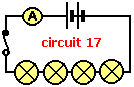 From the four circuits shown, in which two 'will the lamps be the same brightness'?
Note that the bulbs are identical and the batteries identical. [7j-19]- circuit 04 and circuit 06
- circuit 06 and circuit 08
- circuit 04 and circuit 17
- circuit 08 and circuit 17
- From the four circuits shown, which will have 'the brightest lit bulb or bulbs'? Note that the bulbs are identical and the batteries identical. [7j-20]
- circuit 08
- circuit 04
- circuit 17
- circuit 06
- From the four circuits shown, which will have 'the dimmest lit bulb or bulbs'? Note that the bulbs are identical and the batteries identical. [7j-21]
- circuit 08
- circuit 04
- circuit 17
- circuit 06

Which words means 'does not readily allow the passage of electricity'? [7j-22]- insulator
- conductor
- voltmeter
- ammeter
Which words means 'readily allows the passage of electricity'? [7j-23]- insulator
- conductor
- voltmeter
- ammeter
Which words means an 'instrument that measures electrical force'? [7j-24]- insulator
- conductor
- voltmeter
- ammeter
Which words means an 'instrument that measures electrical current'? [7j-25]- insulator
- conductor
- voltmeter
- ammeter
Which of the following symbols means a 'variable resistor'? [7j-26]- sym21
- sym05
- sym04
- sym13
Which of the following symbols means a 'fixed resistor'? [7j-27]- sym21
- sym05
- sym04
- sym13
Which of the following symbols means a 'fuse'? [7j-28]- sym21
- sym05
- sym04
- sym13
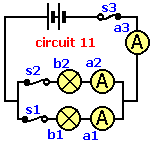
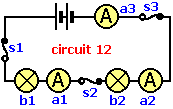 Which of the following is TRUE when comparing the two circuits 11 and 12? Note that the bulbs are identical and the batteries identical. [7j-29]
- in circuit 11 the bulbs are wired in parallel, but not so in circuit 12
- if switch s2 is opened in both circuits, all the bulbs go out
- the bulbs are dimmer in circuit 11 than the bulbs in circuit 12
- the bulbs are brighter in circuit 12 than the bulbs in circuit 11
- Which of the following is TRUE when comparing the two circuits 11 and 12? Note that the bulbs are identical and the batteries identical. [7j-30]
- if switch s2 is opened in both circuits, all the bulbs go out
- in circuit 12 the bulbs are wired in series, but not in circuit 11
- the bulbs are dimmer in circuit 11 than the bulbs in circuit 12
- the bulbs are brighter in circuit 12 than the bulbs in circuit 11
- Which of the following is TRUE when comparing the two circuits 11 and 12? Note that the bulbs are identical and the batteries identical. [7j-31]
- the bulbs in circuit 11 are wired in series
- the bulbs in circuit 12 are wired in parallel
- in circuit 11 the bulbs will be brighter than in circuit 12
- the bulbs are dimmer in circuit 11 than the bulbs in circuit 12
- Which of the following is TRUE when comparing the two circuits 11 and 12? Note that the bulbs are identical and the batteries identical. [7j-32]
- the bulbs in circuit 11 are wired in series
- the bulbs in circuit 12 are wired in parallel
- the bulbs are brighter in circuit 12 than the bulbs in circuit 11
- in circuit 12 the bulbs will be dimmer than in circuit 11
- Which of the following is TRUE when comparing the two circuits 11 and 12? Note that the bulbs are identical and the batteries identical. [7j-33]
- if switch s2 is opened in both circuits, all the bulbs go out in circuit 12 and only bulb b2 in circuit 11
- if switch s2 is opened in both circuits, all the bulbs go out in circuit 11 and only bulb b1 in circuit 12
- if ammeter a3 reads 0.4A in both circuits, ammeter a2 reads 0.4A in circuit 11 and ammeter a2 reads 0.2A in circuit 12
- if ammeter a3 reads 0.4A in both circuits, ammeter a1 reads 0.4A in circuit 11 and ammeter a1 reads 0.2A in circuit 12
- Which of the following is TRUE when comparing the two circuits 11 and 12? Note that the bulbs are identical and the batteries identical. [7j-34]
- if switch s2 is opened in both circuits, all the bulbs go out in circuit 11 and only bulb b1 in circuit 12
- if switch s3 is opened in both circuits, all the bulbs go out in both circuits
- if ammeter a3 reads 0.4A in both circuits, ammeter a2 reads 0.4A in circuit 11 and ammeter a2 reads 0.2A in circuit 12
- if ammeter a3 reads 0.4A in both circuits, ammeter a1 reads 0.4A in circuit 11 and ammeter a1 reads 0.2A in circuit 12
- Which of the following is TRUE when comparing the two circuits 11 and 12? Note that the bulbs are identical and the batteries identical. [7j-35]
- if switch s2 is opened in both circuits, all the bulbs go out in circuit 11 and only bulb b1 in circuit 12
- if ammeter a3 reads 0.4A in both circuits, ammeter a2 reads 0.4A in circuit 11 and ammeter a2 reads 0.2A in circuit 12
- if ammeter a3 reads 0.4A in both circuits, ammeter a2 reads 0.2A in circuit 11 and ammeter a2 reads 0.4A in circuit 12
- if ammeter a3 reads 0.4A in both circuits, ammeter a1 reads 0.4A in circuit 11 and ammeter a1 reads 0.2A in circuit 12
- Which of the following is TRUE when comparing the two circuits 11 and 12? Note that the bulbs are identical and the batteries identical. [7j-36]
- if switch s2 is opened in both circuits, all the bulbs go out in circuit 11 and only bulb b1 in circuit 12
- if ammeter a3 reads 0.4A in both circuits, ammeter a2 reads 0.4A in circuit 11 and ammeter a2 reads 0.2A in circuit 12
- if ammeter a3 reads 0.4A in both circuits, ammeter a1 reads 0.4A in circuit 11 and ammeter a1 reads 0.2A in circuit 12
- if ammeter a3 reads 0.4A in both circuits, ammeter a1 reads 0.2A in circuit 11 and ammeter a1 reads 0.4A in circuit 12
Which of the following is a unit of electrical force shown on a battery? [7j-37]- volts
- amps
- joules
- series
Which of the following is a unit of current? [7j-38]- volts
- amps
- joules
- series
Which of the following is a unit of energy? [7j-39]- volts
- amps
- joules
- series
Which of the following is a unit of fuse rating? [7j-40]- volts
- coulombs
- joules
- amps
 Circuit 18 shows how three lamps and four ammeters are wired together. All the lamps are identical and all four switches are closed. If ammeter a4 reads 12A, what will be the current reading on ammeter a2? [7j-41]
- 4A
- 8A
- 12A
- 3A
- Circuit 18 shows how three lamps and four ammeters are wired together. All the lamps are identical and all four switches are closed. If ammeter a1 reads 3A, what will be the current reading on ammeter a4? [7j-42]
- 3A
- 9A
- 6A
- 1A
- Circuit 18 shows how three lamps and four ammeters are wired together. The lamps are NOT identical but all four switches are closed. If ammeter a4 reads 8A, a1 reads 3A and a2 reads 2A, what will be the current reading on ammeter a3? [7j-43]
- 1A
- 2A
- 3A
- 4A
- Circuit 18 shows how three lamps and four ammeters are wired together. The lamps are NOT identical but all four switches are closed. If ammeter a1 reads 2A, a2 reads 1A and a3 reads 4A, what will be the current reading on ammeter a4? [7j-44]
- 4A
- 6A
- 5A
- 7A
Which statement about electricity and circuits is TRUE? [7j-45]- the conventional current flows from + to -
- the circuit does not have to be complete for a current to flow
- to be effective cells must be connected + to + and - to -
- more bulbs wired in series decreases the total resistance
Which statement about electricity and circuits is TRUE? [7j-46]- the conventional current flows from + to +
- the circuit must be complete for a current to flow
- to be effective cells must be connected + to + and - to -
- more bulbs wired in series decreases the total resistance
Which statement about electricity and circuits is TRUE? [7j-47]- the conventional current flows from - to -
- the circuit does not have to be complete for a current to flow
- to be effective cells must be connected + to -
- more bulbs wired in series decreases the total resistance
Which statement about electricity and circuits is TRUE? [7j-48]- the conventional current flows from - to +
- the circuit does not have to be complete for a current to flow
- to be effective cells must be connected + to + and - to -
- more bulbs wired in series increases the total resistance
Which statement about electricity and circuits is TRUE? [7j-49]- a battery or cell is a supply of electrical energy
- bulbs wired in parallel increase the total resistance
- for a current to flow a switch must be open
- electrical current is a flow of positive protons
Which statement about electricity and circuits is TRUE? [7j-50]- a battery or cell is a supply of chemical energy
- bulbs wired in parallel decrease the total resistance
- for a current to flow a switch must be open
- electrical current is a flow of positive protons
Which statement about electricity and circuits is TRUE? [7j-51]- a battery or cell is a supply of heat energy
- bulbs wired in parallel increase the total resistance
- for a current to flow a switch must be closed
- electrical current is a flow of positive protons
Which statement about electricity and circuits is TRUE? [7j-52]- a battery or cell is a supply of kinetic energy
- bulbs wired in parallel increase the total resistance
- for a current to flow a switch must be open
- electrical current is a flow of negative electrons
 Circuit 19 shows a switch closed, battery, bulb and a variable resistor wired in a complete series circuit. Which statement about the operation of the circuit is TRUE? [7j-53]
- if the resistance is decreased, more current flows and the bulb is brighter
- if the resistance is increased less current flows and the bulb cannot light up
- if the cell or battery connections are swapped around, the bulb goes out
- the variable resistor cannot be used as a switch
- Circuit 19 shows a switch closed, battery, bulb and a variable resistor wired in a complete series circuit. Which statement about the operation of the circuit is TRUE? [7j-54]
- if the resistance is decreased, less current flows and the bulb is brighter
- if the resistance is increased less current flows and the bulb is dimmer
- if the cell or battery connections are swapped around, the bulb goes out
- the variable resistor cannot be used as a switch
- Circuit 19 shows a switch closed, battery, bulb and a variable resistor wired in a complete series circuit. Which statement about the operation of the circuit is TRUE? [7j-55]
- if the resistance is decreased, less current flows and the bulb is dimmer
- if the resistance is increased more current flows and the bulb burns out
- if the cell or battery connections are swapped around, the bulb still lights
- the variable resistor cannot be used as a switch
- Circuit 19 shows a switch closed, battery, bulb and a variable resistor wired in a complete series circuit. Which statement about the operation of the circuit is TRUE? [7j-56]
- if the resistance is decreased, less current flows and the bulb is brighter
- if the resistance is increased more current flows and the bulb burns out
- if the cell or battery connections are swapped around, the bulb goes out
- the variable resistor can be used as a switch
 Circuit 20 shows a circuit arrangement for six switches (s) and six bulbs (b). Which bulbs light up if switch s5 is closed? [7j-57]
- b1 only
- b1 and b6
- b1, b2, b3 and b6
- b1, b5 and b6
- Circuit 20 shows a circuit arrangement for six switches (s) and six bulbs (b). Which bulbs light up if switches s1, s3 and s5 are closed? [7j-58]
- b1, b2 and b5
- b1, b2, b3 and b6
- b1, b2, b4 and b6
- b1, b2, b4, b5 and b6
- Circuit 20 shows a circuit arrangement for six switches (s) and six bulbs (b). Which bulbs light up if switches s1, s2 and s5 are closed? [7j-59]
- b1, b2, b5 and b6
- b1, b2, b3 and b6
- b1, b2, b4 and b6
- b1, b2, b4, b5 and b6
- Circuit 20 shows a circuit arrangement for six switches (s) and six bulbs (b). Which bulbs light up if switches s1, s2, s4 and s5 are closed? [7j-60]
- b1, b2, b5 and b6
- b1, b2, b3 and b6
- b1, b2, b4 and b6
- b1, b2, b4, b5 and b6
- Circuit 20 shows a circuit arrangement for six switches (s) and six bulbs (b). Which bulbs light up if switches s1, s3, s4 and s5 are closed? [7j-61]
- b1, b2, b3, b5 and b6
- b1, b2, b3 and b6
- b1, b2, b4 and b6
- b1, b2, b4, b5 and b6
 Circuit 21 shows the arrangement of six identical bulbs (X) and four ammeters (a1 to a4). To solve the problem you need to realise that each bulb has an identical resistance. The more bulbs there are in series, the greater the resistance to current flow. If a1 reads 3A and a4 reads 5.5A what will ammeter a2 read? [7j-62]
- 1.0A
- 1.5A
- 2.0A
- 0.5A
- Circuit 21 shows the arrangement of six identical bulbs (X) and four ammeters (a1 to a4). To solve the problem you need to realise that each bulb has an identical resistance. The more bulbs there are in series, the greater the resistance to current flow. If a1 reads 6A and a2 reads 3A what will ammeter a4 read? [7j-63]
- 12A
- 10A
- 11A
- 9A
- Circuit 21 shows the arrangement of six identical bulbs (X) and four ammeters (a1 to a4). To solve the problem you need to realise that each bulb has an identical resistance. The more bulbs there are in series, the greater the resistance to current flow. If a2 reads 4.5A and a3 reads 3.0A what will ammeter a1 read? [7j-64]
- 6.0A
- 7.5A
- 1.5A
- 9.0A
 The ratings for four typical domestic appliance fuses are given below. Which is the safest fuse to use for an appliance with a normal operating current of 2A? [7j-65]
 - 3A

- 5A
- 8A
- 13A
- 3A
- The ratings for four typical domestic appliance fuses are given below. Which is the safest fuse to use for an appliance with a normal operating current of 3A? [7j-66]
- 3A
- 5A
- 8A
- 13A
- 3A
- The ratings for four typical domestic appliance fuses are given below. Which is the safest fuse to use for an appliance with a normal operating current of 6A? [7j-67]
- 3A
- 5A
- 8A
- 13A
- 3A
- The ratings for four typical domestic appliance fuses are given below. Which is the safest fuse to use for an appliance with a normal operating current of 10A? [7j-68]
- 3A
- 5A
- 8A
- 13A
- 3A
- The ratings for four typical domestic appliance fuses are 3A, 5A, 8A and 13A. Which fuse wires will melt if a current of 4A is passed through them? [7j-69]
- 3A only
- 3A and 5A only
- 3A, 5A and 8A only
- 3A, 5A, 8A and 13A
- 3A only
- The ratings for four typical domestic appliance fuses are 3A, 5A, 8A and 13A. Which fuse wires will melt if a current of 6A is passed through them? [7j-70]
- 3A only
- 3A and 5A only
- 3A, 5A and 8A only
- 3A, 5A, 8A and 13A
- 3A only
- The ratings for four typical domestic appliance fuses are 3A, 5A, 8A and 13A. Which fuse wires will melt if a current of 9A is passed through them? [7j-71]
- 3A only
- 3A and 5A only
- 3A, 5A and 8A only
- 3A, 5A, 8A and 13A
- 3A only
- The ratings for four typical domestic appliance fuses are 3A, 5A, 8A and 13A. Which fuse wires will melt if a current of 14A is passed through them? [7j-72]
- 3A only
- 3A and 5A only
- 3A, 5A and 8A only
- 3A, 5A, 8A and 13A
- 3A only
 The Circuit 22 shows two, two way switches, s1 and s2, connected to a power supply and lamp. Which conditions ensure the lamp is ON in Circuit 22? [7j-73]
 - s1a closed (up) and s2b open (up)
- s1b open (up) and s2a open (down)
- s1a open (down) and s2a closed (up)
- s1b closed (down) and s2b open (up)
- The Circuit 22 shows two, two way switches, s1 and s2, connected to a power supply and lamp. Which conditions ensure the lamp is OFF in Circuit 22? [7j-74]
- s1a closed (up) and s2b open (up)
- s1b open (up) and s2a open (down)
- s1b open (up) and s2a closed (up)
- s1a open (down) and s2b closed (down)
- The Circuit 22 shows two, two way switches, s1 and s2, connected to a power supply and lamp. Which conditions ensure the lamp is OFF in Circuit 22? [7j-75]
- s1b closed (down) and s2a open (down)
- s1b open (up) and s2a closed (up)
- s1a open (down) and s2a closed (up)
- s1a open (down) and s2b closed (down)
- The Circuit 22 shows two, two way switches, s1 and s2, connected to a power supply and lamp. Which conditions ensure the lamp is ON in Circuit 22? [7j-76]
- s1a closed (up) and s2a open (down)
- s1a closed (up) and s2b closed (down)
- s1a open (down) and s2a closed (up)
- s1a open (down) and s2b closed (down)
 The Circuit 23 shows a two way switch s1 and a simple switch s2, connected to a power supply and five lamps (b1 to b5). Which lamps will be ON when only switch s1a is closed (up)? [7j-77]
 - b2 and b3
- b1 and b4
- b1, b2, b3 and b5
- b1, b2, b4 and b5
- The Circuit 23 shows a two way switch s1 and a simple switch s2, connected to a power supply and five lamps (b1 to b5). Which lamps will be ON when only switch s1b is closed (down)? [7j-78]
- b2 and b3
- b1 and b4
- b1, b2, b3 and b5
- b1, b2, b4 and b5
- The Circuit 23 shows a two way switch s1 and a simple switch s2, connected to a power supply and five lamps (b1 to b5). Which lamps will be ON when switches s1a and s2 are closed? [7j-79]
- b2 and b3
- b1 and b4
- b1, b2, b3 and b5
- b1, b2, b4 and b5
- The Circuit 23 shows a two way switch s1 and a simple switch s2, connected to a power supply and five lamps (b1 to b5). Which lamps will be ON when switches s1b and s2 are closed? [7j-80]
- b2 and b3
- b1 and b4
- b1, b2, b3 and b5
- b1, b2, b4 and b5
 Which statement is TRUE about mains electricity in the house? [7j-81]
- the voltage is much bigger than a battery
- wet skin has a bigger resistance than dry skin
- the current flow is usually similar to triple batteries in a torch
- a fuse allows a much higher than normal current to flow safely
- Which statement is TRUE about mains electricity in the house? [7j-82]
- the voltage is a little bigger than a battery
- wet skin has a lower resistance than dry skin
- the current flow is usually similar to triple batteries in a torch
- a fuse allows a much higher than normal current to flow safely
- Which statement is TRUE about mains electricity in the house? [7j-83]
- the voltage is a little bigger than a battery
- wet skin has a bigger resistance than dry skin
- the current flow is usually big compared to a torch battery
- a fuse allows a much higher than normal current to flow safely
- Which statement is TRUE about mains electricity in the house? [7j-84]
- the voltage is a little bigger than a battery
- wet skin has a bigger resistance than dry skin
- the current flow is usually similar to triple batteries in a torch
- a fuse should melts if a significantly higher than normal current flows
 The five circuits show various arrangements of identical cells and identical batteries. If the ammeter reading in circuit 02 is 0.3A, in which circuit will the ammeter reading be 0.6A? [7j-85]
- circuit 03
- circuit 04
- circuit 07
- circuit 08
- The five circuits show various arrangements of identical cells and identical batteries. If the ammeter reading in circuit 02 is 0.3A, in which circuit will the ammeter reading be 0.15A? [7j-86]
- circuit 03
- circuit 04
- circuit 07
- circuit 08
- The five circuits show various arrangements of identical cells and identical batteries. If the ammeter reading in circuit 02 is 0.3A, in which circuit will the ammeter reading be 0.9A? [7j-87]
- circuit 03
- circuit 04
- circuit 07
- circuit 08
- The five circuits show various arrangements of identical cells and identical batteries. If the ammeter reading in circuit 02 is 0.3A, in which circuit will the ammeter reading be 0.1A? [7j-88]
- circuit 03
- circuit 04
- circuit 07
- circuit 08
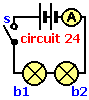
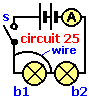
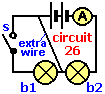
 In circuit 24 two cells, 2 bulbs and a switch are wired in series. An extra wire has been added to the similar circuits 25, 26 and 27. In which circuit will bulbs b1 and b2 light up when the switch s is closed is closed? [7j-89]
- circuit 24
- circuit 25
- circuit 26
- circuit 27
- In circuit 24 two cells, 2 bulbs and a switch are wired in series. An extra wire has been added to the similar circuits 25, 26 and 27. In which circuit will only bulb b2 light up and only if switch s is closed? [7j-90]
- circuit 24
- circuit 25
- circuit 26
- circuit 27
- In circuit 24 two cells, 2 bulbs and a switch are wired in series. An extra wire has been added to the similar circuits 25, 26 and 27. In which circuit will only bulb b2 light up but does not need switch s to be closed? [7j-91]
- circuit 24
- circuit 25
- circuit 26
- circuit 27
- In circuit 24 two cells, 2 bulbs and a switch are wired in series. An extra wire has been added to the similar circuits 25, 26 and 27. In which circuit will only bulb b1 light up when the switch s is closed? [7j-92]
- circuit 24
- circuit 25
- circuit 26
- circuit 27
- If bulb b1 'blows' what happens to the other bulbs? [7j-93]
- b2, b3, b4, b5 and b6 all stay lit
- b2 and b3 stay lit but b4, b5 and b6 also go out
- b4, b5 and b6 stay lit, but b2 and b3 also go out
- b2, b3, b4, b5 and b6 also go out
- If bulb b2 'blows' what happens to the other bulbs? [7j-94]
- b1, b3, b4, b5 and b6 stay lit
- b1, b4, b5 and b6 stay lit, but b3 also goes out
- b4, b5 and b6 stay lit, but b1 and b3 also go out
- b1, b3, b4, b5 and b6 also go out
- If bulb b5 'blows' what happens to the other bulbs? [7j-95]
- b1, b2, b3, b4 and b6 stay lit
- b1, b2, b3 and b6 stay lit, but b4 also goes out
- b1, b2 and b3 stay lit but b4 and b6 also go out
- b1, b2, b3, b4 and b6 also go out
 In the circuit 20 shown above, all the bulbs light up when all the switches are closed. What happens to the other bulbs if bulb b2 'blows'? [7j-96]
- b4 and b5 go out, b1, b3 and b6 stay lit
- b1, b3 and b6 go out, b4 and b5 stay lit
- b1, b5 and b6 stay lit, b3 and b4 go out
- b1 still lit, b3, b4, b5 and b6 go out
- In the circuit 20 shown above, all the bulbs light up when all the switches are closed. What happens to the other bulbs if bulb b3 'blows'? [7j-97]
- b6 goes out, b1, b2, b4 and b5 stay lit
- b2 and b6 go out, b1, b4 and b5 stay lit
- b4 and b5 go out, b1, b2 and b6 stay lit
- b2 goes out, b1, b4, b5 and b6 stay lit
- In the circuit 20 shown above, all the bulbs light up when all the switches are closed. What happens to the other bulbs if bulb b4 'blows'? [7j-98]
- b5 and b6 go out, b1, b2 and b3 stay lit
- b5 goes out, b1, b2, b3 and b6 stay lit
- b1 and b5 go out, b2, b3 and b6 stay lit
- b3, b5 and b6 go out, b1 and b2 stay lit
- In the circuit 20 shown above, all the bulbs light up when all the switches are closed. What happens to the other bulbs if bulb b5 'blows'? [7j-99]
- b3 goes out, b1, b2, b4 and b6 stay lit
- b2 and b4 go out, b1 and b6 stay lit
- b4 goes out, b1, b2, b3 and b6 stay lit
- b3 and b6 go out, b1, b2 and b4 stay lit
- In the circuit 20 shown above, all the bulbs light up when all the switches are closed. What happens to the other bulbs if bulb b6 'blows'? [7j-100]
- b4 goes out, b1, b2, b3 and b5 stay lit
- b3 and b5 go out, b1, b2 and b4 stay lit
- b4 and b5 go out, b1, b2 and b3 stay lit
- b3 goes out, b1, b2, b4 and b5 stay lit
Which of the following are units of mass? [7k-1]- kg
- N
- g/cm3
- cm3
Which of the following are units of weight? [7k-2]- kg
- N
- g/cm3
- cm3
Which of the following are units of density? [7k-3]- kg
- N
- g/cm3
- cm3
Which of the following are units of volume? [7k-4]- kg
- N
- g/cm3
- cm3
Which of the following are units of mass? [7k-5]- kilogram
- newton
- grams per centimetre cubed
- centimetre cubed
Which of the following are units of weight? [7k-6]- kilogram
- newton
- grams per centimetre cubed
- centimetre cubed
Which of the following are units of density? [7k-7]- kilogram
- newton
- grams per centimetre cubed
- centimetre cubed
Which of the following are units of volume? [7k-8]- kilogram
- newton
- grams per centimetre cubed
- centimetre cubed
Which of the following are units of force? [7k-9]- N
- m/s
- kg
- cm3
Which of the following are units of speed? [7k-10]- N
- m/s
- kg
- cm3
Which of the following are units of force? [7k-11]- kilogram
- centimetre cubed
- newton
- metres per second
Which of the following are units of speed? [7k-12]- kilogram
- centimetre cubed
- newton
- metres per second
 Which word means an upward force acting on an object in a fluid (gas or liquid)? [7k-13]
- upthrust
- gravity
- friction
- weight
 Which word means the force of attraction between any two objects? [7k-14]
- upthrust
- gravity
- friction
- weight
- Which word means the force preventing two materials or objects in contact passing each other? [7k-15]
- upthrust
- gravity
- friction
- weight
- Which word means the force of gravity on an object? [7k-16]
- upthrust
- pressure
- friction
- weight
 The diagram shows the four forces involved and their direction of 'action' as a person is swimming through water. Which of the four forces corresponds to friction ? [7k-17]
- force F1
- force F2
- force F3
- force F4
- The diagram shows the four forces involved and their direction of 'action' as a person is swimming through water. Which of the four forces corresponds to gravity ? [7k-18]
- force F1
- force F2
- force F3
- force F4
- The diagram shows the four forces involved and their direction of 'action' as a person is swimming through water. Which of the four forces corresponds to the 'driving' force ? [7k-19]
- force F1
- force F2
- force F3
- force F4
- The diagram shows the four forces involved and their direction of 'action' as a person is swimming through water. Which of the four forces corresponds to the upthrust ? [7k-20]
- force F1
- force F2
- force F3
- force F4
 Which of the following is a 'force'? [7k-21]
- friction
- electricity
- kinetic
- light
- Which of the following is a 'force'? [7k-22]
- heat
- magnetism
- kinetic
- light
- Which of the following is a 'force'? [7k-23]
- heat
- electricity
- gravity
- light
- Which of the following is a 'force'? [7k-24]
- heat
- electricity
- kinetic
- buoyancy
 Calculate the block volume if L = 2 cm, B = 3 cm and H = 4 cm. [7k-25]
- 24 cm3
- 12 cm3
- 36 cm3
- 9 cm3
- Calculate the block volume if L = 15 cm, B = 2 cm and H = 4 cm. [7k-26]
- 60 cm3
- 120 cm3
- 90 cm3
- 240 cm3
- Calculate the block volume if L = 4 cm, B = 2 cm and H = 7 cm. [7k-27]
- 112 cm3
- 28 cm3
- 56 cm3
- 42 cm3
- Calculate the block volume if L = 3 cm, B = 6 cm and H = 2 cm. [7k-28]
- 15 cm3
- 18 cm3
- 54 cm3
- 36 cm3
- Which of the following is a 'force'? [7k-29]
- air resistance
- electricity
- kinetic
- light
- You are given the following masses and volumes for various blocks of materials. The mass of 1 cm3 of water is 1 g. From them choose which one will sink in water? [7k-30]
- material W: mass = 8 g, volume = 10 cm3
- material X: mass = 30 g, volume = 20 cm3
- material Y: mass = 27 g, volume = 30 cm3
- material Z: mass = 20 g, volume = 40 cm3
- You are given the following masses and volumes for various blocks of materials. The mass of 1 cm3 of water is 1 g. From them choose which one will float on water? [7k-31]
- material W: mass = 12 g, volume = 10 cm3
- material X: mass = 22 g, volume = 20 cm3
- material Y: mass = 27 g, volume = 30 cm3
- material Z: mass = 20 g, volume = 19 cm3
- You are given the following masses and volumes for various blocks of materials. The mass of 1 cm3 of water is 1 g. From them choose which one will float on water? [7k-32]
- material W: mass = 12 g, volume = 10 cm3
- material X: mass = 22 g, volume = 20 cm3
- material Y: mass = 30 g, volume = 28 cm3
- material Z: mass = 12 g, volume = 13 cm3
- You are given the following masses and volumes for various blocks of materials. The mass of 1 cm3 of water is 1 g. From them choose which one will sink in water? [7k-33]
- material W: mass = 15 g, volume = 10 cm3
- material X: mass = 10 g, volume = 20 cm3
- material Y: mass = 27 g, volume = 30 cm3
- material Z: mass = 20 g, volume = 40 cm3
- You are given the following masses and volumes for various blocks of materials. From them choose which one has a density of 0.5 g/cm3? [7k-34]
- material W: mass = 8 g, volume = 8 cm3
- material X: mass = 8 g, volume = 16 cm3
- material Y: mass = 12 g, volume = 8 cm3
- material Z: mass = 16 g, volume = 8 cm3
- You are given the following masses and volumes for various blocks of materials. From them choose which one has a density of 1.5 g/cm3? [7k-35]
- material W: mass = 8 g, volume = 8 cm3
- material X: mass = 8 g, volume = 16 cm3
- material Y: mass = 12 g, volume = 8 cm3
- material Z: mass = 16 g, volume = 8 cm3
- You are given the following masses and volumes for various blocks of materials. From them choose which one has a density of 2 g/cm3? [7k-36]
- material W: mass = 8 g, volume = 8 cm3
- material X: mass = 8 g, volume = 16 cm3
- material Y: mass = 12 g, volume = 8 cm3
- material Z: mass = 16 g, volume = 8 cm3

 The diagram on the left summarises the forces acting on a cyclist. The one on the right is trying to catch up! Which corresponds to friction and air resistance? [7k-37]
- force F1
- force F2
- force F3
- force F4
- The diagram on the left summarises the forces acting on a cyclist. The one on the right is trying to catch up! Which corresponds to the effect of gravity? [7k-38]
- force F1
- force F2
- force F3
- force F4
- The diagram on the left summarises the forces acting on a cyclist. The one on the right is trying to catch up! Which corresponds to the pedalling of the cyclist? [7k-39]
- force F1
- force F2
- force F3
- force F4
- The diagram on the left summarises the forces acting on a cyclist. The one on the right is trying to catch up! Which corresponds to the force produced by compression? [7k-40]
- force F1
- force F2
- force F3
- force F4
- The diagram on the left summarises the forces acting on a cyclist. The one on the right is trying to catch up! Which must be TRUE to get constant speed? [7k-41]
- force F1 is equal to F3
- force F1 is bigger than F3
- force F3 is bigger than F1
- force F2 is equal to F4
- The diagram on the left summarises the forces acting on a cyclist. The one on the right is trying to catch up! Which must be TRUE to get the speed reduced? [7k-42]
- force F1 is equal to F3
- force F1 is bigger than F3
- force F3 is bigger than F1
- force F2 is equal to F4
- The diagram on the left summarises the forces acting on a cyclist. The one on the right is trying to catch up! Which must be TRUE to get a 'speeding up'? [7k-43]
- force F1 is equal to F3
- force F1 is bigger than F3
- force F3 is bigger than F1
- force F2 is equal to F4
- The diagram on the left summarises the forces acting on a cyclist. The one on the right is trying to catch up! Which must be TRUE when the brakes are applied effectively? [7k-44]
- force F2 is equal to F4
- force F2 is bigger than F3
- force F1 is bigger than F2
- force F1 is greater than F3
- A student carried out an experiment by putting weights on the end of a spring. After each weight was added, the length of the spring was carefully measured. The results are summarised below.
Weight added to spring (N) 2 4 6 8 10 Length of spring (cm) 23 27 31 35 39 From the data, what is the spring extension per N weight added? [7k-45]
- 2 cm
- 1 cm
- 3 cm
- 4 cm
- A student carried out an experiment by putting weights on the end of a spring. After each weight was added, the length of the spring was carefully measured. The results are summarised below.
Weight added to spring (N) 2 4 6 8 10 Length of spring (cm) 23 27 31 35 39 From the data, what would be the spring length with a weight of 7N on? [7k-46]
- 32 cm
- 33 cm
- 34 cm
- 30 cm
- A student carried out an experiment by putting weights on the end of a spring. After each weight was added, the length of the spring was carefully measured. The results are summarised below.
Weight added to spring (N) 2 4 6 8 10 Length of spring (cm) 23 27 31 35 39 From the data, what is the real length of the spring with no weight on? [7k-47]
- 20 cm
- 21 cm
- 19 cm
- 22 cm
- A student carried out an experiment by putting weights on the end of a spring. After each weight was added, the length of the spring was carefully measured. The results are summarised below.
Weight added to spring (N) 2 4 6 8 10 Length of spring (cm) 23 27 31 35 39 From the data, what would be the spring length with a weight of 15N on? [7k-48]
- 47 cm
- 51 cm
- 53 cm
- 49 cm
 Which can be picked up by a magnet? [8j-1]
- iron nail
- aluminium can
- plastic comb
- graphite rod
- Which can be picked up by a magnet? [8j-2]
- copper nail
- nickel plate
- paper boat
- wooden rod
- Which can be picked up by a magnet? [8j-3]
- brass door handle
- aluminium can
- steel paper clip
- ceramic bowl
- Which can be picked up by a magnet? [8j-4]
- pewter mug
- aluminium screw
- plastic fork
- tinned steel can
- Which can be picked up by a magnet? [8j-5]
- cobalt plate
- aluminium screw
- plastic fork
- pewter mug
- Which of the following is TRUE? [8j-6]
- if object x is attracted by a magnet, x must be a magnet
- unlike poles attract
- like poles have no effect on each other
- if object x is repelled by a magnet, x cannot be a magnet
- Which of the following is TRUE? [8j-7]
- if object x is attracted by a magnet, x must be a magnet
- magnetic forces cannot act through non-magnetic materials
- like poles repel
- if object x is repelled by a magnet, x cannot be a magnet
- Which of the following is TRUE? [8j-8]
- if object x is attracted by a magnet, x must be a magnet
- magnetic forces cannot act through non-magnetic materials
- like poles have no effect on each other
- if object x is repelled by a magnet, x must be a magnet
- Which of the following is TRUE? [8j-9]
- if object x is attracted by a magnet, x may be a magnet
- magnetic forces cannot act through non-magnetic materials
- like poles have no effect on each other
- if object x is repelled by a magnet, x cannot be a magnet
- Which of the following is TRUE? [8j-10]
- if object x is attracted by a magnet, x must be a magnet
- magnetic forces can act through non-magnetic materials
- unlike poles have no effect on each other
- if object x is repelled by a magnet, x cannot be a magnet
- Which of the following is TRUE? [8j-11]
- if object x is attracted by a magnet, x must be a magnet
- unlike poles have no effect on each other
- magnetic forces cannot act through magnetic materials
- if object x is repelled by a magnet, x cannot be a magnet
- Which of the following is TRUE? [8j-12]
- if object x is attracted by a magnet, x must be a magnet
- magnetic forces cannot act through non-magnetic materials
- magnetic forces can act through magnetic materials
- magnetic materials can be made into a magnet by stroking with the pole of a magnet
- Which of the following is TRUE? [8j-13]
- a freely moving magnet comes to rest pointing in a north-south direction
- magnetic forces cannot act through non-magnetic materials
- magnetic forces can act through magnetic materials
- the Earth's geographic north pole is actually the north pole of the Earth's magnetic field
- Which of the following is TRUE? [8j-14]
- a freely moving magnet comes to rest pointing in an east-west direction
- the Earth's geographic north pole is actually the south pole of the Earth's magnetic field
- magnetic forces can act through magnetic materials
- unlike poles have no effect on each other
- Which of the following is TRUE? [8j-15]
- the magnetic field of a bar magnet goes from the south pole to the north pole
- the Earth's geographic north pole is actually the north pole of the Earth's magnetic field
- if two pieces of metal repel each other, they are both a magnet
- unlike poles have no effect on each other
- Which of the following is TRUE? [8j-16]
- a freely moving magnet comes to rest pointing in an east-west direction
- the Earth's geographic south pole is actually the south pole of the Earth's magnetic field
- if two pieces of metal repel each other, neither can be a magnet
- the magnetic field of a bar magnet goes from the north pole to the south pole
 The sketch on the left shows the design of a simple circuit breaker. These are safety switches which 'break' the circuit if the current becomes too large. What useful effect does the coil produce? [8j-17]
- magnetic force field
- electrical force field
- gravitational force field
- nuclear force field
- The sketch on the left shows the design of a simple circuit breaker. These are safety switches which 'break' the circuit if the current becomes too large. To make the magnetic field effect of the coil stronger what should the core be made of?? [8j-18]
- hard steel
- soft iron
- malleable copper
- alloyed aluminium
- The sketch on the left shows the design of a simple circuit breaker. These are safety switches which 'break' the circuit if the current becomes too large. What is the purpose of the soft iron core? [8j-19]
- to hold the coil in place
- to ensure it is a good electrical conductor
- to concentrate the magnetic field produced
- to allow efficient conduction of heat to keep the switch cool at higher currents
- The sketch on the left shows the design of a simple circuit breaker. These are safety switches which 'break' the circuit if the current becomes too large. What should the coil surrounding the core be made of? [8j-20]
- steel wire
- insulated steel wire
- bare copper wire
- insulated copper wire
- The sketch on the left shows the design of a simple circuit breaker. These are safety switches which 'break' the circuit if the current becomes too large. Which are the best combination of reasons why the rocker should be made of iron? [8j-21]
- its strong, magnetic and a good electrical conductor
- its strong, high melting and a good conductor of heat
- its high melting, strong but flexible and a good electrical conductor
- its strong, magnetic and won't corrode easily
- The sketch on the left shows the design of a simple circuit breaker. These are safety switches which 'break' the circuit if the current becomes too large. What is the purpose of the 'springy piece of steel? [8j-22]
- to keep the electrical circuit complete
- to ensure the contacts stay together
- to spring back the contacts on current overload
- to act as a switch control
- The sketch on the left shows the design of a simple circuit breaker. These are safety switches which 'break' the circuit if the current becomes too large. What happens if there is an unsafe increase in current? [8j-23]
- the rocker heats up and bends away from the upper contact breaking the circuit
- the end of the rocker melts breaking the circuit
- the magnetic field increases sufficiently for the soft iron core to attract the rocker breaking the circuit
- the spring breaks allowing the contacts to move apart breaking the circuit
- The sketch on the left shows the design of a simple circuit breaker. These are safety switches which 'break' the circuit if the current becomes too large. How can the strength of the magnetic field of the coil be increased without change in the current? [8j-24]
- make the radius of the coils larger
- make the core longer
- use thinner wire
- add more coils of wire around the core
- Which of the following is TRUE? [8j-25]
- soft iron makes a good temporary magnet
- steel makes a poor permanent magnet
- iron is a poor magnetic shield
- copper is a good magnetic shield
- Which of the following is TRUE? [8j-26]
- soft iron makes a poor temporary magnet
- steel makes a good permanent magnet
- iron is a poor magnetic shield
- copper is a good magnetic shield
- Which of the following is TRUE? [8j-27]
- soft iron makes a good permanent magnet
- steel makes a good temporary magnet
- iron is a good magnetic shield
- copper is a good magnetic shield
- Which of the following is TRUE? [8j-28]
- soft iron makes a good permanent magnet
- steel makes a good temporary magnet
- iron is a poor magnetic shield
- copper is a poor magnetic shield
- Which of the following is TRUE? [8j-29]
- steel is a good magnetic shield
- iron in contact with a magnet cannot become a magnet
- aluminium is a good magnetic shield
- only iron, and not steel, can be magnetised inside wire coils of an electric circuit
- Which of the following is TRUE? [8j-30]
- steel is a poor magnetic shield
- iron in contact with a magnet becomes a magnet
- aluminium is a good magnetic shield
- only iron, and not steel, can be magnetised inside wire coils of an electric circuit
- Which of the following is TRUE? [8j-31]
- steel is a poor magnetic shield
- iron in contact with a magnet cannot become a magnet
- aluminium is a poor magnetic shield
- only iron, and not steel, can be magnetised inside wire coils of an electric circuit
- Which of the following is TRUE? [8j-32]
- steel is a poor magnetic shield
- iron in contact with a magnet cannot become a magnet
- aluminium is a good magnetic shield
- both iron and steel can be magnetised inside wire coils of an electric circuit


WHAT HAPPENS when brass and a steel magnet are brought together? [8j-33]- NOTHING
- REPEL
- ATTRACT

WHAT HAPPENS when the two magnets are brought together? [8j-34]- NOTHING
- REPEL
- ATTRACT


WHAT HAPPENS when the two magnets are brought together? [8j-35]- NOTHING
- REPEL
- ATTRACT

WHAT HAPPENS when aluminium and a steel magnet are brought together? [8j-36]- NOTHING
- REPEL
- ATTRACT
WHAT HAPPENS when the two magnets are brought together? [8j-37]- NOTHING
- REPEL
- ATTRACT
WHAT HAPPENS when the two magnets are brought together? [8j-38]- NOTHING
- REPEL
- ATTRACT
WHAT HAPPENS when the two magnets are brought together? [8j-39]- THEY VIBRATE
- THEY DO NOTHING
- THEY ATTRACT
- THEY REPEL
WHAT HAPPENS when the two magnets are brought together? [8j-40]- THEY VIBRATE
- THEY DO NOTHING
- THEY REPEL
- THEY ATTRACT


 Various rods are placed inside a transparent plastic tube surrounded with coils of insulated wire. Which is TRUE for the effect of switching the d.c. current ON and OFF in the three circuits shown above? [8j-41]
- when current switched ON the two rods repel in coil 3
- when current switched OFF nothing happens to the rods in coil 3
- when current switched ON nothing happens to the rods in coil 5
- when current switched ON the two rods attract in coil 4
- Various rods are placed inside a transparent plastic tube surrounded with coils of insulated wire. Which is TRUE for the effect of switching the d.c. current ON and OFF in the three circuits shown above? [8j-42]
- when current switched ON nothing happens to the rods in coil 3
- when current switched OFF the two rods roll back in coil 3
- when current switched ON nothing happens to the rods in coil 5
- when current switched ON the two rods attract in coil 4
- Various rods are placed inside a transparent plastic tube surrounded with coils of insulated wire. Which is TRUE for the effect of switching the d.c. current ON and OFF in the three circuits shown above? [8j-43]
- when current switched ON nothing happens to the rods in coil 3
- when current switched OFF nothing happens to the rods in coil 3
- when current switched ON the two rods repel in coil 5
- when current switched ON the two rods attract in coil 4
- Various rods are placed inside a transparent plastic tube surrounded with coils of insulated wire. Which is TRUE for the effect of switching the d.c. current ON and OFF in the three circuits shown above? [8j-44]
- when current switched ON nothing happens to the rods in coil 3
- when current switched OFF nothing happens to the rods in coil 3
- when current switched ON nothing happens to the rods in coil 5
- when current switched ON nothing happens to the two rods in coil 4
- Various rods are placed inside a transparent plastic tube surrounded with coils of insulated wire. Which is TRUE for the effect of switching the d.c. current ON and OFF in the three circuits shown above? [8j-45]
- when current switched OFF the rods stay apart in coil 5
- when current switched OFF nothing happens to the rods in coil 3
- when current switched ON nothing happens to the rods in coil 5
- when current switched ON the two rods attract in coil 4
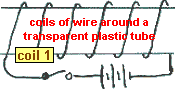
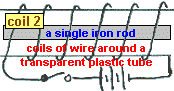 Which is TRUE for the effect of switching ON the d.c. in the two circuits shown above? [8j-46]
- there is no magnetic field outside coil 2
- there is a magnetic field produced in coil 1
- the iron rod weakens the magnetic field in coil 2
- there is a much stronger magnetic field produced in coil 1
- Which is TRUE for the effect of switching ON the d.c. in the two circuits shown above? [8j-47]
- there is no magnetic field outside coil 2
- there is no magnetic field produced in coil 1
- the iron rod strengthens the magnetic field in coil 2
- there is a much stronger magnetic field produced in coil 1
- Which is TRUE for the effect of switching ON the d.c. in the two circuits shown above? [8j-48]
- there is no magnetic field outside coil 2
- there is no magnetic field produced in coil 1
- the iron rod weakens the magnetic field in coil 2
- there is a much stronger magnetic field produced in coil 2
 You are shown the direction a compass would point on the left hand side of the north pole. From your knowledge of the magnetic field pattern of a bar magnet predict the compass bearing for the magnetic field position 1? [8j-49]
-
- You are shown the direction a compass would point on the left hand side of the north pole. From your knowledge of the magnetic field pattern of a bar magnet predict the compass bearing for the magnetic field position 2? [8j-50]
-
- >You are shown the direction a compass would point on the left hand side of the north pole. From your knowledge of the magnetic field pattern of a bar magnet predict the compass bearing for the magnetic field position 3? [8j-51]
-
- You are shown the direction a compass would point on the left hand side of the north pole. From your knowledge of the magnetic field pattern of a bar magnet predict the compass bearing for the magnetic field position 4? [8j-52]
-
- You are shown the direction a compass would point on the left hand side of the north pole. From your knowledge of the magnetic field pattern of a bar magnet predict the compass bearing for the magnetic field position 5? [8j-53]
-
- You are shown the direction a compass would point on the left hand side of the north pole. From your knowledge of the magnetic field pattern of a bar magnet predict the compass bearing for the magnetic field position 2? [8j-54]
-
- : with current flowing
 : away from apparatus
You are shown the direction a compass would point on the right hand side of the coil when current is flowing and when it is far away from the apparatus. Two iron rods have been placed inside the coil and the switch closed to allow current flow. Predict the compass bearing for the magnetic field if the battery connections are switched round and the current turned on again? [8j-55] -
- : with current flowing : away from apparatus
You are shown the direction a compass would point on the right hand side of the coil when current is flowing and when it is far away from the apparatus. Two iron rods have been placed inside the coil and the switch closed to allow current flow. Predict the compass bearing for the magnetic field if the current is switched off after being on for 10 minutes? [8j-55] -
- : with current flowing : away from apparatus
You are shown the direction a compass would point on the right hand side of the coil when current is flowing and when it is far away from the apparatus. Two steel rods have been placed inside the coil and the switch closed to allow current flow. Predict the compass bearing for the magnetic field if the battery connections are switched round with the current turned on again? [8j-57] -
- : with current flowing : away from apparatus
You are shown the direction a compass would point on the right hand side of the coil when current is flowing and when it is far away from the apparatus. Two steel rods have been placed inside the coil and the switch closed to allow current flow. Predict the compass bearing for the magnetic field if the current is switched on for five minutes, and then switched off? [8j-58] -
WHAT HAPPENS when two iron blocks are brought together? [8j-59]- NOTHING
- REPEL each other
- ATTRACT each other
- start to VIBRATE
WHAT HAPPENS when a steel bar magnet and an iron block are brought together? [8j-60]- NOTHING
- REPEL each other
- ATTRACT each other
- start to VIBRATE
WHAT HAPPENS when a copper block and steel bar magnet are brought together? [8j-61]- REPEL each other
- NOTHING
- ATTRACT each other
- start to VIBRATE
WHAT HAPPENS when two steel blocks are brought together? [8j-62]- start to VIBRATE
- REPEL each other
- ATTRACT each other
- NOTHING

Some students tried to predict the patterns plotting compass needles would make with various arrangements. Starting with two compasses placed apart or together, they then considered three compasses in a triangle or four compasses forming a square. From their sketches, and remembering that a plotting compass is a tiny magnet, which is probably a correct expt. arrangement? [8j-63]- arrangement in expt. 1
- arrangement in expt. 7
- arrangement in expt. 11
- arrangement in expt. 13
Some students tried to predict the patterns plotting compass needles would make with various arrangements. Starting with two compasses placed apart or together, they then considered three compasses in a triangle or four compasses forming a square. From their sketches, and remembering that a plotting compass is a tiny magnet, which is probably a correct expt. arrangement? [8j-64]- arrangement in expt. 3
- arrangement in expt. 5
- arrangement in expt. 10
- arrangement in expt. 12
Some students tried to predict the patterns plotting compass needles would make with various arrangements. Starting with two compasses placed apart or together, they then considered three compasses in a triangle or four compasses forming a square. From their sketches, and remembering that a plotting compass is a tiny magnet, which is probably a correct expt. arrangement? [8j-65]- arrangement in expt. 4
- arrangement in expt. 6
- arrangement in expt. 8
- arrangement in expt. 15
Some students tried to predict the patterns plotting compass needles would make with various arrangements. Starting with two compasses placed apart or together, they then considered three compasses in a triangle or four compasses forming a square. From their sketches, and remembering that a plotting compass is a tiny magnet, which is probably a correct expt. arrangement? [8j-66]- arrangement in expt. 4
- arrangement in expt. 17
- arrangement in expt. 12
- arrangement in expt. 9
Some students tried to predict the patterns plotting compass needles would make with various arrangements. Starting with two compasses placed apart or together, they then considered three compasses in a triangle or four compasses forming a square. From their sketches, and remembering that a plotting compass is a tiny magnet, which is probably a correct expt. arrangement? [8j-67]- arrangement in expt. 2
- arrangement in expt. 17
- arrangement in expt. 6
- arrangement in expt. 13
Some students tried to predict the patterns plotting compass needles would make with various arrangements. Starting with two compasses placed apart or together, they then considered three compasses in a triangle or four compasses forming a square. From their sketches, and remembering that a plotting compass is a tiny magnet, which is probably a correct expt. arrangement? [8j-68]- arrangement in expt. 3
- arrangement in expt. 14
- arrangement in expt. 7
- arrangement in expt. 15
Some students tried to predict the patterns plotting compass needles would make with various arrangements. Starting with two compasses placed apart or together, they then considered three compasses in a triangle or four compasses forming a square. From their sketches, and remembering that a plotting compass is a tiny magnet, which is probably a correct expt. arrangement? [8j-69]- arrangement in expt. 3
- arrangement in expt. 6
- arrangement in expt. 16
- arrangement in expt. 11
 Two blocks of iron are placed inside a coil through which a current is passed. Which of the following statements is NOT correct? [8j-70]
- the blocks of iron become very slowly magnetised
- the bocks of iron move towards each other
- the poles of the iron blocks will be [N-S] [N-S] or [S-N] [S-N] depending on the direction of current flow
- the iron blocks stay together even after the current is switched off
- Two blocks of iron are placed inside a coil through which a current is passed. Which of the following statements is NOT correct? [8j-71]
- the blocks of iron become quickly magnetised
- the bocks of iron repel each other
- the poles of the iron blocks will be [N-S] [N-S] or [S-N] [S-N] depending on the direction of current flow
- the iron blocks stay together even after the current is switched off
- Two blocks of iron are placed inside a coil through which a current is passed. Which of the following statements is NOT correct? [8j-72]
- the blocks of iron become quickly magnetised
- the bocks of iron move towards each other
- the poles of the iron blocks will be [N-S] [S-N] or [S-N] [N-S] depending on the direction of current flow
- the iron blocks stay together even after the current is switched off
- Two blocks of iron are placed inside a coil through which a current is passed. Which of the following statements is NOT correct? [8j-73]
- the blocks of iron become quickly magnetised
- the bocks of iron move towards each other
- the poles of the iron blocks will be [N-S] [N-S] or [S-N] [S-N] depending on the direction of current flow
- the iron blocks will repel each other after the current is switched off
 What material should a compass needle be made of? [8j-74]
- iron
- brass
- aluminium
- steel
 Which of the following gives out light? [8k-1]
- a star
- the Moon
- white paint
- a mirror
- Which of the following gives out light? [8k-2]
- the Moon
- a candle
- white paint
- a mirror
- Which of the following gives out light? [8k-3]
- white paint
- the Moon
- an electric lamp
- a mirror
- Which of the following is seen by reflected light? [8k-4]
- a star
- a candle
- an electric lamp
- the Moon
 When materials are placed in the path of a light beam various things can happen. Which word describes materials that allow light through easily? [8k-5]
- transparent
- translucent
- opaque
- absorber
- When materials are placed in the path of a light beam various things can happen. Which word describes materials that allow light through but scatters it around? [8k-6]
- transparent
- translucent
- opaque
- absorber
- When materials are placed in the path of a light beam various things can happen. Which word describes materials that will not allow light through? [8k-7]
- transparent
- translucent
- opaque
- transmitter
- When materials are placed in the path of a light beam various things can happen. Which word describes materials that 'bounce' light off? [8k-8]
- transparent
- translucent
- opaque
- reflector
- When materials are placed in the path of a light beam various things can happen. Which word describes materials that neither bounce light off or allow light through? [8k-9]
- absorber
- translucent
- reflector
- transparent
- When materials are placed in the path of a light beam various things can happen. Which word describes materials that allow light through without scattering? [8k-10]
- absorbs
- transmits
- opaque
- translucent
- When materials are placed in the path of a light beam various things can happen. Which word mainly describes the behaviour of glass when light is shone on it? [8k-11]
- opaque
- absorbed
- transparent
- translucent
- When materials are placed in the path of a light beam various things can happen. Which word describes the behaviour of tracing paper when light is shone on it? [8k-12]
- opaque
- reflect
- transparent
- translucent
- When materials are placed in the path of a light beam various things can happen. Which word describes the behaviour of soil when light is shone on it? [8k-13]
- opaque
- reflect
- transparent
- translucent
- When materials are placed in the path of a light beam various things can happen. Which word describes the behaviour of aluminium foil when light is shone on it? [8k-14]
- opaque
- reflect
- transparent
- translucent
- When materials are placed in the path of a light beam various things can happen. Which word mainly describes the behaviour of water when light is shone on it? [8k-15]
- opaque
- absorbed
- transparent
- translucent
- When materials are placed in the path of a light beam various things can happen. Which word describes the behaviour of fog when light is shone through it? [8k-16]
- opaque
- reflect
- transparent
- translucent
- When materials are placed in the path of a light beam various things can happen. Which word describes the behaviour of wood when light is shone on it? [8k-17]
- opaque with some reflection
- total reflector
- partly transparent
- partly translucent
- When materials are placed in the path of a light beam various things can happen. Which word describes the behaviour of chromium plated steel when light is shone on it? [8k-18]
- opaque
- reflect
- transparent
- translucent
- When materials are placed in the path of a light beam various things can happen. Which word describes the behaviour of air when light is shone on it? [8k-19]
- opaque
- reflect
- transparent
- translucent
- When materials are placed in the path of a light beam various things can happen. Which word describes the behaviour of ground glass when light is shone on it? [8k-20]
- opaque
- reflect
- transparent
- translucent
- When materials are placed in the path of a light beam various things can happen. Which word mainly describes the behaviour of carpet when light is shone on it? [8k-21]
- opaque
- reflect
- transparent
- translucent
- When materials are placed in the path of a light beam various things can happen. Which word describes the behaviour of polished brass pot when light is shone on it? [8k-22]
- opaque
- reflect
- transparent
- translucent
 When an incident ray of light hits a water or glass surface, most of the light passes through the air-water interface and a little is reflected. Which of the four rays is the reflected ray? [8k-23]
- ray 2
- ray 3
- ray 1
- ray 4
- When an incident ray of light hits a water or glass surface, most of the light passes through the air-water interface and a little is reflected. Which of the four rays is the refracted ray? [8k-24]
- ray 2
- ray 3
- ray 1
- ray 4
 In the diagram an incident ray of light hits a transparent surface, most of the light passes through the air-water interface and a little is reflected. Which of the four rays is the reflected ray? [8k-25]
- ray 4
- ray 2
- ray 1
- ray 3
- In the diagram an incident ray of light hits a transparent surface, most of the light passes through the air-water interface and a little is reflected. Which of the four rays is the refracted ray? [8k-26]
- ray 4
- ray 2
- ray 1
- ray 3
- Which word means the ray 'bouncing off a surface' like ray 1? [8k-27]
- induction
- transformation
- reflection
- refraction
- Which word means the ray 'bends at a medium change' like ray2? [8k-28]
- induction
- transformation
- reflection
- refraction
- Which colour combination produces the colour yellow? [8k-29]
- red and green
- blue and red
- green and blue
- red, green and blue
- Which colour combination produces the colour magenta? [8k-30]
- red and green
- blue and red
- green and blue
- red, green and blue
- Which colour combination produces the colour cyan? [8k-31]
- red and green
- blue and red
- green and blue
- red, green and blue
- Which colour combination produces the colour white? [8k-32]
- red and green
- blue and red
- green and blue
- red, green and blue
 Which of the following times will it take for light to come to your eyes from a lightning flash a few miles away? [8k-33]
- 1/100000th of a second
- 1.3 seconds
- 8.5 minutes
- 4.3 years
- Which of the following times will it take for light to come to your eyes from sunlight reflected off the moon? [8k-34]
- 1/100000th of a second
- 1.3 seconds
- 8.5 minutes
- 4.3 years
- Which of the following times will it take for light to come to your eyes from our Sun? [8k-35]
- 1/100000th of a second
- 1.3 seconds
- 8.5 minutes
- 4.3 years
- Which of the following times will it take for light to come to your eyes from Alpha Centauri, the next nearest star to us after the Sun? [8k-36]
- 1/100000th of a second
- 1.3 seconds
- 8.5 minutes
- 4.3 years
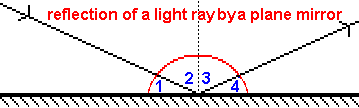 The diagram shows what happens to a ray of light when it strikes the surface of a plane mirror. The vertical dotted line is at 90o to the surface of the mirror. Which statement is NOT true? [8k-37]
- angle 1 always equals angle 3
- angle 2 always equals angle 3
- angle 2 = angle of incidence
- angle 3 = angle of reflection
- The diagram shows what happens to a ray of light when it strikes the surface of a plane mirror. The vertical dotted line is at 90o to the surface of the mirror. Which statement is NOT true? [8k-38]
- angle 1 always equals angle 4
- angle 2 always equals angle 4
- angle 2 = angle of incidence
- angle 3 = angle of reflection
- The diagram shows what happens to a ray of light when it strikes the surface of a plane mirror. The vertical dotted line is at 90o to the surface of the mirror. Which statement is NOT true? [8k-39]
- angle 1 always equals angle 4
- angle 2 always equals angle 3
- angle 1 = angle of incidence
- angle 3 = angle of reflection
- The diagram shows what happens to a ray of light when it strikes the surface of a plane mirror. The vertical dotted line is at 90o to the surface of the mirror. Which statement is NOT true? [8k-40]
- angle 1 always equals angle 4
- angle 2 always equals angle 3
- angle 2 = angle of incidence
- angle 3 = angle of refraction
 The diagram shows what happens to a ray of light when it strikes the surface of a thick glass plane mirror. Which statement is NOT true? [8k-41]
- 1 is the only incident ray
- 3 and 4 are reflected rays
- 2 and 5 are refracted rays
- 4 and 5 are dimmer rays than ray 1
- The diagram shows what happens to a ray of light when it strikes the surface of a thick glass plane mirror. Which statement is NOT true? [8k-42]
- 1 and 2 are incident rays
- 4 and 5 are reflected rays
- 2 and 5 are refracted rays
- 4 and 5 are dimmer rays than ray 1
- The diagram shows what happens to a ray of light when it strikes the surface of a thick glass plane mirror. Which statement is NOT true? [8k-43]
- 1 and 2 are incident rays
- 3 and 4 are reflected rays
- 2 and 4 are refracted rays
- 4 and 5 are dimmer rays than ray 1
- The diagram shows what happens to a ray of light when it strikes the surface of a thick glass plane mirror. Which statement is NOT true? [8k-44]
- 1 and 2 are incident rays
- 3 and 4 are reflected rays
- 2 and 5 are refracted rays
- 4 and 5 are brighter rays than ray 1

Which optical effect is produced by block 1? [8k-45]- effect V
- effect W
- effect X
- effect Y
- effect Z
Which optical effect is produced by mirror 2? [8k-46]- effect V
- effect W
- effect X
- effect Y
- effect Z
Which optical effect is produced by block 3? [8k-47]- effect V
- effect W
- effect X
- effect Y
- effect Z
Which optical effect is produced by prism 4? [8k-48]- effect V
- effect W
- effect X
- effect Y
- effect Z
Which optical effect is produced by prism 5? [8k-49]- effect V
- effect W
- effect X
- effect Y
- effect Z
Which optical effect is produced by prism 6? [8k-50]- effect V
- effect W
- effect X
- effect Y
- effect Z
Which optical effect is produced by prism 7? [8k-51]- effect V
- effect W
- effect X
- effect Y
- effect Z
Which two pieces of apparatus will best produce a visible spectrum of colours? [8k-52]- 1 and 3
- 5 and 7
- 2 and 7
- 4 and 6
 White light is passed through a clear plastic red filter. Which colour is produced on the white screen? [8k-53]
- red
- green
- blue
- yellow (green + red)
- cyan (green + blue)
- magenta (red + blue)
 White light is passed through a clear plastic green filter. Which colour is produced on the white screen? [8k-54]
- red
- green
- blue
- yellow (green + red)
- cyan (green + blue)
- magenta (red + blue)
 White light is passed through a clear plastic blue filter. Which colour is produced on the white screen? [8k-55]
- red
- green
- blue
- yellow (green + red)
- cyan (green + blue)
- magenta (red + blue)
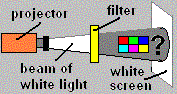 White light is passed through a clear plastic yellow filter. Which colour is produced on the white screen? [8k-56]
- red
- green
- blue
- yellow (green + red)
- cyan (green + blue)
- magenta (red + blue)
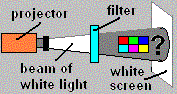 White light is passed through a clear plastic cyan filter. Which colour is produced on the white screen? [8k-57]
- red
- green
- blue
- yellow (green + red)
- cyan (green + blue)
- magenta (red + blue)
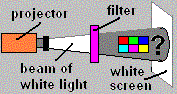 White light is passed through a clear plastic magenta filter. Which colour is produced on the white screen? [8k-58]
- red
- green
- blue
- yellow (green + red)
- cyan (green + blue)
- magenta (red + blue)
 An object looks red in white light. The white light is passed through a clear plastic red filter onto the object in front of the screen. What colour will the object appear to be? [8k-59]
- red
- green
- blue
- white
- black
- cyan (green + blue)
 An object looks green in white light. The white light is passed through a clear plastic blue filter onto the object in front of the screen. What colour will the object appear to be? [8k-60]
- red
- green
- blue
- white
- black
- yellow (red + green)
- An object looks blue in white light. The white light is passed through a clear plastic blue filter onto the object in front of the screen. What colour will the object appear to be? [8k-61]
- red
- green
- blue
- white
- black
- yellow (red + green)
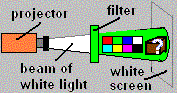 An object looks green in white light. The white light is passed through a clear plastic green filter onto the object in front of the screen. What colour will the object appear to be? [8k-62]
- red
- green
- blue
- white
- black
- magenta (red + blue)
- An object looks red in white light. The white light is passed through a clear plastic green filter onto the object in front of the screen. What colour will the object appear to be? [8k-63]
- red
- green
- blue
- white
- black
- cyan (green + blue)
- An object looks blue in white light. The white light is passed through a clear plastic red filter onto the object in front of the screen. What colour will the object appear to be? [8k-64]
- red
- green
- blue
- white
- black
- magenta (red + blue)
- An object looks yellow in white light. The white light is passed through a clear plastic red filter onto the object in front of the screen. What colour will the object appear to be? [8k-65]
- red
- green
- blue
- white
- black
- An object looks yellow in white light. The white light is passed through a clear plastic green filter onto the object in front of the screen. What colour will the object appear to be? [8k-66]
- red
- green
- blue
- white
- black
- An object looks yellow in white light. The white light is passed through a clear plastic blue filter onto the object in front of the screen. What colour will the object appear to be? [8k-67]
- red
- green
- blue
- white
- black
- An object looks white in white light. The white light is passed through a clear plastic red filter onto the object in front of the screen. What colour will the object appear to be? [8k-68]
- red
- green
- blue
- cyan (green + blue)
- black
- An object looks white in white light. The white light is passed through a clear plastic green filter onto the object in front of the screen. What colour will the object appear to be? [8k-69]
- red
- green
- blue
- magenta (red + blue)
- black
- An object looks white in white light.
The white light is passed through a clear plastic blue filter onto the object in front of the screen. What colour will the object appear to be? [8k-70]- red
- green
- blue
- yellow (red + green)
- black
 Which of the following statements about colour is NOT true? [8k-71]
- an object looks red in white light because it reflects blue and green light
- a green filter produces green light because it absorbs red and blue light
- a blue object looks black in red or green light because it absorbs red or green light
- an object looks black in white light because it absorbs red, green and blue light
- an object looks white in white light because it reflects red, green and blue light
- Which of the following statements about colour is NOT true? [8k-72]
- an object looks red in white light because it absorbs blue and green light
- a green filter produces green light because it reflects red and blue light
- a blue object looks black in red or green light because it absorbs red or green light
- an object looks black in white light because it absorbs red, green and blue light
- an object looks white in white light because it reflects red, green and blue light
- Which of the following statements about colour is NOT true? [8k-73]
- an object looks red in white light because it absorbs blue and green light
- a green filter produces green light because it absorbs red and blue light
- a blue object looks black in red or green light because it reflects red or green light
- an object looks black in white light because it absorbs red, green and blue light
- an object looks white in white light because it reflects red, green and blue light
- Which of the following statements about colour is NOT true? [8k-74]
- an object looks red in white light because it absorbs blue and green light
- a green filter produces green light because it absorbs red and blue light
- a blue object looks black in red or green light because it absorbs red or green light
- an object looks black in white light because it reflects red, green and blue light
- an object looks white in white light because it reflects red, green and blue light
- Which of the following statements about colour is NOT true? [8k-75]
- an object looks red in white light because it absorbs blue and green light
- a green filter produces green light because it absorbs red and blue light
- a blue object looks black in red or green light because it absorbs red or green light
- an object looks black in white light because it absorbs red, green and blue light
- an object looks white in white light because it absorbs red, green and blue light
Which piece of apparatus mainly produces a reflection effect? [8k-76]- 1
- 2
- 3
- 4
- 5
- In the diagram an incident ray of light hits a transparent surface, most of the light passes through the air-water interface and a little is reflected. Which of the four rays is/are possible? [8k-77]
- rays 2 and 4
- ray 1 only
- rays 1 and 4
- ray 2 only
- In the diagram an incident ray of light hits a transparent surface, most of the light passes through the air-water interface and a little is reflected. Which of the four rays is/are possible? [8k-78]
- rays 2 and 4
- ray 1 only
- rays 1 and 4
- ray 3 only
 Through which of the following will sound travel the fastest? [8L-1]
- solids
- gases
- pure liquids
- solutions
- Through which of the following will sound travel the slowest? [8L-2]
- solids
- gases
- pure liquids
- solutions
- Through which of the following will sound travel the fastest? [8L-3]
- seawater
- wooden plank
- steel rail
- air
- Through which of the following will sound travel the slowest? [8L-4]
- seawater
- wooden plank
- steel rail
- air
 Various sounds were recorded using a microphone and the signal displayed on an oscilloscope (CRO). Which sound wave was the quietist? [8L-5]
- sound 1
- sound 2
- sound 3
- sound 4
- Various sounds were recorded using a microphone and the signal displayed on an oscilloscope (CRO). Which sound wave was the loudest? [8L-6]
- sound 1
- sound 2
- sound 3
- sound 4
- Various sounds were recorded using a microphone and the signal displayed on an oscilloscope (CRO). Which sound wave had the lowest pitch? [8L-7]
- sound 1
- sound 2
- sound 3
- sound 4
- Various sounds were recorded using a microphone and the signal displayed on an oscilloscope (CRO). Which sound wave had the highest pitch? [8L-8]
- sound 1
- sound 2
- sound 3
- sound 4
- Various sounds were recorded using a microphone and the signal displayed on an oscilloscope (CRO). Which sound wave had the lowest frequency? [8L-9]
- sound 3
- sound 4
- sound 1
- sound 2
- Various sounds were recorded using a microphone and the signal displayed on an oscilloscope (CRO). Which sound wave had the highest frequency? [8L-10]
- sound 3
- sound 4
- sound 1
- sound 2

 Which of the following is TRUE about light and sound? [8L-11]
- light waves travel faster than sound waves
- you can have sound without anything vibrating
- amplitude measures the frequency of a sound wave
- light cannot pass through a vacuum
- Which of the following is TRUE about light and sound? [8L-12]
- light waves travel slower than sound waves
- you cannot have sound without anything vibrating
- amplitude measures the frequency of a sound wave
- light cannot pass through a vacuum
- Which of the following is TRUE about light and sound? [8L-13]
- light waves travel slower than sound waves
- you can have sound without anything vibrating
- amplitude measures the loudness of a sound wave
- light cannot pass through a vacuum
- Which of the following is TRUE about light and sound? [8L-14]
- light waves travel slower than sound waves
- you can have sound without anything vibrating
- amplitude measures the frequency of a sound wave
- light can pass through a vacuum
- Which of the following is TRUE about light and sound? [8L-15]
- sound waves cannot travel through a vacuum
- high or low pitch means a loud or soft sound
- light cannot transfer energy
- light cannot behave like a wave
- Which of the following is TRUE about light and sound? [8L-16]
- sound waves can travel through a vacuum
- high or low pitch means a high or low frequency sound
- light cannot transfer energy
- light cannot behave like a wave
- Which of the following is TRUE about light and sound? [8L-17]
- sound waves can travel through a vacuum
- high or low pitch means a loud or soft sound
- light is a form of energy transfer
- light cannot behave like a wave
- Which of the following is TRUE about light and sound? [8L-18]
- sound waves can travel through a vacuum
- high or low pitch means a loud or soft sound
- light cannot transfer energy
- light behaves like a wave
- Various sounds were recorded using a microphone and the signal displayed on an oscilloscope (CRO). Which sound wave had the smallest amplitude? [8L-19]
- sound 3
- sound 4
- sound 1
- sound 2
- Various sounds were recorded using a microphone and the signal displayed on an oscilloscope (CRO). Which sound wave had the largest amplitude? [8L-20]
- sound 3>
- sound 4
- sound 1
- sound 2
 A steel wire was mounted on a board, so that the left hand bridge position could be changed, but fixed with an adjusting screw on the right to vary the tension on the wire. The wire thickness and length, its tension (tightness) and force applied can be varied to change the 'character' of the sound produced on plucking the wire. Which change will produce a lower pitched note in the wire sound? [8L-21]
- thicker wire
- shorter wire
- plucking harder
- tighter wire
- A steel wire was mounted on a board, so that the left hand bridge position could be changed, but fixed with an adjusting screw on the right to vary the tension on the wire. The wire thickness and length, its tension (tightness) and force applied can be varied to change the 'character' of the sound produced on plucking the wire. Which change will produce a higher pitched note in the wire sound? [8L-22]
- thicker wire
- tighter wire
- plucking harder
- longer wire
- A steel wire was mounted on a board, so that the left hand bridge position could be changed, but fixed with an adjusting screw on the right to vary the tension on the wire. The wire thickness and length, its tension (tightness) and force applied can be varied to change the 'character' of the sound produced on plucking the wire. Which change will produce a higher pitched note in the wire sound? [8L-23]
- thicker wire
- plucking harder
- shorter wirer
- slacker wire
- A steel wire was mounted on a board, so that the left hand bridge position could be changed, but fixed with an adjusting screw on the right to vary the tension on the wire. The wire thickness and length, its tension (tightness) and force applied can be varied to change the 'character' of the sound produced on plucking the wire. Which change will produce a louder note in the wire sound? [8L-24]
- thicker wire
- longer wire
- tighter wire
- plucking harder
- A steel wire was mounted on a board, so that the left hand bridge position could be changed, but fixed with an adjusting screw on the right to vary the tension on the wire. The wire thickness and length, its tension (tightness) and force applied can be varied to change the 'character' of the sound produced on plucking the wire. Which change will produce a higher pitched note in the wire sound? [8L-25]
- thinner wire
- longer wire
- plucking harder
- slacker wire
- A steel wire was mounted on a board, so that the left hand bridge position could be changed, but fixed with an adjusting screw on the right to vary the tension on the wire. The wire thickness and length, its tension (tightness) and force applied can be varied to change the 'character' of the sound produced on plucking the wire. Which change will produce a lower pitched note in the wire sound? [8L-26]
- thinner wire
- slacker wire
- plucking more softly
- shorter wire
- A steel wire was mounted on a board, so that the left hand bridge position could be changed, but fixed with an adjusting screw on the right to vary the tension on the wire. The wire thickness and length, its tension (tightness) and force applied can be varied to change the 'character' of the sound produced on plucking the wire. Which change will produce a lower pitched note in the wire sound? [8L-27]
- shorter wire
- thinner wire
- longer wire
- tighter wire
- A steel wire was mounted on a board, so that the left hand bridge position could be changed, but fixed with an adjusting screw on the right to vary the tension on the wire. The wire thickness and length, its tension (tightness) and force applied can be varied to change the 'character' of the sound produced on plucking the wire. Which change will produce a softer note in the wire sound? [8L-28]
- thinner wire
- longer wire
- slacker wire
- plucking more lightly
- Various sounds were recorded using a microphone and the signal displayed on an oscilloscope (CRO). Which sound wave was the softest? [8L-29]
- sound 1
- sound 2
- sound 3
- sound 4
- Various sounds were recorded using a microphone and the signal displayed on an oscilloscope (CRO). Which sound wave has the lowest volume? [8L-30]
- sound 2
- sound 1
- sound 3
- sound 4
- Various sounds were recorded using a microphone and the signal displayed on an oscilloscope (CRO). Which sound wave was the largest volume? [8L-31]
- sound 1
- sound 3
- sound 2
- sound 4
- Various sounds were recorded using a microphone and the signal displayed on an oscilloscope (CRO). Which sound wave picture shows exactly one complete wave? [8L-32]
- sound 4
- sound 1
- sound 2
- sound 3
 A class of students were listening to single music notes played into a microphone and the result displayed on a cathode ray oscilloscope (CRO). The students where asked to sketch pictures for each sound produced. A selection of their sketches is shown above. Which student has sketched the result of a loud highly pitched note? [8L-33]
- FRED
- JO
- TANYA
- RICKY
- A class of students were listening to single music notes played into a microphone and the result displayed on a cathode ray oscilloscope (CRO). The students where asked to sketch pictures for each sound produced. A selection of their sketches is shown above. Which student has sketched the result of a soft low pitched note? [8L-34]
- FRED
- JO
- TANYA
- RICKY
- A class of students were listening to single music notes played into a microphone and the result displayed on a cathode ray oscilloscope (CRO). The students where asked to sketch pictures for each sound produced. A selection of their sketches is shown above. Which student has sketched the result of a loud low pitched note? [8L-35]
- FRED
- JO
- TANYA
- RICKY
- A class of students were listening to single music notes played into a microphone and the result displayed on a cathode ray oscilloscope (CRO). The students where asked to sketch pictures for each sound produced. A selection of their sketches is shown above. Which student has sketched the result of a soft highly pitched note? [8L-36]
- FRED
- JO
- TANYA
- RICKY
- A sound is most likely produced when an object? [8L-37]
- vibrates
- pitches
- moves
- gains energy
- Another word for pitch is? [8L-38]
- volume
- frequency
- amplitude
- wavelength
- Another word for frequency is? [8L-39]
- wavelength
- amplitude
- pitch
- volume
- Which word relates to the loudness of sound waves? [8L-40]
- wavelength
- frequency
- pitch
- amplitude
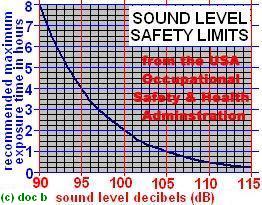


 What is the maximum safe time you should be exposed to a sound level of 103dB? [8L-41]
- 11/4 hours
- 3/4 hour
- 11/2 hours
- 13/4 hours
- What is the maximum safe time you should be exposed to a sound level of 107dB? [8L-42]
- 11/4 hours
- 3/4 hours
- 1/2 hours
- 11/2 hours
- What is the maximum sound level in decibels, you should be exposed to for 6 hours? [8L-43]
- 95 dB
- 93 dB
- 92 dB
- 97 dB
- What is the maximum sound level in decibels, you should be exposed to for 3 hours? [8L-44]
- 95 dB
- 93 dB
- 92 dB
- 97 dB
- What is the maximum sound level in decibels, you should be exposed to for 2 hours? [8L-45]
- 100 dB
- 98 dB
- 102 dB
- 101 dB
- What is the maximum safe time you should be exposed to a sound level of 95 dB? [8L-46]
- 33/4 hours
- 4 hours
- 41/4 hours
- 41/2 hours
- Which word relates to the loudness of sound waves? [8L-47]
- wavelength
- frequency
- volume
- pitch
- Which is the unit for the loudness of sound? [8L-48]
- hertz
- metres
- meters/second
- decibels
- Which is the unit for the frequency of sound waves? [8L-49]
- hertz
- metres
- meters/second
- decibels
- Which is the unit for the frequency of sound waves? [8L-50]
- m/s
- Hz
- dB
- m
- Which is the unit for the loudness of sound waves? [8L-51]
- m/s
- Hz
- dB
- m
- Which is the unit for the volume of sound? [8L-52]
- hertz
- metres
- meters/second
- decibels

 Which is NOT true about sound? [8L-53]
- the flash from lightning arrives after the sound of the thunder
- too loud a sound can immediately damage your eardrum
- the frequency of sound waves is usually the number of vibrations per second
- hard smooth surfaces are good sound reflectors
- Which is NOT true about sound? [8L-54]
- the flash from lightning arrives before the sound of the thunder
- a loud sound can only cause temporary damage to your eardrum
- the frequency of sound waves is usually the number of vibrations per second
- hard smooth surfaces are good sound reflectors
- Which is NOT true about sound? [8L-55]
- the flash from lightning arrives before the sound of the thunder
- too loud a sound can immediately damage your eardrum
- the volume of sound waves is usually the number of vibrations per second
- hard smooth surfaces are good sound reflectors
- Which is NOT true about sound? [8L-56]
- the flash from lightning arrives before the sound of the thunder
- too loud a sound can immediately damage your eardrum
- the frequency of sound waves is usually the number of vibrations per second
- hard smooth surfaces are good sound absorbers
- Which is NOT true about sound? [8L-57]
- sound travels faster than light
- soft materials are good sound absorbers
- eardrums can be gradually and permanently damaged by continuous moderately loud sounds
- as a car accelerates the pitch of the engine increases
- Which is NOT true about sound? [8L-58]
- light travels much faster than sound
- soft materials are poor sound absorbers
- eardrums can be gradually and permanently damaged by continuous moderately loud sounds
- as a car accelerates the pitch of the engine increases
- Which is NOT true about sound? [8L-59]
- light travels much faster than sound
- soft materials are good sound absorbers
- eardrums cannot be permanently damaged by continuous moderately loud sounds
- as a car accelerates the pitch of the engine increases
- Which is NOT true about sound? [8L-60]
- light travels much faster than sound
- soft materials are good sound absorbers
- eardrums can be gradually and permanently damaged by continuous moderately loud sounds
- as a car accelerates the pitch of the engine decreases
 TYPICAL FREQUENCY HEARING RANGES (Hertz)
ANIMAL LOWEST HIGHEST ANIMAL LOWEST HIGHEST Sheep 100 30000 Human 60 23000 Cat 45 64000 Dolphin 75 120000 Dog 65 45000 Bat 2000 110000 Which animal has the smallest frequency range of hearing? [8L-61]
- Human
- Dolphin
- Bat
- Cat
- TYPICAL FREQUENCY HEARING RANGES (Hertz)
ANIMAL LOWEST HIGHEST ANIMAL LOWEST HIGHEST Sheep 100 30000 Human 60 23000 Cat 45 64000 Dolphin 75 120000 Dog 65 45000 Bat 2000 110000 Which animal has the largest frequency range of hearing? [8L-62]
- Human
- Dolphin
- Bat
- Cat
- TYPICAL FREQUENCY HEARING RANGES (Hertz)
ANIMAL LOWEST HIGHEST ANIMAL LOWEST HIGHEST Sheep 100 30000 Human 60 23000 Cat 45 64000 Dolphin 75 120000 Dog 65 45000 Bat 2000 110000 Which animal(s) can hear a frequency of 108 000 Hz? [8L-63]
- Bat only
- Dolphin only
- Bat and Dolphin
- Cat and Dolphin
- TYPICAL FREQUENCY HEARING RANGES (Hertz)
ANIMAL LOWEST HIGHEST ANIMAL LOWEST HIGHEST Sheep 100 30000 Human 60 23000 Cat 45 64000 Dolphin 75 120000 Dog 65 45000 Bat 2000 110000 Which animal(s) can hear a frequency of 55 Hz? [8L-64]
- Cat and Human
- Dog and Human
- Human only
- Cat only
- TYPICAL FREQUENCY HEARING RANGES (Hertz)
ANIMAL LOWEST HIGHEST ANIMAL LOWEST HIGHEST Sheep 100 30000 Human 60 23000 Cat 45 64000 Dolphin 75 120000 Dog 65 45000 Bat 2000 110000 Which statement is NOT true about the hearing of animals? [8L-65]
- a shepherd cannot use a whistle a sheep dog can hear but the sheep cannot hear
- a bat and human can both hear some sounds of the same frequency
- a cat can hear some high and low frequencies that humans cannot hear
- bats and dolphins can hear sounds that most other animals cannot hear
- TYPICAL FREQUENCY HEARING RANGES (Hertz)
ANIMAL LOWEST HIGHEST ANIMAL LOWEST HIGHEST Sheep 100 30000 Human 60 23000 Cat 45 64000 Dolphin 75 120000 Dog 65 45000 Bat 2000 110000 Which statement is NOT true about the hearing of animals? [8L-66]
- a shepherd can use a whistle a sheep dog can hear but the sheep cannot hear
- a bat and human cannot both hear some sounds of the same frequency
- a cat can hear some high and low frequencies that humans cannot hear
- bats and dolphins can hear sounds that most other animals cannot hear
- TYPICAL FREQUENCY HEARING RANGES (Hertz)
ANIMAL LOWEST HIGHEST ANIMAL LOWEST HIGHEST Sheep 100 30000 Human 60 23000 Cat 45 64000 Dolphin 75 120000 Dog 65 45000 Bat 2000 110000 Which statement is NOT true about the hearing of animals? [8L-67]
- a shepherd can use a whistle a sheep dog can hear but the sheep cannot hear
- a bat and human can both hear some sounds of the same frequency
- a cat cannot hear frequencies that humans cannot hear
- bats and dolphins can hear sounds that most other animals cannot hear
- TYPICAL FREQUENCY HEARING RANGES (Hertz)
ANIMAL LOWEST HIGHEST ANIMAL LOWEST HIGHEST Sheep 100 30000 Human 60 23000 Cat 45 64000 Dolphin 75 120000 Dog 65 45000 Bat 2000 110000 Which statement is NOT true about the hearing of animals? [8L-68]
- a shepherd can use a whistle a sheep dog can hear but the sheep cannot hear
- a bat and human can both hear some sounds of the same frequency
- a cat can hear some high and low frequencies that humans cannot hear
- bats and dolphins can hear low frequency sounds that most other animals cannot hear
 What is the maximum sound level in decibels, you should be exposed to for 11/2 hours? [8L-69]
- 102 dB
- 101.5 dB
- 102.5 dB
- 103 dB
- What is the maximum safe time you should be exposed to a sound level of 101dB? [8L-70]
- 11/4 hours
- 13/4 hours
- 11/2 hours
- 2 hours

 Which statement is most likely to be TRUE? [8L-71]
- only air vibrates when the flute is played
- only the strings vibrate when the double base is played
- the average pitch of the double base sound is lower than the average sound of the flute
- the average frequency of the double base notes are higher than the average notes of the flute
- Which statement is most likely to be TRUE? [8L-72]
- only air vibrates when the flute is played
- only the strings vibrate when the double base is played
- the average pitch of the double base sound is higher than the average sound of the flute
- the average frequency of the double base notes are lower than the average notes of the flute
- Which statement is most likely to be TRUE? [8L-73]
- both the flute and air vibrate when the flute is played
- only the strings vibrate when the double base is played
- the average pitch of the double base sound is higher than the average sound of the flute
- the average frequency of the double base notes are higher than the average notes of the flute
- Which statement is most likely to be TRUE? [8L-74]
- only air vibrates when the flute is played
- both the case and the strings vibrate when the double base is played
- the average pitch of the double base sound is higher than the average sound of the flute
- the average frequency of the double base notes are higher than the average notes of the flute
- Which form of energy does the Sun provide for a solar panel? [9i-1]
- heat/thermal radiation
- kinetic radiation
- chemical radiation
- nuclear radiation
- Which form of energy does vibration produce? [9i-2]
- electrical
- sound
- chemical
- nuclear
 Which form of energy is stored in a battery? [9i-3]
- heat/thermal
- electrical
- chemical
- nuclear
 Which form of energy is released when an atom splits? [9i-4]
- gravitational potential
- sound
- chemical
- nuclear
 Which form of energy is stored in a clock spring? [9i-5]
- elastic/strain potential
- gravitational potential
- electrical potential
- chemical potential
- Which form of energy is due to movement? [9i-6]
- elastic/strain potential
- kinetic
- electrical
- light
- Which form of energy is produced by a generator? [9i-7]
- elastic/strain potential
- nuclear
- electrical
- light
 Which form of energy does the eye respond to? [9i-8]
- elastic/strain potential
- kinetic
- electrical
- light
- Which form of energy is to do with water held by a dam? [9i-9]
- gravitational potential
- heat/thermal
- kinetic
- chemical
- Which form of energy comes from a convector heater? [9i-10]
- gravitational potential
- thermal
- electrical
- chemical
- Which form of energy comes from a loudspeaker? [9i-11]
- light
- heat/thermal
- sound
- electrical
- Which form of energy is stored in cylinder of butane gas? [9i-12]
- gravitational potential
- heat/thermal
- kinetic
- chemical
- Which form of energy is released by uranium and plutonium in an atomic reactor? [9i-13]
- nuclear
- chemical
- kinetic
- electrical
- Which form of energy is stored in a bow and arrow before release? [9i-14]
- sound
- elastic/strain potential
- kinetic
- heat/thermal
 Which form of energy has a bullet? [9i-15]
- nuclear
- elastic/strain potential
- kinetic
- electrical
Which form of energy is carried by a current of moving charge? [9i-16]- nuclear
- elastic/strain potential
- kinetic
- electrical
- Which form of energy is needed for photosynthesis? [9i-17]
- light
- gravitational potential
- kinetic
- electrical
- Which form of energy is stored by a lift on the top floor? [9i-18]
- elastic/strain potential
- gravitational potential
- kinetic
- electrical
 One unit of electricity is equal to using a 1000W (1kW) appliance for 1 hour. [9i-19] What is the cost of using a 1.5kW heater for 2 hours if the cost of electricity is 7p/unit?
- 10.5p
- 3.5p
- 21p
- 7p
- One unit of electricity is equal to using a 1000W (1kW) appliance for 1 hour. [9i-20] What is the cost of using a 3 kW heater for 6 hours if the cost of electricity is 6p/unit?
- 54p
- £2.16
- 36p
- £1.08
- One unit of electricity is equal to using a 1000W (1kW) appliance for 1 hour. [9i-21] What is the cost of using a 60W light bulb for 20 hours if the cost of electricity is 5p/unit?
- 6p
- £6.00
- £1.20
- 60p
- One unit of electricity is equal to using a 1000W (1kW) appliance for 1 hour. [9i-22] What is the cost of using a 700W iron for 2.5 hours if the cost of electricity is 8p/unit?
- 7.0p
- 14p
- 160p
- 3p
- One unit of electricity is equal to using a 1000W (1kW) appliance for 1 hour. [9i-23] What is the cost of using a 200W hair dryer for 10 minutes if the cost of electricity is 6p/unit?
- 2p
- 1.2p
- 0.2p
- 12p
- One unit of electricity is equal to using a 1000W (1kW) appliance for 1 hour. [9i-24] What is the cost of using a 4kW oven for 5 hours if the cost of electricity is 7p/unit?
- £0.70
- 20p
- 35p
- £1.40

What is the overall energy change using a loudspeaker? [9i-25]- electrical to sound
- sound to electrical
- chemical to kinetic
- light to electrical
What is the overall energy change using a microphone? [9i-26]- electrical to sound
- sound to electrical
- chemical to kinetic
- light to electrical
What is the overall energy change using a racing car? [9i-27]- electrical to sound
- sound to electrical
- chemical to kinetic
- light to electrical
What is the overall energy change using a solar cell? [9i-28]- electrical to sound
- sound to electrical
- chemical to kinetic
- light to electrical


What are the energy changes for a rising lift? [9i-29]- electrical => kinetic => gravitational potential energies
- chemical => kinetic => electrical => heat energies
- chemical => kinetic => gravitational potential energies
- chemical => kinetic => elastic potential energies
What are the energy changes for using a diesel generator to operate an iron? [9i-30]- electrical => kinetic => gravitational potential energies
- chemical => kinetic => electrical => heat energies
- chemical => kinetic => gravitational potential energies
- chemical => kinetic => elastic potential energies
What are the energy changes when a football is kicked into the air? [9i-31]- electrical => kinetic => gravitational potential energies
- chemical => kinetic => electrical => heat energies
- chemical => kinetic => gravitational potential energies
- chemical => kinetic => elastic potential energies
What are the energy changes when winding up a clock? [9i-32]- electrical => kinetic => gravitational potential energies
- chemical => kinetic => electrical => heat energies
- chemical => kinetic => gravitational potential energies
- chemical => kinetic => elastic potential energies
 Left is a basic design of a ride, starting with the car being pulled to the top of a hill, falling down the hill, passing through the loop and brought to a halt by applying a brake pad system. The main useful energy change from the diesel engine is? [9i-33]
- chemical to kinetic energy
- kinetic to gravitational potential energy
- gravitational potential to kinetic energy
- kinetic to heat energy
- Left is a basic design of a ride, starting with the car being pulled to the top of a hill, falling down the hill, passing through the loop and brought to a halt by applying a brake pad system. The main energy change happening at points (2) and (6) is? [9i-34]
- chemical to kinetic energy
- kinetic to gravitational potential energy
- gravitational potential to kinetic energy
- kinetic to heat energy
- Left is a basic design of a ride, starting with the car being pulled to the top of a hill, falling down the hill, passing through the loop and brought to a halt by applying a brake pad system. The main energy change happening at points (4) and (8) is? [9i-35]
- chemical to kinetic energy
- kinetic to gravitational potential energy
- gravitational potential to kinetic energy
- kinetic to heat energy
- Left is a basic design of a ride, starting with the car being pulled to the top of a hill, falling down the hill, passing through the loop and brought to a halt by applying a brake pad system. The main energy change happening at point (9) is? [9i-36]
- chemical to kinetic energy
- kinetic to gravitational potential energy
- gravitational potential to kinetic energy
- kinetic to heat energy
- Left is a basic design of a ride, starting with the car being pulled to the top of a hill, falling down the hill, passing through the loop and brought to a halt by applying a brake pad system. The main force acting after point (9) is? [9i-37]
- friction
- gravity
- magnetic
- air resistance
- Left is a basic design of a ride, starting with the car being pulled to the top of a hill, falling down the hill, passing through the loop and brought to a halt by applying a brake pad system. The main force acting at points (4) and (8) is? [9i-38]
- friction
- gravity
- magnetic
- air resistance
- Left is a basic design of a ride, starting with the car being pulled to the top of a hill, falling down the hill, passing through the loop and brought to a halt by applying a brake pad system. At which point does the ride car have the least useful gravitational potential energy and zero kinetic energy? [9i-39]
- point (3)
- point (5)
- point (1)
- point (8)
- Left is a basic design of a ride, starting with the car being pulled to the top of a hill, falling down the hill, passing through the loop and brought to a halt by applying a brake pad system. At which point does the ride car have about equal amounts useful gravitational potential energy and kinetic energy? [9i-40]
- point (3)
- point (5)
- point (7)
- point (4)
- Left is a basic design of a ride, starting with the car being pulled to the top of a hill, falling down the hill, passing through the loop and brought to a halt by applying a brake pad system. At which point does the ride car have zero kinetic energy? [9i-41]
- point (1)
- point (7)
- point (5)
- point (9)
- Left is a basic design of a ride, starting with the car being pulled to the top of a hill, falling down the hill, passing through the loop and brought to a halt by applying a brake pad system. At which point does the ride car have the most useful gravitational potential energy? [9i-42]
- point (1)
- point (3)
- point (7)
- point (4)
- Left is a basic design of a ride, starting with the car being pulled to the top of a hill, falling down the hill, passing through the loop and brought to a halt by applying a brake pad system. At which point does the ride car have the most kinetic energy? [9i-43]
- point (8)
- point (3)
- point (5)
- point (4)
- Left is a basic design of a ride, starting with the car being pulled to the top of a hill, falling down the hill, passing through the loop and brought to a halt by applying a brake pad system. At which point does the ride car have the least useful gravitational potential energy and the most kinetic energy? [9i-44]
- point (4)
- point (3)
- point (8)
- point (5)
- Wind generators are a useful energy resource to provide small scale power for a group of houses. Which is NOT true about this situation? [9i-45]
- the overall energy change is heat to electrical energy
- it is a renewable energy resource because the wind blows regularly
- as an energy resource, it is advantage that there is little pollution compared to using fossil fuels
- as the wind is uncertain, it is a disadvantage compared to using fossil fuels
- Wind generators are a useful energy resource to provide small scale power for a group of houses. Which is NOT true about this situation? [9i-46]
- the overall energy change is kinetic to electrical energy
- it is a non-renewable energy resource because the wind does not blow regularly
- as an energy resource, it is advantage that there is little pollution compared to using fossil fuels
- as the wind is uncertain, it is a disadvantage compared to using fossil fuels
- Wind generators are a useful energy resource to provide small scale power for a group of houses. Which is NOT true about this situation? [9i-47]
- the overall energy change is kinetic to electrical energy
- it is a renewable energy resource because the wind blows regularly
- just because there is little pollution, it has no great advantage compared to using fossil fuels as an energy source
- as the wind is uncertain, it is a disadvantage compared to using fossil fuels as an energy source
- Wind generators are a useful energy resource to provide small scale power for a group of houses. Which is NOT true about this situation? [9i-48]
- the overall energy change is kinetic to electrical energy
- it is a renewable energy resource because the wind blows regularly
- as an energy resource, it is advantage that there is little pollution compared to using fossil fuels
- as the is wind fairly constant, it is an advantage compared to using fossil fuels
- In the home electrical energy is
converted into useful forms by various appliances. Four examples (1)-(4) are listed below, including what happens to a % of the original electrical energy. Which statement of A-D is most likely NOT true?
Examples: (1)A lamp coverts 5% of the energy into light. (2) A kettle uses 97% of the energy to heat the water. (3) a typical food mixer wastes 60% of the energy input. (4)A HiFi system converts 30% of the energy into sound and light. [9i-49]- 95% of the electrical energy in the lamp is useful heat
- the electric kettle is the most energy efficient appliance with least wasted energy
- the food mixer converts 40% of the electrical energy into useful kinetic energy
- The HiFi wastes 70% of the electrical energy, mainly as heat or thermal energy
- In the home electrical energy is
converted into useful forms by various appliances. Four examples (1)-(4) are listed below, including what happens to a % of the original electrical energy. Which statement of A-D is most likely NOT true?
Examples: (1)A lamp coverts 5% of the energy into light. (2) A kettle uses 97% of the energy to heat the water. (3) a typical food mixer wastes 60% of the energy input. (4)A HiFi system converts 30% of the energy into sound and light. [9i-50]- 95% of the electrical energy is wasted as heat by the lamp by conduction and radiation
- the electric kettle is the least energy efficient appliance with least wasted energy
- the food mixer converts 40% of the electrical energy into useful kinetic energy
- The HiFi wastes 70% of the electrical energy, mainly as heat or thermal energy
- In the home electrical energy is
converted into useful forms by various appliances. Four examples (1)-(4) are listed below, including what happens to a % of the original electrical energy. Which statement of A-D is most likely NOT true?
Examples: (1)A lamp coverts 5% of the energy into light. (2) A kettle uses 97% of the energy to heat the water. (3) a typical food mixer wastes 60% of the energy input. (4)A HiFi system converts 30% of the energy into sound and light. [9i-51]- 95% of the electrical energy is wasted as heat by the lamp by conduction and radiation
- the electric kettle is the most energy efficient appliance with least wasted energy
- the food mixer converts 40% of the electrical energy into useful heat energy
- The HiFi wastes 70% of the electrical energy, mainly as heat or thermal energy
- In the home electrical energy is
converted into useful forms by various appliances. Four examples (1)-(4) are listed below, including what happens to a % of the original electrical energy. Which statement of A-D is most likely NOT true?
Examples: (1)A lamp coverts 5% of the energy into light. (2) A kettle uses 97% of the energy to heat the water. (3) a typical food mixer wastes 60% of the energy input. (4)A HiFi system converts 30% of the energy into sound and light. [9i-52]- 95% of the electrical energy is wasted as heat by the lamp by conduction and radiation
- the electric kettle is the most energy efficient appliance with least wasted energy
- the food mixer converts 40% of the electrical energy into useful kinetic energy
- The HiFi wastes 50% of the electrical energy, mainly as heat or thermal energy
- In the home electrical energy is
converted into useful forms by various appliances. Four examples (1)-(4) are listed below, including what happens to a % of the original electrical energy. Which statement of A-D is most likely NOT true?
Examples: (1)A lamp coverts 5% of the energy into light. (2) A kettle uses 97% of the energy to heat the water. (3) a typical food mixer wastes 60% of the energy input. (4)A HiFi system converts 30% of the energy into sound and light. [9i-53]- the lamp is the most efficient appliance with the least wasted energy
- 3% of the electrical energy is wasted by the kettle, mainly by conduction and convection losses
- the food mixer converts about 60% of the electrical energy into heat and sound energy
- The HiFi produces sound energy that is not wasted
- In the home electrical energy is
converted into useful forms by various appliances. Four examples (1)-(4) are listed below, including what happens to a % of the original electrical energy. Which statement of A-D is most likely NOT true?
Examples: (1)A lamp coverts 5% of the energy into light. (2) A kettle uses 97% of the energy to heat the water. (3) a typical food mixer wastes 60% of the energy input. (4)A HiFi system converts 30% of the energy into sound and light. [9i-54]- the lamp is the least efficient appliance with the most wasted energy
- 3% of the electrical energy is wasted by the kettle, mainly by leaked conduction of electrical charge or current
- the food mixer converts about 60% of the electrical energy into heat and sound energy
- The HiFi produces sound energy that is not wasted
- In the home electrical energy is
converted into useful forms by various appliances. Four examples (1)-(4) are listed below, including what happens to a % of the original electrical energy. Which statement of A-D is most likely NOT true?
Examples: (1)A lamp coverts 5% of the energy into light. (2) A kettle uses 97% of the energy to heat the water. (3) a typical food mixer wastes 60% of the energy input. (4)A HiFi system converts 30% of the energy into sound and light. [9i-55]- the lamp is the least efficient appliance with the most wasted energy
- 3% of the electrical energy is wasted by the kettle, mainly by conduction and convection losses
- the food mixer converts about 40% of the electrical energy into useful heat and sound energy
- The HiFi produces sound energy that is not wasted
- In the home electrical energy is
converted into useful forms by various appliances. Four examples (1)-(4) are listed below, including what happens to a % of the original electrical energy. Which statement of A-D is most likely NOT true?
Examples: (1)A lamp coverts 5% of the energy into light. (2) A kettle uses 97% of the energy to heat the water. (3) a typical food mixer wastes 60% of the energy input. (4)A HiFi system converts 30% of the energy into sound and light. [9i-56]- the lamp is the least efficient appliance with the most wasted energy
- 3% of the electrical energy is wasted by the kettle, mainly by conduction and convection losses
- the food mixer converts about 60% of the electrical energy into heat and sound energy
- The HiFi produces sound energy that is wasted
 Mobile phones operate on a charged up battery system. Which energy
transfer corresponds to listening to recorded message? [9i-57]
Mobile phones operate on a charged up battery system. Which energy
transfer corresponds to listening to recorded message? [9i-57]- chemical => electrical => sound
- electrical => chemical
- chemical => electrical => light
- light => electrical => sound
- Mobile phones operate on a charged up battery system. Which energy
transfer corresponds to charging the battery? [9i-58]
- chemical => electrical => sound
- electrical => chemical
- chemical => electrical => light
- light => electrical
- Mobile phones operate on a charged up battery system. Which energy
transfer corresponds to receiving video pictures? [9i-59]
- chemical => electrical => sound
- electrical => chemical
- chemical => electrical => light
- light => electrical
- Mobile phones operate on a charged up battery system. Which energy
transfer corresponds to recording pictures to transmit? [9i-60]
- chemical => electrical => sound
- electrical => chemical
- chemical => electrical => light
- light => electrical
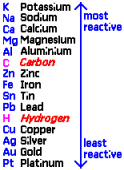
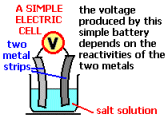 A simple battery (cell) can be made by dipping two different strips of metal into a conducting salt solution of ions. Which two metals will produce the largest voltage? [9h-61]
- magnesium and silver electrodes
- zinc and iron electrodes
- magnesium and zinc electrodes
- zinc and tin electrodes
- A simple battery (cell) can be made by dipping two different strips of metal into a conducting salt solution of ions. Which two metals will produce the smallest voltage? [9h-62]
- magnesium and silver electrodes
- zinc and iron electrodes
- magnesium and zinc electrodes
- zinc and tin electrodes
- A simple battery (cell) can be made by dipping two different strips of metal into a conducting salt solution of ions. Which two metals will produce the biggest voltage? [9h-63]
- zinc and copper electrodes
- zinc and tin electrodes
- magnesium and copper electrodes
- tin and lead electrodes
- A simple battery (cell) can be made by dipping two different strips of metal into a conducting salt solution of ions. Which two metals will produce the smallest voltage? [9h-64]
- zinc and copper electrodes
- zinc and tin electrodes
- magnesium and copper electrodes
- tin and lead electrodes
 A simple battery (cell) can be made by dipping two different strips of metal (electrodes) into a conducting salt solution of ions. Which statement is TRUE about the battery cell? [9h-65]
- the closer the two metals are in reactivity, the smaller the voltage produced
- an electrical current cannot flow through the salt solution of ions
- the smaller the metal electrodes the bigger the current
- the energy transfer change is from electrical to chemical energy
- A simple battery (cell) can be made by dipping two different strips of metal (electrodes) into a conducting salt solution of ions. Which statement is TRUE about the battery cell? [9h-66]
- the closer the two metals are in reactivity, the bigger the voltage produced
- an electrical current can flow through the salt solution of ions
- the smaller the metal electrodes the bigger the current
- the energy transfer change is from electrical to chemical energy
- A simple battery (cell) can be made by dipping two different strips of metal (electrodes) into a conducting salt solution of ions. Which statement is TRUE about the battery cell? [9h-67]
- the closer the two metals are in reactivity, the bigger the voltage produced
- an electrical current cannot flow through the salt solution of ions
- the bigger the metal electrodes the bigger the current
- the energy transfer change is from electrical to chemical energy
- A simple battery (cell) can be made by dipping two different strips of metal (electrodes) into a conducting salt solution of ions. Which statement is TRUE about the battery cell? [9h-68]
- the closer the two metals are in reactivity, the bigger the voltage produced
- an electrical current cannot flow through the salt solution of ions
- the smaller the metal electrodes the bigger the current
- the energy transfer change is from chemical to electrical energy
- Various sorts of energy resources can be used to produce
electricity for use in the home. Which type of energy resource is used to make electricity from a torch battery? [9i-69]
- chemical energy
- sunlight energy
- kinetic energy
- heat energy
- Various sorts of energy resources can be used to produce
electricity for use in the home. Which of the following types of energy resource is used to make electricity in a calculator solar cell? [9i-70]
- chemical energy
- sunlight energy
- kinetic energy
- heat energy
- Various sorts of energy resources can be used to produce
electricity for use in the home. Which of the following types of energy resource is used to make electricity using a wind turbine? [9i-71]
- chemical energy
- geothermal energy
- kinetic energy
- gravitational potential energy
- Various sorts of energy resources can be used to produce
electricity for use in the home. Which of the following types of energy resource is used to make electricity in a geothermal power station? [9i-72]
- chemical energy
- sunlight energy
- gravitational potential energy
- heat energy
- Various sorts of energy resources can be used to produce
electricity for use in the home. Which of the following types of energy resource is used to make electricity from a diesel/petrol generator? [9i-73]
- chemical energy
- sunlight energy
- kinetic energy
- gravitational potential energy
- Various sorts of energy resources can be used to produce
electricity for use in the home. Which of the following types of energy resource is used to make electricity from a mountain stream turbine generator? [9i-74]
- chemical energy
- gravitational potential energy
- solar radiation energy
- heat energy
- Various sorts of energy resources can be used to produce
electricity for use in the home. Which of the following types of energy resource is used to make electricity from a river paddle wheel generator? [9i-75]
- chemical energy
- solar radiation energy
- kinetic energy
- heat energy
- Various sorts of energy resources can be used to produce
electricity for use in the home. Which of the following types of energy resource is used to make electricity inside a clockwork radio? [9i-76]
- chemical energy
- gravitational potential energy
- heat energy
- elastic potential energy
- Various sorts of energy
transfers occur when generating and using electricity. Which of the following energy transfers happens in a hydroelectric power station? [9i-77]
- gravitational potential => kinetic => electrical energy
- chemical => heat => kinetic => electrical energy
- heat => kinetic => electrical energy
- elastic potential => kinetic => electrical energy
- Various sorts of energy
transfers occur when generating and using electricity. Which of the following energy transfers happens in a fossil fuel power station? [9i-78]
- gravitational potential => kinetic => electrical energy
- chemical => heat => kinetic => electrical energy
- heat => kinetic => electrical energy
- elastic potential => kinetic => electrical energy
- Various sorts of energy
transfers occur when generating and using electricity. Which of the following energy transfers happens in a geothermal power station? [9i-79]
- gravitational potential => kinetic => electrical energy
- chemical => heat => kinetic => electrical energy
- heat => kinetic => electrical energy
- elastic potential => kinetic => electrical energy
- Various sorts of energy
transfers occur when generating and using electricity. Which of the following energy transfers happens in a clockwork radio? [9i-80]
- gravitational potential => kinetic => electrical energy
- chemical => heat => kinetic => electrical energy
- heat => kinetic => electrical energy
- elastic potential => kinetic => electrical energy
electrical energy => useful/wasted energy outputs energy input transfers as a 3 J/s of wasted sound energy of 600 J/s to hair dryer 590 J/s of useful heat energy the appliance is being used ? J/s of ? energy The table summarises what happens to the energy input and output of an electrical appliance. Which is the most likely missing quantity and form of output energy when the hair dryer is in use? [9i-81]
- 7 J/s of useful kinetic energy
- 7 J/s of wasted potential energy
- 5 J/s of wasted kinetic energy
- 5 J/s of useful potential energy
electrical energy => useful/wasted energy outputs energy input transfers as a 5 J/s of useful kinetic energy of 400 J/s to hair dryer 393 J/s of useful heat energy the appliance is being used ? J/s of ? energy The table summarises what happens to the energy input and output of an electrical appliance. Which is the most likely missing quantity and form of output energy when the hair dryer is in use? [9i-82]
- 2 J/s of useful kinetic energy
- 2 J/s of wasted sound energy
- 1 J/s of wasted kinetic energy
- 1 J/s of useful potential energy
electrical energy => useful/wasted energy outputs input energy transfers as a 4 J/s of useful kinetic energy of 300 J/s to hair dryer 1 J/s of wasted sound energy the appliance is being used ? J/s of ? energy The table summarises what happens to the energy input and output of an electrical appliance. Which is the most likely missing quantity and form of output energy when the hair dryer is in use? [9i-83]
- 290 J/s of wasted kinetic energy
- 295 J/s of wasted heat energy
- 200 of J/s of useful heat and 95 J/s of wasted heat energy
- 200 J/s of useful potential and 95 J/s of wasted heat energy
electrical energy => useful/wasted energy outputs input energy transfers as a 50 J/s of wasted sound energy of 1000 J/s to food mixer 400 J/s of useful kinetic energy the appliance is being used ? J/s of ? energy The table summarises what happens to the energy input and output of an electrical appliance. Which is the most likely missing quantity and form of output energy when the food mixer is in use? [9i-84]
- 550 J/s of wasted kinetic energy
- 300 J/s of useful heat and 250 J/s of wasted kinetic energy
- 300 J/s of useful heat and 350 J/s of wasted potential energy
- 550 J/s of wasted heat energy
electrical energy => useful/wasted energy outputs input energy transfers as a 80 J/s of wasted sound energy of 1200 J/s to food mixer 620 J/s of wasted heat energy the appliance is being used ? J/s of ? energy The table summarises what happens to the energy input and output of an electrical appliance. Which is the most likely missing quantity and form of output energy when the food mixer is in use? [9i-85]
- 500 J/s of useful kinetic energy
- 500 J/s of useful potential energy
- 300 J/s of useful heat and 280 J/s of wasted potential energy
- 580 J/s of wasted heat energy
electrical energy => useful/wasted energy outputs input energy transfers as a 370 J/s of useful kinetic energy of 800 J/s to food mixer 400 J/s of wasted heat energy the appliance is being used ? J/s of ? energy The table summarises what happens to the energy input and output of an electrical appliance. Which is the most likely missing quantity and form of output energy when the food mixer is in use? [9i-86]
- 30 J/s of wasted kinetic energy
- 30 J/s of wasted sound energy
- 20 J/s of useful heat energy
- 130 J/s of wasted heat energy
electrical energy => useful/wasted energy outputs input energy transfers as a 2 J/s of useful kinetic energy of 200 J/s CD-HiFi system 192 J/s of wasted heat energy to the is being 5 J/s of useful sound energy appliance used ? J/s of ? energy The table summarises what happens to the energy input and output of an electrical appliance. Which is the most likely missing quantity and form of output energy when the CD-HiFi system is in use? [9i-87]
- 2 J/s of wasted light energy
- 2 J/s of wasted sound energy
- 1 J/s of useful light energy
- 1 J/s of useful heat energy
electrical energy => useful/wasted energy outputs input energy transfers as a 4 J/s of useful kinetic energy of 500 J/s CD-HiFi system 2 J/s of useful light energy to the is being 464 J/s of wasted heat energy appliance used ? J/s of ? energy The table summarises what happens to the energy input and output of an electrical appliance. Which is the most likely missing quantity and form of output energy when the CD-HiFi system is in use? [9i-88]
- 30 J/s of wasted light energy
- 28 J/s of wasted sound energy
- 28 J/s of useful potential energy
- 30 J/s of useful sound energy
electrical energy => useful/wasted energy outputs input energy transfers as a 3 J/s of useful kinetic energy of 400 J/s CD-HiFi system 1 J/s of useful light energy to the is being 20 J/s of useful sound energy appliance used ? J/s of ? energy The table summarises what happens to the energy input and output of an electrical appliance. Which is the most likely missing quantity and form of output energy when the CD-HiFi system is in use? [9i-89]
- 376 J/s of wasted heat energy
- 300 J/s of useful heat and 66 J/s of useful potential energy
- 376 J/s of useful potential energy
- 290 J/s of wasted sound and 76 J/s wasted kinetic energy
electrical energy => useful/wasted energy outputs input energy transfers as a 287.5 J/s of wasted heat energy of 300 J/s CD-HiFi system 0.5 J/s of useful light energy to the is being 10.0 J/s of useful sound energy appliance used ? J/s of useful ? energy The table summarises what happens to the energy input and output of an electrical appliance. Which is the most likely missing quantity and form of output energy when the CD-HiFi system is in use? [9i-90]
- 2.5 J/s of useful heat energy
- 2.0 J/s of useful kinetic energy
- 1.5 J/s of useful potential energy
- 1.5 J/s of wasted sound and 1.5 J/s wasted kinetic energy
electrical energy => useful/wasted energy outputs input energy transfers as a 1200 J/s of useful kinetic energy of 3000 J/s to washing machine 10 J/s of wasted sound energy the appliance is being used ? J/s of ? energy The table summarises what happens to the energy input and output of an electrical appliance. Which is the most likely missing quantity and form of output energy when the washing machine is in use? [9i-91]
- 1800 J/s of wasted kinetic energy
- 1790 J/s of useful potential energy
- 1300 J/s of useful heat and 490 J/s of wasted heat energy
- 1200 J/s of useful potential and 580 J/s of wasted heat energy
electrical energy => useful/wasted energy outputs input energy transfers as a 5 J/s of wasted sound energy of 2000 J/s to washing machine 1485 J/s of useful/wasted heat energy the appliance is being used ? J/s of ? energy The table summarises what happens to the energy input and output of an electrical appliance. Which is the most likely missing quantity and form of output energy when the washing machine is in use? [9i-92]
- 500 J/s of wasted kinetic energy
- 510 J/s of useful potential energy
- 500 J/s of useful potential and 10 J/s of wasted potential energy
- 510 J/s of useful kinetic energy
electrical energy => useful/wasted energy outputs input energy transfers as a 900 J/s of kinetic energy of 2500 J/s to washing machine 1593 J/s of useful/wasted heat energy the appliance is being used ? J/s of ? energy The table summarises what happens to the energy input and output of an electrical appliance. Which is the most likely missing quantity and form of output energy when the washing machine is in use? [9i-93]
- 7 J/s of wasted sound energy
- 7 J/s of useful potential energy
- 5 J/s of wasted kinetic energy
- 5 J/s of useful potential energy
Which of the following is a unit of time? [9k-1]- s
- m
- m/s
- N
Which of the following is a unit of length? [9k-2]- s
- m
- m/s
- N
Which of the following is a unit of speed? [9k-3]- s
- m
- m/s
- N
Which of the following is a unit of force? [9k-4]- s
- m
- m/s
- N
Which of the following is a unit of force? [9k-5]- newtons
- metres per second
- metres per sec per sec
- newton x metres
Which of the following is a unit of speed? [9k-6]- newtons
- metres per second
- metres per sec per sec
- newton x metres
Which of the following is a unit of distance? [9k-7]- km/s
- h
- cm
- y
Which of the following is a unit of speed? [9k-8]- m/s2
- h
- cm
- km/h
Which of the following is a unit of distance? [9k-9]- km
- h
- cm/s
- N
Which of the following is a unit of time? [9k-10]- km
- h
- cm/s
- N
Which of the following is a unit of speed? [9k-11]- km/h2
- h
- cm/s
- N
Which of the following is a unit of speed? [9k-12]- newtons per kilogram
- metres per second per second
- seconds per centimetre
- kilometres per hour
 The graph shows how the speed of a parachutist varies from point (1) immediately jumping out of an aeroplane, to landing safely with the parachute opened at point (8). At which point is the speeding up or acceleration the greatest? [9k-13]
- point (1)
- point (2)
- point (3)
- point (5)
- The graph shows how the speed of a parachutist varies from point (1) immediately jumping out of an aeroplane, to landing safely with the parachute opened at point (8). At which point is the speed constant? [9k-14]
- point (1)
- point (4)
- point (6)
- point (2)
- The graph shows how the speed of a parachutist varies from point (1) immediately jumping out of an aeroplane, to landing safely with the parachute opened at point (8). Between which points is the speed constant? [9k-15]
- points (5) and (6)
- points (1) and (2)
- points (7) and (8)
- points (2) and (3)
- The graph shows how the speed of a parachutist varies from point (1) immediately jumping out of an aeroplane, to landing safely with the parachute opened at point (8). At which point was the parachute opened? [9k-16]
- point (2)
- point (3)
- point (7)
- point (5)
- The graph shows how the speed of a parachutist varies from point (1) immediately jumping out of an aeroplane, to landing safely with the parachute opened at point (8). Between which points is the speed decreasing (deceleration)? [9k-17]
- points (5) and (7)
- points (2) and (3)
- points (7) and (8)
- points (4) and (5)
- The graph shows how the speed of a parachutist varies from point (1) immediately jumping out of an aeroplane, to landing safely with the parachute opened at point (8). Between which points is the air resistance force (friction) equal to the force of gravity on the parachutist? [9k-18]
- points (1) and (3)
- points (3) and (5)
- points (5) and (6)
- points (6) and (7)
- The graph shows how the speed of a parachutist varies from point (1) immediately jumping out of an aeroplane, to landing safely with the parachute opened at point (8). Between which points is the air resistance force (friction) equal to the force of gravity on the parachutist? [9k-19]
- points (1) and (2)
- points (2) and (3)
- points (7) and (8)
- points (5) and (6)
- The graph shows how the speed of a parachutist varies from point (1) immediately jumping out of an aeroplane, to landing safely with the parachute opened at point (8). At which point is the gravity force on the parachutist greater than the air resistance force (friction)? [9k-20]
- point (6)
- point (4)
- points (8)
- point (2)
- The graph shows how the speed of a parachutist varies from point (1) immediately jumping out of an aeroplane, to landing safely with the parachute opened at point (8). At which point is the air resistance force (friction) greater than the gravity force on the parachutist? [9k-21]
- point (6)
- point (4)
- point (8)
- point (2)
- When a lift is operating, the two main forces are the tension
 in the cable, from the motor action, and the weight
 of the lift car and people, due to gravity. Which of the following applies to the situation when the lift is stationary? [9k-22]
- the tension is equal to the weight
- the tension is more than the weight
- the tension is less than the weight
- the tension
- When a lift is operating, the two main forces are the tension in the cable, from the motor action, and the weight of the lift car and people, due to gravity. Which of the following applies to the situation when the lift is moving up at a constant speed? [9k-23]
- the tension is equal to the weight
- the tension is more than the weight
- the tension is less than the weight
- the tension
- When a lift is operating, the two main forces are the tension in the cable, from the motor action, and the weight of the lift car and people, due to gravity. Which of the following applies to the situation when the lift is moving down at a constant speed? [9k-24]
- the tension is equal to the weight
- the tension is more than the weight
- the tension is less than the weight
- the tension
- When a lift is operating, the two main forces are the tension in the cable, from the motor action, and the weight of the lift car and people, due to gravity. Which of the following applies to the situation when the lift is moving upwards with increasing speed? (e.g. start of lift ascent) [9k-25]
- the tension is equal to the weight
- the tension is more than the weight
- the tension is less than the weight
- the tension
- When a lift is operating, the two main forces are the tension in the cable, from the motor action, and the weight of the lift car and people, due to gravity. Which of the following applies to the situation when the lift is moving upwards and slowing down? (e.g. as lift reaches top) [9k-26]
- the tension is equal to the weight
- the tension is more than the weight
- the tension is less than the weight
- the tension
- When a lift is operating, the two main forces are the tension in the cable, from the motor action, and the weight of the lift car and people, due to gravity. Which of the following applies to the situation when the lift is moving down with increasing speed? (e.g. as lift starts descent) [9k-27]
- the tension is equal to the weight
- the tension is more than the weight
- the tension is less than the weight
- the tension
- When a lift is operating, the two main forces are the tension in the cable, from the motor action, and the weight of the lift car and people, due to gravity. Which of the following applies to the situation when the lift is moving down and slowing down? (e.g. as lift reaches bottom) [9k-28]
- the tension is equal to the weight
- the tension is more than the weight
- the tension is less than the weight
- the tension
 A broken down bus is being towed along a road by a truck. Which force is represented on the diagram by F3 and F8? [9k-29]
- friction
- weight
- upthrust
- thrust
- tension
- A broken down bus is being towed along a road by a truck. Which force is represented on the diagram by F4 and F9? [9k-30]
- air resistance
- weight
- upthrust
- thrust
- tension
- A broken down bus is being towed along a road by a truck. Which force is represented on the diagram by F2 and F7? [9k-31]
- friction
- weight
- upthrust
- thrust
- tension
- A broken down bus is being towed along a road by a truck. Which force is represented on the diagram by F1 and F6? [9k-32]
- air resistance
- weight
- upthrust
- thrust
- tension
- A broken down bus is being towed along a road by a truck. Which force is represented on the diagram by F10? [9k-33]
- friction
- weight
- upthrust
- thrust
- tension
- A broken down bus is being towed along a road by a truck. Which force is represented by on the diagram F5? [9k-34]
- air resistance
- weight
- upthrust
- thrust
- tension
- Which of the following matches a speed of 9.8m/s? [9k-35]
- a sprinter runs 100m in 10.2s
- a conveyer belt moves along 20m in 2.5s
- a cyclist covers 500m in 40s
- a car moves 400m in 36s
- Which of the following matches a speed of 8.0m/s? [9k-36]
- a sprinter runs 100m in 10.2s
- a conveyer belt moves along 20m in 2.5s
- a cyclist covers 500m in 40s
- a car moves 400m in 36s
- Which of the following matches a speed of 12.5m/s? [9k-37]
- a sprinter runs 100m in 10.2s
- a conveyer belt moves along 20m in 2.5s
- a cyclist covers 500m in 40s
- a car moves 400m in 36s
- Which of the following matches a speed of 11.1m/s? [9k-38]
- a sprinter runs 100m in 10.2s
- a conveyer belt moves along 20m in 2.5s
- a cyclist covers 500m in 40s
- a car moves 400m in 36s
 Which graph represents speeding up? [9k-39]
- graph (1)
- graph (2)
- graph (3)
- graph (4)
- Which graph represents a stationary object? [9k-40]
- graph (1)
- graph (2)
- graph (3)
- graph (4)
- Which graph represents slowing down? [9k-41]
- graph (1)
- graph (2)
- graph (3)
- graph (4)
- Which graph represents constant speed greater than zero? [9k-42]
- graph (1)
- graph (2)
- graph (3)
- graph (4)
 [9k-43] The graph shows part of an urban car journey in terms of the distance the car has travelled in a certain time. Which describes the motion of the car from 20 to 40 seconds?
 - constant speed
- slowing down
- speeding up
- stopped
- [9k-44] The graph shows part of an urban car journey in terms of the distance the car has travelled in a certain time. Which describes the motion of the car from 50 to 80 seconds?
- constant speed
- slowing down
- speeding up
- stopped
- [9k-45] The graph shows part of an urban car journey in terms of the distance the car has travelled in a certain time. Which describes the motion of the car from 0 to 20 seconds?
- constant speed
- slowing down
- speeding up
- stopped
- [9k-46] The graph shows part of an urban car journey in terms of the distance the car has travelled in a certain time. Which describes the motion of the car from 82 to 90 seconds?
- constant speed
- slowing down
- speeding up
- stopped
- [9k-47] The graph shows part of an urban car journey in terms of the distance the car has travelled in a certain time. What is the average speed of the car from 0 to 20 seconds?
- 10 m/s
- 20 m/s
- 1.5 m/s
- 5.0 m/s
- [9k-48] The graph shows part of an urban car journey in terms of the distance the car has travelled in a certain time. What is the average speed of the car from 20 to 40 seconds?
- 10 m/s
- 20 m/s
- 40.0 m/s
- 30.0 m/s
- [9k-49] The graph shows part of an urban car journey in terms of the distance the car has travelled in a certain time. What is the average speed of the car from 40 to 80 seconds?
- 12.5 m/s
- 15.0 m/s
- 7.5 m/s
- 0.0 m/s
- [9k-50] The graph shows part of an urban car journey in terms of the distance the car has travelled in a certain time. What is the average speed of the car from 82 to 90 seconds?
- 10.0 m/s
- 2.0 m/s
- 1.0 m/s
- 0.0 m/s
- [9k-51] The graph shows part of an urban car journey in terms of the distance the car has travelled in a certain time. How far has the car travelled between 0 and 25 seconds?
- 300 m
- 320 m
- 340 m
- 260 m
- [9k-52] The graph shows part of an urban car journey in terms of the distance the car has travelled in a certain time. How far has the car travelled between 30 and 64 seconds?
- 480 m
- 440 m
- 460 m
- 420 m
- [9k-53] The graph shows part of an urban car journey in terms of the distance the car has travelled in a certain time. How far has the car travelled between 52 and 64 seconds?
- 60 m
- 40 m
- 80 m
- 120 m
- [9k-54] The graph shows part of an urban car journey in terms of the distance the car has travelled in a certain time. The graph shows part of an urban car journey in terms of the distance the car has travelled in a certain time.
How far has the car travelled between 82 and 90 seconds?- 40 m
- 20 m
- 160 m
- 0 m
- [9k-55] The graph shows part of an urban car journey in terms of the distance the car has travelled in a certain time. The car engine produces the forward motion thrust force F1. Acting against this are the combined forces of (i) moving parts friction (including braking) and (ii) the drag from air resistance, giving a total force F2. In which time span is force F2 more than F1?
- 44 to 82 seconds
- 20 to 44 seconds
- 0 to 20 seconds
- 82 to 90 seconds
- [9k-56] The graph shows part of an urban car journey in terms of the distance the car has travelled in a certain time. The car engine produces the forward motion thrust force F1. Acting against this are the combined forces of (i) moving parts friction (including braking) and (ii) the drag from air resistance, giving a total force F2. In which time span is force F1 equal to F2?
- 44 to 82 seconds
- 20 to 44 seconds
- 0 to 20 seconds
- 82 to 90 seconds
- [9k-57] The graph shows part of an urban car journey in terms of the distance the car has travelled in a certain time. The car engine produces the forward motion thrust force F1. Acting against this are the combined forces of (i) moving parts friction (including braking) and (ii) the drag from air resistance, giving a total force F2. In which time span is force F1 more than F2?
- 44 to 82 seconds
- 20 to 44 seconds
- 0 to 20 seconds
- 82 to 90 seconds
- [9k-58] The graph shows part of an urban car journey in terms of the distance the car has travelled in a certain time. The car engine produces the forward motion thrust force F1. Acting against this are the combined forces of (i) moving parts friction (including braking) and (ii) the drag from air resistance, giving a total force F2. In which time span are forces F1 and F2 both zero?
- 44 to 82 seconds
- 20 to 44 seconds
- 0 to 20 seconds
- 82 to 90 seconds
- [9k-59] A cyclist is travelling at an average speed of 5 m/s.
How far will the cyclist travel in 10 s?- 50 m
- 2 m
- 0.5 m
- 500 m
- [9k-60] A cyclist is travelling at an average speed of 10 m/s.
How far will the cyclist travel in 20 s?- 2 m
- 200 m
- 0.5 m
- 50 m
- [9k-61] A cyclist is travelling at an average speed of 2.5 m/s.
How far will the cyclist travel in 1 minute?- 2.5 m
- 180 m
- 150 m
- 15 m
- [9k-62] A cyclist is travelling at an average speed of 6 m/s.
How far will the cyclist travel in 2 minutes?- 24 m
- 3 m
- 360 m
- 720 m
- [9k-63] A racing car is travelling at an average speed of 20 m/s through a
curvy section of the race track. How long will it take the driver to cover 600 m?
- 30 s
- 60 s
- 15 s
- 3 s
- [9k-64] A racing car is travelling at an average speed of 40 m/s through a
curvy section of the race track. How long will it take the driver to cover 1 km?
- 40 s
- 25 s
- 60 s
- 50 s
- [9k-65] A racing car is travelling at an average speed of 60 m/s through a straight section of the race track. How long will it take the driver to cover 300 m?
- 18 s
- 15 s
- 5 s
- 20 s
- [9k-66] A racing car is travelling at an average speed of 80 m/s through a straightish section of the race track. How long will it take the driver to cover 2 km?
- 40 s
- 20 s
- 50 s
- 25 s
 [9k-67] A child is playing on a slide. Which statement is NOT true?
- the two main forces involved are weight due to gravity and friction acting in the same direction
- when the force of friction equals the child's weight, the downward speed is constant
- if the child sat on a rough cushion the 'slide' will be slower
- if the child tucks in their arms and head the 'slide' will be faster
- [9k-68] A child is playing on a slide. Which statement is NOT true?
- the two main forces involved are weight due to gravity and friction acting in opposite directions
- when the force of friction equals the child's weight, the downward speed decreases
- if the child sat on a rough cushion the 'slide' will be slower
- if the child tucks in their arms and head the 'slide' will be faster
- [9k-69] A child is playing on a slide. Which statement is NOT true?
- the two main forces involved are weight due to gravity and friction acting in opposite directions
- when the force of friction equals the child's weight, the downward speed is constant
- if the child sat on a rough cushion the 'slide' will be faster
- if the child holds out their arms and holds up their head the 'slide' will be slower
- [9k-70] A child is playing on a slide. Which statement is NOT true?
- the two main forces involved are weight due to gravity and friction acting in opposite directions
- when the force of friction equals the child's weight, the downward speed is constant
- if the child sat on a rough cushion the 'slide' will be slower
- if the child tucks in their arms and head the 'slide' will be slower
- A car travels 10 km in 15 minutes. What is the average speed of the car? [9k-71]
- 40 km/hour
- 1.5 km/hour
- 20 km/hour
- 150 km/hour
- A train travels 40 km in 20 minutes. What is the average speed of the train? [9k-72]
- 2 km/hour
- 120 km/hour
- 20 km/hour
- 80 km/hour
- A speed skater travels 120 m in 8 seconds. What is the average speed of the skater? [9k-73]
- 960 m/s
- 0.67 m/s
- 15 m/s
- 10 m/s
- An athlete completes a 400 m race in 50 seconds. What is the average speed of the athlete? [9k-74]
- 0.125 m/s
- 10 m/s
- 9 m/s
- 8 m/s
- A car travels 40 km in 30 minutes. What is the average speed of the car? [9k-75]
- 80 km/hour
- 1.33 km/hour
- 40 km/hour
- 120 km/hour
- A train travels 60 km in 15 minutes. What is the average speed of the train? [9k-76]
- 300 km/hour
- 240 km/hour
- 120 km/hour
- 180 km/hour
- A skier travels 300 m in 5 seconds. What is the average speed of the skater? [9k-77]
- 150 m/s
- 30 m/s
- 60 m/s
- 15 m/s
- An athlete completes a 800 m race in 1 minute 51 seconds. What is the average speed of the athlete? [9k-78]
- 6.7 m/s
- 8.1 m/s
- 6.1 m/s
- 7.2 m/s
- Which is NOT true about the situation illustrated? [9k-79]
- when the pedal power force equals the drag or friction forces, the speed is increased
- if the cyclist crouches down and wears smoother clothing the speed can be increased without increasing pedal power
- if the pedal power force exceeds the drag or friction forces, the cyclist will increase in speed
- drag or air resistance is caused by the collision of air particles with the surface of the moving object
- Which is NOT true about the situation illustrated? [9k-80]
- when the pedal power force equals the drag or friction forces, the speed is constant
- if the cyclist crouches down and wears smoother clothing the speed cannot be increased without increasing pedal power
- if the pedal power force exceeds the drag or friction forces, the cyclist will increase in speed
- drag or air resistance is caused by the collision of air particles with the surface of the moving object
- Which is NOT true about the situation illustrated? [9k-81]
- when the pedal power force equals the drag or friction forces, the speed is constant
- if the cyclist crouches down and wears smoother clothing the speed can be increased without increasing pedal power
- if the pedal power force exceeds the drag or friction forces, the cyclist will be able to maintain a constant speed
- drag or air resistance is caused by the collision of air particles with the surface of the moving object
- Which is NOT true about the situation illustrated? [9k-82]
- when the pedal power force equals the drag or friction forces, the speed is constant
- if the cyclist crouches down and wears smoother clothing the speed can be increased without increasing pedal power
- if the pedal power force exceeds the drag or friction forces, the cyclist will increase in speed
- drag or air resistance is caused by the heating up of the surface of the moving object
- Which of the following is NOT true? [9k-83]
- if the air resistant drag and other friction forces are less than the engine power of the car, the car will gradually come to a halt
- air resistance drag increases the faster the car travels
- tyres grip the road using the force of friction
- if the foot is taken off the accelerator pedal, the car slows down because the drag or friction force is greater than the motion thrust force
- Which of the following is NOT true? [9k-84]
- if the air resistant drag and other friction forces are greater than the engine power of the car, the car will slow down
- air resistance drag stays the same whatever the speed of the car
- tyres grip the road using the force of friction
- if the foot is taken off the accelerator pedal, the car slows down because the drag or friction force is greater than the motion thrust force
- Which of the following is NOT true? [9k-85]
- if the air resistant drag and other friction forces are greater than the engine power of the car, the car will slow down
- air resistance drag increases the faster the car travels
- tyres grip the road using the force of gravity
- if the foot is taken off the accelerator pedal, the car slows down because the drag or friction force is greater than the motion thrust force
- Which of the following is NOT true? [9k-86]
- if the air resistant drag and other friction forces are greater than the engine power of the car, the car will slow down
- air resistance drag increases the faster the car travels
- tyres grip the road using the force of friction
- if the foot is taken off the accelerator pedal, the car slows down because the drag or friction force is reduced

 The graph shows the comparative distance-time behaviour of a 500kg object dropped on the Earth, Jupiter and the Earth's Moon from a height of 20 000m. Some 'drops' may involve the use of a parachute. Which d-t graph line corresponds to dropping the object on Jupiter? [9k-87]
- graph line (1)
- graph line (2)
- graph line (3)
- graph line (4)
- The graph shows the comparative distance-time behaviour of a 500kg object dropped on the Earth, Jupiter and the Earth's Moon from a height of 20 000m. Some 'drops' may involve the use of a parachute. Which d-t graph line corresponds to dropping the object on Earth without a parachute? [9k-88]
- graph line (1)
- graph line (2)
- graph line (3)
- graph line (4)
- The graph shows the comparative distance-time behaviour of a 500kg object dropped on the Earth, Jupiter and the Earth's Moon from a height of 20 000m. Some 'drops' may involve the use of a parachute. Which d-t graph line corresponds to dropping the object on Earth with a parachute deployed on the way down? [9k-89]
- graph line (1)
- graph line (2)
- graph line (3)
- graph line (4)
- The graph shows the comparative distance-time behaviour of a 500kg object dropped on the Earth, Jupiter and the Earth's Moon from a height of 20 000m. Some 'drops' may involve the use of a parachute. Which d-t graph line corresponds to dropping the object on the Moon without a parachute? [9k-90]
- graph line (1)
- graph line (2)
- graph line (3)
- graph line (4)
- The graph shows the comparative distance-time behaviour of a 500kg object dropped on the Earth, Jupiter and the Earth's Moon from a height of 20 000m. Some 'drops' may involve the use of a parachute. Which d-t graph line corresponds to dropping the object on the Moon with a parachute? [9k-91]
- graph line (1)
- graph line (2)
- graph line (3)
- graph line (4)
- Which animal has a shape well adapted for speed through air or water? [9k-92]
- dolphin
- hare
- duck
- giraffe
- Which animal has a shape well adapted for speed through air or water? [9k-93]
- hare
- kestrel
- duck
- giraffe
- Which animal has a shape well adapted for speed through air or water? [9k-94]
- fox
- duck
- seal
- elephant

In which time period is the train travelling at 100 km/hour? [9k-95]- 1300 to 1400 hours
- 1400 to 1530 hours
- 1530 to 1700 hours
- 1700 to 1800 hours
In which time period is the train stopped? [9k-96]- 1300 to 1400 hours
- 1400 to 1530 hours
- 1530 to 1700 hours
- 1700 to 1800 hours
In which time period is the train travelling at 66.7 km/hour? [9k-97]- 1300 to 1400 hours
- 1400 to 1530 hours
- 1530 to 1700 hours
- 1700 to 1800 hours
In which time period is the train travelling at 50 km/hour? [9k-98]- 1300 to 1400 hours
- 1400 to 1530 hours
- 1530 to 1700 hours
- 1700 to 1800 hours
How far has the train travelled by 4.30pm? [9k-99]- 170 km
- 150 km
- 200 km
- 185 km
How far has the train travelled by 1.45pm? [9k-100]- 60 km
- 75 km
- 90 km
- 95 km
At what time has the train travelled 215 km? [9k-101]- 5.45pm
- 5.30pm
- 5.15pm
- 5pm
At what time has the train travelled 120 km? [9k-102]- 3.30pm
- 4pm
- 4.15pm
- 3.45pm

During which time period is the cyclist speeding up (accelerating) at the slowest rate? [9k-103]- 0 to 40 seconds
- 40 to 50 seconds
- 50 to 90 seconds
- 90 to 100 seconds
During which time period is the cyclist getting faster by 5 m/s in 10 seconds? [9k-104]- 0 to 40 seconds
- 40 to 50 seconds
- 50 to 90 seconds
- 90 to 100 seconds
During which time period is the cyclist moving at constant speed? [9k-105]- 0 to 40 seconds
- 40 to 50 seconds
- 50 to 90 seconds
- 90 to 100 seconds
During which time period is the cyclist increasing speed (accelerating) at the greatest rate? [9k-106]- 0 to 40 seconds
- 40 to 50 seconds
- 50 to 90 seconds
- 90 to 100 seconds
What is speed of the cyclist after 32 seconds? [9k-107]- 8 m/s
- 7 m/s
- 6 m/s
- 10 m/s
What is speed of the cyclist after 94 seconds? [9k-108]- 17 m/s
- 19 m/s
- 21 m/s
- 15 m/s
How long did it take the cyclist to reach a speed of 13 m/s? [9k-109]- 43 s
- 48 s
- 46 s
- 51 s
How long did it take the cyclist to reach a speed of 3 m/s? [9k-110]- 11 s
- 9 s
- 10 s
- 12 s
 [9k-111]
During which time period is the train moving with the smallest acceleration other than when at constant speed?- 0 to 20 mins
- 20 to 40 mins
- 40 to 50 mins
- 50 to 70 mins
- 70 to 100 s
- [9k-112]
During which time period is the train moving at the lowest constant speed?- 0 to 20 mins
- 20 to 40 mins
- 40 to 50 mins
- 50 to 70 mins
- 70 to 100 s
- [9k-113]
During which time period is the train moving with the greatest acceleration?- 0 to 20 mins
- 20 to 40 mins
- 40 to 50 mins
- 50 to 70 mins
- 70 to 100 s
- [9k-114]
During which time period is the train moving at the highest constant speed?- 0 to 20 mins
- 20 to 40 mins
- 40 to 50 mins
- 50 to 70 mins
- 70 to 100 s
- [9k-115]
During which time period is the train steadily decreasing in speed?- 0 to 20 mins
- 20 to 40 mins
- 40 to 50 mins
- 50 to 70 mins
- 70 to 100 s
- [9k-116]
At what time into the journey is the train moving at 80 km/h?- 16 min
- 15 min
- 18 min
- 13 min
- [9k-117]
At what time into the journey is the train moving at 140 km/h?- 40 min
- 44 min
- 42 min
- 45 min
- [9k-118]
What is the speed of the train after 82 minutes?- 112 km/hour
- 114 km/hour
- 110 km/hour
- 108 km/hour
- [9k-119]
What is the speed of the train after 14 minutes?- 73 km/hour
- 67 km/hour
- 68 km/hour
- 70 km/hour
 Which diagram (?) corresponds to when the acceleration is the greatest? [9k-120]
- diagram (1)
- diagram (3)
- diagram (4)
- diagram (5)
- diagram (7)
- Which diagram (?) corresponds to when the parachutist first reaches a constant high speed? [9k-121]
- diagram (1)
- diagram (3)
- diagram (4)
- diagram (5)
- diagram (7)
- Which diagram (?) corresponds to when moving at constant speed just before the parachute is opened? [9k-122]
- diagram (1)
- diagram (3)
- diagram (4)
- diagram (5)
- diagram (7)
- Which diagram (?) corresponds to just after the parachute was opened? [9k-123]
- diagram (1)
- diagram (3)
- diagram (4)
- diagram (5)
- diagram (7)
- Which diagram (?) corresponds to when the parachutist first reaches a low constant speed? [9k-124]
- diagram (1)
- diagram (3)
- diagram (4)
- diagram (5)
- diagram (7)
Which of the following is a unit of force? [9L-1]- N
- m2
- N/m2
- Nm
Which of the following is a unit of area? [9L-2]- N
- m2
- N/m2
- Nm
Which of the following is a unit of pressure? [9L-3]- N
- m2
- N/m2
- Nm
Which of the following is a unit of a moment? [9L-4]- N
- m2
- N/m2
- Nm
Which of the following is a unit of pressure? [9L-5]- Pa
- m2
- N
- Nm
Which of the following is a unit of force? [9L-6]- newtons x metres
- newtons
- metres squared
- newtons per square metre
Which of the following is a unit of area? [9L-7]- newtons x metres
- newtons
- metres squared
- newtons per square metre
Which of the following is a unit of pressure? [9L-8]- newtons x metres
- newtons
- metres squared
- newtons per square metre
Which of the following is a unit of a moment? [9L-9]- newtons x metres
- newtons
- metres squared
- newtons per square metre
Which of the following is a unit of pressure? [9L-10]- newtons x metres
- Pascal
- metres squared
- newtons


Which is 'designed' to create the greatest pressure on contact with a surface? [9L-11]- the feet of a camel
- skis
- drawing pin
- snowshoes
Which is 'designed' to create the greatest pressure on contact with a surface? [9L-12]- the feet of a camel
- skis
- snowshoes
- hypodermic needle on a syringe
Which is 'designed' to create the greatest pressure on contact with a surface? [9L-13]- scissor blade
- snow board
- snowshoes
- the feet of a camel
Which is 'designed' to create the least pressure on contact with a surface? [9L-14]- scissor blade
- snowshoes
- drawing pin
- hypodermic syringe needle
Which is 'designed' to create the least pressure on contact with a surface? [9L-15]- scissor blade
- drawing pin
- feet of a camel
- hypodermic syringe needle
Which is 'designed' to create the least pressure on contact with a surface? [9L-16]- scissor blade
- drawing pin
- hypodermic syringe needle
- railway sleeper supporting the steel rail
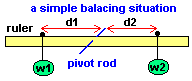 If weight w1 is 4 N, distance d2 is 50 cm and weight w2 is 2 N, what distance d1, must weight w1 be from the pivot rod to balance the ruler? [9L-17]
- 25 cm
- 20 cm
- 10 cm
- 40 cm
- If distance d1 is 40 cm, distance d2 is 8 cm and weight w2 is 15 N, what weight must w1 be to balance the ruler? [9L-18]
- 6 N
- 3 N
- 9 N
- 12 N
- If weight w1 is 6 N, distance d1 is 30 cm and weight w2 is 36 N, what must distance d2 be to balance the ruler? [9L-19]
- 10.0 cm
- 15.0 cm
- 5.0 cm
- 2.5 cm
- If distance d1 is 240 mm, weight w1 is 8 N and distance d2 is 320 mm, what weight must w2 be to balance the ruler? [9L-20]
- 12 N
- 3 N
- 4 N
- 6 N


child Joe Mary Fred Sally Mike weight (N) 380 390 400 380 370 Two children sit in rubber tyres connected to a see-saw system. Which two children will balance the see-saw in a horizontal (level) position? (assume average distance from pivot or turning point, to the centre of the people is the same) [9L-21]
- Joe and Sally
- Joe and Mike
- Mike and Sally
- Mary and Sally
child Joe Mary Fred Sally Mike weight (N) 380 390 400 380 370 Two children sit in rubber tyres connected to a see-saw system. If Joe sits on the left, which children will cause the see-saw to tip down on the right (clockwise)? (assume average distance from pivot or turning point, to the centre of the people is the same) [9L-22]
- Sally or Mike
- Mary or Fred
- only Mary
- only Fred
child Joe Mary Fred Sally Mike weight (N) 380 390 400 380 370 Two children sit in rubber tyres connected to a see-saw system. If Sally sits on the left, which children cannot cause the see-saw to tip down on the right (clockwise)? (assume average distance from pivot or turning point, to the centre of the people is the same) [9L-23]
- only Mike
- only Joe
- Joe or Mike
- Mary or Fred
child Joe Mary Fred Sally Mike weight (N) 380 390 400 380 370 Four children sit in rubber tyres connected to a see-saw system. If Mary and Sally sit on the right, which two children sitting on the left will balance the see-saw horizontally (level)? (assume average distance from pivot or turning point, to the centre of the people is the same) [9L-24]
- Fred and Joe
- Mike and Joe
- Joe and his identical twin brother
- Fred and Mike
child Joe Mary Fred Sally Mike weight (N) 380 390 400 380 370  Mr Brown, weighing 755 N, sits on the left side of a see-saw. Who could be sitting on the right if the see-saw tips down on the left side (anticlockwise) when they all take their feet of the ground? (assume average distance from pivot or turning point, to the centre of the people is the same) [9L-25]
- Joe and Mike
- Mary and Sally
- Joe and Sally
- Mary and Fred
child Joe Mary Fred Sally Mike weight (N) 380 390 400 380 370 Mr Gravity, weighing 770 N, sits on the left side of a see-saw. Who could be sitting on the right if the see-saw stays in a horizontal (level) position when they all take their feet of the ground? (assume average distance from pivot or turning point, to the centre of the people is the same) [9L-26]- Joe and Mike
- Mary and Sally
- Joe and Sally
- Mary and Fred
child Joe Mary Fred Sally Mike weight (N) 380 390 400 380 370 Mr Moon, weighing 760 N, sits on the left side of a see-saw. Who could be sitting on the right if the see-saw stays in a horizontal (level) position when they all take their feet of the ground? (assume average distance from pivot or turning point, to the centre of the people is the same) [9L-27]- Joe and Mike
- Mary and Sally
- Joe and Sally
- Mary and Fred
child Joe Mary Fred Sally Mike weight (N) 380 390 400 380 370 Mr Smith, weighing 780 N, sits on the left side of a see-saw. Who could be sitting on the right if the see-saw tips down on the right side when they all take their feet of the ground? (assume average distance from pivot or turning point, to the centre of the people is the same) [9L-28]- Joe and Mike
- Mary and Sally
- Joe and Sally
- Mary and Fred
- Examples to help you get to the point of the question! or do you get a sinking feeling because P = F / A! Which features is designed to reduce the pressure of the situation? [9L-29]
- the caterpillar tracks of a building site vehicle
- the blades of ice skates
- a cheese knife blade
- the crampons on a mountain climbers boots
- Examples to help you get to the point of the question! or do you get a sinking feeling because P = F / A! Which features is designed to reduce the pressure of the situation? [9L-30]
- the blades of ice skates
- a roofer laying a ladder across a roof to work on a repair
- a cheese knife blade
- the crampons on a mountain climbers boots
- Examples to help you get to the point of the question! or do you get a sinking feeling because P = F / A! Which features is designed to reduce the pressure of the situation? [9L-31]
- a cheese knife blade
- the blades of ice skates
- a snowboard for winter sports
- the crampons on a mountain climbers boots
- Examples to help you get to the point of the question! or do you get a sinking feeling because P = F / A! Which features is designed to reduce the pressure of the situation? [9L-32]
- the crampons on a mountain climbers boots
- the blades of ice skates
- a cheese knife blade
- the skis for mountain sports
- Examples to help you get to the point of the question! or do you get a sinking feeling because P = F / A! Which features is designed to reduce the pressure of the situation? [9L-33]
- an elephant's foot
- the blades of ice skates
- a cheese knife blade
- the crampons on a mountain climbers boots
- Examples to help you get to the point of the question! or do you get a sinking feeling because P = F / A! Which features is designed to increase the pressure of the situation? [9L-34]
- an elephant's foot
- the blades of ice skates
- the skis for mountain sports
- the caterpillar tracks of a building site vehicle
- Examples to help you get to the point of the question! or do you get a sinking feeling because P = F / A! Which features is designed to increase the pressure of the situation? [9L-35]
- a roofer laying a ladder across a roof to work on a repair
- the skis for mountain sports
- a cheese knife blade
- the caterpillar tracks of a building site vehicle
- Examples to help you get to the point of the question! or do you get a sinking feeling because P = F / A! Which features is designed to increase the pressure of the situation? [9L-36]
- a roofer laying a ladder across a roof to work on a repair
- an elephant's foot
- a snowboard for winter sports
- the crampons on a mountain climbers boots
 Which is NOT true about a football and football boots? [9L-37]
- the studs have a small contact area compared to the sole, to decrease the pressure, so they penetrate the ground easily
- the sole has a much broader area than the studs so the pressure is reduced and the boot does not sink into the ground too easily
- the more air that is pumped into a football, the greater the gas pressure
- if the temperature rises during a match, the plastic of the ball becomes softer and the gas pressure rises
- Which is NOT true about a football and football boots? [9L-38]
- the studs have a small contact area compared to the sole, to increase the pressure, so they penetrate the ground easily
- the sole has a much broader area than the studs so the pressure is increased and the boot does not sink into the ground too easily
- the more air that is pumped into a football, the greater the gas pressure
- if the temperature rises during a match, the plastic of the ball becomes softer and the gas pressure rises
- Which is NOT true about a football and football boots? [9L-39]
- the studs have a small contact area compared to the sole, to increase the pressure, so they penetrate the ground easily
- the sole has a much broader area than the studs so the pressure is reduced and the boot does not sink into the ground too easily
- the more air that is pumped into a football, the lower the gas pressure
- if the temperature rises during a match, the plastic of the ball becomes softer and the gas pressure rises
- Which is NOT true about a football and football boots? [9L-40]
- the studs have a small area contact compared to the sole, to increase the pressure, so they penetrate the ground easily
- the sole has a much broader area than the studs so the pressure is reduced and the boot does not sink into the ground too easily
- the more air that is pumped into a football, the greater the gas pressure
- if the temperature rises during a match, the plastic of the ball becomes harder and the gas pressure decreases
 [9L-41] A spanner is 10 cm long (d), and is turned with a force of 20 N (F). What is the applied turning effect of the force or its moment?
 - 200 Ncm
- 2 N/cm
- 0.5 cm/N
- 30 cmN
- [9L-42]A spanner is 20 cm long (d), and is turned with a force of 5 N (F). What is the applied turning effect of the force or its moment?
- 0.25 N/cm
- 100 Ncm
- 4 cm/N
- 25 cmN
- [9L-43] A spanner is 14 cm long (d), and is turned with a force of 7 N (F). What is the applied turning effect of the force or its moment?
- 2 cm/N
- 0.5 N/cm
- 98 Ncm
- 21 cmN
- [9L-44] A spanner is 0.4 m long (d), and is turned with a force of 10 N (F). What is the applied turning effect of the force or its moment?
- 10.4 mN
- 2.5 N/m
- 0.04 m/N
- 4 Nm
- [9L-45] A spanner is a useful tool to apply the turning effect of a force or a moment. Which is a FALSE statement about the situation?
- only in tightening, and not loosening, a nut, must the spanner overcome the force of friction
- the axis of the bolt acts as the 'lever pivot point'
- applying 'loosening oil' to the bolt and nut reduces friction
- the shorter the spanner, the smaller is the maximum turning force that can be produced
- [9L-46] A spanner is a useful tool to apply the turning effect of a force or a moment. Which is a FALSE statement about the situation?
- in tightening or loosening a nut, the spanner must overcome the force of friction
- the middle of the spanner acts as the 'lever pivot point'
- applying 'loosening oil' to the bolt and nut reduces friction
- the shorter the spanner, the smaller is the maximum turning force that can be produced
- [9L-47] A spanner is a useful tool to apply the turning effect of a force or a moment. Which is a FALSE statement about the situation?
- in tightening or loosening a nut, the spanner must overcome the force of friction
- the axis of the bolt acts as the 'lever pivot point'
- applying 'loosening oil' to the bolt and nut reduces the contact surface between them
- the shorter the spanner, the smaller is the maximum turning force that can be produced
- [9L-48] A spanner is a useful tool to apply the turning effect of a force or a moment. Which is a FALSE statement about the situation?
- in tightening or loosening a nut, the spanner must overcome the force of friction
- the axis of the bolt acts as the 'lever pivot point'
- applying 'loosening oil' to the bolt and nut reduces friction
- the shorter the spanner, the bigger the maximum turning force that can be produced

[9L-49] Which statement is NOT true?- gases are easy to compress to a smaller volume because of the weak forces between the particles
- liquids are difficult to compress to a smaller volume because there is little space between the particles
- solids are almost impossible to compress to a smaller volume because there is almost no space between the particles
- the higher the pressure, the more a gas will dissolve in a liquid
[9L-50] Which statement is NOT true?- gases are easy to compress to a smaller volume because of lots space between the particles
- liquids are easy to compress to a smaller volume because there is a little space between the particles
- solids are almost impossible to compress to a smaller volume because there is almost no space between the particles
- the higher the pressure, the more a gas will dissolve in a liquid
[9L-51] Which statement is NOT true?- gases are easy to compress to a smaller volume because of lots space between the particles
- liquids are difficult to compress to a smaller volume because there is little space between the particles
- solids are almost impossible to compress to a smaller volume because the attractive forces between the particles are so strong
- the higher the pressure, the more a gas will dissolve in a liquid
[9L-52] Which statement is NOT true?- gases are easy to compress to a smaller volume because of lots space between the particles
- liquids are difficult to compress to a smaller volume because there is little space between the particles
- solids are almost impossible to compress to a smaller volume because there is almost no space between the particles
- the higher the pressure, the less a gas will dissolve in a liquid
 [9L-53] Which statement is FALSE about being trodden on by a stiletto heeled shoe?
- the stiletto heel produces a low pressure situation
- the smaller the under surface of the stiletto heel, the higher the pressure created
- the stiletto heel causes a high pressure because a significant weight acts on a small surface area
- it is less painful if trodden on by the front part of the shoe, rather than the stiletto heel, because the weight of the person is spread over a larger area
- [9L-54] Which statement is FALSE about being trodden on by a stiletto heeled shoe?
- the stiletto heel produces a high pressure situation
- the smaller the under surface of the stiletto heel, the lower the pressure created
- the stiletto heel causes a high pressure because a significant weight acts on a small surface area
- it is less painful if trodden on by the front part of the shoe, rather than the stiletto heel, because the weight of the person is spread over a larger area
- [9L-55] Which statement is FALSE about being trodden on by a stiletto heeled shoe?
- the stiletto heel produces a high pressure situation
- the smaller the under surface of the stiletto heel, the higher the pressure created
- the stiletto heel causes a high pressure because a small weight acts on a large surface area
- it is less painful if trodden on by the front part of the shoe, rather than the stiletto heel, because the weight of the person is spread over a larger area
- [9L-56] Which statement is FALSE about being trodden on by a stiletto heeled shoe?
- the stiletto heel produces a high pressure situation
- the smaller the under surface of the stiletto heal, the higher the pressure created
- the stiletto heel causes a high pressure because a significant weight acts on a small surface area
- it is less painful if trodden on by the front part of the shoe, rather than the stiletto heel, because the weight of the person is spread over a smaller area
 [9L-57] The diagram shows a simple machine to punch holes in a sheet of material. The lever is pulled down to produce the hole. If d1 is 10 cm, d2 120 cm and the pull down force F2 required is 2 N, what punch force F1 is produced?
- 24 N
- 2.4 N
- 120 N
- 60 N
- [9L-58] The diagram shows a simple machine to punch holes in a sheet of material. The lever is pulled down to produce the hole. If d2 is 80 cm and the pull force F2 used is 4 N, what is the maximum length d1 can be to produce a minimum required punch force F1 of 40 N?
- 2 cm
- 8 cm
- 4 cm
- 10 cm
- [9L-59] The diagram shows a simple machine to punch holes in a sheet of material. The lever is pulled down to produce the hole. If d1 is 9 cm, d2 108 cm and the punch force F1 required is 60 N, what is the minimum pull down force F2 required?
- 54 N
- 1.8 N
- 5 N
- 12 N
- [9L-60] The diagram shows a simple machine to punch holes in a sheet of material. The lever is pulled down to produce the hole. When d1 is 12 cm, the punch force required F1 is 36 N if a pull-down force F2 of 3N is applied. What is the minimum length of the lever d2 required to punch the hole?
- 108 cm
- 72 cm
- 60 cm
- 144 cm
- [9L-61]
Which statement is NOT true about the material inside the cylinders and pipes of a hydraulic jack or car braking system?- liquids are good to use because they are fluid and readily compressed to a smaller volume
- although very fluid, gases are no good because they are too easily compressed to a smaller volume
- although not easily compressed to a smaller volume, solids are no good because they are not fluid
- if air gets into a hydraulic system, the system becomes less effective because air is readily compressed to a smaller volume
- [9L-62]
Which statement is NOT true about the material inside the cylinders and pipes of a hydraulic jack or car braking system?- liquids are good to use because they are fluid and not readily compressed to a smaller volume
- although not very fluid, gases are good because they are easily compressed to a smaller volume
- although not easily compressed to a smaller volume, solids are no good because they are not fluid
- if air gets into a hydraulic system, the system becomes less effective because air is readily compressed to a smaller volume
- [9L-63]
Which statement is NOT true about the material inside the cylinders and pipes of a hydraulic jack or car braking system?- liquids are good to use because they are fluid and not readily compressed to a smaller volume
- although very fluid, gases are no good because they are too easily compressed to a smaller volume
- although easily compressed to a smaller volume, solids are good because they are not too fluid
- if air gets into a hydraulic system, the system becomes less effective because air is readily compressed to a smaller volume
- [9L-64]
Which statement is NOT true about the material inside the cylinders and pipes of a hydraulic jack or car braking system?- liquids are good to use because they are fluid and not readily compressed to a smaller volume
- although very fluid, gases are no good because they are too easily compressed to a smaller volume
- although not easily compressed to a smaller volume, solids are no good because they are not fluid
- if air gets into a hydraulic system, the system becomes less effective because air readily leaks out
- [9L-65] A person is standing on both feet, with flat trainers, each of which has an ground contact area of 0.025 m2. If the person weighs 800 N, what pressure is created on the ground?
- 16000 N/m2
- 32000 N/m2
- 0.2 N/m2
- 2000 N/m2
- [9L-66] An elephant is standing on all of its feet, each of which has an ground contact area of 0.08 m2. If the elephant weighs 50000 N, what pressure is created on the ground?
- 625000 N/m2
- 156250 N/m2
- 0.2 N/m2
- 2000 N/m2
 [9L-67] A ski design team has to take into account the pressure created by the skier on the surface of deep snow. They need to the calculate the effects of the variables which are (i) area of one ski, (ii) weight of skier, (iii) pressure created by the skier on the snow and (iv) the pressure the snow can take without the skier sinking in too much! If the maximum acceptable snow pressure is 5000 N/m2, for a single ski surface area of 0.15 m2, what is the maximum weight the skier can be?
- 33333 N
- 375 N
- 750 N
- 15000 N
- [9L-68] A ski design team has to take into account the pressure created by the skier on the surface of deep snow. They need to the calculate the effects of the variables which are (i) area of one ski, (ii) weight of skier, (iii) pressure created by the skier on the snow and (iv) the pressure the snow can take without the skier sinking in too much! If the
maximum acceptable snow pressure is 4000 N/m2, what is the minimum single ski surface area acceptable, for a skier of weight 800 N?
- 0.1 m2
- 0.4 m2
- 5 m2
- 0.2 m2
- A bag of sugar has a base of 6 cm x 10 cm. If it weighs 18 N, what pressure does it create standing on a shelf? [9L-69]
- 0.3 N/cm2
- 3 N/cm2
- 1.8 N/cm2
- 18 N/cm2
- A stiletto heal has a base area of 3 cm2. If the woman weighs 750 N, what pressure does she create on the floor when standing on one heel? [9L-70]
- 250 N/m2
- 250 N/cm2
- 2250 N/m2
- 2250 N/cm2
- A waste skip a base of 2m x 4m. If it weighs 10000 N when full, what pressure does it create when standing on the road? [9L-71]
- 5000 N/m2
- 5000 N/cm2
- 1250 N/m2
- 1250 N/cm2
- A brick has a base of 10 cm x 25 cm and weighs 30 N. what pressure does a stack of ten bricks create simulating the pressure created by a low wall? [9L-72]
- 3 N/m2
- 3 N/cm2
- 2.5 N/cm2
- 1.2 N/cm2
 Which statement is NOT true ? [9L-73]
- the base of a dam is wider at the bottom than the top because that is where the lowest pressure is
- the pressure in water increases with increase in depth of water
- the pressure in water acts in all directions
- the deeper a diver goes to examine the dam wall, the more nitrogen from the air supply dissolves in the blood
- Which statement is NOT true ? [9L-73]
- the base of a dam is wider at the bottom than the top because that is where the greatest pressure is
- the pressure in water decreases with increase in depth of water
- the pressure in water acts in all directions
- the deeper a diver goes to examine the dam wall, the more nitrogen from the air supply dissolves in the blood
- Which statement is NOT true ? [9L-75]
- the base of a dam is wider at the bottom than the top because that is where the greatest pressure is
- the pressure in water increases with increase in depth of water
- the pressure in water acts only in a downward directions
- the deeper a diver goes to examine the dam wall, the more nitrogen from the air supply dissolves in the blood
- Which statement is NOT true ? [9L-76]
- the base of a dam is wider at the bottom than the top because that is where the greatest pressure is
- the pressure in water increases with increase in depth of water
- the pressure in water acts in all directions
- the deeper a diver goes to examine the dam wall, the less nitrogen from the air supply dissolves in the blood
- Which word matches the phrase can be readily reduced in volume under pressure? [9L-7]
- compressible
- incompressible
- pneumatic
- hydraulic
- Which word matches the phrase cannot be readily reduced in volume under pressure? [9L-78]
- compressible
- incompressible
- pneumatic
- hydraulic
- Which word matches the phrase a device that uses compressed air? [9L-79]
- compressible
- incompressible
- pneumatic
- hydraulic
- Which word matches the phrase a device that works off pressure transmitted through a liquid in a pipe or cylinder? [9L-80]
- compressible
- incompressible
- pneumatic
- hydraulic

Which is NOT true about the function and nutrition of your bone and muscle system? [9L-81]- to raise your arm the biceps contract and the triceps contract
- to lower or straighten your arm the biceps relax and the triceps contract
- cartilage is a softer material between the bones of a joint and acts as a shock absorber to minimise the chance of fracture damage
- cartilage is a softer material between the bones of a joint and reduces friction that would cause pain and wear
Which is NOT true about the function and nutrition of your bone and muscle system? [9L-82]- to raise your arm the biceps contract and the triceps relax
- to lower or straighten your arm the biceps contract and the triceps contract
- cartilage is a softer material between the bones of a joint and acts as a shock absorber to minimise the chance of fracture damage
- cartilage is a softer material between the bones of a joint and reduces friction that would cause pain and wear
Which is NOT true about the function and nutrition of your bone and muscle system? [9L-83]- to raise your arm the biceps contract and the triceps relax
- to lower or straighten your arm the biceps relax and the triceps contract
- cartilage is a harder material between the bones of a joint and reduces friction that would cause pain and wear
- cartilage is a harder material between the bones of a joint and acts as a binding agent to minimise the chance of fracture damage
Which is NOT true about the function and nutrition of your bone and muscle system? [9L-84]- to raise your arm the biceps contract and the triceps relax
- to lower or straighten your arm the biceps relax and the triceps contract
- cartilage is a softer material between the bones of a joint and acts as a shock absorber to minimise the chance of fracture damage
- cartilage is a harder material between the bones of a joint and increases friction to reduce pain and wear
The bones and muscles of your skeleton are a mechanical system to do various physical tasks e.g. lifting, walking etc. Which word best matches the phrase your arm acting to lift an object? [9L-85]- a lever
- a pivot point or fulcrum
- a moment
- a force
The bones and muscles of your skeleton are a mechanical system to do various physical tasks e.g. lifting, walking etc. Which word best matches the phrase the point where the humerus and ulna bones are linked? [9L-86]- a lever
- a pivot point or fulcrum
- a moment
- a force
The bones and muscles of your skeleton are a mechanical system to do various physical tasks e.g. lifting, walking etc. Which word best matches the phrase the weight of a lifted object x the length of your arm? [9L-87]- a lever
- a pivot point or fulcrum
- a moment
- a force
The bones and muscles of your skeleton are a mechanical system to do various physical tasks e.g. lifting, walking etc. Which word best matches the phrase the unit of any weight you lift? [9L-88]- a lever
- a force
- a moment
- a newton
The bones and muscles of your skeleton are a mechanical system to do various physical tasks e.g. lifting, walking etc. Which word best matches the phrase produced by any push or pull of your arm? [9L-89]- a force
- a lever
- a moment
- a newton
The bones and muscles of your skeleton are a mechanical system to do various physical tasks e.g. lifting, walking etc. Which word(s) best matches the phrase the units of the effect of a turning force? (e.g. as you bend your arm to lift something) [9L-90]- a lever
- a newton metre
- a moment
- a newton


